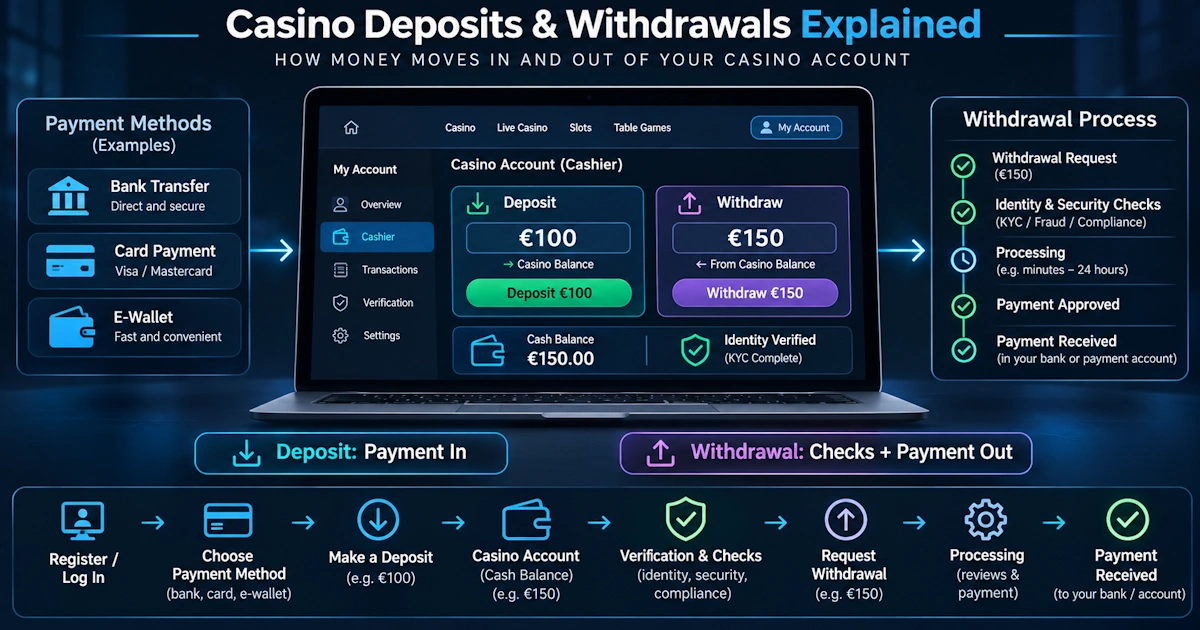
Casino deposits and withdrawals are the processes used to move money into and out of an online casino account.
A deposit normally starts when a player selects a payment method, enters an amount and authorizes the transaction. Once the payment is approved, the casino credits the player’s account balance.
A withdrawal works in the opposite direction, but it can involve more steps. The casino may need to confirm that the funds are withdrawable, verify the player’s identity, perform fraud or anti-money-laundering checks and send the payment through the appropriate payment provider.
This helps explain why deposits can appear almost immediately while withdrawals sometimes take longer.
The exact process, available payment methods, fees and processing times vary between casinos, payment providers and jurisdictions. Understanding the basic payment flow makes it easier to see what happens to money after it enters a casino account.
What Is a Casino Deposit?
A casino deposit is money transferred by a player into an online gambling account.
Once a deposit is accepted, the corresponding amount normally appears in the player’s cash balance and can be used to place eligible wagers.
For example: Deposit: €100 Casino cash balance credited: €100
A deposit is not the same as casino revenue. The money belongs to the player’s account until it is wagered, withdrawn or otherwise handled according to the applicable terms and rules.
In Great Britain, for example, deposited money remaining in an online gambling account is considered customer funds, together with certain winnings and bonus money to which the customer has become entitled.
How Does an Online Casino Deposit Work?
A typical casino deposit follows several steps.
1. Choose a Payment Method The player opens the casino’s cashier or banking section and selects one of the available methods. Depending on the operator and jurisdiction, options can include:
debit cards
bank transfers
e-wallets
digital payment services
other locally supported payment methods
Not every payment method is available in every country. Local gambling rules can also restrict particular payment types.
For example, UK-licensed gambling operators cannot accept credit-card payments for gambling, including through e-wallets where those wallets can be funded by credit cards for gambling purposes. That is a Great Britain-specific rule rather than a universal worldwide restriction.
2. Enter the Deposit Amount The player chooses how much money to add. The casino may specify:
minimum deposit
maximum deposit
daily or other account limits
payment-method limits
Responsible gambling controls can also affect how much money the account is allowed to accept.
3. Authorize the Payment The transaction is sent through the relevant payment system. Depending on the method, authorization might involve:
card information
online banking
an e-wallet login
an authentication code
another security step
The payment provider or financial institution then decides whether the transaction can proceed.
4. The Casino Receives Confirmation If the transaction is approved, the payment system sends confirmation to the casino.
5. The Casino Balance Is Updated The corresponding deposit is credited to the player’s account. For many electronic payment methods, this can happen quickly. A bank transfer may take longer because it can involve banking settlement processes outside the casino itself.
Why Can a Casino Deposit Be Declined?
A failed deposit does not necessarily mean there is a problem with the casino. Possible reasons include:
insufficient funds
incorrect payment information
bank security controls
transaction limits
unsupported payment method
gambling restrictions placed by a bank
casino deposit limits
geographical restrictions
account-security checks
The bank, casino or payment provider may reject the transaction depending on where the problem occurs.
Repeatedly attempting a declined payment without understanding the reason is generally less useful than checking the payment-provider message or contacting the relevant financial institution.
What Happens to Deposited Money?
When a deposit reaches a casino account, it becomes part of the player’s available balance subject to applicable account rules.
Suppose a player deposits: €100 and places: €20 in wagers
If €80 remains unused, the account could still contain: €80 cash balance
Any winnings would then affect that amount. For example: Starting deposit: €100 Net gambling result: +€30 Account cash balance: €130
The casino needs systems that record deposits, wagers, winnings and withdrawals so that the account balance remains accurate.
Deposit Balance vs Bonus Balance
This distinction becomes important when casino bonuses are involved.
Imagine a player deposits: €100 and receives: €100 bonus
The account may display: Cash balance: €100 Bonus balance: €100 Total displayed value: €200
But the two balances may have different rules. The player’s €100 deposit may be unrestricted cash, while the €100 promotional balance could be subject to wagering requirements or other bonus conditions.
At least in Great Britain, operators are required to display deposit and bonus balances separately and cannot simply apply promotional wagering requirements to the player’s deposit balance.
This is why the number shown as a casino’s total account balance is not always identical to the amount immediately available for withdrawal.
What Is a Casino Withdrawal?
A casino withdrawal is a request to move eligible money from the player’s gambling account back through a supported payment method.
For example: Casino cash balance: €250 Withdrawal request: €150
If the request is approved and processed, the casino account would normally reduce by €150 and the money would be sent through the chosen payout route. But withdrawal processing can involve more checks than a deposit.
How Does a Casino Withdrawal Work?
A typical withdrawal can be simplified into several stages.
1. The Player Requests a Withdrawal The player opens the cashier and chooses:
withdrawal method
withdrawal amount
The casino checks whether the requested amount is available for withdrawal.
2. The Casino Checks the Account Depending on the circumstances, the operator may need to confirm:
identity
account ownership
payment-method ownership
available balance
bonus status
fraud indicators
anti-money-laundering requirements
3. The Withdrawal Is Approved for Payment If the necessary checks are complete, the operator sends a payment instruction.
4. The Payment Provider Processes the Transaction A bank, card network, e-wallet or another payment service may then process the payout.
5. The Money Reaches the Player The final stage depends partly on the receiving payment method.
This is why the time shown as casino processing time is not always the same as the total time until money appears in the player’s bank or wallet.
Why Are Withdrawals Slower Than Deposits?
A deposit and withdrawal do not involve exactly the same risk.
When a player deposits, the casino is receiving money. When money leaves the account, the operator needs greater confidence that it is being paid to the correct person and that the transaction complies with relevant legal and financial requirements.
Withdrawals can therefore involve:
account verification
fraud checks
source-of-funds questions
payment-method verification
bonus-balance checks
payment-provider processing
bank settlement
The delay does not automatically indicate a problem. However, operators should not unnecessarily postpone checks until the player happens to request a withdrawal.
The UK Gambling Commission specifically states that operators should not ask for identity information at withdrawal if they could reasonably have requested it earlier. Additional checks may still be required at that stage where another legal obligation creates the need.
Why Does a Casino Ask for ID Before a Withdrawal?
Regulated online casinos can be required to know who their customers are.
Verification can serve several purposes, including:
confirming identity
checking age
preventing account fraud
supporting anti-money-laundering controls
confirming that funds belong to the customer
Documents requested can include items such as:
passport
driving licence
proof of address
financial information in appropriate circumstances
The exact information required depends on the jurisdiction and situation.
For UK-licensed online gambling businesses, a minimum level of identity verification must occur before gambling begins rather than being postponed until the first successful withdrawal.
That distinction is important. A legitimate verification request can be part of regulatory compliance. Using verification simply as an excuse to delay a withdrawal that could have been checked earlier is a different issue.
Why Might a Casino Ask About Source of Funds?
Casinos can be used for financial crime, so regulated operators may need systems designed to detect suspicious activity.
This can include monitoring:
deposits
withdrawals
unusual payment patterns
account ownership
sources of money
In some cases, a casino may request information helping it understand where gambling funds came from. This might involve documents such as bank statements or other evidence relevant to a compliance review.
The UK Gambling Commission’s anti-money-laundering guidance specifically describes monitoring deposits and withdrawals as part of the casino customer relationship and recognizes source-of-funds information as relevant in appropriate circumstances.
A request for this information should not automatically be interpreted as the casino refusing to pay. However, requests should be connected to legitimate compliance needs rather than used arbitrarily.
Why Do Casinos Prefer Withdrawals to the Same Payment Method?
Many gambling operators try to return money through the same payment route used for deposits where possible.
For example: Deposit from Payment Method A → Withdrawal back to Payment Method A
This is often described as a closed-loop payment process. It helps reduce the possibility that someone deposits money from one financial source and then attempts to withdraw it somewhere unrelated.
The UK Gambling Commission describes closed-loop payment systems as best practice for managing money-laundering risk and strongly recommends that withdrawals and winnings be processed back to the same payment method used for deposits where appropriate.
This can explain why a casino may not allow a player to freely choose any available withdrawal method after depositing through another route.
What If the Original Payment Method Cannot Receive Withdrawals?
Not every deposit method can necessarily receive a payout.
For example, a particular payment service might allow outgoing casino deposits but not incoming gambling withdrawals. In such cases, the operator may need to offer another approved withdrawal method.
This could involve:
bank transfer
another verified payment account
another payment route permitted by the operator
The player may also need to confirm ownership of the replacement method. The exact process depends on the casino and jurisdiction.
Can Someone Deposit Using Another Person’s Card or Account?
Casino terms commonly restrict third-party payment methods.
There are obvious fraud and money-laundering concerns when: Account holder ≠ payment-method owner
For example, using a family member’s card to fund a personal casino account can create problems even if that person gave permission. The operator may need to verify who owns the payment method and where the money originated.
The UK Gambling Commission has specifically warned operators about accepting potentially third-party-funded deposits and then investigating them only after a withdrawal is requested. Such checks should be managed promptly rather than used only when a customer wins.
Using payment methods registered in the player’s own name can therefore avoid unnecessary complications.
What Does “Pending Withdrawal” Mean?
A withdrawal marked pending generally means the request has been submitted but has not yet completed the casino’s processing stage.
The operator may still be:
reviewing the request
performing required checks
preparing the payment instruction
After that, the status might change to something such as:Processed or:Approved
Terminology differs between casinos. Importantly: Casino says processed ≠ money must already appear in bank
Once the casino sends the payment, the bank or payment provider can still require time to complete the transaction.
How Long Do Casino Withdrawals Take?
There is no universal withdrawal time.
The total period can depend on:
casino processing time
verification status
payment method
bank processing
weekends or banking schedules
fraud or AML checks
jurisdictional requirements
Some electronic payment methods can be relatively fast once approved. Bank transfers may take longer.
The more useful distinction is between: Casino processing time and: Payment-provider settlement time
If an operator promises a specific timeframe in its terms, that information should be considered alongside the payment provider’s own expected processing period. Avoid assuming that every online casino withdrawal should arrive instantly.
Can a Casino Delay a Withdrawal for Verification?
Sometimes verification or compliance obligations can legitimately delay a payout. But that does not mean any verification delay is automatically reasonable.
For example, UK Gambling Commission rules say a withdrawal request should not suddenly trigger a demand for additional identity information that could reasonably have been requested earlier.
However, an operator can still seek information required at that point by other legal obligations, including appropriate anti-money-laundering checks.
So there is an important difference between: a legitimate compliance check and: using avoidable verification as a withdrawal obstacle
Can You Withdraw Your Deposit Without Gambling It?
This depends partly on regulatory rules and legitimate financial-crime checks.
In Great Britain, operators must allow customers to withdraw their deposit balance without being forced to gamble it first, except where restrictions are necessary to comply with general regulatory obligations such as anti-money-laundering or fraud controls.
This also means a casino bonus should not automatically convert the player’s own deposit into money that must be wagered before withdrawal under the current UK rules.
Other jurisdictions can use different frameworks.
Can Bonus Money Be Withdrawn?
Bonus money can operate differently from cash deposits and ordinary winnings.
Suppose the account contains: Cash balance: €80 Bonus balance: €50
The €80 may be withdrawable. The €50 bonus may still require: 10× wagering or another promotional condition.
This is why deposit and bonus balances should not be treated as interchangeable.
Before requesting a withdrawal, check whether the account contains:
unrestricted cash
restricted bonus funds
bonus winnings still subject to conditions
A failed or reduced withdrawal can sometimes be a bonus-terms issue rather than a payment-processing problem.
What Are Minimum and Maximum Withdrawals?
Casinos can place practical limits on transactions.
A withdrawal page might specify: Minimum withdrawal: €20 or impose a maximum amount per transaction or period.
The actual limits vary. They can depend on:
payment method
casino policy
account status
jurisdiction
A minimum withdrawal can exist because processing very small transactions creates administrative or payment-provider costs. Where fees or restrictions apply, they should be disclosed clearly.
Can Casinos Charge Withdrawal Fees?
Some operators or payment methods may charge fees.
Possible charges can include:
withdrawal processing fee
payment-provider fee
currency-conversion cost
Fees should be checked before selecting a payment method.
In Great Britain, the Gambling Commission’s guidance allows reasonable withdrawal processing fees in certain circumstances but says they should reflect the direct cost incurred by the operator and be based on fair and transparent terms.
Do not assume every withdrawal is free simply because the deposit was free.
What About Currency Conversion?
Currency can create an additional cost that is easy to overlook.
Imagine: Casino account: EUR Bank account: GBP
A payment provider or bank may need to convert the withdrawal from euros to pounds. The exchange rate and conversion fee can affect the final amount received.
The same can happen when depositing.
Before using an account in another currency, check:
casino account currency
payment-method currency
exchange rate
conversion fee
Currency conversion is separate from casino game results.
How Are Card Payments Protected?
Card payments involve security requirements outside gambling regulation itself.
The Payment Card Industry Data Security Standard, or PCI DSS, provides baseline technical and operational requirements designed to protect payment account data. It applies to relevant organizations that store, process or transmit cardholder data or can affect the security of the card-data environment.
PCI DSS should not be confused with a gambling licence. The two address different risks: Gambling regulation → casino operation and gambling-related obligations Payment security standards → protection of payment-card data
A casino can rely on specialized payment processors rather than directly handling every part of a card transaction itself.
Does HTTPS Make Casino Payments Safe?
HTTPS is an important security feature because it encrypts the connection between the user and the website. But it does not prove that the gambling operator itself is trustworthy.
A fraudulent website can also use HTTPS.
Payment safety should therefore be considered alongside:
correct domain
secure account login
legitimate payment page
clear operator information
Never treat the browser padlock as a complete casino-safety check.
What Are Customer Funds?
Money shown in a casino account is not necessarily protected in the same way as money held in a bank account. This is an important distinction.
Different gambling jurisdictions use different customer-fund protection rules.
In Great Britain, online gambling operators holding customer funds must disclose the level of protection applying to those funds. The Gambling Commission uses categories including:
not protected
medium protection
high protection
The relevant level must be explained in the operator’s terms.
This does not tell players whether they will win or lose. It concerns what may happen to account funds if the gambling business experiences financial failure.
Is Money in a Casino Account the Same as Money in a Bank?
No.
A casino account is a gambling account, not an ordinary savings or current bank account. Its purpose is to hold funds connected with gambling activity.
That means players should not use a casino balance as a place to store money unnecessarily. Once funds are no longer intended for gambling, withdrawing them can reduce the amount left available for further play.
What Should You Check Before Making a Casino Deposit?
Before sending money to an unfamiliar casino, check:
Licence Is the operator properly licensed for the relevant market?
Payment methods Does the casino support a method you recognize and control?
Minimum deposit How much is required?
Fees Are there casino or payment-provider charges?
Account currency Could currency conversion apply?
Withdrawal options Can the deposit method also receive withdrawals?
Verification requirements What information might the operator need?
Customer-fund information What protection applies to money left in the account?
Checking withdrawals before making the first deposit is particularly useful. The easiest deposit method is not automatically the most convenient withdrawal method.
What Should You Check Before Requesting a Withdrawal?
Before submitting a payout request, confirm:
Withdrawable balance Is the money unrestricted cash or bonus funds?
Verification Has required identity verification been completed?
Payment method Does the withdrawal need to return to the original method?
Minimum withdrawal Does the requested amount meet the required threshold?
Fees Will the casino or payment provider charge anything?
Processing time How long does the casino say approval normally takes?
Currency Will the receiving provider perform a conversion?
This can prevent many avoidable payout problems.
Common Casino Deposit and Withdrawal Misconceptions
“A deposit is casino revenue as soon as I send it.” No. Deposited money enters the player’s account and can potentially be withdrawn or used for gambling.
“If a deposit is instant, the withdrawal should also be instant.” Not necessarily. Withdrawals can involve additional identity, fraud, AML and payment-processing steps.
“The casino can always make me wager my deposit before withdrawing it.” Rules vary by jurisdiction. In Great Britain, players must generally be able to withdraw their deposit balance without being forced to gamble it, subject to legitimate regulatory obligations.
“A pending withdrawal means the casino has refused it.” No. Pending normally means the request has not yet completed processing.
“I can deposit with one person’s card and withdraw to another person’s account.” This can create serious account-ownership and fraud concerns. Gambling operators commonly restrict third-party payment methods.
“Casino balances are protected like bank deposits.” Not necessarily. Customer-fund protection depends on the regulatory system and operator arrangements.
Deposits Should Not Determine How Much You Gamble
Payment convenience can make casino spending feel less tangible. A deposit takes only a few clicks, but the money is still real.
Setting a deposit limit can help separate an entertainment budget from money needed for:
bills
food
rent
savings
other essential expenses
Repeated deposits after losses can also turn a planned gambling session into loss chasing. A failed gambling session does not create a financial reason to make another deposit.
Casino outcomes remain uncertain regardless of how quickly money can be moved into the account.
Withdrawals Should Not Be Treated as a Signal to Keep Playing
The reverse can also happen.
A player may have money available to withdraw but decide to keep wagering because the balance is already inside the casino account. That does not make the money less real.
If funds are no longer intended for gambling, leaving them available can increase the opportunity for additional wagering.
Payment tools are part of the gambling environment, so deposit and withdrawal decisions are also part of managing financial exposure.
Final Thoughts
So, how do casino deposits and withdrawals work?
A deposit moves money from a player’s payment source into the casino account. The basic flow is: Payment Method → Payment Authorization → Casino Cash Balance
A withdrawal moves eligible funds in the opposite direction: Casino Balance → Account and Compliance Checks → Payment Provider → Player
Deposits are often faster because the casino is receiving money. Withdrawals can involve extra steps such as identity verification, payment-method checks, fraud controls and anti-money-laundering procedures before the payout is sent.
The most important things to understand are: who owns the payment method, which funds are actually withdrawable, what verification may be required, how long the casino processing stage takes and whether the payment provider adds more time afterward.
Payment rules also differ between jurisdictions. For example, Great Britain prohibits credit-card gambling, requires identity verification before gambling and gives players specific rights around withdrawing their deposit balance. Other markets can use different rules.
A good payment process should therefore be transparent in both directions. Before depositing, a player should be able to understand not only how money goes in, but also how it comes back out.
Frequently Asked Questions
How do you deposit money into an online casino? A player normally selects a supported payment method in the casino cashier, chooses an amount and authorizes the transaction. Once approved, the casino credits the corresponding amount to the player’s cash balance.
Why do casino withdrawals take longer than deposits? Withdrawals can involve identity, fraud and anti-money-laundering checks before the casino sends the payout. The payment provider or bank may then need additional time to complete the transaction.
Why does a casino ask for ID before paying a withdrawal? Regulated operators may need to verify identity, age, payment ownership and other compliance information. In Great Britain, basic identity verification should take place before gambling begins rather than being unnecessarily delayed until withdrawal.
Can I withdraw money using a different payment method? Sometimes, but casinos often prefer or require funds to be returned through the original payment route where possible. Closed-loop payments help reduce fraud and money-laundering risks.
Can I withdraw my casino deposit without gambling it? Rules vary by jurisdiction. Under current Great Britain rules, customers must generally be allowed to withdraw their deposit balance without being forced to wager it first, except where legitimate regulatory obligations require restrictions.
Are casino deposits and withdrawals free? Not always. The casino, payment provider or currency-conversion service may apply charges. Fees and transaction limits should be checked before choosing a payment method.