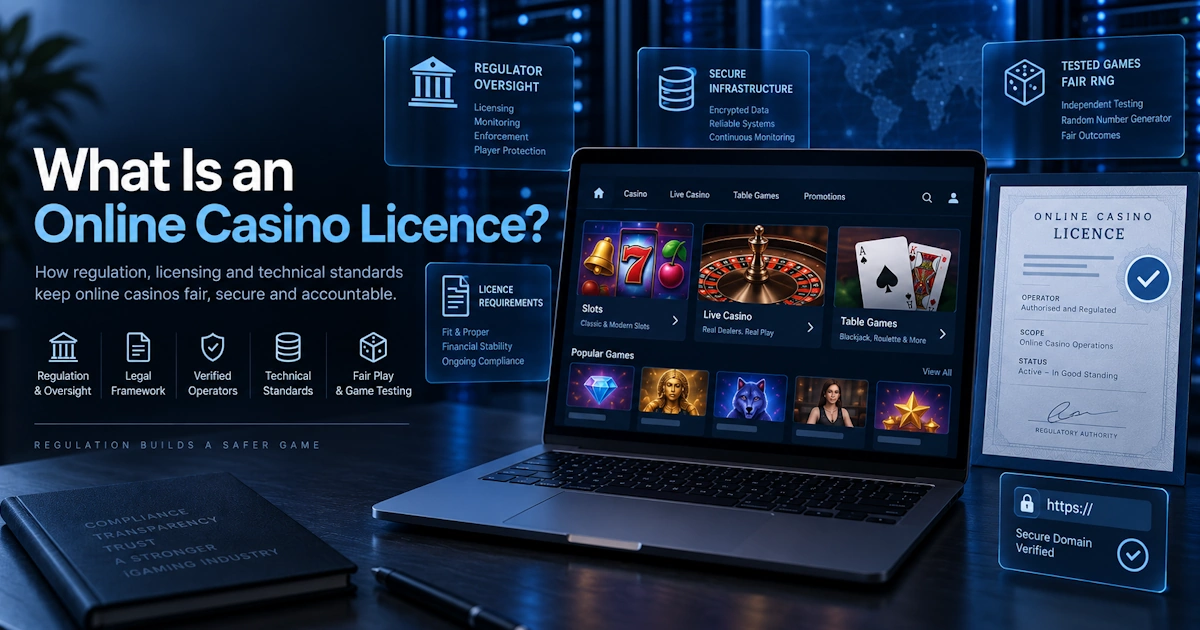
An online casino licence is an official authorization that allows a company to offer regulated gambling services under the rules of a specific jurisdiction.
It is much more than a logo placed at the bottom of a casino website. A gambling regulator may examine who owns the business, where its money comes from, how its games operate, how customers are protected and whether the company is capable of following local gambling laws.
After a licence is issued, the operator normally remains subject to ongoing rules, reporting and regulatory oversight.
However, there is no single worldwide online casino licence. Different countries and jurisdictions have their own systems, and a licence that permits gambling activity in one market does not automatically give an operator permission to serve players everywhere.
Understanding that difference is important when judging whether an online casino is properly regulated.
What Is an Online Casino Licence?
An online casino licence is permission from a gambling authority to carry out specified gambling activities.
For an online casino, this usually means providing casino games to customers remotely through a website, mobile site or application.
The exact legal definition depends on the jurisdiction.
For example, the UK Gambling Commission’s remote casino operating licence allows an operator to provide online casino games including slots, roulette, blackjack, poker and other casino products to consumers in Great Britain.
Malta uses a different licensing structure. The Malta Gaming Authority, or MGA, issues a B2C Gaming Service Licence for businesses providing gaming services to consumers within the scope of Malta’s regulatory framework. Casino games fall within its Type 1 gaming services.
The terminology changes from one regulator to another, but the basic principle is similar:
The regulator gives a business permission to provide certain gambling services, provided that the business follows the conditions attached to that permission.
Who Issues Online Casino Licences?
Online casino licences are issued by gambling regulators or other authorities that have legal responsibility for gambling within a jurisdiction.
Their powers depend on local law.
A regulator may be responsible for:
- reviewing licence applications
- approving or rejecting operators
- maintaining records of licence holders
- setting technical standards
- monitoring compliance
- investigating complaints or breaches
- taking regulatory action
- suspending or revoking licences
Not every regulator follows exactly the same model.
Some jurisdictions regulate gambling directly at national level. Others may use regional, state or territory-based systems.
This is why the phrase “licensed online casino” is incomplete on its own.
The more useful question is:
Licensed by whom, and for which market?
There Is No Universal Online Casino Licence
One of the most common misunderstandings about casino licensing is that one gambling licence gives an operator permission to accept players from anywhere in the world.
It does not.
Online gambling laws are jurisdiction-specific.
A company may legally operate under one licence in one market but still need another authorization before targeting customers somewhere else.
Great Britain is a clear example. The UK Gambling Commission states that an operator needs the relevant licence if it provides online gambling facilities to consumers in Great Britain, even if the company itself is based elsewhere in the world.
This shows why the physical location of the casino company’s office does not always answer the licensing question.
What can matter is:
- where the company is established
- where its gambling equipment is located
- where the players are located
- which markets the operator targets
- what type of gambling activity is being provided
A casino may therefore hold more than one licence if it operates across several regulated markets.
What Does a Regulator Check Before Granting a Licence?
Getting an online casino licence is not normally as simple as paying a fee and receiving a certificate.
A serious regulatory process looks at the business behind the casino.
The exact checks vary, but they can cover several major areas.
Ownership and Identity
Regulators want to know who controls and benefits from the gambling business.
This can include:
- company owners
- shareholders
- directors
- senior managers
- ultimate beneficial owners
- other people with significant control
This is important because gambling businesses handle customer money and operate products involving financial risk.
A regulator needs to understand who is actually behind the operation rather than only the public-facing casino brand.
The UK Gambling Commission, for example, considers identity and ownership when assessing whether an operating licence applicant is suitable.
Financial Resources
A regulator may also examine whether a company has enough legitimate financial resources to operate the gambling business properly.
This can include looking at:
- company finances
- sources of funding
- financial projections
- available operating resources
- people financing the business
This does not mean a regulator guarantees that the company can never face financial problems.
Instead, financial checks help establish whether the proposed gambling operation has a credible financial basis and whether its funding raises regulatory concerns.
The UK Gambling Commission specifically includes finances and the resources available to conduct licensed activities in its suitability assessment. It also considers the legitimacy of the source of funding.
Integrity
A regulator may assess whether the people controlling the business appear honest and trustworthy.
Previous regulatory problems, misleading information or serious failures in other businesses can therefore be relevant when an application is reviewed.
Competence
Running an online casino involves more than creating a website.
Operators need systems for areas such as:
- gambling operations
- customer accounts
- payments
- compliance
- security
- responsible gambling
- technical management
Regulators may therefore consider whether the people responsible for the business have suitable experience, knowledge and systems.
Criminality
Criminal records and links to criminal activity may also form part of a licensing assessment.
Again, exact procedures depend on the jurisdiction.
Taken together, these checks help a regulator decide whether an applicant is suitable to operate a gambling business.
What Happens After an Online Casino Gets a Licence?
Licensing does not normally end when the application is approved.
A casino operator remains responsible for complying with the rules that apply to its licence.
This is an important distinction.
A licence is not simply a one-time certificate that can then be ignored.
Depending on the regulator, ongoing obligations may cover areas such as:
- technical compliance
- customer verification
- game fairness
- financial reporting
- security
- customer funds
- responsible gambling
- advertising
- complaints
- anti-money-laundering controls
- regulatory reporting
For example, the current UK Gambling Commission Licence Conditions and Codes of Practice include requirements relating to technical standards, customer funds, payments, fair and open gambling, identity verification, anti-money laundering, marketing, complaints and protection of vulnerable people.
If an operator fails to meet its obligations, the regulator may investigate and take action according to its powers.
Does a Casino Licence Mean the Games Are Fair?
Licensing and game fairness are closely connected, but they are not exactly the same thing.
A regulator can require licensed operators and software used within its market to meet technical standards.
These standards can cover issues such as:
- random number generation
- game rules
- result determination
- player account information
- displayed transactions
- jackpots
- game interruptions
- security
- live dealer systems
The UK Gambling Commission’s Remote Gambling and Software Technical Standards, for example, contain specific requirements for these areas. Compliance with its technical standards and testing strategy is a licence condition.
Certain gambling products also require testing by approved independent test houses before they are made available to customers.
This does not mean every regulator in the world uses the same testing system.
It means that when evaluating an online casino licence, it is useful to look beyond the existence of the licence and ask what technical requirements come with it.
What Does Licensing Have to Do With RNGs?
Many digital casino games use a Random Number Generator, or RNG, to help determine results.
For a regulated casino, the RNG should operate according to the technical rules of the relevant jurisdiction.
For example, UK technical standards require applicable random number generation and game outcomes to be “acceptably random.” They also prohibit adaptive behavior that changes probabilities during play in response to previous outcomes.
This is one practical way regulation can affect the game a player sees on screen.
Without meaningful technical rules or testing, a casino’s statement that its games are “fair” may be much harder to verify independently.
Are Casino Operators and Game Providers Licensed Separately?
Sometimes, yes.
The company taking bets from players is not necessarily the same company that developed the casino games.
The iGaming industry can involve several separate businesses:
Casino operator → gaming platform → game provider → game server → player
Different parts of this chain may require different types of authorization.
For example, the UK Gambling Commission distinguishes between a remote casino operating licence and a remote gambling software licence. A software licence permits activities such as manufacturing, supplying, installing or adapting gambling software, but it does not by itself authorize a company to provide gambling facilities to customers.
Malta also separates consumer-facing gaming services from certain B2B activities. The MGA uses a B2C Gaming Service Licence for businesses providing gambling services to players and a B2B Critical Gaming Supply Licence for specified gaming software and control-system activities.
So, seeing that a software provider has a licence does not automatically prove that the casino operator itself holds every licence it needs.
The relevant licence needs to match the activity being performed.
Why Does an Online Casino Licence Matter to Players?
Most players will never read a complete gambling licence or technical standard.
Even so, licensing can affect many parts of their experience.
It Identifies the Business Behind the Casino
Casino websites often operate under brand names that are different from the legal company name.
A public licensing record can help connect the website to the actual regulated business.
It Creates Rules the Operator Must Follow
Without regulation, the operator may have far more freedom to create its own procedures.
A licence places the business inside a legal and regulatory framework.
It Can Set Standards for Games
Depending on the jurisdiction, licensed games may need to follow technical rules and testing procedures.
It Can Set Rules Around Customer Protection
Regulatory conditions may cover age checks, customer identification, responsible gambling measures and information provided to players.
It Creates Regulatory Accountability
A regulator can investigate breaches and may have powers to impose sanctions, suspend licences or take other action.
This does not guarantee that every customer problem will be solved.
It does provide a level of outside oversight that may be missing from an unregulated gambling site.
How Can You Verify an Online Casino Licence?
Never judge a casino’s licensing status only by looking at its homepage.
A professional design proves very little.
Even a regulator logo can be copied.
A better approach is to verify the information independently.
Step 1: Find the Operator Name
Look at the casino’s footer, terms and conditions or licensing information.
Find the legal company operating the site.
Do not rely only on the casino brand name.
Step 2: Identify the Regulator
Find out which authority supposedly issued the licence.
Step 3: Open the Regulator’s Official Register
Go directly to the regulator’s official website rather than following an unknown link from an advertisement or search result.
Step 4: Search for the Company
Check the legal business name and licence status.
The UK Gambling Commission’s public register, for example, can be searched using business names, trading names, domains and account numbers. Its records also show information such as licence status and licensed activities.
Step 5: Check the Domain
This step is easy to overlook.
A company may hold a legitimate licence while a fake website copies its name.
Where the regulator provides domain information, compare the website address with the official record.
The UK Gambling Commission requires remote licensees to display their licensed status, and its register includes domains and trading names supplied by licensed businesses.
Step 6: Check the Licence Status
A licence may not always be active.
Registers may show statuses such as active, expired, suspended or surrendered, depending on the regulator.
Always check the current status instead of assuming that an old licence number is still valid.
What If a Casino Displays a Licence Logo?
Treat the logo as a starting point, not proof.
A licence badge can be:
- genuine
- outdated
- used incorrectly
- linked to another company
- copied from a legitimate casino
The safest method is independent verification through the regulator.
Some regulators provide their own verification systems or authorization seals.
For example, the Malta Gaming Authority operates an authorization system that can display the licensee, licence number, licence status and approved game types.
The important point is that verification should come from the regulator’s own system, not from an image controlled entirely by the casino.
Does an Online Casino Licence Guarantee Player Funds?
Not automatically.
This is another area where the details of the regulatory system matter.
Different regulators can have different requirements for how customer money is held or protected.
A licence therefore should not be interpreted as meaning that money in a casino account has the same protection as money in a bank account.
Players should check the rules that apply to customer funds in the relevant jurisdiction and the disclosures provided by the operator.
Licensing can create financial controls, but the exact level of protection must be checked rather than assumed.
Does a Licence Guarantee Fast Withdrawals?
No.
A licence does not mean every withdrawal will be instant.
Withdrawals can involve:
- payment processing
- identity checks
- compliance reviews
- banking delays
- account restrictions
- bonus conditions
Regulated operators still have to follow the rules of their jurisdiction, and some checks can delay a transaction.
However, a licensing framework can place rules around how operators treat customers and provide formal routes for complaints when problems occur.
That is different from guaranteeing a specific payment speed.
Does a Licence Make Gambling Safe?
No.
This is one of the most important limits of gambling regulation.
A licence can help regulate how the casino operates.
It cannot remove the financial risk built into gambling itself.
A regulated casino game can still have:
- a house edge
- uncertain outcomes
- losing streaks
- large short-term losses
A licence also does not guarantee that a player will win, that an operator will never suffer a technical problem or that every dispute will be decided in the player’s favour.
The purpose of licensing is regulation and oversight, not the removal of gambling risk.
Licensed Does Not Always Mean the Same Thing
Two casino websites may both say they are “licensed,” yet operate under very different regulatory systems.
One licence may involve extensive checks, technical standards, public records and ongoing supervision.
Another jurisdiction may apply a different model.
For this reason, asking only “Is this casino licensed?” is not enough.
A better set of questions is:
- Who issued the licence?
- Is the licence currently active?
- Does it cover online casino gambling?
- Does it cover the market in which the player is located?
- Is the actual casino domain connected to the licence?
- What rules does that regulator require the operator to follow?
These questions provide much more useful information than a licence logo alone.
What Are the Risks of Using an Unlicensed Online Casino?
The legal position depends on where the player and operator are located, so an unlicensed casino cannot be discussed as one universal category.
However, using a site that operates outside the regulatory framework applicable to a player can create additional risks.
There may be less certainty about:
- who owns the casino
- how games are tested
- where money is held
- how personal data is handled
- what withdrawal rules apply
- how disputes can be escalated
- whether the operator is subject to meaningful regulatory action
A polished website does not solve these problems.
Neither does a large bonus.
For anyone checking an unfamiliar casino, verifying its legal operator and licensing status is a much stronger starting point than judging it by promotions or design.
Why Online Casino Licensing Matters
An online casino licence matters because gambling requires trust in systems that players cannot fully inspect themselves.
A player cannot normally examine the casino’s source code, financial records, ownership structure or internal compliance procedures.
Regulation creates an outside authority with the power to set rules around at least some of those areas.
A strong licensing system can require the operator to demonstrate that it is suitable to run a gambling business and then continue meeting regulatory requirements after launch.
That does not make every licensed casino identical.
It also does not eliminate gambling losses.
But it gives the term “regulated casino” a meaning beyond the operator simply asking customers to trust it.
Final Thoughts
An online casino licence is official permission to provide specified gambling services under the rules of a particular regulator and jurisdiction.
Before granting a licence, regulators may examine the people behind the business, its finances, integrity, competence, technical systems and ability to comply with gambling rules.
Once licensed, the operator can remain subject to ongoing requirements covering areas such as game fairness, security, customer verification, payments, responsible gambling and complaints.
But the most important point is that there is no universal online casino licence.
A licence must be understood in context.
Check who issued it, whether it is active, what activities it covers and whether the actual casino website is connected to the licensed business.
And remember what licensing does not do. It does not guarantee winnings, remove the house edge or make gambling financially risk-free.
A licence provides regulatory oversight. That is valuable, but it is not the same thing as a guarantee.
Frequently Asked Questions
What is an online casino licence?
An online casino licence is authorization from a gambling regulator allowing a company to provide specified casino gambling services under that regulator’s rules.
Does every online casino need a licence?
Licensing requirements depend on the jurisdictions involved. A casino may need authorization based on where it is established, where it operates and which players or markets it serves. There is no single global licensing rule.
Can one casino have several gambling licences?
Yes. An operator serving several regulated markets may need separate licences or approvals because one jurisdiction’s licence does not automatically authorize gambling activity everywhere.
How do I check if an online casino licence is real?
Find the legal operator name and licence details on the casino website, then verify them through the gambling regulator’s official public register or authorization system. Check the licence status and, where possible, the registered domain.
Is a licensed casino guaranteed to be fair?
A licence can require compliance with game-fairness and technical standards, but requirements differ between regulators. Licensing also does not guarantee that a player will win. Fair casino games can still have a mathematical house edge.
What is the difference between a casino operator licence and a software licence?
An operator licence authorizes specified gambling activities involving customers. A software or B2B licence can cover the manufacture or supply of gaming technology. Holding a software licence does not necessarily authorize a business to operate an online casino for players.