
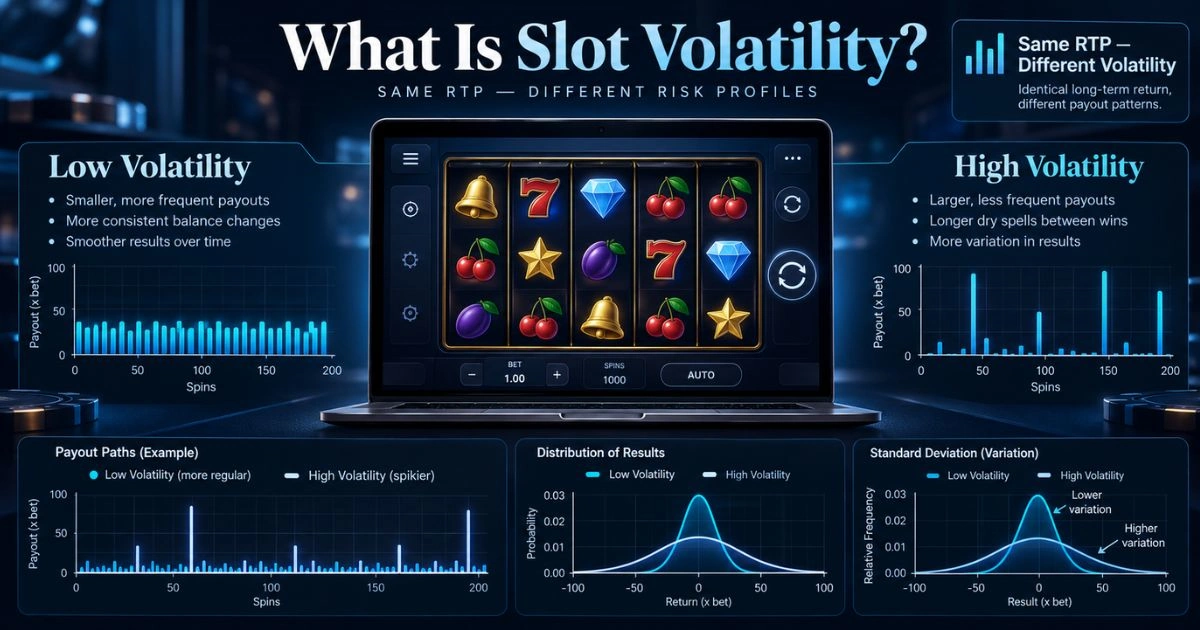
Slot volatility describes how widely a slot game’s results can vary and how its payouts are distributed over time.
A lower-volatility slot generally produces a more even pattern of smaller payouts, while a higher-volatility slot can produce larger swings, with more of the game’s return concentrated in less frequent, potentially larger prizes.
Volatility does not tell you how much a slot returns in the long run. That is the role of Return to Player (RTP). Two slots can have exactly the same theoretical RTP while producing completely different playing experiences because their volatility is different.
In technical game analysis, volatility is commonly represented using standard deviation, a statistical measurement showing how widely outcomes vary around an expected result.
Understanding that distinction helps explain why two mathematically similar slots can feel very different during short sessions.
What Does Slot Volatility Mean?
Slot volatility describes the amount of variation built into a game’s possible results.
The UK Gambling Commission explains that volatility is commonly represented by the standard deviation of a game. A highly volatile game has a wider range of expected variation and may contain prizes that are relatively large but rare. A lower-volatility game tends to produce a more predictable distribution dominated by smaller, more frequent prizes.
In simpler terms, volatility helps answer a question like: How unevenly are this slot’s payouts distributed?
Imagine two fictional slot games.
Both have: 96% theoretical RTP But their prize structures are different.
Slot A Most of the theoretical return is distributed through relatively frequent smaller prizes.
Slot B More of the theoretical return is concentrated in less frequent larger prizes.
The two games could have the same long-term theoretical return while producing very different short-term results.
Slot A would generally be considered lower volatility. Slot B would generally be considered higher volatility.
Low, Medium and High Slot Volatility
Casino games are often described as having low, medium or high volatility.
These descriptions are useful, but there is an important limitation: There is no single universal consumer scale that makes every provider’s “medium volatility” mathematically identical.
One game developer may describe its products differently from another.
The labels should therefore be treated as broad indicators rather than standardized measurements across the entire casino industry.
Low-Volatility Slots
Lower-volatility games generally distribute more of their payout value through relatively frequent smaller prizes.
This can result in a balance that moves less dramatically during ordinary play.
It does not mean:
every spin wins
losses cannot occur
the player will finish ahead
the game has a high RTP
Low volatility describes the distribution of outcomes, not whether the game is profitable for the player.
Medium-Volatility Slots
Medium-volatility slots sit somewhere between the two extremes.
They may combine smaller regular prizes with occasional larger outcomes. Again, “medium” is normally a descriptive classification rather than a precise universal standard.
High-Volatility Slots
Higher-volatility games generally concentrate more payout value in less frequent and potentially larger outcomes.
That can create more dramatic balance movements.
A player may experience longer periods without a significant payout and then occasionally encounter a much larger prize.
However, high volatility does not automatically mean that a game has the largest jackpot or highest maximum win.
Those are separate game-design characteristics.
How Does Slot Volatility Work?
A slot’s volatility comes from its underlying mathematical design.
Every game has a distribution of possible outcomes.
Some outcomes may return nothing. Others may return the stake. Some may pay a small multiple of the stake. Bonus features, special symbols or jackpots can produce much larger prizes.
The combination of the probabilities and values of all those outcomes helps determine the volatility of the game.
Important elements can include:
prize sizes
probability of each prize
base-game payouts
bonus features
jackpot contributions
symbol distribution
game mechanics
Gaming Laboratories International, or GLI, analyses casino game mathematics using payout tables and possible game combinations. Its mathematical evaluations can separately examine base-game return, feature-game return, jackpots and volatility.
Volatility is therefore not a separate switch added to a slot.
It emerges from the probability distribution built into the game’s mathematical model.
A Simple Example of Slot Volatility
Consider two fictional games with the same theoretical RTP. Both return an expected 96% of wagering over the long run.
Game A: Lower Volatility Imagine that its mathematics produces many relatively small payouts. During a short sequence, a player’s results might look something like: Loss → small payout → loss → small payout → small payout → loss
The balance may still decline, but the movement can be relatively gradual.
Game B: Higher Volatility Now imagine a game where more of the theoretical return is concentrated in less frequent larger prizes. A short sequence might look more like: Loss → loss → loss → loss → larger payout → loss
These sequences are only illustrations. Real random results do not have to follow either pattern.
The point is that both games could theoretically return the same percentage over extremely large amounts of wagering while distributing that return very differently.
That distribution is what volatility helps describe.
Slot Volatility vs RTP
Volatility and RTP measure different characteristics.
RTP asks: What proportion of wagers is the game theoretically designed to return over the long run?
Volatility asks: How widely can results vary as that theoretical return is distributed?
Suppose two slots both have: RTP: 96%
One may be low volatility. The other may be high volatility.
Their theoretical long-term return is the same, but their short-term behavior can be very different.
The UK Gambling Commission notes that actual RTP can vary around theoretical RTP because of game volatility. Higher volatility produces a wider statistically expected tolerance around the game’s theoretical return over smaller samples of play.
This is why RTP alone cannot tell you what a slot session will feel like.
Slot Volatility vs House Edge
House edge is also different from volatility.
In a simple casino game:House Edge = 100% − RTP
So a fictional slot with: 96% RTP would have a theoretical: 4% house advantage
But that 4% tells us nothing about how prizes are distributed.
Two 96% RTP games could both have the same theoretical 4% house edge while having completely different volatility.
One might produce frequent smaller payouts. The other might place much more of its return into rare larger outcomes.
House edge measures expected mathematical advantage. Volatility measures variation around expected results.
Slot Volatility vs Variance
The terms volatility and variance are often used almost interchangeably in casino discussions, but technically they are related rather than identical.
Variance is a formal statistical measurement describing how far outcomes are spread around their expected value.
Standard deviation is the square root of variance.
The UK Gambling Commission notes that standard deviation is commonly used as the measure representing game volatility.
In ordinary casino content, however, “volatility” is usually the easier consumer-facing term.
So when a game is described as highly volatile, the practical meaning is that its outcomes can vary more widely.
Is Volatility the Same as Hit Frequency?
No.
Hit frequency and volatility describe different things.
Hit frequency generally refers to how often a game produces an outcome classified as a win or payout.
Volatility considers the broader distribution and size of possible results.
A game could produce frequent payouts but still have unusual large prizes built into its mathematics. Another could produce fewer winning outcomes but have a relatively narrow range of prize values.
You therefore cannot reliably determine volatility from hit frequency alone.
There is another complication: not every result visually presented as a “win” necessarily produces a net profit on the spin.
For example, if a player stakes €1 and receives €0.50 back, money has been returned, but the player has still lost €0.50 overall.
This is one reason game characteristics should be considered separately rather than using “how often I see a win animation” as a mathematical measure.
Does High Volatility Mean Bigger Wins?
Not automatically.
High volatility means the distribution of outcomes is wider.
Large prizes can contribute to that wider distribution, but volatility alone does not tell you:
the maximum possible win
jackpot size
exact bonus frequency
probability of the top prize
A slot could advertise a very large maximum win while making that result extremely rare. Another high-volatility game could have a lower maximum prize but still produce substantial variation in ordinary results.
Check the game’s paytable and rules if you want to understand its actual prize structure. Do not infer maximum-win potential solely from a volatility label.
Does Low Volatility Mean a Slot Is Safer?
Not in the sense that it prevents gambling losses.
A lower-volatility game may produce a smoother pattern of results, but it can still have a mathematical house advantage.
Imagine two fictional slots: Slot A: 96% RTP, lower volatility Slot B: 96% RTP, higher volatility
Their distribution of results is different. Their theoretical long-term return is not.
A lower-volatility game can still gradually reduce a player’s balance over repeated wagering.
The term should therefore not be interpreted as meaning “low risk of losing money.” It describes statistical variability.
Can a High-Volatility Slot Have a High RTP?
Yes.
RTP and volatility are independent game characteristics.
A game could theoretically have: High RTP + high volatility or: High RTP + low volatility
Another could have: Lower RTP + high volatility or: Lower RTP + low volatility
There is no rule saying that a highly volatile slot must have a lower RTP.
This distinction is important because players sometimes assume that a game offering large potential prizes must automatically return less money overall.
That conclusion cannot be made from volatility alone. You need the actual RTP and game mathematics.
Why Does Volatility Matter More in Short Sessions?
The effects of volatility are most noticeable over shorter periods.
A highly volatile game’s results can move far away from its theoretical average during limited play.
This is also relevant when operators and regulators analyse game performance.
The UK Gambling Commission explains that the acceptable statistical range around theoretical RTP depends partly on volatility. Highly volatile games require wider tolerance ranges because large but infrequent prizes can create substantial short-term variation.
As the amount of play becomes much larger, actual performance can be compared more meaningfully with the theoretical mathematical model.
For an individual player, however, this should not be interpreted as meaning that playing longer will eventually guarantee the advertised RTP.
It will not.
RTP describes a game across very large amounts of play, not a personal repayment target.
Does a High-Volatility Slot Eventually Have to Pay?
No.
A high-volatility game does not keep a personal record saying: “This player has lost enough, so a large win is now due.”
Random outcomes do not work that way.
A long sequence without a large prize does not prove that one is about to occur.
Similarly, receiving a large prize does not necessarily mean the game must immediately enter a long losing period.
The probabilities defined by the game’s mathematics continue to apply.
Believing that a win must be approaching simply because a player has been losing is a form of the gambler’s fallacy.
Volatility explains why extended swings are possible. It does not provide a method for predicting when those swings will reverse.
Can You Calculate Slot Volatility Yourself?
Not accurately from a short personal playing session.
A player might record 100 or 1,000 spins and see very different results from another player because random variation can be substantial.
Proper volatility analysis requires knowledge of the game’s mathematical model or enough data for meaningful statistical analysis.
Game-testing laboratories can evaluate the full paytable and combinations mathematically rather than relying only on a player’s observed session.
GLI, for example, describes evaluating or simulating game combinations using mathematical tools to calculate characteristics including RTP and volatility.
A player’s short-term result is therefore not a reliable volatility test.
How Do Game Developers Determine Volatility?
Game designers create volatility through the mathematical structure of the slot.
Consider a simplified prize pool.
The developer could distribute theoretical return across: Many smaller prizes or concentrate more of it into: Fewer larger prizes
Both models could theoretically produce the same RTP.
Bonus features can also affect the distribution.
If a meaningful portion of the game’s return comes from a rare free-spins feature or jackpot, results may vary more widely than in a game where most value comes from ordinary base-game payouts.
GLI’s mathematical analysis explicitly separates contributions from the base game, feature games and jackpots when evaluating casino game mathematics.
This shows why volatility is a property of the entire game’s probability structure rather than simply the size of its top prize.
How Do Progressive Jackpots Affect Volatility?
Progressive jackpots provide an extreme example of uneven prize distribution.
A jackpot may collect value over large amounts of play and then award a very large prize relatively rarely.
The UK Gambling Commission notes that progressive jackpots tend to be infrequent and large and can therefore have high volatility. It also explains that jackpot components may need to be monitored separately when evaluating game performance.
This makes intuitive sense.
If a large portion of potential value is tied to a prize that occurs very rarely, short-term results can vary significantly depending on whether that prize occurs within the sample being measured.
That does not mean every progressive slot is equally volatile. The complete mathematical design still matters.
Can Two Versions of the Same Slot Have Different Volatility?
Potentially, yes, if the underlying mathematical configuration is different.
However, players should not assume that two versions are different without evidence.
Some casino games can exist with different mathematical configurations, RTP settings or other characteristics depending on the approved version supplied to an operator.
If a provider publishes volatility information for the exact game version, use that information rather than assuming that every version or similarly named slot behaves identically.
The same principle applies to RTP. Always evaluate the actual game being offered.
Where Can You Find a Slot’s Volatility?
There is no universal location.
Depending on the game provider, volatility may appear in:
game information
help section
paytable
rules
provider documentation
game description
Some games display a volatility rating directly. Others do not.
When a casino or developer uses labels such as low, medium or high, remember that those classifications may be based on its own scale.
Comparing a “high-volatility” slot from one provider with a “high-volatility” slot from another does not guarantee identical statistical behavior.
If no volatility information is published, avoid trying to infer a precise rating simply from a few spins.
How Volatility Affects Actual RTP Results
Volatility also helps explain why short-term actual RTP can look very different from theoretical RTP.
Suppose a slot has: Theoretical RTP: 96%
A limited sample might produce: Actual RTP: 82%
Another period might produce: Actual RTP: 108%
Those figures do not automatically mean the game has changed.
Random variation can produce results above or below theoretical RTP.
The UK Gambling Commission specifically requires volatility to be considered when determining how far actual game performance can reasonably vary from theoretical RTP during monitoring.
Higher volatility generally means that a wider range of short-term results can still be statistically consistent with the underlying game model.
This is another reason an individual player’s session cannot be used to verify whether a game’s published RTP is correct.
Common Slot Volatility Misconceptions
“High volatility means high RTP.” False. RTP and volatility measure different characteristics. A highly volatile game can have a high or low RTP.
“Low volatility means I cannot lose much.” False. Lower volatility can mean a smoother distribution of payouts, but repeated gambling can still produce substantial losses.
“High volatility means the slot has a huge jackpot.” Not necessarily. Large rare prizes can increase volatility, but the volatility label alone does not tell you the game’s maximum win.
“A high-volatility slot that has not paid recently must pay soon.” False. Previous losses do not make a future random win automatically due.
“Volatility tells me how often I will win.” Not directly. Win or hit frequency and volatility are separate mathematical characteristics.
“Two slots with the same RTP should behave the same.” False. They can have identical theoretical RTPs while distributing that return very differently.
Why Understanding Slot Volatility Matters
Volatility helps explain something RTP alone cannot.
RTP tells you about theoretical long-term return. Volatility helps explain how much short-term results may move around that expectation.
Together with house edge, these concepts provide a much clearer picture of casino game mathematics:
RTP — theoretical proportion returned to players over the long run.
House edge — theoretical mathematical advantage held by the casino.
Volatility — degree to which game results can vary and how unevenly payouts are distributed.
None of these measures predicts what will happen on the next spin. They describe properties of the game’s mathematical model.
Volatility Is Not a Strategy for Making Money
Some players may prefer one type of game experience over another, but volatility should not be treated as a system for beating slots.
Choosing lower volatility does not guarantee profit. Choosing higher volatility does not make a large prize inevitable.
Slots remain games of chance.
A high-volatility slot can produce a large payout quickly, but it can also produce extended losing periods. A lower-volatility slot may produce more regular smaller returns while the player’s balance still declines over time.
RTP, volatility and previous results do not provide a reliable method for guaranteeing casino income.
Gambling should be treated as entertainment involving the possibility of financial loss.
Final Thoughts
So, what is slot volatility?
Slot volatility describes how widely a game’s outcomes can vary and how its payouts are distributed across play.
Lower-volatility slots generally concentrate more of their payout value into relatively frequent smaller prizes.
Higher-volatility games tend to produce a wider spread of results, with more value potentially concentrated in less frequent larger outcomes.
But volatility should never be confused with RTP.
Two games can both have a 96% theoretical RTP while having completely different volatility.
It is also different from house edge, hit frequency and maximum win.
In technical terms, volatility is commonly represented using standard deviation, which measures how widely outcomes vary around an expected result.
For players, the simpler interpretation is enough: RTP tells you about long-term theoretical return. Volatility tells you how uneven the journey can be.
Neither one predicts the next spin.
Frequently Asked Questions
What does high volatility mean in slots? High slot volatility means game results can vary widely, with more of the payout value potentially concentrated in less frequent, larger prizes. It can lead to larger short-term balance swings.
What does low volatility mean in slots? Low volatility generally means a more even distribution of results, often with relatively frequent smaller payouts. It does not mean the player is guaranteed to lose less or finish with a profit.
Is high or low volatility better? Neither is objectively better. They describe different mathematical distributions. More importantly, neither removes the casino’s mathematical advantage or guarantees a particular result.
What is the difference between RTP and volatility? RTP describes the percentage of total wagering a game theoretically returns over the long run. Volatility describes how widely results vary and how that return is distributed.
Can a high-volatility slot have a high RTP? Yes. RTP and volatility are separate characteristics. A slot can have both a relatively high theoretical RTP and high volatility.
Does a high-volatility slot have to pay after a long losing streak? No. A losing streak does not make a future prize automatically due. Random game outcomes are not required to compensate an individual player for previous losses.