Еве ја последната статија “What Is House Edge in Casino Games and How Does It Work?” со вметнати линкови.
Овде исто така направив одлично вкрстено поврзување (cross-linking) со останатите статии што се занимаваат со математиката и правилата на казината. Вкупно додадов 5 линкови (3 интерни и 2 екстерни).
Интерни линкови (кон твојот сајт):
casinos can remain profitable -> води кон статијата “How Do Online Casinos Make Money”.
Return to Player, or RTP -> води кон статијата “What Is RTP in Online Casinos”.
understanding whether player decisions actually affect probability -> води кон статијата “How to Compare Online Casino Games and Understand Their Odds”.
Екстерни линкови:
UK Gambling Commission -> води кон почетната страница на UKGC, бидејќи ја цитираш нивната дефиниција на почетокот.
Gaming Laboratories International -> води кон GLI, бидејќи ја користиш нивната дефиниција за RTP.
Еве го текстот подготвен за копирање:
What Is House Edge in Casino Games and How Does It Work?
The house edge is the mathematical advantage a casino has over players in a casino game.
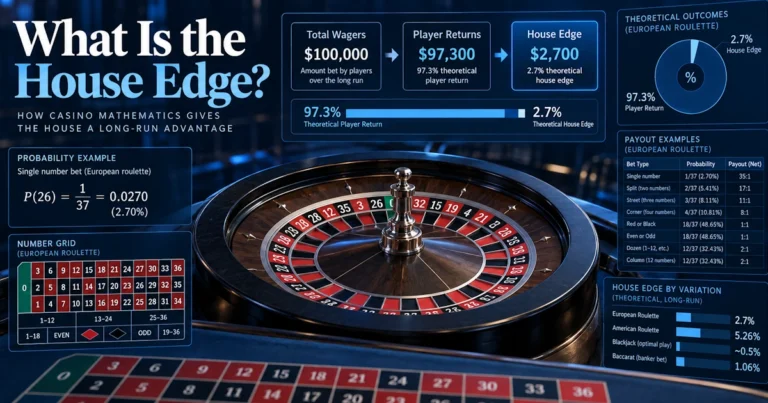
It is usually expressed as a percentage of the amount wagered. For example, if a game has a theoretical house edge of 3%, the casino would expect to retain about €3 for every €100 wagered over a very large amount of play.
That does not mean every player loses exactly €3 from €100. Someone could lose the full amount, finish ahead or experience a large win.
House edge describes long-term mathematical expectation, not the result of one bet or one gambling session.
Different casino games have different house edges, and even different versions or bets within the same game can produce different mathematical advantages. Understanding the house edge therefore helps explain why casinos can remain profitable while still paying winners every day.
What Does House Edge Mean?
House edge measures the casino’s expected mathematical advantage in a game.
The UK Gambling Commission describes it as the percentage that a casino would expect to keep, on average, from casino games such as roulette and blackjack under normal patterns of play.
Consider a simplified fictional game with a 4% house edge.
If €100,000 is wagered over enough play for the theoretical mathematics to become meaningful:
Total wagers: €100,000
Theoretical amount returned to players: €96,000
Theoretical casino advantage: €4,000
That €4,000 represents 4% of the total amount wagered.
But this is an expected mathematical result.
The casino could retain more or less than €4,000 during a particular period because casino games involve chance and short-term variation.
How Is House Edge Calculated?
House edge comes from the relationship between:
the probability of an outcome
the amount a winning bet pays
the amount lost when the bet fails
If a casino paid perfectly fair odds on every possible outcome, there would be no built-in house advantage.
Casino games normally pay slightly less than mathematically fair odds would require.
That difference creates the house edge.
Roulette provides one of the clearest examples.
A Simple Roulette House Edge Example
A European roulette wheel normally contains 37 pockets:
numbers 1 to 36
one zero
Suppose you place €1 on a single number.
Your chance of winning is: 1 out of 37
A winning straight-up roulette bet normally pays 35 to 1.
If completely fair odds were being offered on a 1-in-37 event, the profit would need to be 36 to 1.
Because the actual payout is lower, the casino has an advantage.
The mathematical house edge works out to: 1 ÷ 37 ≈ 2.70%
This means the casino has a theoretical advantage of about 2.7% on standard European roulette bets.
Again, that does not mean the casino takes 2.7 cents from every €1 spin.
One spin can result in a complete loss or a 35-to-1 win.
The percentage becomes meaningful across very large amounts of wagering.
Why Roulette Rules Change the House Edge
Now consider a traditional American roulette wheel.
It normally contains:
numbers 1 to 36
zero
double zero
That creates 38 possible outcomes instead of 37.
But a straight-up winning bet still typically pays 35 to 1.
The result is a larger mathematical advantage for the casino.
For a standard straight-up bet: European roulette: about 2.70% house edge American double-zero roulette: about 5.26% house edge
The basic game is still roulette.
What changed was the rule structure.
This demonstrates an important principle:
The house edge belongs to the exact game rules and bet, not simply to the name of the game.
Two versions of the same casino game can have different mathematical advantages.
House Edge and RTP
House edge and Return to Player, or RTP, are closely connected.
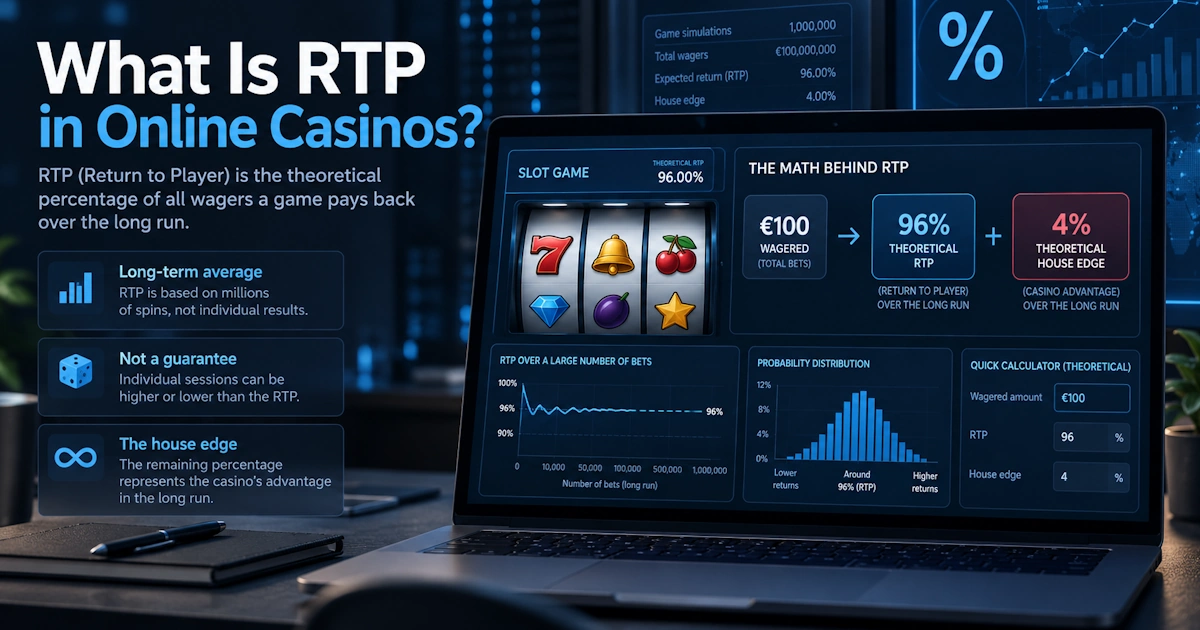
For a simple fixed casino game: House Edge = 100% − RTP
For example: RTP: 96% House edge: 4%
Or: RTP: 97.3% House edge: 2.7%
They describe the same long-term mathematical relationship from opposite perspectives.
RTP describes the theoretical amount returned to players.
House edge describes the theoretical advantage retained by the casino.
Gaming Laboratories International defines RTP as the expected percentage of wagers a game returns to players over the long run. Its game-mathematics analysis can calculate theoretical RTP using mathematical evaluation or simulation.
However, the relationship is not always as simple as subtracting one published number from 100.
Games involving player decisions, different bet types or special rules can require more context.
Why Blackjack Does Not Have One Universal House Edge
Blackjack is a good example of a game where the house edge depends on more than the cards.
Player decisions matter.
During a blackjack hand, a player may choose to:
hit
stand
double down
split pairs
Different decisions can change the expected mathematical result.
Table rules also matter.
For example, blackjack games may differ in:
the number of decks
how the dealer plays certain hands
blackjack payouts
doubling rules
splitting rules
As a result, there is no single house-edge percentage that applies to every blackjack game.
The player’s strategy can also affect the expected return.
The UK Gambling Commission’s technical guidance recognizes this issue. When a game contains an element of skill, theoretical RTP may be calculated using a standard or published strategy rather than assuming all possible player decisions are equal.
So when someone says “blackjack has a low house edge,” the next question should be: Under which rules and using which strategy?
Different Bets Can Have Different House Edges
A single casino game can contain several betting options with different mathematical values.
This is common in table games.
For example, baccarat usually allows bets such as:
Banker
Player
Tie
Those bets do not necessarily have the same house advantage.
Roulette can also contain special rules that change the expected return on certain bets.
The important lesson is that the name of the game alone is not always enough.
When evaluating house edge, look at the specific wager and game rules.
A casino can therefore offer one game containing both relatively low-edge and relatively high-edge bets.
Does a 5% House Edge Mean You Lose €5 From Every €100?
No.
A 5% house edge does not mean: Bet €100 → lose exactly €5
It means that, under the mathematical model, the casino’s expected advantage is equivalent to 5% of wagering over a sufficiently large amount of play.
Your actual result could be: €100 wagered → €100 lost or: €100 wagered → €150 returned or: €100 wagered → €500 returned
Short-term outcomes can be far away from the theoretical average.
The house edge becomes useful as a measure of expected value, not as a prediction of what will happen to one person’s balance.
House Edge Is Based on Wagering, Not Deposits
Another common mistake is applying house edge directly to a player’s original deposit.
Suppose you deposit €100. You then place 100 bets of €10 while repeatedly recycling money won back into additional bets.
Your total wagering is: 100 × €10 = €1,000 even though you originally deposited only €100.
If the game has a theoretical house edge of 2.7%, the simplified expected mathematical cost across €1,000 of wagering would be: €1,000 × 2.7% = €27
This does not mean you must lose €27.
It means €27 is the theoretical expected loss associated with that amount of wagering under the model.
Your actual result could be much higher or lower.
This is also why repeated betting matters.
The same initial balance can create a much larger amount of total wagering.
Why More Play Gives the House Edge More Opportunity to Matter
House edge exists on each qualifying wager, but short-term randomness can easily overwhelm it.
A player can win several bets in a row. Another can lose immediately.
As the amount of wagering grows, the underlying mathematical advantage has more opportunities to influence the overall result.
Consider a fictional game with a 4% house edge.
A single €10 bet has an expected mathematical cost of: €10 × 4% = €0.40
But there is no realistic outcome where the casino simply removes €0.40 and returns €9.60 after every bet.
You either receive whatever the game’s result pays or lose according to its rules.
Across €10,000 of total wagering, however, the theoretical expected casino advantage becomes: €10,000 × 4% = €400
Actual results can still differ substantially. The calculation describes expectation, not certainty.
Why the Casino Can Lose Even With a House Edge
If casinos have a mathematical advantage, how can players win?
Because house edge does not guarantee individual results.
Imagine a casino accepting one roulette bet. A player places €1,000 on a number and wins. The casino has clearly lost money on that particular bet.
Nothing about the house edge prevents this.
The business model depends on many wagers from many players over time.
That allows the underlying mathematical advantage to become more relevant at scale.
This is why the phrase “the house always wins” is technically misleading. The house does not win every bet or every session.
A more accurate statement is: The house normally has a long-term mathematical advantage.
House Edge vs Casino Hold
House edge and casino hold are sometimes treated as though they mean the same thing, but they describe different ideas.
House edge is a theoretical property of a game. It comes from the game’s rules, probabilities and payouts.
Hold usually describes what the casino actually retained from gambling activity during a measured period.
Actual results can therefore differ from the theoretical house edge.
For example, a casino game could have a 3% theoretical house edge while the casino experiences an unusually successful week and retains much more than that.
The opposite can also happen. Players could have an unusually strong period and the casino could retain less than the theoretical expectation.
The theoretical mathematics has not changed. Only the short-term results have.
House Edge Does Not Measure How Often You Win
A low house edge does not necessarily mean you will win frequently.
Consider two fictional games.
Game A The game produces frequent small wins but has a 4% house edge.
Game B The game produces fewer wins but has a 2% house edge.
Game B has the lower theoretical casino advantage. But Game A might still create more winning rounds.
House edge measures expected mathematical value.
It does not directly tell you:
win frequency
jackpot frequency
volatility
average session length
likelihood of finishing one session ahead
These are different characteristics.
House Edge and Volatility Are Not the Same Thing
House edge describes the casino’s theoretical mathematical advantage.
Volatility describes how results may be distributed.
Two games could have similar house edges but very different short-term behavior.
One could generate many small wins and losses. Another could generate long losing periods combined with occasional large prizes.
Gaming Laboratories International treats RTP and volatility as separate characteristics when analysing casino game mathematics.
This matters because a low-house-edge game can still be highly volatile.
A player can therefore experience significant short-term losses even when playing a game with comparatively favorable theoretical mathematics.
Can Player Decisions Change the House Edge?
In some games, yes.
Blackjack is the obvious example.
The rules create the basic mathematical environment, but player decisions can affect expected results.
Poor decisions may increase the casino’s effective advantage.
Using a mathematically sound strategy can reduce mistakes, but it does not turn gambling into guaranteed income.
Other casino games offer little or no meaningful strategic influence.
A normal roulette spin, for example, does not become mathematically more favorable because a player chooses numbers based on previous results.
Understanding whether player decisions actually affect probability is therefore important.
Strategy matters in some games. In others, it does not change the underlying house edge.
Does Betting More Change the House Edge?
Usually, changing the size of the same type of wager does not change its house-edge percentage.
Suppose a particular bet has a theoretical house edge of 3%.
A €1 wager and a €100 wager can both face the same 3% mathematical edge.
What changes is the amount of money exposed.
The simplified theoretical expected cost would be: €1 × 3% = €0.03 versus: €100 × 3% = €3
This does not predict either bet’s actual result. The percentage is the same, but the financial exposure is different.
Can a Betting System Beat the House Edge?
Changing the size of bets does not normally change the underlying mathematics of an independent casino game.
Systems based on ideas such as:
doubling after losses
increasing bets after wins
following streaks
betting against streaks
do not automatically remove the house edge.
Consider roulette.
Changing from a €10 bet to a €20 bet does not remove the zero from the wheel. The probabilities and payout structure remain the same.
A betting system can change:
how quickly the bankroll moves
the size of potential wins
the size of potential losses
the pattern of risk
But changing stake progression alone does not make an unfavorable bet mathematically favorable.
Does a Losing Streak Mean the House Edge Has Increased?
Not necessarily.
A player can experience a long losing streak while the game’s underlying house edge remains exactly the same.
Similarly, a player can have a highly profitable session without reducing the game’s theoretical house advantage.
Random variation creates short-term results. House edge describes long-term expected mathematics.
Confusing the two can lead players to think a game has suddenly become “hot,” “cold” or more generous.
In properly regulated random games, outcomes should follow the game’s defined mathematical rules rather than being changed simply because previous results favored the player or casino.
Current UK remote gambling standards require relevant information about the likelihood of winning to be available to players and recognize house edge, RTP and event probabilities as ways of communicating that information.
Is a Lower House Edge Always Better for the Player?
From a purely mathematical long-term perspective, a lower house edge generally means a smaller expected disadvantage.
Suppose two otherwise comparable games have: Game A: 2% house edge Game B: 5% house edge
Across €10,000 of theoretical wagering: Game A expected mathematical cost: €200 Game B expected mathematical cost: €500
The difference is €300.
However, this does not mean Game A must produce the better result during one session.
Volatility, game rules and random outcomes still matter.
A player could win on the 5% game and lose on the 2% game.
The lower house edge becomes meaningful as a comparison of long-term expected cost, not as a guarantee of better short-term results.
How Can You Find the House Edge of a Casino Game?
Start with the game’s own information.
Look for sections such as:
Rules
Help
How to Play
Paytable
Game Information
Depending on the game, the information may provide:
house edge
RTP
probabilities
payout tables
In Great Britain, the UK Gambling Commission requires applicable games to make information about rules and the likelihood of winning easily available before a customer gambles. Its implementation guidance specifically recognizes house edge, RTP and probability information as ways to explain the player’s chances.
For games where player decisions affect expected results, remember that a published percentage may assume a particular strategy.
Do not assume that every player automatically receives exactly the theoretical return shown.
Are House Edge Figures Tested?
In regulated markets, game mathematics and software can be subject to technical requirements and independent testing.
The UK Gambling Commission requires relevant remote gambling and software licence holders to follow its technical standards and testing requirements. Some gambling products must be tested by approved independent test houses before release.
Testing laboratories can analyse mathematical models, payout tables and possible game outcomes.
GLI, for example, describes mathematical evaluations that calculate theoretical RTP using game combinations and payout information and can also analyse characteristics such as jackpots and volatility.
Testing does not make the house edge disappear.
Its purpose is to help verify that the game operates according to the mathematics and technical requirements that apply to it.
Common House Edge Misconceptions
“A 3% house edge means I lose 3% every session.” No. It describes theoretical expected value over long-term wagering, not your guaranteed session result.
“The house wins every bet.” No. Casino games regularly produce winning bets. The casino advantage appears mathematically over large amounts of play.
“A low house edge means I am likely to win tonight.” Not necessarily. Short-term outcomes can differ greatly from long-term expectation.
“If I double my bet after losing, I remove the house edge.” No. Changing stake size does not normally change the underlying probability and payout structure of the wager.
“House edge and RTP are unrelated.” They are closely connected. In a simple fixed game, a 96% RTP corresponds to a 4% theoretical house edge.
“Every game of the same type has the same house edge.” No. Different rules, payouts, bet types and strategies can change the mathematical advantage.
Why House Edge Matters
House edge is useful because it allows casino games to be compared using mathematics rather than short-term results.
Someone might play Game A and win immediately. The same person might play Game B and lose.
That does not tell us which game has the lower mathematical cost.
House edge provides a more objective long-term measure.
It helps explain:
why casinos can make money while paying winners
why different game rules matter
why repeated wagering increases exposure to casino mathematics
why a winning session does not prove a game is favorable
why betting systems cannot simply erase a mathematical disadvantage
Understanding the concept does not provide a way to predict individual outcomes. It provides a clearer way to understand the cost built into casino gambling.
House Edge Does Not Make Gambling an Investment
A lower house edge can reduce the theoretical cost of play, but it does not make a casino game a reliable income source.
Casino outcomes remain uncertain.
Even games with relatively small mathematical edges can produce substantial losses in a short period.
More importantly, repeated wagering increases the total amount exposed to the game’s advantage.
A player should therefore avoid interpreting house-edge percentages as a method for guaranteeing profit.
They are tools for understanding risk and game mathematics.
Gambling should be treated as entertainment involving the possibility of financial loss, not as a predictable investment strategy.
Final Thoughts
So, what is house edge?
House edge is the casino’s theoretical mathematical advantage over players, expressed as a percentage of wagering.
If a game has a 4% house edge, the casino expects to retain the equivalent of about 4% of total wagers over sufficiently large amounts of play.
But that does not mean every player loses 4%. Individual results can be dramatically different.
House edge also varies between games, game versions and sometimes individual bets. In games such as blackjack, player decisions and rules can affect the expected return.
In simple casino games, house edge and RTP describe opposite sides of the same mathematical relationship: House Edge = 100% − RTP
The most important thing to remember is that house edge measures long-term expectation, not short-term destiny.
A casino can lose individual bets and players can have winning sessions.
The casino’s advantage comes from the mathematics operating across a large amount of wagering over time.
Frequently Asked Questions
What does a 5% house edge mean? A 5% house edge means the casino has a theoretical expected advantage equal to 5% of total wagering over long-term play. It does not mean every player loses exactly €5 for every €100 wagered.
Is house edge the same as RTP? They are closely related. In a simple fixed game, a 96% RTP corresponds to a 4% house edge because 100% − 96% = 4%.
Which casino game has the lowest house edge? There is no single answer without specifying the exact rules and bets. House edge can vary between game versions, and games involving strategy can produce different expected results depending on how they are played.
Can the house edge change while I am playing? The underlying mathematical edge of a fixed bet does not normally change simply because you have recently won or lost. Different bets, game rules or player decisions can have different mathematical advantages.
Can a betting strategy remove the house edge? Changing bet sizes or following winning and losing streaks does not normally change the probability and payout structure that creates the house edge. A staking system can change risk but does not automatically turn a negative-expectation bet into a positive one.
Why do players win if the casino has a house edge? House edge is a long-term expected advantage, not a guarantee on every wager. Random variation allows players to win individual bets, sessions and large prizes even when the underlying mathematics favors the casino over time.