Online slots are digital casino games in which a player chooses a stake, starts a game round and receives a result based on the game’s underlying software and mathematics.
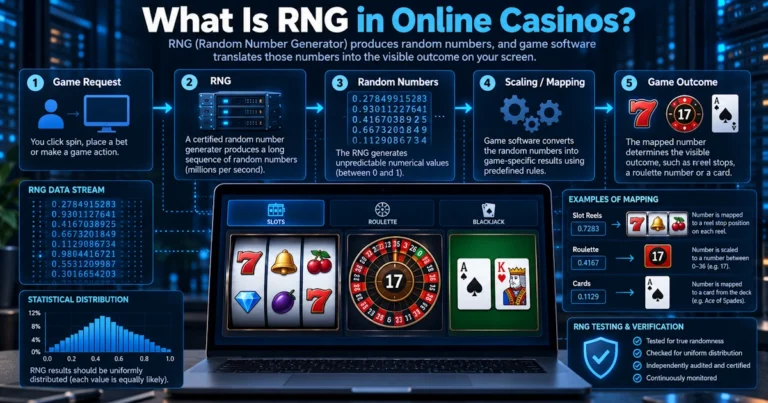
The spinning reels are the visual part of the experience, but they are not usually what creates the result. In modern online slots, a Random Number Generator (RNG) produces random inputs, and the game software maps those inputs to possible reel positions, symbols or outcomes according to the game’s rules.
The resulting symbol arrangement is then compared with the game’s paytable to determine whether the spin has produced a payout.
Behind that simple process can be a much more complicated mathematical model involving reel strips, paylines or ways to win, bonus features, free spins, wild symbols, jackpots, Return to Player (RTP) and volatility.
Understanding how these pieces connect makes online slots much easier to understand.
What Is an Online Slot?
An online slot is a reel-based casino game played through a website, app or other online gambling platform.
The UK Gambling Commission defines slots as casino games of a reel-based type and notes that this can include games using non-traditional reels. Its current online-slot rules also describe reel-based games as games where changing images or text are displayed using visual representations of reels or similar mechanisms and prizes may depend on the resulting arrangement.
Classic slots may contain three reels and a small number of symbols.
Modern video slots can be much more complex, using:
five or more reels
several rows of symbols
multiple paylines
hundreds or thousands of ways to win
wild and scatter symbols
free-spin rounds
multipliers
expanding reels
bonus games
progressive jackpots
Despite the visual differences, the core idea is usually similar: a wager is placed, a game round is initiated, a random result is produced and the game rules determine whether that result wins a prize.
What Happens When You Press Spin?
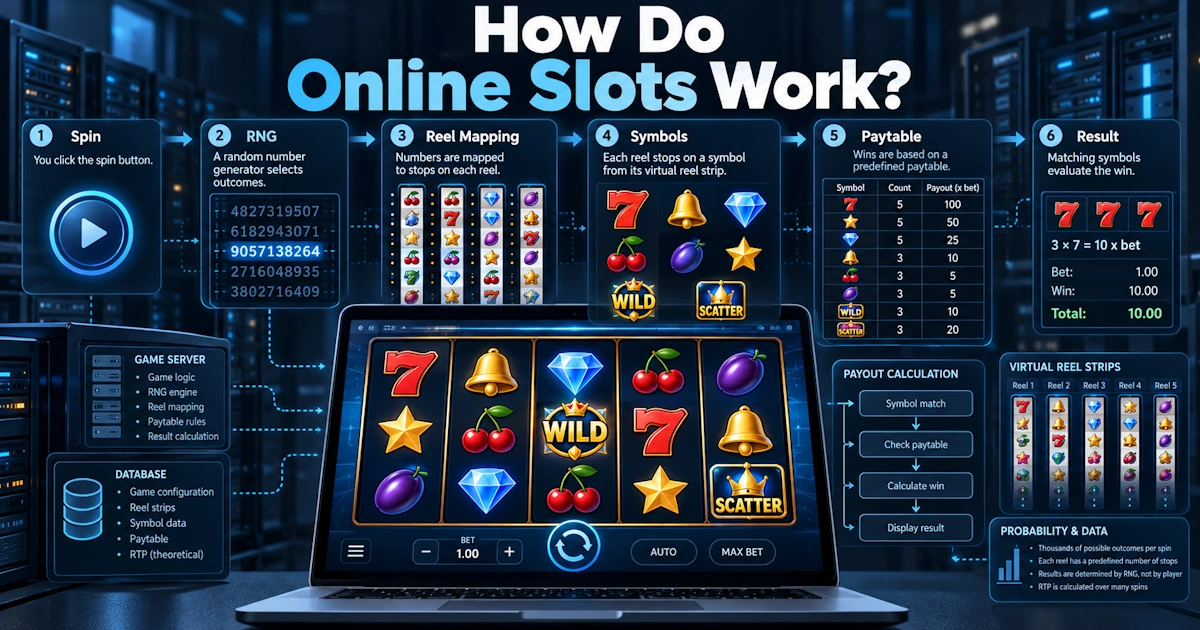
A simplified online slot game cycle looks like this:
1. The player chooses a stake The game records the amount being wagered.
2. The player presses Spin This begins a new game cycle.
3. The game requests or receives random input An RNG provides the random information used to determine the outcome.
4. The random input is mapped to a game result The software converts the RNG output into relevant reel positions, symbols or another result format.
5. The result is displayed The reels animate and stop at the symbol arrangement representing that result.
6. The paytable is applied The game checks whether the displayed result qualifies for a payout or feature.
7. Any winnings are credited The corresponding amount is added to the player’s casino balance.
This process can happen extremely quickly even though animations make the spin appear to take longer.
Regulatory standards distinguish between random-number generation and mapping. The UK Gambling Commission defines mapping as the process of using an RNG result to select a game outcome, giving the example of mapping an RNG result to a reel-strip symbol.
What Is an RNG in Online Slots?
RNG stands for Random Number Generator.
It is one of the most important components of an online slot.
An RNG is hardware or software designed to generate numbers with the intended property of statistical randomness. Those numbers provide the random input used by the game to produce outcomes.
The player normally never sees these numbers.
Instead, the slot software converts them into meaningful game information.
For example, an RNG result might ultimately correspond to:
Reel 1 stopping on Symbol A
Reel 2 stopping on Symbol B
Reel 3 stopping on Symbol C
Reel 4 stopping on Symbol A
Reel 5 stopping on Symbol A
The visible result then appears on the screen.
How Does the RNG Choose Slot Symbols?
The RNG does not necessarily choose a picture of a cherry, bell or wild symbol directly.
There can be several steps between the random number and the final screen.
A simplified model might look like: RNG output → scaling/mapping → reel position → symbol → final screen
Suppose a game’s virtual reel contains 100 possible positions.
The RNG produces random information that the software converts into one of those positions.
The position corresponds to a particular symbol on that reel.
The same process occurs for the other reels, producing the final combination.
The UK Gambling Commission describes scaling as converting RNG output into the range required by a particular game and mapping as converting that random result into an outcome such as a reel-strip symbol.
Real slots can use considerably more complex mathematical structures, but the general principle is the same.
Are Online Slot Outcomes Really Random?
In properly regulated RNG-based slots, game results are expected to satisfy technical randomness requirements.
For example, the UK Gambling Commission requires RNG output and game results to be “acceptably random.” Its technical standards require outcomes to follow the expected or theoretical probabilities, be unpredictable and avoid inappropriate patterns introduced through RNG implementation.
The same rules prohibit adaptive behaviour that changes game probabilities during play based on previous payouts or results.
This is important because it means a properly regulated slot should not decide: “This player has just won too much, so reduce the chance of winning.”
Nor should it operate according to: “This player has lost enough, so now give them a prize.”
The game’s defined mathematical probabilities continue to apply.
Randomness can still produce long winning or losing streaks naturally.
Are the Spinning Reels Actually Choosing the Result?
The visual reels are primarily the interface through which the game presents the result.
In an RNG-based online slot, the underlying software uses random input and maps that input to the game outcome.
The reel animation then shows the resulting symbols.
This is different from a traditional mechanical slot machine where physical reels themselves form part of the outcome mechanism.
Modern online slots can therefore use virtual reel structures that are far more complex than what is visible on screen.
A game might display five reels with three visible positions on each reel while its underlying mathematical model contains many more virtual positions and probabilities.
The graphics show the outcome. The mathematical system determines how likely that outcome is.
What Are Reel Strips?
A reel strip is the sequence of symbol positions associated with a slot reel.
Imagine a very simple reel containing: Cherry – Lemon – Bell – Cherry – Wild – Lemon – Cherry – Bar
When the game selects a stopping position, one or more of those symbols becomes visible on screen.
Real online slots may use much longer and more complex reel structures.
The number and placement of symbols can affect the probability of different combinations occurring.
For example, if one symbol appears many times on a virtual reel while another appears only once, the first symbol can be much more likely to appear.
This is why simply counting the symbols visible on screen does not tell you their true probability.
The underlying reel mathematics matters.
Independent testing laboratories can review reel strips, paytables, source code and RNG implementation when evaluating gaming software. GLI, for example, requires information such as reel-strip listings, percentage calculations and paytables as part of relevant software submissions.
What Are Paylines?
A payline is a defined pattern across the reels that can produce a winning combination.
The simplest slot might have one horizontal payline. For example: Cherry – Cherry – Cherry across the center row could create a win.
Modern slots may contain:
5 paylines
10 paylines
20 paylines
50 paylines
hundreds of paylines
Paylines do not need to run straight across the screen. They can follow patterns such as:
horizontal
diagonal
zigzag
V-shaped
The game’s paytable explains which symbol combinations qualify and how much they pay.
What Are Ways-to-Win Slots?
Not every modern slot uses traditional fixed paylines.
Some use ways to win.
Instead of requiring symbols to appear along a predefined payline, these systems can award prizes when matching symbols appear on consecutive reels in qualifying positions.
For example, a five-reel game might require matching symbols on: Reel 1 + Reel 2 + Reel 3 without requiring them to follow one specific line.
Some games expand the reel grid or change the number of active symbols during bonus features, which can increase or decrease the number of possible winning arrangements.
The exact rules vary, so the game’s information screen is more useful than assuming all “ways” slots work identically.
What Is a Slot Paytable?
The paytable explains how the slot pays.
It may show:
symbol values
winning combinations
wild behavior
scatter payouts
bonus triggers
free-spin rules
multiplier rules
jackpot conditions
Suppose a fictional slot shows: 3 matching symbols = 2× stake 4 matching symbols = 10× stake 5 matching symbols = 50× stake
If the qualifying stake for the winning combination is €1, the corresponding prizes could be: €2 €10 €50 depending on the result.
Regulated technical standards can require game rules and payout information to be available to players and accurately reflected in the game itself. GLI-19, for example, requires game information and paytables to explain applicable rules and possible winning outcomes.
How Is the Slot Bet Calculated?
The exact betting system depends on the game.
Some slots simply offer a total stake such as: €0.20 €0.50 €1 €2 per spin.
Others historically used a structure involving: Coin value × coins per line × number of active paylines
For example: €0.01 × 2 coins × 20 lines = €0.40 total stake
Modern online slots often simplify this and show only the total amount being wagered per game cycle.
Before starting, the player should be able to see the amount at risk.
What Are Wild Symbols?
A wild is a special symbol that can substitute for certain other symbols to help form winning combinations.
It is similar in concept to a joker in some card games.
For example: King – King – Wild – King – King might be treated as five matching King symbols if the rules allow the wild to substitute in that position.
Different games use wilds differently. Wilds can sometimes be:
standard substitutes
expanding
stacked
sticky
moving
multiplied
A wild may also exclude certain symbols, such as scatters or bonus symbols.
The exact rule comes from the individual game’s paytable.
What Are Scatter Symbols?
Scatter symbols usually work differently from ordinary line-paying symbols.
They may award a prize or trigger a feature based on the number appearing anywhere on qualifying reels rather than on a particular payline.
For example, a game might require: 3 Scatter symbols → 10 Free Spins
The position requirements vary between games. Some slots require scatters on particular reels. Others count them anywhere on the screen.
Again, the game’s rules determine what qualifies.
How Do Free Spins Work?
Free spins are bonus game rounds that do not normally require an additional cash stake for each qualifying spin once the feature has been triggered.
A slot might award free spins after:
landing scatter symbols
completing a bonus event
filling a meter
triggering another game feature
The bonus mode can use different rules from the base game. For example, free spins might contain:
extra wilds
larger multipliers
expanding reels
different symbol distributions
additional bonus opportunities
Different rules during a bonus round are not inherently unusual. Regulatory standards can permit bonus features with different rules provided those rules are properly described to the player.
What Are Multipliers?
A multiplier increases the value of a qualifying win.
For example: Base win: €10 3× multiplier Final win: €30
Multipliers can appear in the base game or during bonus features.
Some games allow multipliers to increase progressively during a feature, while others attach them to particular symbols.
A large multiplier shown in promotional material does not mean that every win receives that multiplier.
The conditions in the game’s rules still apply.
How Do Slot Jackpots Work?
A jackpot is a larger prize associated with particular game conditions.
Fixed Jackpot A fixed jackpot has a predetermined prize amount or payout structure.
Progressive Jackpot A progressive jackpot can increase over time.
The UK Gambling Commission defines a progressive jackpot as an incremental prize that increases through contributions from money wagered in the game from a predefined base value.
Progressive systems can work in different ways. A jackpot may be:
limited to one slot
shared across several games
shared across multiple casinos or networks
The rules should explain how the jackpot is funded and what conditions are required to win it.
What Is RTP in Online Slots?
Return to Player, or RTP, describes the theoretical percentage of wagers that a game is designed to return to players over long-term play.
Suppose a slot has: 96% theoretical RTP
In a simplified long-run model, that means the game is designed to return approximately 96% of qualifying wagers and retain a theoretical 4% house advantage.
But this does not mean: Wager €100 → receive €96
RTP applies across very large amounts of wagering. An individual player can lose the entire balance, win more than was wagered or finish anywhere between those outcomes.
RTP describes the mathematics of the game, not the result of one session.
What Is Slot Volatility?
Volatility describes how widely slot results can vary and how the game’s theoretical payouts are distributed.
Imagine two slots with the same: 96% RTP
One could pay relatively frequent smaller prizes. Another could produce longer gaps between meaningful wins but include larger prizes.
Their RTP can be identical even though their short-term behavior feels very different.
The first would generally be lower volatility. The second would generally be higher volatility.
Volatility and RTP therefore measure different things.
What Is Hit Frequency?
Hit frequency generally refers to how often a slot produces an outcome counted as a winning result or payout.
It should not be confused with RTP.
Imagine a game produces many small payouts. Its hit frequency may be relatively high.
But those frequent payouts could still be smaller than the amount wagered or combined with enough losing spins for the game to retain its mathematical house advantage.
Similarly, a slot can have fewer winning events while placing more of its theoretical return into larger prizes.
How often something pays and how much the game theoretically returns are different measurements.
Are Bonus Features Random?
They can be.
If a bonus feature depends on random events, those events become part of the game’s mathematical model.
The RNG may determine things such as:
whether a bonus triggers
which mystery prize appears
how a bonus wheel lands
which symbols are added
which multiplier applies
Some bonus features also involve player choices. For example, a player might choose one of several hidden objects.
Whether that choice genuinely affects the result depends on the game’s design.
Game rules should accurately explain how the feature works.
Can a Slot Change Its Odds Because You Are Winning?
A properly regulated RNG slot should not change its probabilities simply because one player has recently won or lost.
The UK Gambling Commission specifically prohibits adaptive behavior that alters the probability of game outcomes based on previous payouts or intake.
This means common ideas such as: “The slot knows I am winning.” or: “The machine needs to recover the money it just paid.” do not describe how a compliant random game should operate.
Previous outcomes can still form surprising patterns.
Randomness does not guarantee that wins and losses alternate neatly.
Can a Slot Be “Due” to Pay?
No.
A long sequence of losing spins does not mean a winning spin must occur next.
Consider a fair coin. Five heads in a row do not force the sixth toss to be tails. Each new random event is still governed by the relevant probability.
The same basic principle applies to independent slot outcomes.
A slot’s RTP also does not behave like a personal account that keeps track of how much one player has lost and then returns enough money to reach the published percentage.
The idea that a win becomes increasingly “due” after losses is an example of the gambler’s fallacy.
How Are Online Slots Tested?
In regulated markets, slot software may be subject to independent testing before release.
Testing can examine areas including:
RNG behavior
game mathematics
RTP
payout calculations
reel combinations
bonus rounds
jackpots
source code
game rules
The UK Gambling Commission requires applicable online RNG games offered in Great Britain to undergo testing under its regulatory framework before release and requires operators to monitor game performance after launch.
GLI describes game testing that uses source code, mathematical documentation and simulations to verify that game behavior, payouts and expected RTP match the intended design.
Testing does not guarantee that a player will win. It is intended to verify that the software follows its approved rules and mathematics.
Are Online Slots the Same in Every Country?
No.
The fundamental mathematics may be similar, but product-design and gambling rules can differ significantly between jurisdictions.
For example, in Great Britain, current rules require customers to initiate each online gaming cycle individually, so autoplay is not permitted.
British rules also prohibit features such as turbo play or quick spin that reduce the time before a result is presented, and online slot game cycles must observe specific timing requirements.
Other jurisdictions can apply different rules.
This is why features available in one country’s version of a slot or casino platform may not necessarily be available in another.
What Happens If an Online Slot Disconnects?
Technical interruptions can happen because of:
internet connection problems
device problems
server interruptions
software errors
What happens next depends on the game and operator’s rules.
The important point is that the game system should be capable of correctly recording and settling accepted wagers.
UK technical standards require gambling systems to process and settle bets according to published game rules and to address faults or errors that affect customers.
In practice, a completed or accepted game may therefore be recoverable from game records even if the visual animation was interrupted.
Exact procedures depend on the platform and jurisdiction.
Do Online Slots Remember Previous Spins?
Game systems can maintain records of previous transactions and game activity, but this does not mean previous results should be used to manipulate future random outcomes.
For a compliant RNG game, earlier wins or losses do not create a personal sequence that must be balanced.
The RNG and game mathematics determine new outcomes according to the game’s rules.
This distinction is important: Recording past spins is not the same as using past spins to change future probabilities.
Can You Predict the Next Slot Spin?
Not reliably in a properly functioning regulated RNG game.
A core requirement of random-number generation is unpredictability.
The UK Gambling Commission requires RNG outputs to be unpredictable, while GLI’s RNG testing is designed to examine whether output shows inappropriate predictability or bias.
Previous symbols therefore do not provide a reliable pattern for forecasting the next result.
Strategies based on:
watching previous spins
counting losses
waiting for a “hot” machine
looking for repeating symbols do not reveal the next RNG result.
Common Misconceptions About Online Slots
“The reels physically decide the result.” In an RNG-based online slot, random input is mapped to a game outcome and the visual reels display that result.
“A slot that has not paid recently must pay soon.” No. A losing sequence does not make a future winning result due.
“96% RTP means I receive €96 from every €100.” No. RTP is a theoretical long-term measure across total wagering.
“More paylines automatically mean better odds.” Not necessarily. The complete mathematical model and bet structure determine expected return and probabilities.
“High volatility means high RTP.” No. Volatility and RTP describe different characteristics.
“A casino can simply turn down my odds because I won.” A properly regulated random game should follow its defined probabilities rather than adapt them because of previous player results.
“A large win means the slot will now stop paying.” Previous payouts do not create a requirement for future results to compensate the casino.
Online Slots Are Games of Chance
Understanding slot mechanics can make the mathematics clearer, but it does not provide a way to predict future results.
RNG outcomes remain uncertain. RTP describes long-term theoretical return. Volatility describes variation. Paylines and ways-to-win rules describe how qualifying symbol combinations are evaluated.
None of these concepts guarantees a profitable session.
Repeated wagering also increases the total amount of money exposed to the game’s mathematical house advantage.
Online slots should therefore be treated as paid entertainment involving the possibility of losing money rather than as a method for generating reliable income.
Final Thoughts
So, how do online slots work?
The basic process is straightforward.
A player chooses a wager and starts a game cycle. A random number generator provides random input, the game maps that input to an outcome, and the resulting symbols are displayed on the reels.
The game’s paytable then determines whether the combination qualifies for a payout or activates features such as free spins, wilds, multipliers or jackpots.
Behind the graphics is a mathematical model controlling probabilities, possible prizes, RTP and volatility.
That also explains several important misconceptions.
The visible reels do not provide a reliable way to predict the next outcome. A slot does not need to pay simply because it has produced a losing streak, and a published RTP does not guarantee what one player will receive.
Online slots can be visually complicated. The underlying principle is much simpler:
random input + game mathematics + payout rules = the result of each game cycle.
Frequently Asked Questions
How does an online slot decide whether you win? An RNG provides random input that the game software maps to an outcome according to its mathematical rules. The resulting symbols are then compared with the paytable to determine whether the spin wins a prize.
Are online slot reels actually random? In regulated RNG-based slots, the underlying game result should be generated using an RNG that meets applicable randomness requirements. The visible reel animation represents the resulting game outcome.
Does pressing Spin at a different time change the result? The result depends on the random input used for that game cycle. Players cannot reliably time the Spin button to predict or control a properly functioning RNG.
What is the difference between paylines and ways to win? Paylines require qualifying symbols to appear along specific patterns. Ways-to-win systems generally allow matching symbols on qualifying consecutive reels without requiring one predefined line. Exact rules differ between games.
Do online slots know how much you have lost? Casino systems can record account and gameplay history, but a properly regulated random slot should not alter game probabilities simply because an individual player has recently won or lost.
Can online slots be beaten with a strategy? There is no reliable strategy that predicts random slot results. Changing stakes or following previous spins does not remove the mathematical house advantage or guarantee future chances of winning.