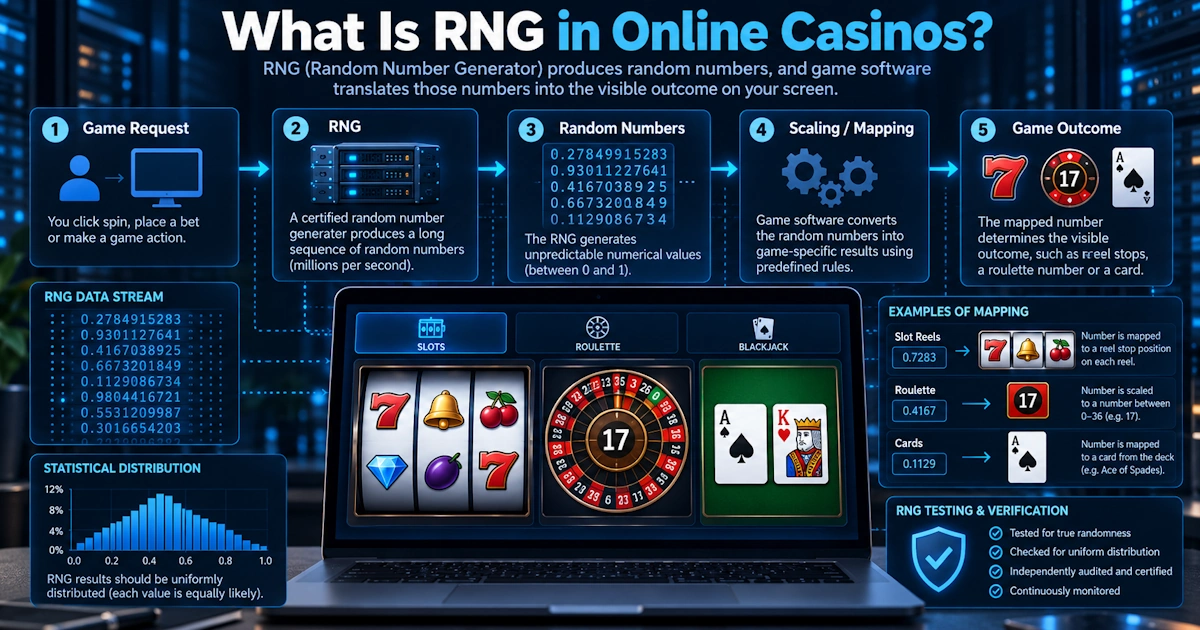
RNG stands for Random Number Generator. In online casinos, an RNG is a hardware or software system used to generate random numbers that help determine the outcomes of games such as online slots, digital roulette and other computer-based casino games.
The player never needs to see those numbers. The casino game converts them into something meaningful, such as a slot reel position, a card or a roulette result.
The important point is that the RNG is only one part of the process. It generates the random input, while the game’s rules and mathematics determine how that input is mapped to possible outcomes and how much each result pays.
In regulated online gambling, RNG systems can be subject to technical standards, statistical testing and source-code review to help confirm that game results are unpredictable and follow the intended probabilities.
What Does RNG Mean in Online Casinos?
A Random Number Generator is a system designed to produce numbers with the intended property of statistical randomness.
The UK Gambling Commission defines an RNG as hardware or software used to generate random numbers with that intended property.
Online casino games use those random numbers as input when they need an unpredictable outcome.
For example, RNG technology can be involved in determining:
where slot reels stop
which card is dealt in a digital card game
the result of a digital roulette spin
the outcome of virtual dice
bonus selections
mystery prizes
The exact use depends on the game’s design.
The RNG itself does not need to understand that a player is looking at a cherry symbol, an Ace or roulette number 17. It generates numerical input. The game software then interprets that input.
How Does an RNG Work in an Online Casino?
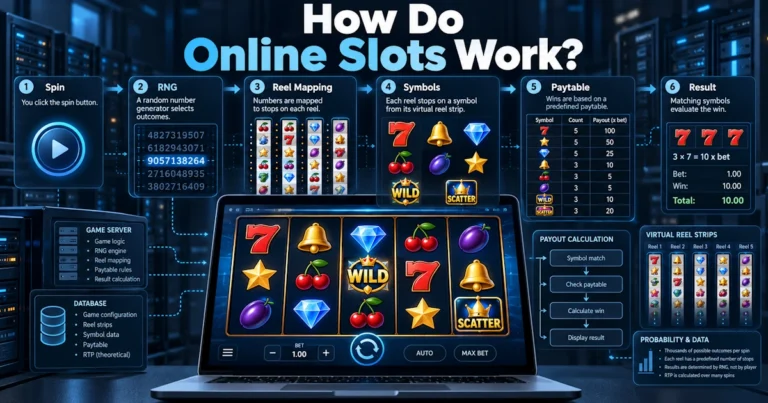
A simplified casino game process looks like this: Player starts game → RNG generates input → input is scaled or mapped → game outcome is selected → game rules calculate payout
Consider a fictional digital roulette game. The RNG may produce numbers across a very large range.
The game does not need billions of possible numerical values. A European roulette game needs a result corresponding to one of 37 pockets: 0 to 36
The system therefore converts the RNG output into the range needed by the game.
The UK Gambling Commission describes this process as scaling, while mapping refers to using an RNG result to select the actual game outcome. One example given by the regulator is mapping an RNG result to a slot reel-strip symbol.
So the flow might be: Large RNG number → usable game value → roulette pocket 17 or: Large RNG number → reel position → Wild symbol
The exact implementation can be more complicated, but the principle is the same.
The RNG Does Not Create the Whole Casino Game
It is easy to imagine that the RNG controls everything. It does not.
The RNG provides random input. The game’s mathematical model determines what that input means.
For an online slot, the full system can include:
RNG
scaling rules
virtual reel strips
symbol mapping
paylines or ways to win
paytable
bonus mechanics
jackpot rules
RTP calculation
volatility model
Imagine a slot where one virtual reel contains many common symbols but only a small number of rare symbols.
The RNG selects according to the game’s approved process, but the reel structure determines how likely different symbols are to become part of the final outcome.
The game mathematics and payout table then determine the financial value of that outcome.
This is why RNG, RTP and volatility are connected but are not the same thing.
RNG vs RTP: What Is the Difference?
RNG determines random outcomes.
RTP, or Return to Player, describes the theoretical percentage of wagering that a game is designed to return over the long run.
Suppose a slot has: 96% theoretical RTP
The RNG does not simply count wagers until it has returned exactly 96%.
Instead, the game contains a mathematical distribution of possible outcomes and payouts designed to produce that theoretical RTP across very large amounts of play.
The RNG supplies unpredictable selections from the possible outcomes according to the game’s intended probabilities.
This distinction matters.
A game with 96% RTP does not use its RNG to say: “This player has lost too much, so produce a win.”
It also should not say: “We have paid too much today, so produce more losing results.”
In the UK regulatory framework, adaptive or compensated behaviour that changes outcome probabilities during play in response to previous results is not permitted.
RTP describes the long-run mathematics. RNG creates unpredictable individual outcomes within that mathematical system.
RNG vs Volatility
Volatility describes how widely game results can vary.
RNG provides the random selections that produce individual outcomes.
Again, the two concepts are different.
Imagine two slots with the same: 96% RTP
One could have lower volatility, with more of its theoretical return distributed through smaller payouts. The other could have high volatility, with more value concentrated in rarer, larger prizes.
Both games use RNG technology. The difference comes from their mathematical structures and prize distributions.
The RNG does not independently decide whether the game is high or low volatility. It operates within the model created for that game.
Software-Based RNGs
Online casino games commonly rely on software systems, so one important category is the software-based RNG.
Gaming Laboratories International defines software-based RNGs as systems that derive their randomness primarily from computer-based or software-driven algorithms rather than from physical hardware events.
These systems use an internal state and mathematical processes to produce sequences of values.
An important part of the process is called seeding. A seed is information used to initialize the state of an RNG.
Strong implementations need to prevent the seed or internal state from making future results predictable.
GLI-19 requires gaming-platform RNGs used for outcome determination to be cryptographically strong and resistant to attempts to predict future outputs. It also specifies that a software RNG should not be seeded using a time value alone and that seeding methods should not weaken the system.
For ordinary players, the technical detail can be simplified: Knowing previous game results should not give you a practical way to calculate what comes next.
What Is a Hardware RNG?
Not every RNG gets its randomness only from software.
Hardware-based RNGs can generate randomness from physical processes. GLI gives examples including:
electrical circuit feedback
thermal noise
radioactive decay
photon behaviour
These physical processes provide entropy that can be used to generate unpredictable values.
Hardware RNGs also need monitoring because physical components can malfunction or change over time.
GLI-19 therefore includes requirements for statistical monitoring of hardware-based RNG output and for preventing gameplay if serious malfunction or degradation is detected.
For most players, however, the practical distinction between software and hardware RNG technology is less important than whether the complete gaming system has been properly implemented and tested.
What About Mechanical Randomness?
There is also a third category: mechanical randomness.
A physical roulette wheel is an obvious example.
Other examples can include:
card shufflers
ball machines
lottery-style blowers
physical wheels
GLI classifies these as mechanical RNGs or physical randomness devices when game outcomes are generated through physical processes and the laws of physics rather than primarily through a software algorithm.
This distinction becomes particularly relevant with live casino games.
Do Live Casino Games Use RNGs?
Not every online casino game uses an RNG to determine the main outcome.
In a live dealer roulette game, for example, the result may come from a real physical roulette wheel. In live blackjack, physical cards may be dealt by a real dealer.
The online platform still uses software to:
receive bets
stream the game
record the round
calculate payouts
update player balances
But the main random event may come from the physical gaming equipment rather than a software RNG.
This is different from digital roulette, where an RNG can determine the result electronically.
So the statement: “All online casino games use RNGs” is not accurate.
Many digital casino games do. Some live games rely primarily on physical randomness.
What Makes a Casino RNG Fair?
A fair RNG is not simply one that produces numbers that “look random.” There are several technical properties that matter.
Results Should Be Unpredictable
A player, casino employee or attacker should not be able to calculate future results from previous outputs.
The UK Gambling Commission requires applicable RNG and game outcomes to be unpredictable. Its guidance says that for a software RNG it should be computationally infeasible to predict the next number without the necessary knowledge of the algorithm and seed state.
Results Must Follow the Intended Distribution
Random does not always mean that every final game outcome has the same probability.
A fair coin should produce heads and tails with equal probabilities. But slot symbols do not necessarily all have equal probabilities. A jackpot symbol can intentionally be much rarer than an ordinary symbol.
The important requirement is that results match the intended mathematical distribution of the game. GLI-19 requires final RNG-derived output to be tested against its intended distribution.
Outcomes Should Be Independent Where Required
In games built around independent rounds, previous results should not provide useful information about future results. GLI requires RNG output to be tested for independence between draws where appropriate.
Scaling and Mapping Must Not Introduce Bias
A perfectly good random number source can still produce a bad game if the conversion from random numbers to game outcomes is poorly designed.
The scaling and mapping process therefore matters. UK technical guidance requires RNG scaling to preserve the required randomness qualities, while mapping should follow the game’s probabilities and paytables.
How Are Online Casino RNGs Tested?
Testing an RNG involves much more than pressing Spin a few thousand times and looking at the results.
Independent testing laboratories can examine several layers of the system.
Source-Code Review
Testers can review the code responsible for:
random-number generation
scaling
mapping
shuffling
seeding
GLI-19 requires the relevant source code to be examined for issues such as bias, implementation errors, malicious code or hidden parameters that could influence randomness or fair play.
Statistical Testing
Large samples of RNG output can be analysed using statistical tests.
GLI lists tests covering issues such as distribution, runs, serial correlation and independence.
The purpose is not to prove that every sequence will look neat. Random data often contains streaks and clusters.
Instead, testing asks whether the overall output behaves consistently with the intended statistical properties.
Game-Level Testing
Testing can also examine what happens after the raw random numbers leave the RNG.
This matters because: good RNG output + bad mapping = potentially incorrect game outcomes
Testing may therefore assess whether RNG values are correctly converted into reels, cards or other events and whether those results match the game’s approved probabilities.
GLI requires testing of final outcome output after scaling, shuffling or mapping rather than looking only at the raw RNG values.
Who Tests Casino RNGs?
The answer depends on the gambling jurisdiction.
Regulators can require games to be examined by approved independent testing laboratories.
For example, the UK Gambling Commission requires RNG-driven online gambling products offered in Great Britain to undergo testing under its testing framework. It states that relevant gambling products must be tested by an approved test house before they are released to that market, followed by ongoing performance monitoring after launch.
Gaming Laboratories International is one example of an independent testing organization that publishes technical standards covering interactive gaming systems and RNGs.
Different regulators may use different testing standards and approval processes. There is no single global RNG certification system applying identically to every online casino.
Can an RNG Be Rigged?
Software can theoretically be designed or altered to behave unfairly.
That is precisely why licensing, technical standards and independent testing matter.
A regulator cannot simply assume that a game is fair because its developer says it uses an RNG. The implementation needs to be evaluated.
A meaningful test can examine:
the RNG algorithm
source code
seed handling
statistical output
mapping
game probabilities
payout logic
GLI’s source-code requirements specifically call for examination of undisclosed switches, malicious code and other implementation issues that could influence randomness or fair play.
This is also one reason playing through an appropriately regulated operator matters.
An unknown website saying “certified RNG” without providing credible regulatory or testing context is not equivalent to independent oversight.
Can the Casino Change the RNG Because You Are Winning?
In a properly regulated random game, probabilities should not be automatically changed because one particular player has won or lost.
The UK Gambling Commission’s RTS 7 rules specifically prohibit adaptive behaviour that alters outcome probabilities during play based on previous results.
This does not mean every game always has only one possible mode.
A legitimate slot can have:
bonus rounds
free-spin modes
different game features
jackpots
Those features may operate under different rules if the differences are part of the published game design.
What is not the same is secretly changing probabilities simply because recent results were favorable or unfavorable to the player.
Does an RNG Remember Previous Spins?
A casino system can record previous spins.
That does not mean the RNG should use those results to make the next independent spin compensate for what happened earlier.
Suppose a slot produces: Loss – Loss – Loss – Loss – Loss
The next spin does not automatically become more likely to win simply because five losses occurred.
Likewise: Win – Win – Win does not mean the RNG must intentionally produce a loss next.
For independent random events, previous outcomes do not create a debt that later outcomes must repay.
This is why previous spins cannot reliably tell a player what will happen next.
Why Random Results Can Look Non-Random
Human beings are good at spotting patterns. Sometimes we are too good at it.
Imagine these roulette results: Black – Black – Black – Black – Black
Many people instinctively think: “Red must be next.”
But a random process can naturally create streaks.
Likewise, a slot might display the same symbol several times, produce a long losing sequence or generate several wins close together.
None of those patterns proves that the RNG has stopped working.
Randomness does not mean results must alternate evenly.
In fact, a system that deliberately prevented streaks because they “look wrong” would itself be changing the natural random distribution.
Does a Near Miss Mean the RNG Almost Gave You a Jackpot?
Not necessarily.
A near miss is a displayed result that visually appears close to a winning combination, such as two jackpot symbols appearing with another symbol beside them.
That visual appearance does not mean the RNG was “almost” going to choose the jackpot in the human sense.
The displayed outcome is simply the mapped result of the game cycle.
Regulated game-design rules can also restrict deliberately misleading near-miss behaviour. UK rules prohibit replacing one losing outcome with another losing outcome simply to create a false near-miss presentation.
So seeing a jackpot symbol one position away does not mean a jackpot is becoming more likely.
Can You Predict a Casino RNG?
A properly implemented regulated RNG should be designed so that future outputs are not feasibly predictable.
GLI-19 requires RNGs used for gaming-platform outcome determination to be cryptographically strong and resistant to attacks in which someone attempts to predict future values from previous outputs.
The UK Gambling Commission similarly requires RNG outcomes to be unpredictable.
This means common ideas such as:
tracking previous slot symbols
counting losing spins
studying roulette histories
waiting for a “hot” game
looking for repeating sequences
do not provide a reliable way to predict a properly functioning RNG. Historical results describe what already happened. They do not reveal the next random output.
Can You Time the Spin Button to Beat an RNG?
There is no reliable method for timing a properly functioning RNG from the player interface.
The player does not have access to the internal random state needed to know what value will be used for the next game cycle.
The output is specifically intended to be unpredictable.
Pressing Spin slightly earlier or later may start a different game cycle, but that does not create a practical strategy for choosing a winning RNG output.
Trying to find a rhythm from previous animations confuses the visible interface with the underlying random system.
Does the Casino Know the Next RNG Result?
The important regulatory requirement is not whether a computer technically processes the value before displaying the result.
It is whether the outcome is generated and used according to the game’s approved rules without improper intervention.
The gambling system must process the RNG output, map it to an outcome and display the result.
That does not mean the casino should be free to reject an unfavorable random number and request another one.
UK technical guidance states that random numbers received for a game should be used in their received order and should not be discarded because of adaptive behaviour.
The goal is to prevent selective intervention in random outcomes.
RNG Does Not Mean Every Outcome Has Equal Odds
This is an important misconception.
Random does not always mean: every result = equally likely
Consider a slot with ordinary symbols and a rare jackpot symbol.
The RNG process can be completely fair while the jackpot remains much less likely than an ordinary symbol. The game’s mathematical model defines those probabilities.
Similarly, drawing a specific card from a shuffled deck and winning a jackpot slot feature are both random events, but they do not have to have the same probability.
The requirement is that outcomes occur according to the probabilities defined by the game.
Common RNG Misconceptions
“The RNG makes every casino outcome equally likely.” No. The RNG supports random selection, but game mathematics can assign different probabilities to different outcomes.
“The slot owes me a win after many losses.” No. Previous losses do not create a requirement for an independent future spin to win.
“The casino lowers my RNG because I won too much.” A properly regulated random game should not adapt outcome probabilities simply because of a player’s previous wins or losses.
“A near miss means the jackpot was almost selected.” Not in a way that makes the jackpot more likely next time. A near miss is simply a losing displayed outcome.
“RNG means RTP.” No. RNG generates random input. RTP describes theoretical long-run return produced by the complete game mathematics.
“I can predict the RNG by recording previous spins.” A properly implemented RNG should be unpredictable, and previous independent results should not provide a practical method for forecasting the next output.
Why RNG Matters in Online Casinos
When playing a physical roulette game, players can see the wheel and ball. When playing a digital slot, they cannot see the internal mechanism generating the result.
RNG technology provides the random input that makes digital games of chance possible.
But trust should not rely on the letters RNG appearing on a casino website.
What matters is the wider framework: RNG design → secure implementation → correct mapping → game mathematics → independent testing → regulatory oversight
Each part matters. A strong RNG with incorrectly implemented game logic could still produce the wrong game behavior. Likewise, correct mathematical documentation is not enough if the software does not implement it properly.
Fair online gaming therefore depends on the complete system, not on one algorithm alone.
RNG Does Not Make Gambling Predictable or Profitable
Understanding RNG technology can explain why casino outcomes behave the way they do. It does not create a strategy for guaranteeing wins.
Random outcomes remain uncertain.
RNG technology does not remove:
volatility
losing streaks
financial risk
A properly functioning RNG is designed to make results unpredictable, not profitable for the player.
Previous outcomes cannot reliably tell you when the next win will arrive.
Gambling should therefore be treated as entertainment involving the possibility of financial loss rather than as a predictable income system.
Final Thoughts
So, what is RNG in online casinos?
A Random Number Generator creates the random numerical input used to determine outcomes in many digital casino games.
The process can be simplified as: RNG → scaling and mapping → game outcome → paytable → result
The RNG generates unpredictable values, while the game’s mathematics determines how those values correspond to reels, cards, roulette results or other outcomes.
RNG should not be confused with RTP, volatility or house edge.
RTP describes long-term theoretical return. Volatility describes how widely results can vary. House edge describes the casino’s mathematical advantage.
RNG provides the random input that allows individual game outcomes to occur unpredictably within that mathematical structure.
In regulated markets, RNG systems can be tested through source-code reviews, statistical analysis and game-level verification.
And perhaps the most important point for players is simple: Random does not mean evenly alternating, and previous results do not reveal what comes next.
Frequently Asked Questions
What does RNG stand for in online casinos? RNG stands for Random Number Generator. It is hardware or software used to generate random numerical input that helps determine outcomes in digital casino games.
How does an RNG decide a slot result? The RNG produces random input, which the game software scales or maps to reel positions or other game outcomes. The paytable and game rules then determine whether the resulting combination wins a prize.
Are online casino RNGs really random? Regulated gaming systems can be required to demonstrate statistical randomness, unpredictability and correct distribution through testing. Software-based RNGs use algorithms, while hardware RNGs can use physical sources of randomness.
Can an online casino change the RNG after I win? A compliant regulated game should not change probabilities during play simply because of previous wins or losses. For example, UK technical standards prohibit adaptive behaviour that changes outcome probabilities based on previous results.
Can I predict an RNG from previous spins? A properly implemented gaming RNG should be designed to make future results computationally unpredictable. Previous independent results do not provide a reliable way to forecast the next outcome.
Do live dealer casino games use RNGs? Not necessarily for the main result. Live roulette and live card games can use physical wheels, cards and other real gaming equipment to generate outcomes, while software manages betting, streaming and account transactions.