Casino KYC verification is the process online casinos use to confirm that a customer is who they claim to be.
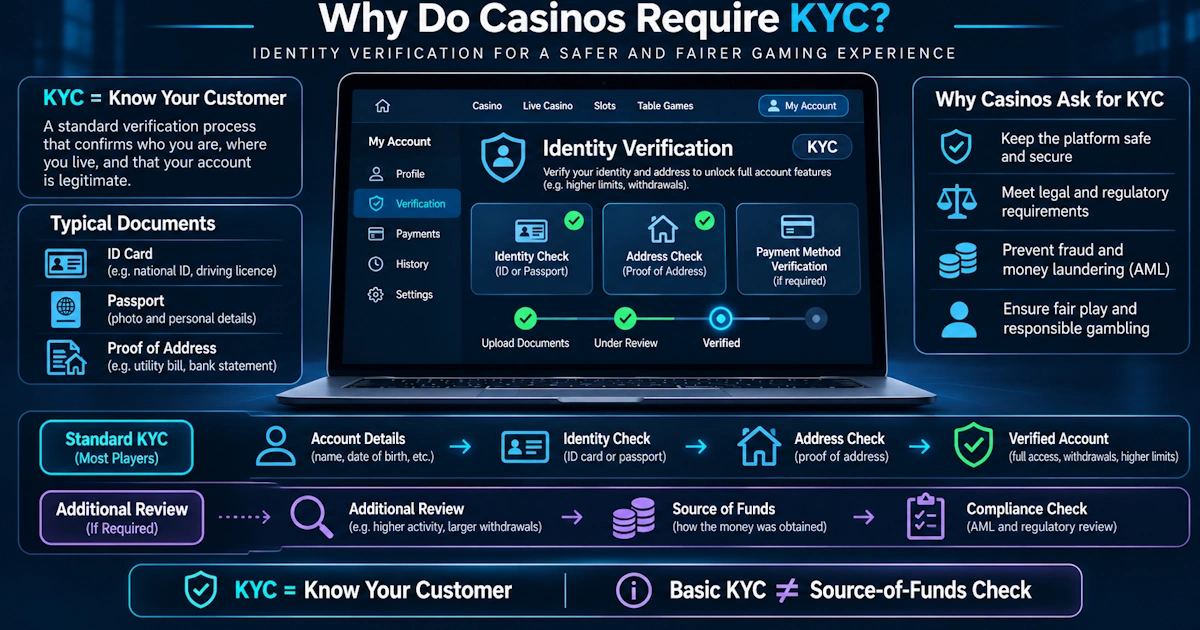
KYC stands for Know Your Customer.
A casino may check information such as a player’s name, date of birth and address. In some cases, it may request an identity document, proof of address or information about where gambling funds came from.
These checks are not simply an administrative step. Regulated casinos can have legal duties to prevent underage gambling, identity fraud, money laundering and the misuse of gambling accounts.
The exact verification process depends on the casino, jurisdiction and level of risk. Some customers can be verified electronically without uploading documents. Others may be asked for additional evidence.
KYC also does not always end when the account is opened. Casinos can continue monitoring accounts and may request updated information if the player’s activity or payment patterns create a legitimate need for further checks.
What Does KYC Mean in Online Casinos?
KYC means Know Your Customer.
It is a common industry term for processes used to identify customers and confirm their identities. Regulatory documents may use more formal terms such as:
identity verification
customer due diligence
CDD
ongoing monitoring
enhanced due diligence
These concepts are related but are not always identical.
Basic identity verification answers questions such as:Who is this person?Is the name genuine?Does the date of birth match?Does the address belong to the same individual?
Customer due diligence can go further by considering the customer relationship and financial-crime risk.
The UK Gambling Commission explains that customer due diligence involves identifying customers and verifying information using reliable and independent sources.
In simple terms: KYC helps the casino know who is behind the account.
Why Do Online Casinos Need to Know Their Customers?
Online casinos handle real money. Customers can:
deposit funds
place wagers
receive winnings
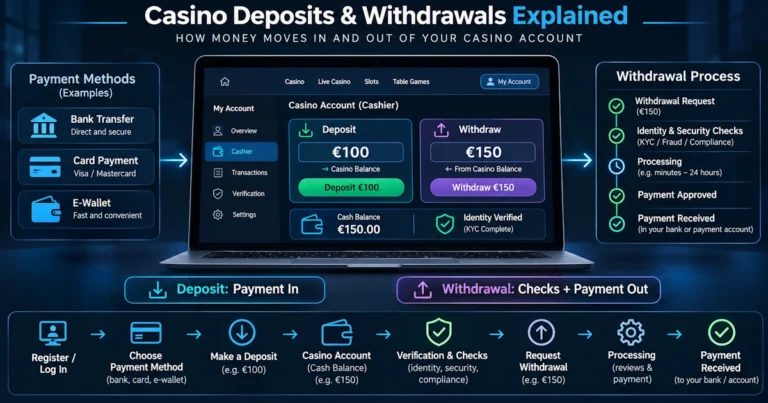
withdraw money
That makes gambling accounts potentially attractive for more than ordinary gambling.
For example, someone could attempt to:
gamble while underage
use another person’s identity
use someone else’s payment method
create multiple accounts
bypass self-exclusion
move criminal funds
disguise the source of money
Regulated casinos therefore need controls that make anonymous or false-account activity more difficult.
The UK Gambling Commission’s 2026 risk assessment continues to classify the British remote casino sector as high risk for money laundering, noting risks including third-party funding, unusual deposit and withdrawal activity and customers whose gambling appears inconsistent with known sources of funds.
What Are the Main Reasons for Casino KYC Verification?
Casino KYC serves several purposes.
1. Confirming the Player’s Identity
The casino needs reasonable confidence that the account belongs to a real person using their correct details. This can help prevent:
stolen identities
fake accounts
account impersonation
fraudulent withdrawals
In Great Britain, current identity-verification rules require remote operators to establish that a customer exists and that the customer’s name, address and date of birth belong to the same individual before allowing that person to gamble.
2. Preventing Underage Gambling
Age verification is one of the most important parts of the process. A customer must meet the legal gambling age that applies in the relevant jurisdiction.
In Great Britain, online gambling businesses must verify a customer’s age and identity before the customer gambles. This means simply entering a date of birth into a registration form is not necessarily enough. The operator needs a method of confirming the information.
3. Supporting Self-Exclusion Controls
Identity information can also help operators recognise customers who should not be permitted to gamble because of applicable self-exclusion controls.
The UK Gambling Commission lists checking whether someone has self-excluded as one of the reasons gambling businesses confirm customer identity. Accurate identification therefore supports responsible gambling systems as well as financial-crime prevention.
4. Preventing Money Laundering
Casinos can be used in attempts to move or disguise illegally obtained money.
A simple example could involve someone: Depositing suspicious funds → gambling very little → requesting withdrawal to another financial account
That pattern could raise questions because the gambling account may be being used more like a money-transfer service than for genuine gambling. Casino operators therefore monitor financial activity as part of anti-money-laundering controls.
UK regulatory guidance requires casino operators to monitor transactions throughout the customer relationship and, where necessary, understand the source of funds.
5. Reducing Payment Fraud
KYC can help establish whether the casino account and payment method belong to the correct person.
This can reduce risks involving:
stolen cards
unauthorised payment accounts
third-party deposits
fraudulent withdrawals
A casino may therefore ask questions when the name on a gambling account does not match the owner of the payment method.
What Information Does a Casino Check?
Basic KYC commonly starts with personal information entered during registration. This may include:
Full name
Date of birth
Home address
The casino may verify that information electronically using reliable external data.
The UK Gambling Commission notes that gambling businesses can sometimes match customer details against databases such as credit-reference information or electoral records. If those checks are insufficient, documents may be required.
This is why two players at the same casino may have different verification experiences. One may be verified automatically. Another may need to upload documents.
What Documents Can a Casino Ask For?
The exact documents depend on what needs to be verified.
Proof of Identity
Examples can include:
passport
national identity card
driving licence
Proof of Address
Depending on the casino and jurisdiction, acceptable evidence might include a document showing the customer’s name and current address. Examples can include:
bank statement
utility-related document
official correspondence
Payment Verification
The casino may also need evidence that a payment method belongs to the account holder.
Financial Information
In some circumstances, additional financial documents can be requested as part of anti-money-laundering or source-of-funds checks.
Not every customer will need to provide every type of document. KYC should be proportionate to what the operator needs to verify.
Can a Casino Verify You Without Documents?
Yes. Document upload is not always necessary.
A casino may use electronic verification to compare the registration information with reliable external data. If the information matches successfully, the basic identity check may be completed without asking the customer to upload a passport or utility bill.
If the information cannot be confirmed, the operator may request additional evidence. For example, a mismatch can happen because:
the customer recently moved
a name was entered incorrectly
an address format differs
external records are incomplete
A request for documents therefore does not automatically mean the account has been considered suspicious. It may simply mean the electronic verification was not sufficient.
What Is Customer Due Diligence?
Customer Due Diligence, commonly shortened to CDD, is broader than simply checking a passport.
CDD can involve:
identifying the customer
verifying identity
understanding the customer relationship
assessing risk
monitoring transactions
The UK Gambling Commission’s anti-money-laundering guidance says customer due diligence is designed to make it harder for casinos to be used for money laundering, terrorist financing or proliferation financing.
The Malta Gaming Authority similarly requires applicable gaming licensees to use risk-based AML/CFT controls and customer due diligence procedures.
This is why KYC should not be viewed only as an ID-upload screen. It is part of a wider compliance system.
What Is Ongoing Monitoring?
Passing the first identity check does not necessarily end the casino’s compliance obligations. Regulated casinos may need to monitor the customer relationship over time.
For example, an operator may consider whether:
transaction patterns have changed
unusual deposits are appearing
payment methods have changed
gambling levels are inconsistent with existing information
customer records need updating
UK anti-money-laundering guidance requires casinos to monitor transactions and keep relevant customer information up to date on a risk-sensitive basis.
So it is possible to pass KYC when opening an account and later be asked for additional information. That does not necessarily mean the first KYC check failed. It can be part of ongoing due diligence.
What Is a Source-of-Funds Check?
A source-of-funds check looks at where the money being used for gambling came from.
For example, legitimate sources could include income or other explainable funds.
The important point is that source of funds is not the same as basic identity verification.
Basic KYC might establish:This person is Jane Smith, born on this date and living at this address.
A source-of-funds review asks another question:Where did the money being used in these transactions come from?
Depending on the circumstances, a casino may request evidence such as bank information or other financial documents.
UK guidance requires ongoing transaction monitoring and, where necessary, examination of source of funds to ensure activity is consistent with what the operator knows about the customer and their risk profile.
Why Would a Casino Ask for a Bank Statement?
A bank statement can be requested for different reasons. For example, it may help the operator:
verify an address
confirm account ownership
understand payment activity
examine source of funds
The UK Gambling Commission specifically notes that bank statements can be used in appropriate anti-money-laundering checks to help assess whether funds come from a legitimate source.
That does not mean every casino customer should automatically be asked for bank statements. The need for additional information should depend on the applicable rules and circumstances.
What Is Source of Wealth?
Source of wealth and source of funds are related but different.
Source of funds focuses on the money involved in particular gambling activity. Source of wealth is broader and considers how a person’s overall wealth was accumulated.
For example, source of wealth may relate to the wider financial background of a higher-risk customer. These deeper checks are more likely to appear when enhanced due diligence is needed.
UK Gambling Commission guidance highlights the need for operators to understand the source of customers’ funds and wealth where additional KYC information is appropriate.
Ordinary players should not assume every casino account automatically requires a full source-of-wealth investigation. These checks are generally risk-based.
What Is Enhanced Due Diligence?
Some customers or transactions present greater risk than others. When risk is higher, an operator may need to perform additional checks commonly described as Enhanced Due Diligence, or EDD.
The exact requirements depend on the jurisdiction and circumstances. Enhanced checks can become relevant where there are concerns involving areas such as:
unusual transaction patterns
higher-risk payment activity
high-risk jurisdictions
unclear source of funds
politically exposed persons
possible third-party funding
The principle is that the amount of due diligence should reflect the level of risk. KYC is therefore not necessarily identical for every customer.
Does Every Casino Use the Same KYC Rules?
No. There is no single global casino KYC process.
Rules can differ according to:
gambling jurisdiction
anti-money-laundering laws
casino licence
customer location
transaction activity
risk profile
Great Britain and Malta, for example, both impose AML and customer-verification requirements on regulated casino operators, but their detailed frameworks are not identical.
International standards also influence national rules. The Financial Action Task Force, or FATF, includes casinos within its framework for customer due diligence and requires countries to ensure appropriate identification and verification controls for relevant casino financial transactions.
This is why a verification process seen at one casino should not automatically be treated as the worldwide standard.
Why Is Online Casino KYC Important?
Online casinos have a particular challenge: the customer is not physically standing in front of the operator.
Registration, gambling, deposits and withdrawals can all take place remotely. That creates additional identity and fraud risks.
A person could potentially attempt to create an account using someone else’s:
name
address
documents
bank account
Remote casinos therefore need ways to establish that the person behind the screen is the genuine account holder.
FATF guidance has long recognised that non-face-to-face casino relationships can create specific customer-due-diligence risks and may require additional verification methods.
Does KYC Protect the Player Too?
KYC is mainly a regulatory and risk-control process, but it can also protect customers.
Identity controls can make it harder for another person to:
create an account in your name
use your payment details
withdraw your casino balance
misuse personal information for gambling
KYC can also support age restrictions and self-exclusion controls.
So although document requests can feel inconvenient, a properly run verification system serves purposes beyond protecting the casino itself.
Why Do Casinos Sometimes Ask for a Selfie?
Some operators may use additional identity-verification technology where ordinary document checks are not enough.
This could involve comparing a photo or live image with the identity document supplied. The purpose is to establish that:the document is genuine enough for verification purposes and:the person presenting it is actually the account holder
Not every casino requires this. Methods differ between verification providers and jurisdictions.
A selfie request should therefore be evaluated within the context of a legitimate licensed operator’s official verification system.
Why Does a Casino Ask for KYC Before Withdrawal?
Sometimes a withdrawal request can reveal that additional checks are legitimately required.
But there is an important distinction between:a new compliance issue that genuinely arises and:basic verification the casino could reasonably have completed earlier.
In Great Britain, online gambling businesses must complete basic age and identity verification before gambling. The Gambling Commission also states that a withdrawal should not trigger a demand for identity information that the operator could reasonably have requested earlier.
However, additional information can still legitimately be requested at withdrawal if a new anti-money-laundering or other legal obligation arises.
So: “Never ask for documents at withdrawal” would be inaccurate.
A better rule is: Basic checks should not be deliberately postponed until withdrawal, but legitimate additional checks can still occur later.
Can a Casino Hold a Withdrawal During KYC?
A withdrawal can sometimes be delayed while a legitimate required check is completed.
For example, the casino may need to resolve:
identity questions
payment-method ownership
unusual transactions
source-of-funds issues
However, regulated operators should not use KYC simply as a tactic to create unnecessary withdrawal delays.
The UK Gambling Commission says operators should request relevant information promptly rather than waiting until a customer asks to withdraw when that information could have been obtained earlier.
This is one reason completing requested account verification early can reduce later payment friction.
How Long Does Casino KYC Take?
There is no universal KYC processing time.
Verification may be completed quickly when:
electronic records match
documents are clear
information is current
no additional review is required
It can take longer when:
documents are unreadable
details do not match
an address has changed
the payment method needs checking
manual review is necessary
additional financial information is required
The important issue is not simply speed. The casino needs enough reliable information to complete the required checks correctly.
What Happens If KYC Fails?
If the casino cannot verify required information, the account may be restricted.
Depending on the applicable rules and circumstances, the operator may be unable to:
allow gambling
process certain transactions
continue the customer relationship
UK casino AML guidance states that operators must carry out required customer due diligence and can be unable to establish or continue a business relationship where those obligations cannot be met.
A failed KYC check does not always mean the customer attempted fraud. Sometimes the issue can be a simple mismatch or inadequate document.
The casino may ask for replacement information before making a final decision.
Can You Use Someone Else’s Documents for Casino KYC?
No legitimate KYC process is designed to let one person verify an account using another person’s identity.
Doing so can create serious fraud and account-security issues.
The UK Gambling Commission specifically warns consumers not to provide personal details to third parties for opening gambling accounts, noting risks involving self-exclusion circumvention, bonus abuse, identity theft and criminal activity.
The account details, identity and payment activity should genuinely belong to the correct customer.
Is KYC the Same as an Affordability Check?
Not exactly. These terms are sometimes mixed together, but they serve different purposes.
KYC Primarily concerns:Who is the customer?
AML Customer Due Diligence Can involve:Does the activity make sense given what the casino knows about the customer and source of funds?
Financial Risk or Affordability-Related Controls Can focus more on whether gambling activity may indicate financial harm.
There can be overlap because the same financial information may be relevant to more than one type of risk assessment. But they should not automatically be treated as one identical process.
Is KYC the Same as AML?
No, although they are closely connected.
AML means Anti-Money Laundering. It is a much broader compliance framework.
KYC and customer due diligence are important components of AML because the casino needs to know who is conducting transactions.
But AML can also involve:
transaction monitoring
risk assessments
suspicious activity reporting
internal compliance procedures
ongoing monitoring
So: KYC is part of the wider AML system. It is not the entire system.
How Can You Submit KYC Documents Safely?
Personal identity documents are sensitive. Before uploading them, confirm that you are dealing with the genuine casino operator.
A sensible process is to:
verify the casino’s licence through the relevant regulator
check that you are using the correct website domain
use the casino’s official account or verification portal
read its privacy information
avoid sending documents through unfamiliar links
contact official customer support if a request appears unusual
Never provide passwords, PINs or other authentication secrets simply because someone claims they are required for KYC.
A KYC check needs evidence of identity or financial information where justified. It does not require giving another person control of your banking or email accounts.
Is a KYC Request a Sign That a Casino Is Legitimate?
Not by itself.
A fraudulent website could also ask for identity documents. The existence of a KYC form does not prove that a casino is licensed or trustworthy.
Before sending documents, independently check:Who operates the casino?Which regulator supposedly licenses it?Does the official regulator’s register confirm the operator and domain?
This is especially important because identity documents can be valuable to criminals. KYC should therefore be completed only through a casino that has been independently verified.
Common Casino KYC Misconceptions
“KYC is only required when I withdraw.” Not necessarily. In markets such as Great Britain, basic age and identity verification must take place before online gambling begins.
“If I passed KYC once, the casino can never ask me for anything again.” False. Ongoing monitoring can create a legitimate need to update information or request additional documents.
“A source-of-funds check means the casino thinks I committed a crime.” Not automatically. Source-of-funds checks can form part of normal risk-based anti-money-laundering controls.
“Every customer must send a passport and bank statement.” No. Verification methods depend on the operator, jurisdiction and circumstances. Some customers can be verified electronically.
“KYC and AML mean the same thing.” No. KYC is one component of the wider anti-money-laundering framework.
“Any website asking for KYC must be legitimate.” False. Always verify the casino and domain independently before providing sensitive documents.
Why KYC Should Happen at the Right Time
Verification works best when important checks happen at an appropriate stage rather than appearing unexpectedly only after a player wins.
This benefits both sides. The casino gets earlier confidence that the account belongs to a genuine eligible customer. The player has less risk of encountering a basic identity issue when trying to withdraw money later.
The UK Gambling Commission reinforced this point again in 2026, reminding remote operators that basic identity verification must occur before gambling and that information that could reasonably have been obtained earlier should not suddenly become a withdrawal condition.
At the same time, ongoing AML obligations mean new questions can still arise if circumstances change. That distinction is central to understanding casino KYC.
Final Thoughts
So, why do online casinos require KYC verification?
The main purpose is to establish who is actually using the casino account. That supports several important controls:
Age verification
Identity verification
Self-exclusion
Fraud prevention
Payment security
Anti-money-laundering compliance
Basic KYC may involve little more than confirming a player’s name, address and date of birth through reliable data. If that is not enough, the casino may request an identity document or proof of address.
Higher-risk situations can lead to further customer due diligence, including source-of-funds or enhanced checks.
KYC also does not necessarily end after the account is opened. Regulated casinos can have ongoing monitoring duties throughout the customer relationship.
The most useful distinction to remember is: Basic KYC asks who you are. Wider customer due diligence asks whether the account and financial activity are consistent with what the casino knows about you.
These checks can be inconvenient, but they are a fundamental part of operating a regulated online casino.
Frequently Asked Questions
What is casino KYC verification? Casino KYC verification is the process used to confirm the identity of an online casino customer. It can include checking the player’s name, address and date of birth against reliable data or documents.
What documents do online casinos ask for? Depending on the verification needed, a casino may request an identity document, proof of address or other supporting information. Additional financial documents may be requested when legitimate source-of-funds or AML checks are required.
Why does a casino need my ID if I already deposited money? Accepting a deposit does not remove identity and anti-money-laundering obligations. Regulated casinos need to establish who owns and uses the gambling account.
Why is a casino asking for a bank statement? A bank statement can sometimes be used to verify an address, payment ownership or source of funds. It should be requested for a legitimate verification or compliance purpose.
Can a casino ask for KYC again after I have already been verified? Yes. Ongoing monitoring can create a need to update customer information or carry out additional checks if circumstances or account activity change.
Can a casino delay my withdrawal for KYC? A legitimate new compliance check can sometimes delay a withdrawal. However, basic identity information that could reasonably have been requested earlier should not simply be postponed until withdrawal in regulated markets such as Great Britain.