iGaming technology is the software, infrastructure and digital systems used to operate online gambling services such as online casinos, sportsbooks, poker rooms and other interactive gaming platforms.
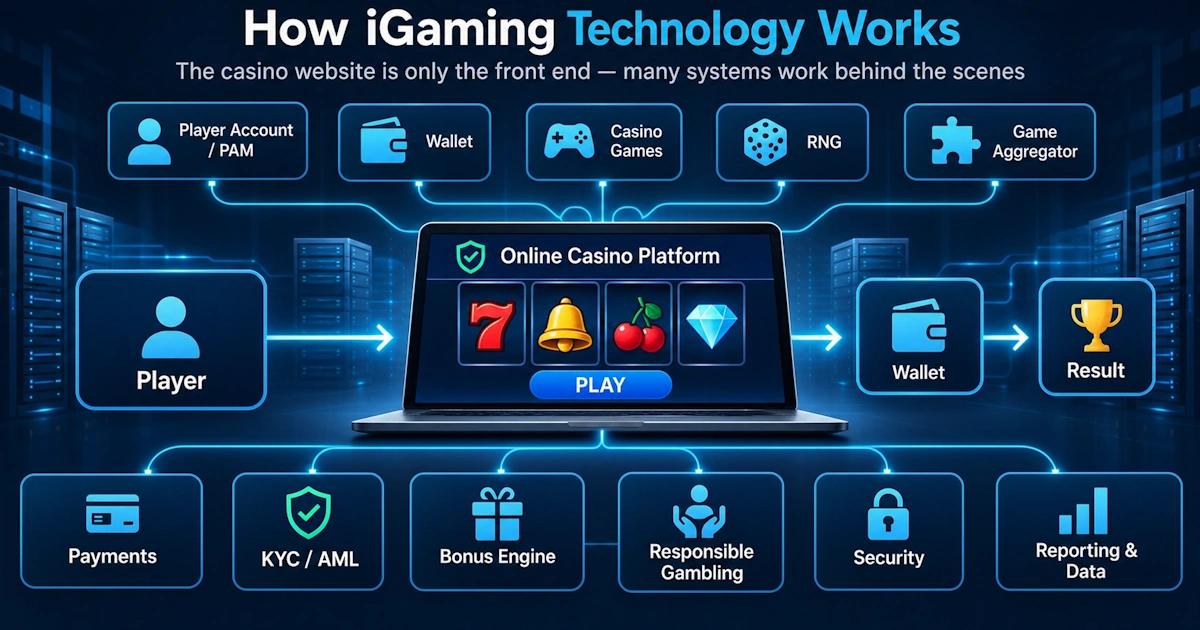
What players see on screen is only the front end.
Behind an online casino can be a much larger technology stack handling player accounts, balances, games, random outcomes, deposits, withdrawals, identity checks, bonuses, fraud monitoring, responsible gambling controls and regulatory reporting.
These systems also need to communicate with external services such as game providers, payment companies and identity-verification platforms.
That means an online casino is rarely just one piece of software. It is better understood as a connected ecosystem in which many specialised systems exchange information in real time.
This article explains the main parts of that ecosystem and how they work together.
What Does iGaming Mean?
The term iGaming generally refers to gambling or wagering services delivered through digital channels.
Depending on the market and how the term is being used, this can include:
online casino games
online slots
virtual table games
live casino
sports betting
online poker
bingo
lotteries
other forms of remote gambling
The technology behind these products differs, but many of the core platform requirements are similar.
Players need accounts. Money needs to be recorded accurately. Games or bets need to be processed. Results need to be settled. Operators need security, monitoring and compliance systems.
So iGaming technology is the digital infrastructure that makes those activities possible.
iGaming Technology Is a Technology Stack
An online casino may appear to the player as a single website or mobile app.
Technically, however, many separate systems can sit behind that interface.
A simplified iGaming technology stack may contain:
Player Interface ↓ Player Account Management ↓ Wallet and Transaction System ↓ Game Platform / Game Integration Layer ↓ Game Providers
Alongside those core systems can be:
Payments
KYC and AML
Bonus Management
Fraud Detection
Responsible Gambling Tools
Reporting
Security
Data and Analytics
Customer Support
The exact architecture differs between operators. Some casinos build large parts of the technology themselves. Others use specialised B2B technology suppliers. Many use a mixture of both.
Technical standards such as GLI-19 reflect this wider structure. The standard separately covers gaming management, player accounts, reporting, random number generation, games, bonuses, jackpots, security and operational controls rather than treating interactive gambling as one simple application.
How Does an Online Casino Platform Work?
Imagine a player opens an online casino and logs in. Several systems may already be working.
The platform needs to:
authenticate the player
retrieve the account
display the correct balance
determine which games are available
enforce any account restrictions
load the selected game
transfer information between the game and casino
process the wager
record the result
update the balance
store the transaction
apply relevant responsible-gambling and compliance controls
To the player, this might happen in seconds. Behind the interface, several services may communicate to complete that single gaming session.
What Is a Player Account Management System?
One of the most important parts of an iGaming platform is the system that manages player accounts. In the industry, this is often called a Player Account Management system, or PAM.
The PAM can act as the central record for the relationship between the player and the operator.
It may manage information such as:
player identity
registration details
login credentials
account status
balances
deposits
withdrawals
bonus balances
transaction history
account restrictions
GLI-19 dedicates a specific section to player account management and requires interactive gaming systems to support functions such as registration, identity verification, authentication, balance information and financial transactions.
The PAM should therefore not be thought of as a simple login database. It is one of the central control layers of an online gambling operation.
Why Is the Player Account So Important?
Almost everything the player does needs to be connected to the correct account.
Suppose a player deposits: €100 Then wagers: €5 and wins: €20
The platform must correctly record: Starting balance: €100 Wager: −€5 Prize: +€20 New balance: €115
At the same time, it may need to store:
the game played
date and time
game round
transaction reference
bonus status
account status
These records can be important for the player, operator and regulator. GLI-19 requires interactive gaming systems to maintain extensive player-account and transaction information and to be capable of generating required reports.
What Is an iGaming Wallet?
The wallet is the system responsible for tracking the player’s financial balance within the platform.
A basic wallet might contain:
Cash Balance
Bonus Balance
More complicated systems can track multiple balance types or currencies.
The wallet needs to know when money should be:
added after a deposit
removed for a wager
returned after a win
reserved during a game
released after settlement
transferred during withdrawal
The wallet and PAM are closely connected. In some platforms they are effectively parts of one larger system. In others they may be separate services communicating through technical interfaces.
The key requirement is that every financial change is recorded accurately.
How Does a Slot Game Connect to the Casino?
The slot that appears inside a casino website may have been developed by a completely different company.
The casino therefore needs a way to connect the player’s account with the game provider’s system.
A simplified process can look like:Player selects slot ↓ Casino sends authorised game session ↓ Game loads ↓ Player places wager ↓ Casino wallet confirms funds ↓ Game produces result ↓ Result and payout are returned ↓ Casino balance is updated
Much of this communication happens automatically between computer systems. This is where integration technologies become important.
What Is a Remote Game Server?
A Remote Game Server, commonly called an RGS, is an industry term for server-side infrastructure used to host or operate digital casino games.
Depending on the architecture, it may manage parts of the game such as:
game logic
mathematical rules
game sessions
RNG interaction
results
payout information
The player sees the graphical game interface. Important parts of the game can operate on remote server infrastructure rather than entirely inside the player’s browser or phone.
This separation helps game providers distribute the same underlying game technology to multiple operators. The exact architecture varies by provider and jurisdiction.
What Does a Random Number Generator Do?
For many digital casino games, the outcome requires random input. That is where the Random Number Generator, or RNG, becomes important.
A simplified slot process is:Player starts spin ↓ RNG provides random input ↓ Game maps input to an outcome ↓ Symbols are displayed ↓ Paytable calculates result
The RNG does not manage the player’s deposit, account or KYC. It has a much more focused job: providing the random input required by the game.
The UK Gambling Commission’s Remote Gambling and Software Technical Standards include dedicated requirements for random outcomes, result determination, game information, jackpots and related gaming functions. The current RTS framework was last updated in March 2026.
What Is a Casino Game Aggregator?
An online casino may want to offer games from many different studios. Connecting independently to every provider can create a large integration workload.
A game aggregator can provide a technical layer between operators and multiple game suppliers.
Instead of: Casino → Provider A Casino → Provider B Casino → Provider C Casino → Provider D
an operator may use:Casino → Aggregator → Multiple Providers
The aggregator can simplify access to a larger game catalogue through fewer integrations.
Depending on the setup, the aggregation layer may also help handle:
game launches
game metadata
session management
transaction messages
provider configurations
Aggregation does not mean the aggregator necessarily develops every game. Its main role can be connecting different systems.
What Is an API in iGaming?
API stands for Application Programming Interface. An API allows software systems to exchange information according to agreed rules.
For example, one iGaming API request might effectively ask:“What is this player’s current balance?” Another might say:“Reserve €1 for this wager.” Another:“Credit €8 because this game round won.” Another:“Has this player successfully completed identity verification?”
The systems exchange structured information automatically rather than requiring a person to enter it manually.
APIs can therefore connect areas such as:
games
wallets
payment systems
KYC services
CRM tools
affiliate systems
reporting systems
customer support
APIs are one of the reasons modern iGaming platforms can combine technology from many specialised suppliers.
What Happens When a Player Places a Slot Bet?
A simplified example helps show how these systems connect.
Imagine a player has: €50 cash balance and places: €1 slot wager
The platform might process the round like this:
Step 1: Player Starts the Game The casino creates or verifies the gaming session.
Step 2: Game Requests a Wager The game system sends the wager information to the casino platform.
Step 3: Wallet Checks the Balance The platform confirms: Available balance: €50 Requested wager: €1 The wager is accepted.
Step 4: Balance Is Debited The wallet records: €50 → €49
Step 5: Game Produces the Outcome The game’s approved mathematical process determines the result.
Step 6: Result Is Returned Suppose the result pays: €4
Step 7: Wallet Credits the Prize The balance becomes: €49 + €4 = €53
Step 8: Records Are Stored The platform records the round and financial transaction.
What looks like one click on Spin can therefore involve several connected technology services.
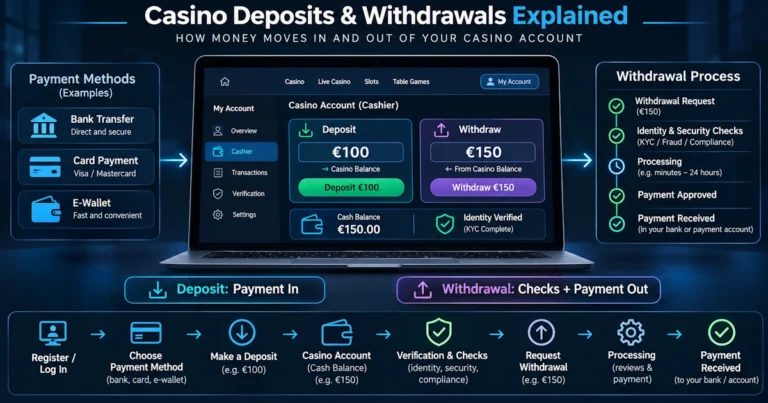
What Is Payment Technology in iGaming?
Casino platforms also need technology for moving money between external financial systems and the internal player wallet.
Payment infrastructure can connect the casino to:
payment gateways
payment processors
banks
card networks
e-wallets
local payment methods
The casino platform needs to know whether a deposit or withdrawal was: approved declined pending reversed or: completed
Once a deposit is authorised, the correct amount can be reflected in the player’s casino balance.
Withdrawals work in the opposite direction and can involve additional account, fraud and compliance checks. For card payments, PCI DSS provides a widely used security baseline for entities that store, process or transmit cardholder data or can affect the security of the cardholder-data environment.
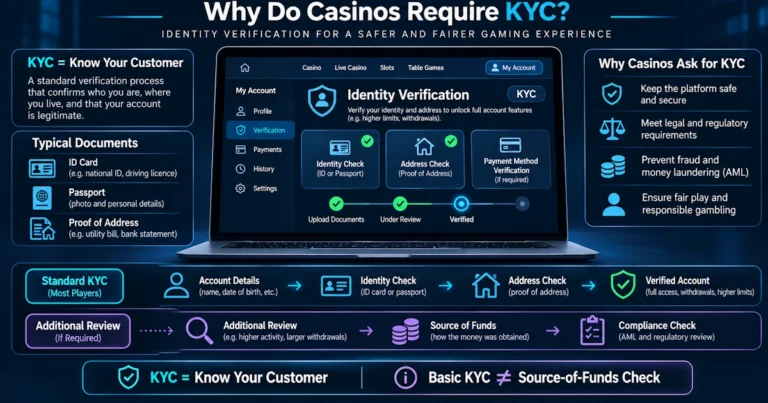
Why Do Online Casinos Need KYC Technology?
Online gambling happens remotely. The operator therefore needs technology that helps establish:Who is behind the account?
KYC systems can help verify:
name
age
date of birth
address
identity documents
A casino may perform some checks internally or integrate with specialised identity-verification providers.
GLI-19 recognizes that player identity verification can be supported directly by the gaming system or through third-party verification software, and it treats registration and verification as core player-account functions.
KYC technology can therefore be another external service connected to the core gaming platform.
What Is AML Technology?
KYC establishes who the player is. AML, or Anti-Money Laundering technology, helps operators identify financial activity that may require further investigation.
Systems can monitor transaction patterns involving:
deposits
withdrawals
payment methods
account activity
unusual financial behaviour
Technology does not automatically decide that a customer has committed financial crime simply because an unusual transaction occurs. Instead, systems can identify patterns or risk signals for further controls and review.
AML requirements vary by jurisdiction.
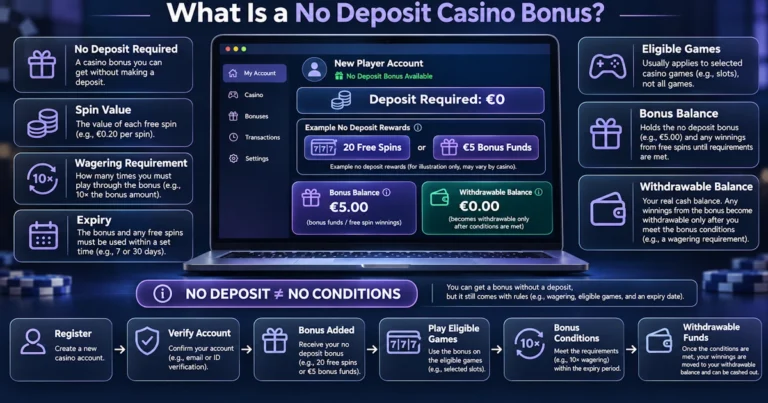
How Do Bonus Systems Work?
Bonuses also require technology.
Suppose an operator offers: 100% welcome bonus up to €100
The bonus engine may need to determine:
whether the player is eligible
whether the deposit qualifies
how much bonus should be credited
which games count
how much wagering is required
when the offer expires
whether maximum betting rules apply
The system then needs to track promotional activity as the player gambles.
A bonus is therefore not simply an extra number added to the account. It may require a rules engine connected to the player, wallet and game systems.
GLI-19 separately addresses incentive credits and game bonus or feature requirements, reflecting the need for promotional balances and rules to be controlled and recorded correctly.
What Is CRM Technology in iGaming?
CRM means Customer Relationship Management.
In iGaming, CRM technology can help operators manage communications and customer segments. For example, the system may support:
account messages
service communications
permitted promotional campaigns
customer segmentation
support workflows
It may combine information from several areas of the platform.
However, gambling marketing is regulated in many jurisdictions. Having the technical ability to send a message does not automatically mean the operator is legally permitted to send it.
Marketing rules, consent requirements and responsible-gambling controls still need to be followed.
What Are Responsible Gambling Tools?
Responsible gambling functionality is also part of the technology stack.
Depending on the market and platform, tools can support controls such as:
deposit limits
spending or financial limits
session information
reality checks
time-outs
self-exclusion
account restrictions
The UK Gambling Commission‘s current Remote Gambling and Software Technical Standards include dedicated sections covering financial limits, time requirements, reality checks and responsible product design.
These controls demonstrate that responsible gambling is not only a policy issue. It also needs to be implemented correctly in software.
Why Is Regulatory Reporting Part of iGaming Technology?
A regulated operator may need to provide information to regulators. That requires accurate data.
Systems therefore need to record and report information such as:
player activity
financial transactions
game activity
system events
account changes
GLI-19 requires interactive gaming systems to be capable of generating information needed for regulatory and operational reporting. It also expects the system to maintain detailed player-account and transaction records.
This means reporting cannot simply be added as an afterthought. The underlying platform needs reliable data from the beginning.
What Is an Audit Trail?
An audit trail is a record showing what happened in a system and, where relevant, who or what caused the change.
For example, an audit record might show: 12:04 — Player deposited €50 12:10 — Player placed €2 wager 12:10 — Game paid €8 12:12 — Account limit changed
Audit trails help operators investigate:
financial disputes
account changes
technical errors
suspicious activity
system administration
GLI-19 includes logging requirements covering events such as player-account adjustments, changes to personal information, account status changes, large financial transactions and changes to game or incentive parameters.
Why Is Cybersecurity Important in iGaming?
An online gambling platform can hold valuable information and money.
Potential targets include:
player accounts
identity information
payment information
account balances
gaming systems
administrative systems
Security therefore needs to protect both data and platform functionality.
The UK Gambling Commission’s RTS framework includes separate security requirements and independent audit expectations alongside game-specific technical rules.
GLI-19 similarly treats personally identifiable information and player funds as critical assets and requires security around communications relevant to gaming and player-account management.
Security is not a single firewall or password. It is a layer across the entire platform.
What Is Encryption Used For?
Encryption helps protect information so that unauthorized parties cannot easily read it.
In an iGaming environment, encryption can be relevant when sensitive data moves between:
player and casino
casino and payment provider
casino and game provider
internal platform services
GLI-19 requires critical communications related to gaming and player-account management to use encryption and authentication. Payment environments can also fall within PCI DSS requirements where cardholder data is stored, processed or transmitted.
What Is the Front End of an iGaming Platform?
The front end is the part the player directly interacts with.
It can include:
website
mobile website
app
login screen
game lobby
cashier
account page
promotions page
responsible gambling controls
A well-designed front end makes complex backend systems feel simple. For example, the player may see only: Balance: €87.50
But that figure might have been calculated from transactions stored across several backend services.
The front end presents information. The backend performs much of the underlying processing.
What Is the Back End?
The back end consists of systems operating behind the user interface.
This can include:
PAM
wallet
database
game management
payments
KYC
AML monitoring
bonus engine
reporting
administration tools
The front end might change significantly without changing all of these underlying systems. This is one reason several casino brands can sometimes use similar core platform technology while having very different visual designs.
What Is a White-Label Casino Platform?
A white-label arrangement generally allows a business to launch a gambling brand using technology and operational infrastructure supplied by another company.
Instead of building every component independently, the brand may receive access to a pre-existing platform containing several integrated services.
Depending on the commercial and regulatory structure, this can include technology for:
player accounts
games
payments
reporting
customer management
The exact responsibilities vary significantly between arrangements and jurisdictions. A white-label solution should therefore not be confused with a single universal licence or technical model.
What Is a Turnkey iGaming Platform?
A turnkey platform is a broad industry term for a more complete technology package intended to provide many of the systems needed to operate an iGaming business.
It may combine components such as: PAM + Wallet + Games + Payments + Bonus Engine + Reporting
The advantage is integration. Instead of building every system separately, the operator begins with a larger connected platform.
However, using a turnkey product does not remove the need to meet applicable licensing and compliance requirements. Technology supply and gambling operation are separate regulatory questions.
B2C Operators vs B2B Technology Suppliers
The iGaming industry includes both:
B2C operators and:
B2B suppliers
A B2C operator provides gambling services directly to players. A B2B supplier provides technology or services used by operators.
Depending on the jurisdiction, certain B2B technology can itself require regulatory authorization. Malta, for example, distinguishes between gaming-service activity and critical gaming supply, while the UK technical framework also specifically addresses gambling software supplied for use with licensed remote gambling.
This is important because the casino brand visible to the player may depend on technology from several separately regulated companies.
Does One Company Build the Entire Casino?
Sometimes a large operator develops significant technology internally. But there is no requirement for every component to come from one company.
A hypothetical online casino might use:
Platform Company A — player accounts
Game Aggregator B — game catalogue
Studios C, D and E — casino games
Payment Provider F — deposits
Verification Provider G — KYC
Analytics Provider H — data tools
The casino brand connects those services into one customer experience. That is why iGaming is often as much an integration business as a software-development business.
What Happens If One System Fails?
Because many services are connected, failures need to be managed carefully.
Imagine a player starts a €5 game round. The wallet deducts €5, but the connection fails before the prize is returned.
A well-designed gaming system needs procedures for interrupted games and transaction recovery.
The UK Gambling Commission includes a dedicated technical standard for interrupted gambling, while GLI-19 contains requirements covering interrupted games and game recall.
The goal is to ensure that an internet problem does not simply make a legitimate wager disappear without a record.
How Is iGaming Technology Tested?
Regulated gaming technology can be subject to independent testing and audits.
Testing may cover areas such as:
RNG
game rules
payout mathematics
account systems
financial transactions
security
technical controls
The UK Gambling Commission’s current RTS framework includes a testing strategy that identifies when independent third-party testing and security audits are required.
GLI-19 was developed specifically as a framework for independent technical analysis and certification of interactive gaming systems and covers both platform and game requirements.
Testing therefore applies to more than the visible game itself. The wider system matters too.
Is iGaming Technology the Same as Gambling Software?
Not exactly.
Gambling software can describe software directly involved in providing gambling. iGaming technology is a broader informal term.
It can include gambling software but also supporting technology such as:
KYC
payments
cybersecurity
CRM
analytics
compliance tools
Not every technology provider in an iGaming ecosystem performs the same regulated function. The legal definition of gambling software or critical gaming supply depends on the jurisdiction.
How Does Data Move Through an iGaming Platform?
Consider a simplified new-player journey.
Registration Player → Casino Platform → KYC Service The player’s identity information is checked.
Deposit Player → Payment Provider → Casino Wallet The authorized payment is reflected in the account.
Game Launch Casino Platform → Game Integration → Game Provider A gaming session is created.
Wager Game → Wallet The system confirms and deducts the stake.
Result Game Provider → Casino Platform → Wallet The prize is recorded.
Reporting Casino Systems → Internal / Regulatory Reporting Relevant transaction records are stored.
The player experiences one website. The data may pass through several specialised systems.
What Makes a Good iGaming Technology Platform?
There is no single specification that defines the “best” platform. But a strong platform generally needs to perform several basic functions reliably.
It should:
record transactions accurately
maintain player accounts correctly
process games reliably
protect sensitive data
integrate external services
support applicable compliance controls
provide reliable reporting
recover safely from interruptions
scale to the required activity
Speed matters. Design matters. Game selection matters.
But none of those compensate for inaccurate balances, weak security or unreliable transaction records.
Why Scalability Matters
An online casino can experience large changes in activity.
Traffic may rise during:
major sports events
promotional campaigns
new game releases
peak evening periods
The technology needs enough capacity to continue processing:
logins
deposits
game requests
balance updates
withdrawals
without losing transaction integrity.
Scaling a gaming system is therefore not just about making pages load faster. Financial and game records still need to remain correct while activity increases.
Why Integrations Matter So Much
Modern iGaming platforms often depend on many external suppliers. Each integration introduces communication between systems.
If those systems interpret data differently, problems can occur.
For example: Casino says wager accepted but: Game server says wager failed
The platform needs transaction logic capable of resolving such inconsistencies. This is why APIs, transaction IDs, logging and audit trails are so important. They make it possible to follow what happened across multiple systems.
Is iGaming Technology Regulated?
Parts of it can be.
The answer depends on:
jurisdiction
type of technology
role of the supplier
function of the software
The UK’s Remote Gambling and Software Technical Standards, for example, contain requirements covering customer account information, transactions, game rules, RNGs, jackpots, interrupted gambling, financial limits, responsible product design, live dealer studios and security.
Other jurisdictions use their own technical and licensing frameworks. There is no single worldwide iGaming technical standard.
iGaming Technology Does Not Guarantee Safe Gambling
A sophisticated platform can improve:
security
transaction accuracy
verification
technical reliability
compliance controls
But technology does not remove the financial risk of gambling.
A perfectly functioning casino platform can still contain games with a mathematical house advantage. RNG testing does not guarantee player winnings. Fast payments do not make gambling an investment.
Responsible-gambling systems can provide useful controls, but the underlying gambling outcomes remain uncertain. Technology determines how the service operates. It does not change gambling into guaranteed income.
Final Thoughts
So, what is iGaming technology?
It is the collection of software and infrastructure that makes online gambling possible.
At the centre may be a player account management platform and wallet. Around that core are connected systems for:
games
RNGs
payments
KYC and AML
bonuses
responsible gambling
security
data
reporting
These systems often communicate through APIs and can come from several different B2B suppliers.
A simple casino session can therefore involve much more technology than the player sees. The process might look like: Player → Casino Platform → Wallet → Game Provider → Result → Wallet → Account Record
At the same time, other systems may be checking identity, financial activity, account limits and regulatory requirements.
That is the main idea behind modern iGaming technology: one player experience built on many connected systems working together behind the screen.
Frequently Asked Questions
What is iGaming technology? iGaming technology is the software and digital infrastructure used to operate online gambling services. It can include player accounts, wallets, casino games, payments, KYC, bonuses, security and reporting systems.
What is a PAM in iGaming? PAM stands for Player Account Management. It is a platform or system used to manage player registration, identity information, account status, balances, transactions and other account functions.
What is an iGaming API? An iGaming API is a technical interface that allows different software systems to exchange information. APIs can connect casino platforms with games, payment providers, identity services and other technology.
What is a casino game aggregator? A game aggregator connects an operator with games from multiple providers through a shared integration layer. This can reduce the need to build a completely separate technical connection to every individual game studio.
What is an RGS in iGaming? RGS usually means Remote Game Server. It refers to server-side infrastructure used to operate or deliver casino game functionality such as game logic, sessions or results, depending on the provider’s architecture.