An online casino platform is the core technology environment used to operate a digital casino.
It connects the systems needed to manage player accounts, balances, games, deposits, withdrawals, bonuses, identity checks, responsible gambling controls, reporting and other operational functions.
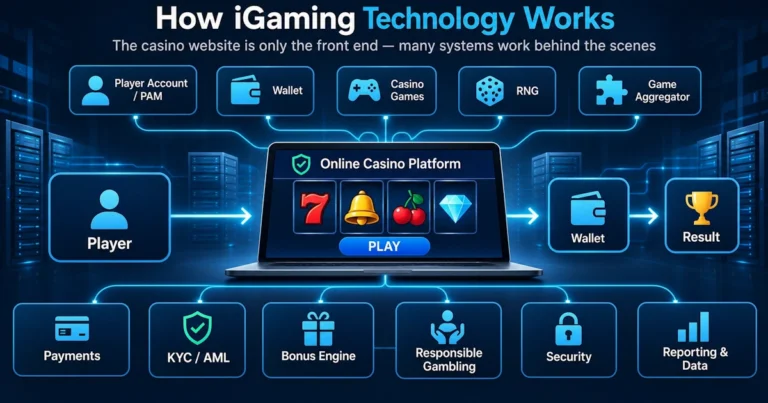
The casino website that a player sees is only one part of this environment.
Behind it may be a Player Account Management system, wallet, game integrations, payment services, KYC tools, fraud monitoring, bonus engine, reporting database and administration interface.
These components can come from one technology supplier or from several specialised companies connected through APIs.
For B2B buyers, the platform is therefore much more than a website template or game catalogue. It is the technical foundation that controls how players, transactions, games and compliance systems work together.
What Is an Online Casino Platform?
There is no single universal regulatory definition of the phrase online casino platform.
In the iGaming industry, it generally refers to the software and infrastructure used to manage an online casino operation and connect its core services.
Gaming Laboratories International uses the broader term interactive gaming system for the hardware, software, communications technology and related operational components that allow players to participate in online gaming. Its current standards library lists GLI-19 Interactive Gaming Systems v4.0 as the current GLI-19 standard.
A casino platform may therefore contain or connect:
player account management
wallet and balances
games
payment systems
bonus management
KYC and AML services
responsible gambling controls
reporting
security systems
administrative tools
The exact architecture varies between suppliers. Some platforms provide almost everything in one package. Others focus on a smaller core and connect external services.
What Does an Online Casino Platform Actually Do?
The main purpose of the platform is to coordinate the systems required to run the casino.
Imagine a player logs in and opens a slot. The platform may need to:
authenticate the player’s account
check whether the account is active
retrieve the correct balance
check applicable account restrictions
launch the game
create or authorise a game session
accept a wager
deduct the stake
receive the game result
credit any winnings
store transaction records
update reports and monitoring systems
The player experiences one simple game round. The platform may be coordinating several different systems behind the screen.
The Core Online Casino Platform Architecture
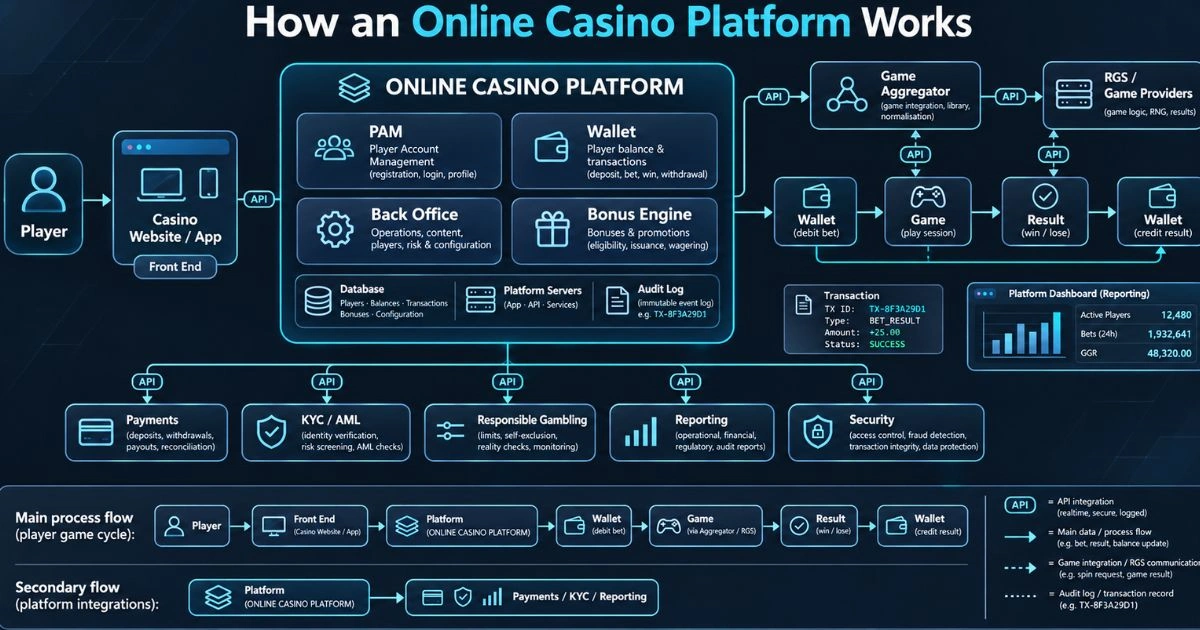
A simplified architecture can look like this:
Player ↓ Casino Website / App ↓ Casino Platform ↓ PAM + Wallet ↓ Game Integration Layer ↓ Game Provider / RGS
At the same time, the platform may connect to:
Payments
KYC
AML
Bonus Engine
Responsible Gambling
CRM
Reporting
Security
The platform acts as the central coordination layer. It does not necessarily perform every function itself.
What Is a PAM in an Online Casino Platform?
PAM stands for Player Account Management. It is one of the most important components of an online casino platform.
The PAM manages information associated with the player account. This can include:
registration details
identity information
account status
authentication
transaction history
restrictions
player preferences
responsible gambling settings
In some platforms, the wallet is also part of the PAM. In others, the wallet operates as a separate service.
The exact technical structure is less important than the underlying principle: Every casino action must be connected to the correct player account.
What Is the Casino Wallet?
The wallet records the player’s financial balances and transactions.
Suppose a player has: €100 cash balance and places: €5 wager
The wallet records: €100 → €95
If the game pays: €20 the wallet then records: €95 → €115
This sounds simple, but a modern casino wallet may need to distinguish between several types of funds.
For example:
Cash Balance
Bonus Balance
It may also need to support:
different currencies
deposits
withdrawals
wager reservations
cancelled transactions
bonus credits
jackpot payments
Financial accuracy is one of the most important requirements of the entire platform.
How Do Games Connect to the Casino Platform?
Most casino operators do not develop every game they offer. Games can come from many external studios.
The casino platform therefore needs a technical method for launching games and exchanging transaction information with them.
A simplified flow might be:Casino Platform → Game Provider
The platform creates an authorised session.
Then:Game → Wallet requests a wager.
The platform checks whether the player has sufficient funds. If the wager is accepted:Wallet → Game confirms the transaction.
After the game produces a result:Game → Platform returns the outcome and payout information.
The wallet then updates the player’s balance. These exchanges can happen in fractions of a second.
What Is an RGS?
RGS usually means Remote Gaming Server or Remote Game Server. It is server-side infrastructure used by game suppliers to deliver casino games.
Depending on the architecture, the RGS can handle elements such as:
game logic
game sessions
game configuration
RNG-related functionality
game results
payout information
GLI describes platform and RGS testing as covering infrastructure and functionality involved in delivering supplier games to the gaming system. Its current evaluation scope can include account systems, financial reporting, data transmission, recovery, player information and game-session records depending on how responsibilities are divided between supplier and operator platforms.
The RGS and casino platform therefore work together, but they are not necessarily the same system.
Online Casino Platform vs RGS
These terms are sometimes confused. An online casino platform generally manages the wider casino operation. An RGS mainly focuses on delivering and operating game functionality.
A simplified distinction is:
Casino Platform Manages the player and casino operation.
RGS Manages or delivers game-side functionality.
For example: Player → Casino Platform → RGS → Slot Game
The platform knows which player is logged in and what their balance is. The RGS knows how the game operates and communicates game transactions back to the platform.
Actual architectures can differ, but this distinction is useful for understanding the roles.
Online Casino Platform vs Game Aggregator
A game aggregator is another different layer.
Its main purpose is to connect the casino with games from multiple suppliers through a shared integration.
Without aggregation, an operator might need: Integration 1 → Provider A Integration 2 → Provider B Integration 3 → Provider C Integration 4 → Provider D
With an aggregation layer:Casino Platform → Aggregator → Providers A, B, C and D
This can simplify game distribution and integration.
However: Aggregator ≠ Full Casino Platform
An aggregator may help deliver games but may not manage the full player account, wallet, payments, KYC and reporting environment. Some technology businesses provide both platform and aggregation services, which is why the terms can sometimes appear blurred in commercial discussions.
What Role Do APIs Play?
An API, or Application Programming Interface, allows software systems to communicate automatically.
APIs are fundamental to modern casino platforms.
For example, a game provider might send: Player ID Game ID Wager €2
The casino platform may respond: Wager Approved
Later the provider sends: Prize €8
The platform responds by updating the wallet.
APIs can also connect the casino platform with:
payment services
identity verification
fraud tools
CRM
affiliate systems
analytics
customer support
regulatory tools
Without reliable integration, a modern casino platform would struggle to combine specialised technology from different suppliers.
What Is the Casino Back Office?
The back office is the administrative side of the platform used by authorised casino staff rather than players.
It can provide tools for managing:
player accounts
transactions
withdrawals
games
bonuses
account restrictions
reports
user permissions
system configuration
A customer may see: Balance: €85
while an authorised back-office user may see a much wider transaction history showing how that balance was created.
Back-office software can therefore contain highly sensitive information and usually requires strict access controls.
Malta’s current regulatory framework specifically recognises B2B software that generates, captures, controls or processes essential regulatory records, or manages the control system on which that software operates, as potentially falling within its Critical Gaming Supply framework.
What Is a Casino Management System?
The phrase casino management system can be used broadly. In online gambling, it may refer to the collection of back-office tools used to control the operation.
Depending on the platform, this could include:
PAM
Wallet
Bonus Engine
Game Management
Reporting
Risk Controls
Administration
Sometimes vendors use terms such as platform, PAM, back office and casino management system differently. This is why B2B buyers should look at actual functionality rather than relying only on product labels.
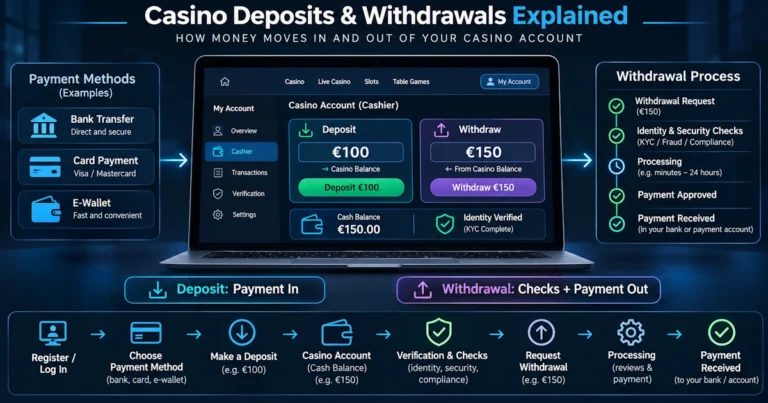
How Do Payments Connect to the Platform?
The casino platform usually connects to external payment services.
A deposit may follow this flow:Player ↓ Casino Cashier ↓ Payment Provider ↓ Payment Approved ↓ Casino Wallet Credited
For withdrawals:Player Requests Withdrawal ↓ Platform Checks Account ↓ Compliance / Risk Checks ↓ Payment Provider ↓ Player Receives Funds
The platform needs to keep its internal financial records synchronized with external payment events. If a payment fails, is reversed or remains pending, the casino balance must reflect the correct status.
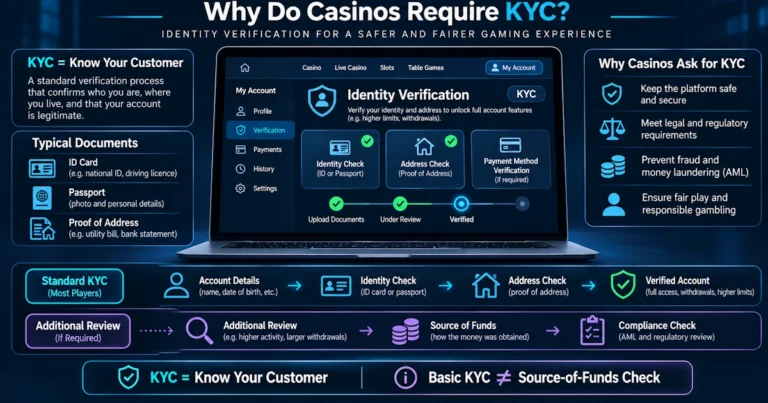
How Does KYC Connect to the Platform?
KYC means Know Your Customer.
The casino platform may connect to external verification providers to confirm information such as:
name
date of birth
address
identity
A simplified process could look like:Player Registration ↓ Platform Sends Verification Request ↓ KYC Provider Checks Data ↓ Verification Result Returned ↓ Platform Updates Account Status
The platform may then allow, restrict or require additional steps depending on the result and applicable rules.
KYC therefore does not need to be completely built inside the casino platform. It can be integrated as another service.
How Does AML Monitoring Work With the Platform?
AML stands for Anti-Money Laundering.
The platform can provide transaction and customer data to systems designed to detect activity requiring further review.
For example, the system may monitor patterns involving:
deposits
withdrawals
payment methods
transaction frequency
unusual financial behaviour
The casino platform provides the underlying account and transaction data. AML tools help analyse that activity according to the operator’s regulatory processes.
This is one reason high-quality transaction records are important. A compliance system cannot analyse activity correctly if the underlying platform data is incomplete.
What Is a Casino Bonus Engine?
The bonus engine manages promotional rules.
Suppose a casino offers: 100% bonus up to €100
The system needs to determine: Is the player eligible? Did the deposit qualify? How much bonus should be credited? Which games count? How much wagering remains? When does the bonus expire?
The bonus engine may also track:
free spins
cashback
reload bonuses
bonus balances
promotional restrictions
It must communicate with the PAM, wallet and games.
For example: Player wagers €10
The platform may need to determine: Was cash or bonus money used? Does this game contribute toward wagering? How much wagering progress should be recorded?
This is why a bonus system is more complicated than simply adding promotional money to an account.
How Does Responsible Gambling Technology Fit In?
Responsible gambling controls can also sit inside or connect to the casino platform.
Depending on the jurisdiction, these can include:
deposit limits
financial limits
session controls
reality checks
time-outs
self-exclusion
account restrictions
The UK Gambling Commission‘s current Remote Gambling and Software Technical Standards contain dedicated requirements covering customer account information, financial limits, time-related controls and responsible product design. The RTS introduction was last updated on March 20, 2026.
This means responsible-gambling functionality is not merely a page containing advice. Some controls need to be implemented at platform level.
Why Does the Platform Need Reporting?
Online casinos generate large volumes of data.
The platform may record:
registrations
account changes
deposits
withdrawals
wagers
winnings
game sessions
bonuses
account restrictions
Some information supports internal operations. Other information may be needed for regulatory reporting or audits.
Reliable reporting depends on accurate source data.
If a wallet records €100 while the reporting system records €90, the operator has a serious reconciliation problem. Reporting therefore needs to be designed into the platform rather than added as an afterthought.
What Is Transaction Reconciliation?
Reconciliation means checking that records from different systems agree.
For example: Casino Wallet says: €1,000 paid and: Payment Provider says: €1,000 paid Those records match.
But imagine: Casino Wallet: €1,000 Payment Provider: €950 The difference needs investigation.
Similar reconciliation can be required between:
casino and payment systems
casino and game providers
wallet and reporting database
bonus system and wallet
When many external services are connected, reconciliation becomes especially important.
What Happens If a Game Connection Fails?
Consider this scenario: A player places: €5 wager The wallet deducts the money. Then the connection to the game provider fails before the result is displayed.
The casino platform cannot simply forget that transaction. It needs a way to determine:
whether the wager was accepted
whether the game produced a result
whether a prize exists
whether the stake should be returned
Good platform architecture therefore needs:
unique transaction references
logging
recovery procedures
retry rules
reconciliation
The UK technical standards specifically address areas including result determination and interrupted gambling, showing why transaction recovery is a regulatory as well as operational issue.
What Is an Audit Trail?
An audit trail records important events and changes.
For example: 20:15 — Deposit €100 20:18 — Wager €5 20:18 — Prize €20 20:30 — Withdrawal €50 requested
Administrative events can also be logged. For example: User X changed account status or: Bonus configuration updated
Audit trails help with:
disputes
security investigations
transaction tracing
regulatory reviews
technical troubleshooting
For B2B platform evaluation, good auditability can be just as important as visible front-end features.
Why Is Platform Security So Important?
The casino platform can process highly sensitive information.
This may include:
identity information
authentication details
account balances
payment-related information
transaction records
A security problem could therefore affect both data and money.
The UK Gambling Commission’s security requirements identify systems handling sensitive customer information, authentication information and customer account balances as critical systems. The requirements are based on relevant parts of ISO/IEC 27001:2022.
Security should therefore exist across the entire platform architecture. It is not simply a login password or HTTPS certificate.
What Is the Difference Between Front End and Platform?
The front end is what the player sees. This includes:
homepage
game lobby
login page
cashier
account pages
promotional pages
The platform is the underlying system managing operations.
For example, two casino brands can have completely different visual designs while using the same underlying platform technology.
A front-end redesign can change: how the casino looks without necessarily changing: how the wallet processes transactions or: how the PAM manages accounts
This distinction is important in B2B discussions. Buying a new website design is not the same as replacing the casino platform.
Online Casino Platform vs White-Label Casino
A casino platform is technology. A white-label casino is a broader business arrangement.
A white-label solution may give another company access to an existing platform and potentially additional services required to operate a branded casino.
Depending on the arrangement, this could include:
technology
games
payments
back office
support
compliance services
But the exact responsibilities differ between suppliers and jurisdictions. Therefore: Platform ≠ White Label
A platform can be sold to an independently licensed operator. A white-label arrangement can use a platform as one part of a larger operational package.
Online Casino Platform vs Turnkey Solution
A turnkey solution is another commercial industry term. It generally refers to a more complete package designed to reduce the amount of technology an operator needs to assemble itself.
For example, a turnkey package might include:
Platform
PAM
Wallet
Games
Payments
Bonus Tools
Back Office
A platform can be part of a turnkey solution. But not every casino platform automatically includes every service required to launch a gambling business.
Licensing, compliance, banking, customer support and commercial contracts can still be separate issues.
Is an Online Casino Platform the Same as Gambling Software?
Not exactly. The phrase online casino platform is a broad industry term.
Regulators can use more specific legal definitions. In Great Britain, gambling software includes software designed for use in connection with remote gambling and can include systems that accept and record gambling transactions, determine results and calculate or allocate winnings. More general software such as ordinary analytics or CRM applications may fall outside that gambling-software definition depending on its function.
This distinction matters for B2B suppliers. Not every software component used by a casino is automatically regulated in exactly the same way.
Does a Platform Supplier Need a Gambling Licence?
It depends on:
jurisdiction
platform functionality
supplier responsibilities
how the software is used
There is no worldwide answer.
In Great Britain, a company manufacturing, supplying, installing or adapting relevant gambling software can require a gambling software licence. A software licence by itself does not authorise the business to provide gambling directly to consumers.
The Malta Gaming Authority distinguishes between: Gaming Service Licence — B2C and: Critical Gaming Supply Licence — B2B
The B2B category can include supplying software that processes essential regulatory records or supplying control systems on which that software operates.
So the fact that a business is “only a technology supplier” does not automatically mean gambling regulation is irrelevant.
Can One Platform Support Several Casino Brands?
Yes, depending on its architecture. Some platforms are designed to support multiple brands from a shared technical environment.
For example: Platform ↙ ↓ ↘ Casino Brand A Casino Brand B Casino Brand C
Each brand could have:
different website design
different game catalogue
different bonus rules
different languages
different currencies
while sharing selected backend infrastructure. This is often called a multi-brand capability.
However, operating multiple brands creates additional configuration, compliance and reporting requirements. The platform needs to keep data correctly separated where necessary.
What Is Multi-Currency Support?
Casino platforms operating across markets may need to support several currencies.
For example:
EUR
GBP
USD
The platform must accurately store the currency associated with:
balances
deposits
wagers
prizes
withdrawals
It should not simply treat: €10 and: £10 as the same numeric value.
Currency conversion may also happen through external payment services. This makes currency handling a financial-control issue, not just a display setting.
What Is Multi-Language Support?
Platforms can also support multiple languages. This can affect:
website interface
game metadata
customer messages
account information
responsible gambling information
But translating an interface is not enough to enter a new gambling market.
Different jurisdictions may also require different:
account controls
game rules
reporting
payment methods
responsible gambling features
A platform intended for several markets therefore needs more than a language selector.
What Does Multi-Jurisdiction Mean?
A multi-jurisdiction platform is designed to support operators working under different regulatory frameworks. This can be technically demanding because one market may require something that another does not.
Examples can include different rules for:
account registration
identity verification
responsible gambling
slot design
reporting
payments
bonus structures
The UK Gambling Commission’s RTS alone covers areas including account information, transactions, game rules, RNG, interrupted gambling, financial limits, responsible product design, third-party software and live dealer studios.
Another jurisdiction may structure its requirements differently. A serious multi-market platform therefore needs configurable compliance controls.
What Is Platform Configuration?
Not every platform change should require new software development. Many systems allow authorised administrators to configure elements such as:
currencies
games
limits
bonuses
payment methods
account settings
This can make the platform more flexible. However, configuration also creates risk.
An incorrect setting could potentially affect:
player balances
game availability
bonus rules
regulatory controls
Important changes should therefore be controlled, logged and tested appropriately.
What Is Platform Scalability?
Scalability is the ability of the system to handle increased activity without losing performance or transaction integrity.
Imagine normal traffic is: 1,000 active players but a major campaign creates: 10,000 active players
The platform may suddenly need to process much more:
authentication
game traffic
wallet activity
deposits
API calls
A scalable platform needs to handle higher demand while continuing to record transactions correctly. For gambling technology, scaling is not only about page speed. Financial correctness must survive the traffic increase.
What Is Platform Availability?
Availability describes how reliably the platform remains accessible and operational.
If the core platform goes offline, players may be unable to:
log in
launch games
deposit
withdraw
view balances
High availability can therefore involve:
redundant systems
monitoring
backup infrastructure
recovery procedures
Platform providers may define availability targets in commercial service-level agreements. Those targets should not be confused with regulatory guarantees unless a specific regulator requires them.
What Should B2B Buyers Evaluate in an Online Casino Platform?
A platform should not be evaluated only by the number of games displayed in a sales presentation. Important areas include:
PAM capabilities How are player accounts managed?
Wallet architecture How are cash, bonuses and transactions recorded?
Game integrations Can the platform connect to the required providers or aggregators?
Payments Which payment systems can be integrated?
KYC and AML How are verification and monitoring systems connected?
Bonus engine How flexible are promotional rules?
Reporting Can the operator obtain accurate operational and regulatory data?
Security How are critical systems and sensitive information protected?
Auditability Can transactions and administrative changes be traced?
Scalability Can the platform handle growth?
Jurisdiction support Can market-specific requirements be configured correctly?
The best platform for one operator is not automatically the best platform for another. Technology needs depend on the business model, target markets and regulatory structure.
Why Platform Integrations Matter So Much
A platform with impressive features can still create operational problems if its integrations are unreliable.
Imagine: Game Provider says win = €100 but: Wallet does not receive the credit
or: Payment Provider says deposit failed while: Casino wallet says deposit succeeded
These inconsistencies need to be prevented or resolved. Good integrations therefore need:
transaction identifiers
status handling
error management
retries where appropriate
logs
reconciliation
The platform’s value comes partly from its ability to keep all connected systems synchronized.
Why the Platform Is the Core of an Online Casino
Games attract attention because they are what players see. But the platform makes the casino operation possible.
Without the platform, there is no reliable way to coordinate: Who the player is How much money they have What they wagered What they won Which bonus applies Whether the account is restricted What should appear in reports
The platform is therefore the operational core connecting the customer-facing casino with the technology behind it.
Final Thoughts
So, what is an online casino platform?
It is the central technology environment that manages and connects the main functions of an online casino. At its core are usually systems for:
Player Account Management
Wallets and Transactions
Around them are connections to:
Casino Games
RGSs
Game Aggregators
Payments
KYC and AML
Bonus Engines
Responsible Gambling Tools
Reporting
Security
A simplified architecture can be shown as: Player → Front End → Casino Platform → PAM / Wallet → Game Provider while supporting systems connect around that core.
For B2B businesses, the important point is that a platform is not simply a website, game catalogue or casino brand. It is the infrastructure that keeps the entire online gambling operation connected.
And because that infrastructure can affect player accounts, financial transactions, games and regulatory records, parts of a casino platform may also fall within gambling-software or critical-supply regulation depending on the jurisdiction.
A strong online casino platform therefore needs more than attractive features. It needs accurate transactions, reliable integrations, security, auditability, regulatory flexibility and the ability to keep many different systems working as one operation.
Frequently Asked Questions
What is an online casino platform? An online casino platform is the core technology used to manage player accounts, balances, games, payments, bonuses, compliance systems and other operational functions behind a digital casino.
Is an online casino platform the same as a PAM? No. A PAM manages player accounts and related information. It is usually one important component of the wider casino platform.
What is the difference between a casino platform and a game aggregator? A casino platform manages the wider casino operation. A game aggregator mainly provides an integration layer that connects the operator with games from multiple suppliers.
What is the difference between a casino platform and an RGS? The casino platform generally manages players, wallets and wider operations. An RGS focuses on server-side delivery and operation of casino games. The systems communicate during gameplay.
What is a white-label casino platform? A white-label arrangement is a broader commercial and operational solution that can use an existing casino platform. The platform is the technology; the white-label arrangement may include additional services.
Do online casino platform providers need licences? Potentially. Licensing depends on the jurisdiction and the functions supplied. For example, Great Britain regulates relevant gambling-software suppliers, while Malta has a B2B Critical Gaming Supply licence for certain gaming software and control systems.