A casino API is a technical interface that allows different iGaming software systems to exchange information automatically.
API stands for Application Programming Interface.
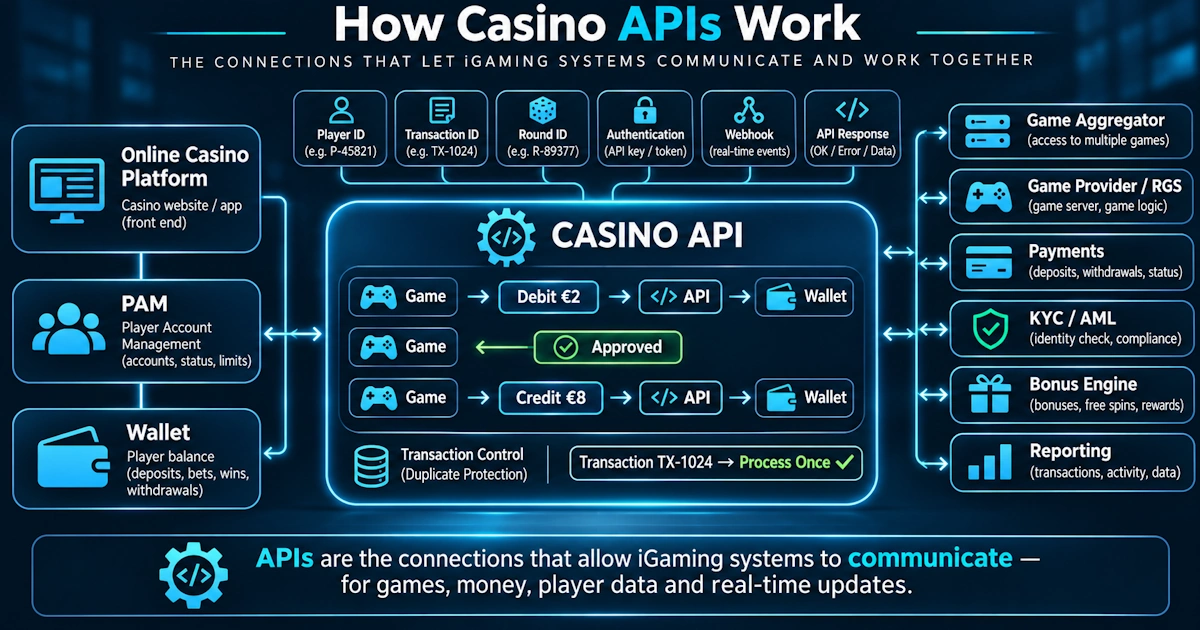
In an online casino, APIs can connect the main platform with player accounts, wallets, game providers, aggregators, payment services, KYC systems, bonus engines and reporting tools.
For example, when a player places a €2 slot wager, several systems may need to communicate: Game → Casino API → Wallet → Wager Approved
After the game finishes: Game → Casino API → Wallet → Winnings Credited
The player sees one game screen. Behind it, APIs can be moving requests and responses between several independent systems in real time.
A casino API is therefore not one specific product or universal industry standard. It is a general way for iGaming systems to communicate according to defined technical rules.
What Does API Mean?
API stands for Application Programming Interface. An API defines how one software system is allowed to interact with another.
The OpenAPI Initiative describes an API as defining the permitted interactions between software systems, in much the same way that a user interface defines how a person interacts with software.
A simple example might be: System A asks:“What is Player 123’s balance?” System B responds:“€85.40”
Another request might say:“Debit €2 from Player 123 for Game Round 789.”
The receiving system then decides whether the request is valid and returns a response.
The API defines:
what information can be requested
how the request should be formatted
what authentication is required
what response should be returned
what happens when something goes wrong
Why Are APIs Important in iGaming?
Modern online casinos rarely run entirely on one piece of software.
An operator may use:
PAM from Supplier A
Wallet from Supplier B
Game Aggregator from Supplier C
KYC from Supplier D
Payments from Supplier E
CRM from Supplier F
These systems need to exchange information. APIs make that possible.
The UK Gambling Commission‘s overview of remote gambling infrastructure specifically describes external system interfaces as APIs or Application Programming Interfaces and notes that they support information exchange between different systems and organisations.
Without integrations, the operator might have many separate technology products that cannot work together as one casino.
Where Does a Casino API Sit in the Technology Stack?
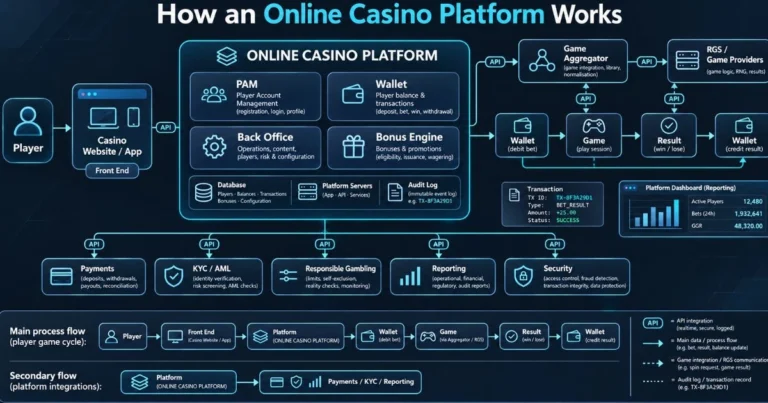
A simplified iGaming architecture might look like:
Player ↓ Casino Website / App ↓ Online Casino Platform ↓ PAM / Wallet
Then APIs connect the platform to:
Game Aggregator
Game Providers
Payments
KYC / AML
Bonus Engine
CRM
Reporting
The API is therefore not necessarily a separate visible system. It is often the communication layer between systems.
What Is the Difference Between an API and a User Interface?
A user interface, or UI, is designed for people. For example:Deposit €50 might appear as a button on a casino website.
An API is designed mainly for software systems. When the player presses that button, the website might send an API request to a payment or platform service.
So:UI → Human interactionAPI → Software-to-software interaction
The player does not normally see the API request itself. They only see the result.
How Does a Casino API Work?
Most API interactions can be understood as:Request → Processing → Response
Imagine a game needs to check whether a player can place a €5 bet.
Step 1: Request The game-side system sends information such as: Player: 12345 Wager: €5 Game: Slot A Round: 98765
Step 2: Platform Processes the Request The casino checks: Is the player valid? Is the account active? Does the player have enough money?
Step 3: Response The platform might return:Approved and:New balance: €45
Or:Declined — insufficient funds
This entire exchange can happen automatically.
What Information Can a Casino API Carry?
Different APIs handle different types of information.
Examples include:
player identifiers
account status
game identifiers
currency
balance
wager amount
payout amount
transaction ID
game round ID
bonus status
KYC status
payment status
A good integration sends only the information required for the relevant function.
For example, a game provider may need a player reference and wallet information. It does not necessarily need the player’s full identity documents.
This separation can reduce unnecessary exposure of sensitive information.
What Are the Main Types of Casino APIs?
There is no official universal list, but common iGaming integrations can be grouped into several areas.
Game APIs Connect casino platforms, aggregators and game providers.
Wallet APIs Handle wagers, payouts and balance-related transactions.
PAM APIs Exchange player-account information.
Payment APIs Connect the casino to deposit and withdrawal services.
KYC APIs Send identity information for verification and return verification results.
Bonus APIs Manage promotional eligibility, bonuses and progress.
Reporting APIs Provide operational or transaction information to other systems.
A single platform may use dozens of APIs internally and externally.
What Is a Game Launch API?
A game launch API helps start a gaming session.
Suppose a player clicks:Play Slot A
The casino may send the game system information such as: Player ID Game ID Currency Language Session Token
The provider then returns the information required to launch the game.
A simplified flow is: Player → Casino Platform → Game API → RGS Then: RGS → Game Session → Player
The exact fields and architecture depend on the provider.
What Is a Wallet API?
The wallet API is one of the most important integrations in real-money casino technology. It allows gaming systems to interact with the player’s financial balance.
Typical actions can include:
Balance Check
Debit
Credit
Rollback
These terms are particularly common in game integrations.
What Is a Balance Request?
Before or during a gaming session, the game system may need to know the player’s available balance.
For example: Request: Player 123 balance Response: €75
The game interface can then display: Balance: €75
The wallet remains responsible for the authoritative balance in many architectures. The game should not create its own unrelated version of that balance.
What Is a Debit API Call?
A debit removes money from the player’s balance for a wager.
Suppose: Player balance: €50 Slot wager: €2
The game system sends:Debit €2
If the wallet accepts the wager:New balance: €48
The response may also contain a unique transaction identifier.
What Is a Credit API Call?
A credit adds winnings to the player’s balance.
Suppose the same €2 round wins: €8
The game system sends:Credit €8
The wallet updates: €48 + €8 = €56
That transaction should be connected to the correct:
player
game
wager
round
Accurate transaction linking becomes essential when millions of game rounds are processed.
What Is a Rollback API Call?
A rollback can be used when a previously initiated transaction needs to be reversed or corrected.
For example: €5 wager accepted but then: game round fails before completion
Depending on the integration design, the platform may need to reverse the wager:Rollback €5
The player’s balance returns to its previous state. The original transaction normally still needs to remain traceable. The system should not simply behave as if nothing happened.
Why Are Transaction IDs Important?
Each financial transaction should be identifiable.
For example: Transaction ID: TX8392107
A unique identifier helps systems determine exactly which event is being discussed.
This becomes important when investigating:
duplicate wagers
missing payouts
failed game rounds
reversed transactions
player disputes
reconciliation differences
Without reliable identifiers, tracing one transaction across several systems becomes much more difficult.
What Is a Game Round ID?
A round ID links related game transactions.
For example: Round 45678 could contain:Debit €2 followed by:Credit €7
The round identifier helps establish that both transactions belong to the same game event.
This is particularly useful when an operator, aggregator and provider all maintain separate transaction records.
Why Is Idempotency Important in Casino APIs?
Idempotency is an important concept for financial APIs.
Imagine the following sequence: Game sends Credit €100 The casino successfully credits the player. But the confirmation response is lost because the internet connection fails.
The game system does not know whether the credit succeeded. So it sends the request again.
Without protection: €100 + €100 = €200 credited That would be incorrect.
An idempotent transaction design allows the casino to recognise:This transaction has already been processed.
The duplicate request therefore does not produce a second financial action. For real-money systems, this type of protection is extremely important.
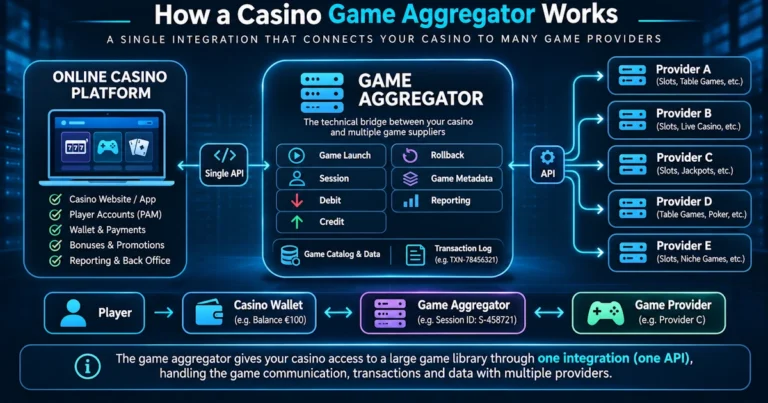
What Is a Casino Aggregator API?
A game aggregator allows a casino to connect with many game providers through a shared integration.
Instead of: Casino API → Provider A Casino API → Provider B Casino API → Provider C
the operator may use: Casino Platform → Aggregator API → Providers A, B and C
The aggregator then translates or normalises the different provider integrations. This can significantly reduce the operator’s own integration workload. The API acts as the technical interface between the casino platform and the aggregator.
Casino API vs Game Aggregator
These terms are not interchangeable. An API is the communication method. A game aggregator is a service or technology layer that may expose an API.
So: Aggregator = system/service API = way to communicate with it
The same principle applies to: PAM Payment Gateway KYC Provider
All can expose APIs.
Casino API vs RGS
An RGS, or Remote Game Server, provides game-side functionality. An API allows the RGS and other systems to communicate.
For example: Casino Platform ↔ API ↔ RGS
The API does not itself determine the slot result simply because it transports the result. The game-side system performs the relevant gaming functionality. The API moves information between the systems.
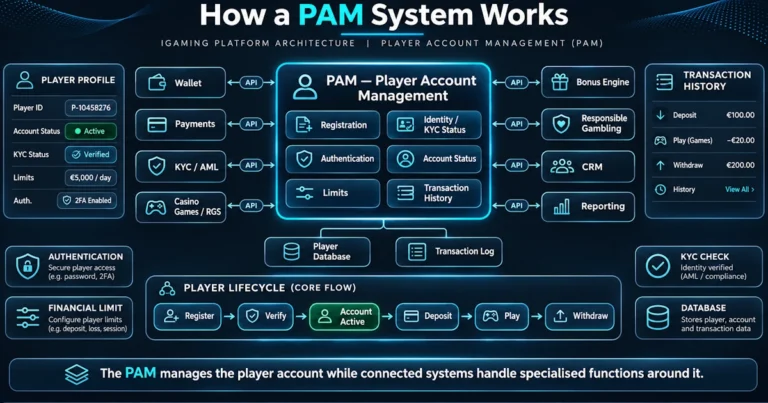
How Are APIs Used With PAM Systems?
A PAM can expose APIs for player-account operations.
For example: Get Account Status Response: Active
Another request: Get KYC Status Response: Verified
Another: Apply Account Restriction
The API allows other authorised platform services to work with the player account without directly accessing the underlying PAM database. This separation can make integrations cleaner and easier to control.
How Are APIs Used for KYC?
An online casino may connect with a specialised identity-verification provider.
A simplified flow could be: Player Registration ↓ Casino Platform ↓ KYC API ↓ Verification Provider
Then the provider returns: Verified or: Additional Information Required
The casino can then update the player’s account status. This allows the operator to use specialised KYC technology without building every verification tool internally.
How Are APIs Used for Payments?
Payment APIs connect the casino with external payment services.
A deposit request might contain: Player Reference Amount: €100 Currency: EUR Payment Method
The provider processes the transaction and later returns a status such as: Approved Declined or: Pending
The casino wallet should update only according to the appropriate payment status. Withdrawals can use a similar integration in the opposite direction.
How Are APIs Used for Bonuses?
A bonus system can also expose APIs.
Suppose a player completes a qualifying €100 deposit. The platform may ask: Is Player 123 eligible for Welcome Bonus A?
The bonus engine responds: Yes
It can then calculate: Bonus: €100
The system may later exchange information about:
wagering progress
bonus expiry
eligible games
bonus completion
This allows a specialised bonus engine to remain synchronized with PAM and wallet systems.
How Are APIs Used for Responsible Gambling Controls?
Responsible gambling settings often need to affect several systems.
Suppose a player reaches a deposit limit. The responsible gambling system might update the account: Deposit Allowed: No
The payment system must receive that status before accepting another deposit.
Similarly, a self-exclusion or account restriction may need to reach:
PAM
payments
casino games
CRM
APIs help distribute those account states to the systems that need them.
What Is a Webhook?
Not every system interaction starts with one system actively asking another for information.
A webhook allows a system to notify another system when an event occurs.
For example: Withdrawal processed ↓ Payment provider sends notification: Payment Completed
The casino does not need to repeatedly ask:“Has the withdrawal completed yet?”
Another example: KYC Provider → Casino Verification Completed
Webhooks are therefore useful for event-driven integrations.
API Request vs Webhook
A simple distinction is:
API Request System A asks System B:“What is the status?”
Webhook System B tells System A:“The status has changed.”
Many integrations use both approaches. For example, an API may create a withdrawal while a webhook later reports that the payment has completed.
What Is API Authentication?
A casino API should not accept sensitive requests from anyone on the internet. The receiving system needs to establish that the request comes from an authorised source.
Different APIs can use mechanisms such as:
API credentials
access tokens
signed requests
certificates
other authentication methods
The exact approach depends on the integration. Authentication answers an important question:Who is making this API request?
Authentication vs Authorization
These terms are related but different.
Authentication asks:Who are you?
Authorization asks:What are you allowed to do?
For example, an API client might be correctly authenticated but only authorised to: Read game catalogue
It should not therefore be able to: Change player balances
This distinction is important in financial and gaming systems. OWASP’s API Security Top 10 identifies broken authentication and several forms of broken authorization as major API security risks.
Why Is API Security So Important in Online Casinos?
Casino APIs can interact with:
money
player accounts
identity information
payment information
gambling transactions
A weak API could potentially expose much more than ordinary website content.
The UK Gambling Commission’s current security framework applies security requirements to critical systems that process, store, transmit or retrieve sensitive customer information, authentication information and customer account balances. The framework references relevant parts of ISO/IEC 27001:2022.
OWASP also highlights risks including:
broken authorization
broken authentication
unrestricted resource consumption
security misconfiguration
poor API inventory management
unsafe use of third-party APIs
These risks are particularly relevant where APIs expose sensitive business logic or personal information.
Why Should APIs Use Encryption?
Casino API requests can contain sensitive information.
If that information travels across networks without appropriate protection, an attacker could potentially intercept or manipulate it.
Secure transport helps protect: confidentiality and: integrity of communications.
For casino integrations involving balances and financial transactions, the operator should be able to trust both: who sent the message and: whether the message changed in transit
The exact security architecture varies by platform and jurisdiction.
What Are API Permissions?
Not every integration needs access to everything.
A game provider might need:
Balance
Debit
Credit
But it probably does not need access to:
full KYC documents
A CRM platform may need:
player communication preferences
but should not necessarily be able to:
change the casino wallet balance
Limiting access according to function reduces unnecessary security exposure. This principle becomes especially important where many B2B suppliers connect to the same platform.
What Is Rate Limiting?
Rate limiting controls how many API requests can be made within a given period. For example, an API might limit a client to a defined number of requests per second.
This can help protect:
system performance
infrastructure capacity
service availability
It can also reduce some forms of abuse.
OWASP includes unrestricted resource consumption among its major API security risks, reflecting the problems that can occur when API clients can consume resources without appropriate controls.
The exact limits need to match the business function. A real-time game-wallet API may require very different capacity from a daily reporting API.
Why Are Error Codes Important?
When something fails, the sending system needs to understand why.
A casino API could return statuses representing: Insufficient Funds Invalid Player Invalid Game Duplicate Transaction Session Expired Temporary System Error
The exact error format varies.
Good error handling allows the connected system to decide what to do next. For example:Insufficient Funds should not normally be treated the same as:Temporary Network Failure
One should stop the wager. The other might justify a controlled retry.
Why Can Blind Retries Be Dangerous?
Imagine a system receives no response after sending: Debit €10
It cannot simply assume that the debit failed. The receiving system may have processed the transaction before the network connection was lost.
If the request is repeated without duplicate protection: €10 could be debited twice
This is why retries, transaction IDs and idempotency need to work together. Financial APIs should be designed for ambiguous network failures, not only perfect connections.
What Is API Versioning?
APIs change over time.
A supplier might introduce: API v1 and later: API v2
The new version might add:
new fields
new authentication
different transaction handling
additional functions
Versioning helps prevent a supplier from changing a live integration in a way that unexpectedly breaks every connected operator.
A B2B platform should therefore understand: Which API version are we using? How long will it be supported? How are breaking changes communicated?
Why Is Backward Compatibility Important?
Imagine an aggregator has 100 operators integrated with its API. If it changes one required field overnight, many of those integrations could stop working.
Backward compatibility allows existing integrations to continue operating while newer features are introduced.
Where a breaking change is unavoidable, suppliers normally need a controlled migration process.
This is particularly important for iGaming systems because integration failures can affect:
game availability
wagers
balances
payments
What Is API Documentation?
API documentation explains how another developer should use the interface.
Good documentation can describe:
endpoints
required fields
authentication
request formats
responses
error codes
example flows
transaction rules
testing environment
Poor documentation can make even a well-designed API difficult to integrate. For B2B buyers, API documentation is therefore part of the product. It is not merely a technical appendix.
What Is OpenAPI?
OpenAPI is a widely used specification for describing HTTP APIs in a structured format.
The OpenAPI Initiative explains that an OpenAPI description can define an API in a programming-language-independent way and can be used to understand capabilities, generate client code, configure infrastructure and create tests.
An iGaming supplier may therefore use OpenAPI documentation to describe parts of its integration.
However: OpenAPI ≠ Casino API
OpenAPI is a general API-description standard. The casino-specific business rules still come from the iGaming supplier.
What Is a Sandbox API?
A sandbox is a test environment.
Instead of immediately connecting to real-money production systems, the operator can test actions such as: Create player Launch game Debit test €1 Credit test €5
without using actual player money.
A sandbox helps development teams test:
integration logic
authentication
error handling
transaction flows
edge cases
Only after the integration has been validated should it move into the relevant production process.
Sandbox vs Production
These environments should be clearly separated.
Sandbox Used for: Testing
Production Used for: Real customers and real transactions
Credentials should also normally be separated. A test API key should not automatically provide production access. This separation reduces the risk that development activity affects real customer accounts.
What Is an API SDK?
An SDK, or Software Development Kit, is not the same as an API.
The API defines the communication interface. An SDK can provide tools or pre-written code that make using the API easier.
So: API = rules for communication SDK = tools for developers using those rules
A supplier can provide an API without an SDK. It can also provide SDKs for selected programming languages.
What Is API Latency?
Latency is the time between sending an API request and receiving the response.
In iGaming, some APIs are more time-sensitive than others. For example: Wallet debit during a slot spin needs to respond quickly.
A report requested by an administrator may tolerate more delay.
High latency in real-time game integrations can result in:
slow spins
delayed balance updates
timeouts
poor player experience
API performance therefore becomes part of platform performance.
Why Does API Availability Matter?
Many casino services depend directly on external APIs.
Suppose: Casino → Aggregator API → Game Providers
If the aggregator API goes down, large parts of the casino game catalogue may stop working.
Likewise: Casino → KYC API If unavailable, new players may not complete verification.
Operators therefore need to understand dependencies created by APIs. Important B2B considerations include:
uptime
monitoring
redundancy
incident response
timeout handling
What Is API Monitoring?
Operators and suppliers need visibility into how integrations are performing.
Monitoring can track:
request volume
response times
error rates
failed transactions
authentication failures
unusual traffic
For example: Normal debit error rate: 0.01% Suddenly: Debit error rate: 8%
That could indicate a serious production problem. Monitoring can help technical teams react before a failure becomes a large customer issue.
Why Are Logs Important?
Logs record technical events.
For an API transaction, a log might record:
Time
Transaction ID
Request type
Response status
Processing time
Sensitive information should be handled carefully rather than indiscriminately stored in logs. But appropriate logging can be essential for investigating:
missing winnings
duplicate transactions
game outages
payment failures
security events
The UK Gambling Commission’s remote gambling framework treats account, transaction and gambling records as important components of the technical system.
APIs and Reconciliation
Imagine three systems record the same gaming activity: Game Provider Aggregator Casino Wallet
At the end of the day: Provider says: €500,000 wagers Aggregator says: €500,000 Casino says: €500,000
Everything matches.
If one system says: €499,990 there is a difference of: €10
Transaction IDs and API logs can help locate exactly where the discrepancy occurred. This process is known as reconciliation.
Is There One Standard Casino API?
No. There is no universal API specification used by every iGaming provider.
Different suppliers can use different:
endpoints
authentication models
transaction names
data formats
error codes
game-launch flows
This is one reason game aggregators can be valuable. They can present a more consistent operator-facing interface while handling different provider integrations behind it.
Is Every Casino API a REST API?
No. REST-style HTTP APIs are common across modern software, but iGaming integrations are not restricted to one architecture.
Systems can use different communication methods depending on their age, requirements and design.
The important question for a B2B integration is not:“Is this a REST API?” but:“Does the interface reliably support the business process we need?”
That includes:
security
transaction integrity
documentation
performance
error handling
Is a Casino API Gambling Software?
Not automatically.
The word API describes a technical interface, not a regulatory category. What matters is what the software behind that API actually does.
The UK Gambling Commission says gambling software includes gambling-specific software used for functions such as bet capture, settlement, random number generation and gambling records. At its core, the Commission focuses on software that accepts or records gambling transactions, determines results, or calculates and allocates winnings.
General software such as ordinary CRM or analytics systems may be treated differently.
So: API technology itself ≠ automatically regulated gambling software but: gambling functionality exposed through an API may fall within gambling-software regulation depending on jurisdiction and role.
Do Casino API Providers Need Licences?
Potentially. There is no general worldwide casino API licence.
Licensing depends on:
jurisdiction
software function
supplier role
operating model
In Great Britain, businesses manufacturing, supplying, installing or adapting relevant gambling software can require a remote gambling software licence.
The regulator’s technical standards also apply to relevant gambling software supplied for use by licensed British remote operators.
An API should therefore be evaluated according to the service it enables, not simply the fact that it is an API.
How Do Regulatory Standards Affect Casino APIs?
Regulators do not necessarily prescribe one particular API architecture. Instead, they can set requirements for the gambling functions the connected systems perform.
The UK Gambling Commission’s current Remote Gambling and Software Technical Standards cover areas including:
customer account information
transactions
result determination
RNGs
interrupted gambling
financial limits
responsible product design
security
The current RTS introduction was updated on March 20, 2026. GLI currently lists GLI-19 Interactive Gaming Systems v4.0 as its current interactive gaming systems standard.
An API integration supporting those functions needs to preserve the accuracy and controls required by the wider gaming system.
What Should B2B Operators Evaluate in a Casino API?
An operator should not choose an integration only because the supplier says: “We have an API.”
Important areas include:
Documentation Is the integration clearly explained?
Authentication How are systems verified?
Authorization Can access be limited by function?
Transaction IDs Can every financial action be traced?
Idempotency Are duplicate transactions prevented?
Error handling Are failures clearly defined?
Retry logic What happens after a timeout?
Security How is sensitive information protected?
Performance Can the API handle real-time gaming traffic?
Availability What happens during an outage?
Versioning How are future changes managed?
Sandbox Can the integration be tested safely?
Monitoring Can failures be identified quickly?
Regulatory scope Does the integration support the requirements of target markets?
The quality of an API can directly affect the reliability of the wider casino platform.
Common Casino API Misconceptions
“A casino API is a casino platform.” No. An API is an interface that allows systems to communicate. A platform is a wider technology environment.
“Every casino uses the same API.” No. Suppliers can use very different technical specifications.
“An API stores player money.” Not necessarily. A wallet stores or manages the balance. The API allows other authorised systems to communicate with that wallet.
“A casino API determines slot outcomes.” Not simply because it is an API. Game outcomes are handled by the relevant gaming systems. APIs can transport requests and results.
“If an API request times out, the transaction failed.” Not necessarily. The receiving system may have processed it before the response was lost. This is why transaction status, idempotency and reconciliation matter.
“One API means one software supplier.” No. An aggregator can expose one API while connecting dozens of other suppliers behind it.
Why Casino APIs Matter More as an Operator Grows
A small casino might begin with only a few external systems. As the operation grows, it can add:
more game providers
more payment methods
more countries
more KYC services
more brands
more analytics tools
The number of integrations grows quickly.
Well-designed APIs allow new systems to be added without tightly coupling every piece of software to every other piece.
For example:PAM API can be used by:
Casino Front End
Payments
KYC
Responsible Gambling
without each service requiring direct database access. This makes the architecture easier to control and scale.
Final Thoughts
So, what is a casino API?
It is a technical interface that allows iGaming systems to exchange information automatically.
The API itself may handle requests related to:
Players
Balances
Games
Wagers
Winnings
Payments
KYC
Bonuses
Reporting
A simple casino game transaction might look like:Game → API → Wallet → Debit Approved followed by:Game → API → Wallet → Winnings Credited
But reliable real-money APIs need more than basic connectivity. They also need:
Authentication
Authorization
Transaction IDs
Duplicate protection
Error handling
Security
Monitoring
Reconciliation
The central B2B idea is simple: The casino platform contains the systems. APIs allow those systems to work together.
As operators add more game providers, payment services, compliance tools and technology partners, API quality becomes increasingly important.
A strong casino API should not only connect systems when everything works perfectly. It should also protect transaction integrity when networks fail, requests are repeated, systems become unavailable or sensitive information is exchanged.
That reliability is what turns an API from a technical connection into dependable iGaming infrastructure.
Frequently Asked Questions
What is a casino API? A casino API is a technical interface that allows different online casino systems to communicate. It can connect platforms with games, wallets, payments, KYC services and other technology.
What is a wallet API in iGaming? A wallet API allows authorised systems to interact with player balances. Common actions can include checking a balance, debiting a wager, crediting winnings and reversing certain transactions.
What is a casino game API? A game API connects casino platforms or aggregators with game systems. It can support game launches, sessions, wagers, payouts and related transaction information.
What is the difference between an API and a casino game aggregator? An API is a method for software communication. A game aggregator is a technology service that connects an operator to multiple game providers and normally exposes an API for that integration.
Why are transaction IDs important in casino APIs? Transaction IDs make individual wagers, payouts and other financial events traceable. They help prevent duplicates and support troubleshooting and reconciliation.
Are casino APIs regulated? There is no universal casino API licence. Regulation depends on the function performed by the software connected through the API. Gambling-specific software can be subject to licensing and technical requirements in regulated markets.