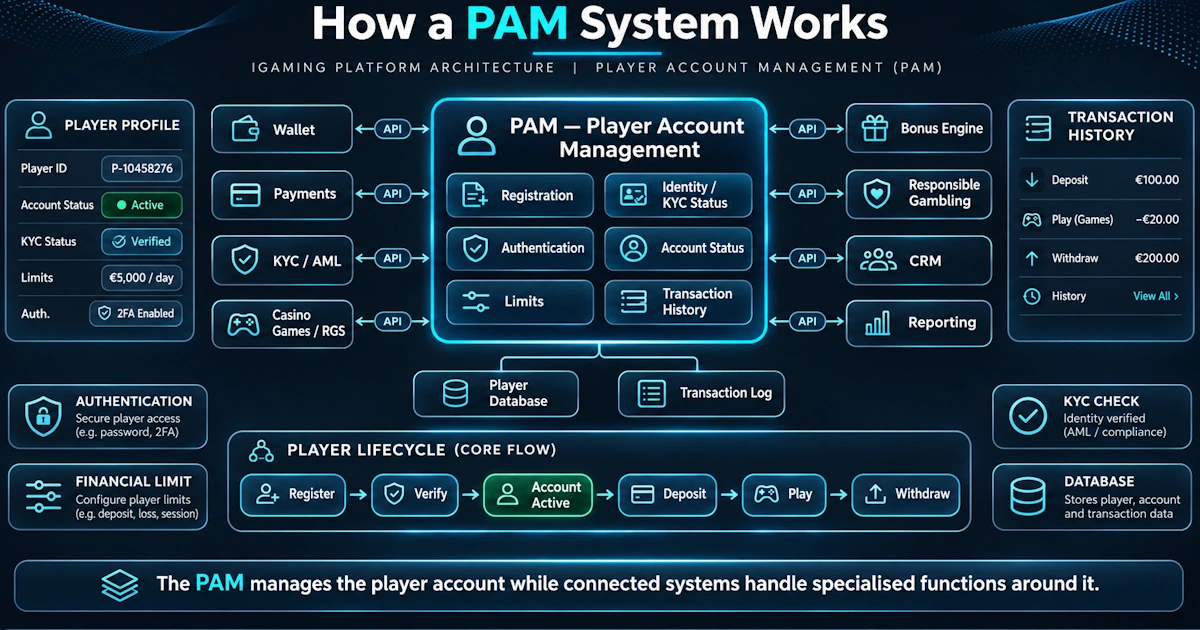
A PAM system in iGaming is a Player Account Management system used to manage the relationship between an online gambling operator and its players.
At a basic level, the PAM knows who the player is, whether the account is active and what rules apply to that account.
In practice, modern PAM technology can support much more. It may manage registration, authentication, identity status, account settings, transaction history, payment methods, bonuses, limits, account restrictions and connections with other systems.
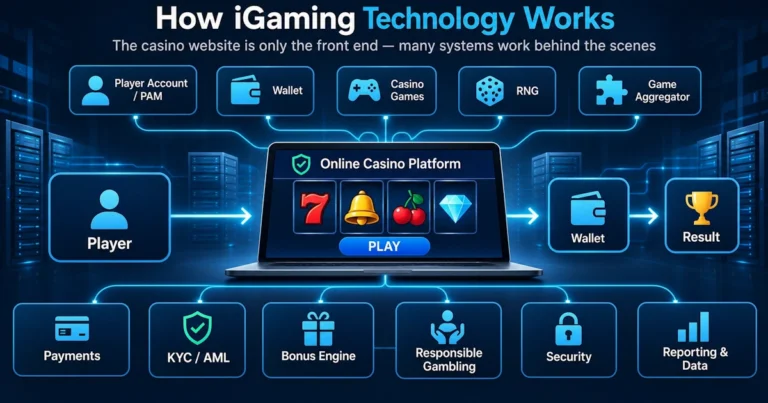
The PAM often sits close to the centre of an online casino or sportsbook technology stack.
A player may see only one website or app, but behind that interface the PAM can be exchanging information with wallets, payment providers, KYC systems, game platforms, bonus engines and responsible gambling tools.
For B2B operators, the PAM is therefore not simply a customer database. It is one of the key systems that coordinates the entire player lifecycle.
What Does PAM Mean in iGaming?
PAM stands for Player Account Management.
The term is widely used in iGaming, although suppliers do not always use it in exactly the same way.
One vendor’s PAM may include:
registration
identity data
authentication
wallet functionality
payments
bonuses
reporting
Another provider may treat some of those systems as separate modules connected to the PAM.
That means PAM should be understood by its functionality, not just by the product label.
A useful general definition is: A PAM is the system responsible for creating, maintaining and controlling player accounts and coordinating account-related activity across an iGaming platform.
The latest GLI-19 standard, Interactive Gaming Systems v4.0, published on November 3, 2026, dedicates an entire chapter to player account requirements, including registration and verification, account management, limits and suspensions, and bonuses.
Why Is the PAM So Important?
Almost every important casino action needs to be associated with the correct player.
Consider one player who:
registers
verifies their identity
deposits €100
claims a bonus
plays a slot
sets a deposit limit
requests a withdrawal
Different specialised systems may process each part.
But all of those events need to relate back to:the same player account
The PAM helps provide that central identity and account context.
Without reliable player-account management, an operator could struggle to answer basic questions such as: Who owns this balance? Is this player verified? Is the account suspended? Which limits apply? Which payment methods belong to this player? Which bonus is active?
This is why the PAM is often described as a core component of the wider casino platform.
Where Does the PAM Sit in the iGaming Technology Stack?
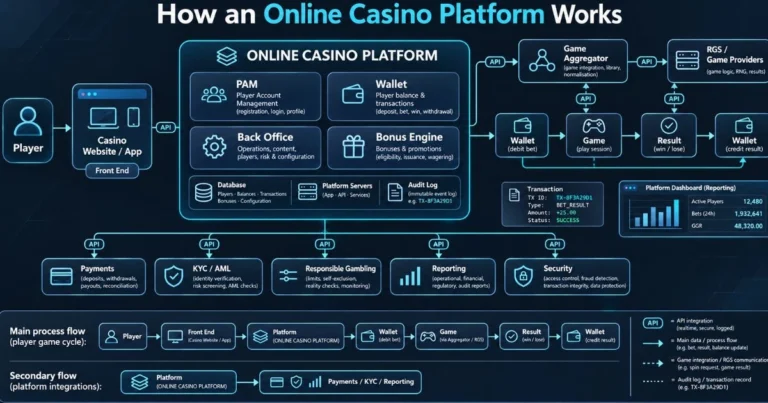
A simplified architecture might look like:
Player ↓ Casino Website / App ↓ PAM ↙ ↓ ↘ Wallet — KYC — Payments ↙ ↓ ↘ Bonus Engine — Games — Responsible Gambling ↓ Reporting / Data
The exact design differs between platforms.
Sometimes the PAM and wallet are one tightly integrated product. Sometimes the wallet is a separate financial service.
The same can apply to:
KYC
payments
bonuses
CRM
responsible gambling
The PAM does not necessarily perform every task itself. Its importance comes partly from its ability to coordinate account-level information between those systems.
What Happens When a Player Registers?
Registration is one of the first jobs involving the PAM.
A player may provide information such as:
Name
Date of birth
Address
Email
Phone number
The PAM creates the player account and stores or references the necessary registration information.
Depending on the jurisdiction, additional steps may be required before the account can become fully active.
GLI-19 v4.0 separates Player Account Registration and Verification from wider Player Account Management, reflecting the fact that account creation, identity checks and ongoing account management are distinct but closely connected functions.
How Does PAM Work With KYC?
KYC stands for Know Your Customer.
The PAM may store the player’s verification status while an external KYC provider performs the actual identity check.
A simplified flow could be:Player enters details ↓ PAM creates account ↓ PAM sends data to KYC provider ↓ KYC provider checks identity ↓ Verification result returned ↓ PAM updates account status
The result could be something like:Verified or:Additional documents required
The PAM can then use that status when deciding whether the player is allowed to continue with account activities.
GLI-19 v4.0 states that account activation should depend on successful registration, identity and eligibility checks, together with other required controls.
Does PAM Store Identity Documents?
It can, but it does not necessarily have to.
A modern architecture may allow a specialist identity provider to store or process sensitive documents while the PAM receives only:
verification result
verification status
reference number
relevant risk indicators
Another architecture may store documents within the operator’s own environment.
The implementation depends on:
platform design
regulatory requirements
security architecture
data-protection rules
For B2B platform evaluation, the better question is not simply: “Does the PAM store passports?”
It is: “How does the PAM securely manage the identity-verification lifecycle and the data associated with it?”
What Does the PAM Do After Login?
Once the player successfully logs in, the PAM can provide important account information and controls.
The current GLI-19 v4.0 standard includes requirements for a Player Account Manager to make account information available after login, including current balance information and appropriate separation of restricted promotional funds.
The PAM may provide or coordinate access to:
account balance
profile details
transaction history
payment methods
account limits
bonus information
account settings
security settings
The UK Gambling Commission‘s remote technical standards also require customers to have access to current account balances and historical account and gambling transactions.
These requirements illustrate why account functionality goes far beyond simply storing a username and password.
PAM and Authentication
The PAM normally plays an important role in account access.
Authentication can include:
password
passkey
biometrics
multi-factor authentication
trusted-device controls
GLI-19 v4.0 includes detailed Player Account Manager requirements for authentication credentials, trusted devices, multi-factor authentication, account recovery and lockouts.
This matters because player accounts can contain:
personal information
payment methods
gambling history
financial balances
Account security is therefore a core PAM responsibility.
What Is Account Recovery?
If a player forgets a password or loses access to an account, the PAM needs a secure recovery process.
A poor recovery system can create a major security weakness. For example, strong login security is not very useful if an attacker can reset the account using an easily guessed answer.
A PAM can therefore support:Account locked ↓ Player requests recovery ↓ Additional authentication / verification ↓ Account access restored
GLI-19 v4.0 specifically includes secure account recovery and lockout requirements within Player Account Management.
PAM vs Wallet: What Is the Difference?
PAM and wallet are closely connected but they are not automatically the same thing.
PAM Primarily manages: the player account and account rules
Wallet Primarily manages: money and financial balances
For example:PAM may know: Player ID: 12345 Status: Active KYC: Verified Deposit limit: €200
The wallet may know: Cash balance: €85 Bonus balance: €30
Some platforms combine these functions. Others use separate services. So the correct architecture depends on the platform rather than one universal industry model.
How Does PAM Work With Deposits?
Imagine a player wants to deposit: €100
A simplified flow might be:Player → PAM / Cashier → Payment Provider
The payment provider processes the transaction. If approved:Payment Provider → Platform returns confirmation.
The wallet then records: +€100
The PAM associates the deposit and resulting balance information with the correct player.
GLI-19 v4.0 includes specific Player Account Manager requirements covering deposits, withdrawals, transaction confirmation, electronic-funds-transfer controls and account-balance safeguards.
The PAM does not necessarily process the banking transaction itself. It helps manage the player-account side of that transaction.
How Does PAM Work With Withdrawals?
The process works in the opposite direction.
Suppose: Player balance: €300 Requested withdrawal: €100
The PAM or connected platform services may need to confirm:
account status
available funds
withdrawal eligibility
payment details
verification status
applicable restrictions
Then the payment process can continue.
The latest GLI-19 standard requires the Player Account Manager to prevent player-initiated withdrawals that would result in a negative account balance and includes controls around approved payment routes and account adjustments.
Again, the PAM manages the account context. A payment processor may execute the actual external transfer.
PAM and Payment Methods
Modern PAM systems may also track which payment methods are connected to an account.
For example: Debit account A E-wallet B
The PAM can help ensure that payment information is associated with the correct player.
GLI-19 v4.0 includes requirements allowing players to view, add, modify or remove stored payment methods, while sensitive payment identifiers should be appropriately protected or masked.
This is important for both: user experience and: account security
Changing a payment method can be a sensitive account action and may require additional authentication.
PAM and Casino Games
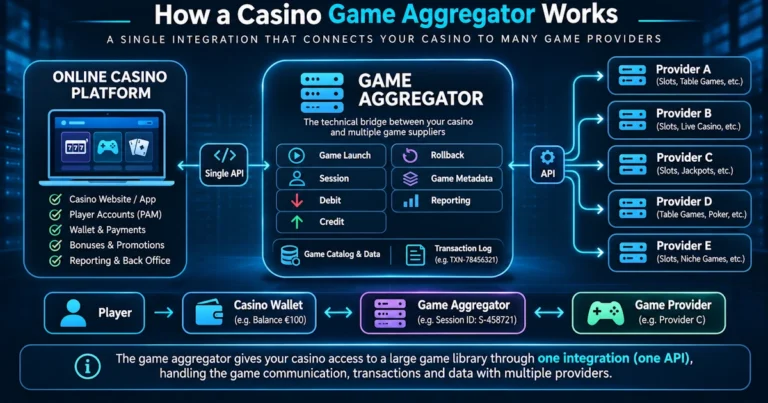
The PAM normally does not determine slot results or run the game mathematics. That is usually the responsibility of:
game server
RGS
game provider
Instead, the PAM helps establish who is playing.
A simplified game flow could look like:Player logs in ↓ PAM identifies player ↓ Casino platform creates game session ↓ Wallet confirms balance ↓ Game provider processes game ↓ Result returned ↓ Wallet updated ↓ PAM account history updated
This distinction matters. PAM manages the player. RGS manages the game.
PAM vs RGS
These systems serve different purposes.
PAM Focus: Player account
Typical functions:
registration
login
verification status
account information
account restrictions
RGS Focus: Casino game
Typical functions:
game sessions
game logic
RNG interaction
game outcomes
payouts
The two systems communicate through the wider casino platform. They should not be treated as interchangeable technology.
PAM vs Online Casino Platform
A PAM is usually a component of a wider online casino platform.
A complete platform may include:
PAM
Wallet
Game Integration
Payments
Bonus Engine
Reporting
Back Office
The PAM focuses primarily on the player-account layer. The casino platform coordinates the wider operation.
However, commercial terminology is not standardized. A supplier may market a product as a PAM platform even when it includes wallet, bonus and payment functionality.
B2B buyers should therefore evaluate actual capabilities rather than product names alone.
PAM vs CRM
PAM and CRM are also different. CRM stands for Customer Relationship Management.
PAM asks: Who is this player and what is the state of the account?
CRM asks: How does the business manage communications and customer relationships?
A CRM may use PAM data for:
segmentation
communications
campaign management
customer-service workflows
But the CRM normally should not be the authoritative source for financial balances or account eligibility. That belongs closer to the core gambling platform.
PAM and Bonus Management
A PAM can also interact with bonus systems.
Suppose a player receives: €50 welcome bonus
The PAM may need to know: Player eligible: Yes Bonus active: Yes Bonus balance: €50 Wagering remaining: €500
The bonus engine may perform the detailed calculations. The PAM provides the player context and makes the relevant status available to other systems.
GLI-19 v4.0 places Bonusing/Promotional Offers directly within its Player Account Requirements chapter, highlighting how closely promotions are connected with account-level controls.
PAM and Responsible Gambling
Responsible gambling controls frequently operate at account level.
Examples can include:
deposit limits
financial limits
time-outs
account suspensions
self-exclusion
The PAM can therefore be central to enforcing them.
Suppose a player sets: Deposit limit: €200 per week
That control needs to follow the player account rather than only one page of the website.
The current UK Remote Gambling and Software Technical Standards require financial-limit facilities at account level and require systems to make them available from registration, with specific rules governing reductions and increases.
This is a good example of why PAM architecture has regulatory consequences.
PAM and Account Suspension
A PAM needs to support different account states.
Examples might include:
Active
Temporarily restricted
Suspended
Self-excluded
Closed
The exact terminology differs between platforms.
Account state can determine whether the player is permitted to:
log in
deposit
wager
withdraw
receive promotions
GLI-19 v4.0 specifically includes player-account limitations, time-outs and suspensions within its Player Account Requirements chapter.
PAM and Account Closure
Players may also request account closure. This is not simply the deletion of one database row.
The platform may need to consider:
active wagers
unsettled games
remaining funds
regulatory records
account history
GLI-19 v4.0 says account closure processes should address outstanding wagers and remaining unrestricted player funds before closure is completed.
Records may still need to be retained according to legal and regulatory requirements even after the customer-facing account is closed.
What Data Does a PAM Typically Manage?
Depending on platform design, PAM-related data can include:
Player identity Name, address, date of birth and account identifiers.
Authentication Login credentials, trusted devices and security status.
Verification KYC and eligibility status.
Financial account information Balances, deposits and withdrawals.
Transaction history Account movements and gameplay-related records.
Payment methods Stored or linked payment information.
Bonus status Promotional credits and restrictions.
Limits and restrictions Responsible gambling and account controls.
Account lifecycle Registration, activation, suspension and closure.
This makes the PAM one of the most data-sensitive parts of an iGaming system.
PAM and Transaction History
A strong PAM needs reliable account records.
A player’s history may contain: Deposit €100 Withdrawal €50 Bonus +€20 Game wagering €200 Game winnings €175
The latest GLI-19 standard requires Player Account Managers to support transaction logs or account statements containing financial and gameplay information, including unique transaction or game identifiers.
The UK Gambling Commission similarly requires remote players to have accessible account and gambling histories, including deposits, withdrawals, bets and winnings.
Transaction history therefore serves both player transparency and operational control.
What Is the PAM’s Source of Truth?
In technology architecture, a source of truth is the authoritative system for a particular type of information.
A good B2B design should clearly define this. For example: PAM = authoritative player identity/account record Wallet = authoritative financial balance RGS = authoritative game-round record
This is only one possible architecture. Another platform may combine PAM and wallet into one system.
What matters is avoiding ambiguity. If three systems all believe they are the authoritative balance source, reconciliation problems can appear quickly.
How Do APIs Connect a PAM to Other Systems?
Modern PAMs commonly expose APIs so other systems can request or update information.
For example:KYC Service → PAM Verification completed
Payment Platform → PAM Deposit approved
Bonus Engine → PAM Bonus activated
Game Platform → PAM Player session requested
Responsible Gambling Tool → PAM Account restriction applied
The exact API structure differs between suppliers. The general principle is that the PAM becomes part of an interconnected ecosystem rather than an isolated database.
Why Does Real-Time Data Matter?
Many PAM decisions need to happen quickly. Suppose a player’s account becomes suspended.
If the game platform learns about that change five minutes later, the player might continue gambling during the gap.
Similarly, if a deposit limit is reached, the payment system needs the correct status before accepting another qualifying transaction.
Good PAM architecture therefore needs reliable synchronization between connected services. Depending on the function, this may involve:
real-time APIs
event messaging
queues
asynchronous updates
The technical method can vary. The business requirement is the same: important account states need to reach the systems that depend on them.
What Is PAM Back-Office Functionality?
Operators also need authorised staff access to player accounts. A PAM back office may allow teams to:
search for players
view account status
review transactions
check verification status
review restrictions
update permitted details
investigate account issues
However, staff access creates security risk. Not every employee should be allowed to: change balances or: modify KYC data or: remove restrictions
Permissions should therefore reflect job responsibilities. Sensitive changes should also be logged.
Why Audit Logs Matter in PAM Systems
If an administrator changes something important, the operator may need to know: Who made the change? What changed? When? What was the previous value?
For example: 14:05 — Account status changed from Active to Suspended or: 16:12 — Payment method updated
Audit trails support:
compliance
fraud investigation
customer disputes
security reviews
operational troubleshooting
GLI-19 v4.0 includes auditability throughout its player-account and financial-transaction requirements, including controls over account adjustments.
Why PAM Security Is Critical
A PAM can contain some of the most sensitive data in the casino environment. Potentially sensitive information includes:
personal data
authentication data
account balances
payment references
gambling history
A compromised PAM could therefore create both: data risk and: financial risk
Security controls can include:
authentication
MFA
encryption
access controls
audit logs
account lockouts
monitoring
secure development practices
GLI-19 v4.0 places significantly stronger account-security detail around authentication, MFA, trusted devices, recovery and payment-method changes than a simple username/password model.
Does a PAM Need Regulatory Certification?
There is no universal worldwide answer. Requirements depend on:
jurisdiction
PAM functionality
operating model
supplier responsibilities
GLI explicitly tests PAM platforms as part of iGaming system evaluation, and its current GLI-19 v4.0 provides technical requirements covering player accounts and platform functionality.
In Great Britain, software designed for use in connection with remote gambling can fall within gambling-software regulation depending on what the software actually does. The Gambling Commission specifically treats software involved in accepting or recording gambling transactions and allocating winnings as core gambling software functions.
A remote gambling software licence can therefore be required for relevant suppliers serving the British regulated market.
B2B suppliers should assess the exact jurisdiction rather than assuming a PAM is either always licensed or always unregulated.
How Is a PAM Tested?
Testing can depend on the functions included in the PAM. Relevant areas may include:
account creation
authentication
KYC integration
financial transactions
balances
account history
limits
bonuses
account closure
security controls
The UK Gambling Commission’s testing strategy specifically identifies player account functionality as part of the technical standards framework for remote gambling products.
GLI-19 v4.0 provides a broader technical framework specifically covering platform and player-account requirements. Testing should therefore focus on what the PAM actually does rather than on the product name.
What Should Operators Look for in a PAM System?
A B2B buyer evaluating PAM technology should look beyond the sales dashboard. Important areas include:
Player lifecycle management Can the PAM reliably manage registration, activation, suspension and closure?
KYC integration Can verification providers be integrated cleanly?
Authentication and security Does it support strong account-access controls?
Wallet integration How are balances and financial transactions connected?
Payment integration Can payment methods and transaction states be handled correctly?
Bonus support Can the PAM communicate effectively with promotional systems?
Responsible gambling controls Can limits and restrictions be applied at player-account level?
Transaction history Can operators and players retrieve accurate account activity?
APIs Can external services integrate without fragile custom work?
Auditability Are sensitive changes traceable?
Multi-brand support Can one deployment manage several brands if required?
Multi-jurisdiction configuration Can different regulatory account rules be supported?
A long feature list is useful. Reliable account control is more important.
What Is Multi-Brand PAM?
Some PAM systems can manage players across multiple casino or sportsbook brands.
For example: PAM ↙ ↓ ↘ Brand A Brand B Brand C
This can create operational efficiencies. But it also raises architectural questions.
For example: Is the player account shared between brands? Are balances shared? Are KYC results shared? Do self-exclusion controls apply across all brands? Can one brand access another brand’s customer data?
The answers depend on licensing, data protection and platform design. Multi-brand capability therefore involves much more than adding another logo.
What Is Multi-Jurisdiction PAM?
An operator may use one PAM across several regulated markets. That can be challenging because account requirements differ.
One jurisdiction may require:
particular verification timing
particular financial limits
specific transaction-history access Another may use different rules.
The PAM therefore needs configurable account controls. The UK Gambling Commission, for example, currently requires customer account information, transaction histories and account-level financial-limit capabilities through its remote technical standards. Other markets can impose different requirements.
A multi-jurisdiction PAM should therefore avoid treating compliance as one fixed global configuration.
PAM vs a Simple Customer Database
A normal customer database might store: Name Email Address
A PAM must typically do much more. It may need to answer: Can this person gamble? Can they deposit? Can they withdraw? What balance applies? What limits apply? Is KYC complete? Is the account suspended? Which payment methods are authorised?
That operational responsibility is what separates a PAM from a basic customer database.
PAM vs Casino Back Office
The PAM is the underlying player-account management capability. The back office is usually the interface through which staff interact with systems such as the PAM.
Think of it this way: PAM = account-management engine Back Office = staff interface
They may be supplied together. But they describe different concepts.
A back-office screen may show information from:
PAM
wallet
KYC
games
payments
bonus systems
The staff user experiences one interface even though the data comes from several services.
Common PAM Misconceptions
“PAM is just a player database.” No. A modern PAM can control registration, authentication, account state, verification status, transactions, restrictions and integrations.
“PAM and wallet are always the same system.” No. They may be combined or separate depending on the architecture.
“PAM runs the casino games.” Normally not. Game functionality is typically handled by game providers or RGS infrastructure.
“PAM and CRM are the same thing.” No. PAM manages operational player accounts. CRM primarily manages customer relationships and communications.
“Every PAM has identical functionality.” No. Supplier scope varies significantly.
“A PAM is automatically compliant everywhere.” No. Regulatory requirements vary by jurisdiction and configuration.
Why PAM Architecture Matters More as an Operator Grows
A small online casino may initially have relatively simple account requirements. As the business expands, the PAM may need to support:
more players
more brands
more jurisdictions
more currencies
more payment providers
more KYC systems
more bonus rules
A weak account architecture becomes harder to manage as integrations increase. For example, changing a player’s account status should not require separate manual updates across five different systems.
The stronger approach is to have clear account ownership and reliable system communication. This is one reason PAM selection can become a strategic B2B technology decision rather than simply another software purchase.
Final Thoughts
So, what is a PAM system in iGaming? PAM stands for Player Account Management.
It is the technology responsible for managing the player account throughout its lifecycle. That can include:
Registration
Identity status
Authentication
Account information
Payment methods
Financial transactions
Limits
Bonuses
Suspensions
Account closure
The PAM then connects that account with the wider iGaming ecosystem: Player → PAM → Wallet → Payments
while also communicating with:
KYC
Games
Bonus Engine
Responsible Gambling
Reporting
The important point is that the PAM does not need to perform every function itself. Instead, it provides the account context that allows specialised systems to work around the same player.
For B2B operators, this makes the PAM one of the most important parts of the technology stack.
Games can be changed. A payment provider can be replaced. A new KYC service can be integrated.
But the player-account layer sits at the centre of the relationship between the customer and the gambling operation.
That is why a strong PAM needs to be more than feature-rich. It needs to be secure, auditable, integration-friendly, financially accurate and flexible enough to support the regulatory markets in which the operator intends to work.
Frequently Asked Questions
What does PAM mean in iGaming? PAM stands for Player Account Management. It refers to technology used to create, manage and control player accounts across an online gambling platform.
Is a PAM the same as an online casino platform? No. A PAM is usually one core component of the wider online casino platform. The platform can also include wallets, game integrations, payments, reporting and other systems.
Is PAM the same as a casino wallet? Not necessarily. The PAM primarily manages the player account, while the wallet manages financial balances and transactions. Some platforms combine both functions.
Does a PAM handle KYC? A PAM can manage the KYC workflow and verification status, but the actual identity check may be performed by an external KYC provider connected through an API.
Does a PAM run casino games? Normally no. Game providers and Remote Game Servers handle game-side functionality. The PAM identifies and manages the player account connected to the game session.
What should operators look for in a PAM? Important areas include player lifecycle management, KYC integration, security, wallet and payment connectivity, responsible gambling controls, APIs, audit logs, multi-brand capability and support for relevant regulatory requirements.