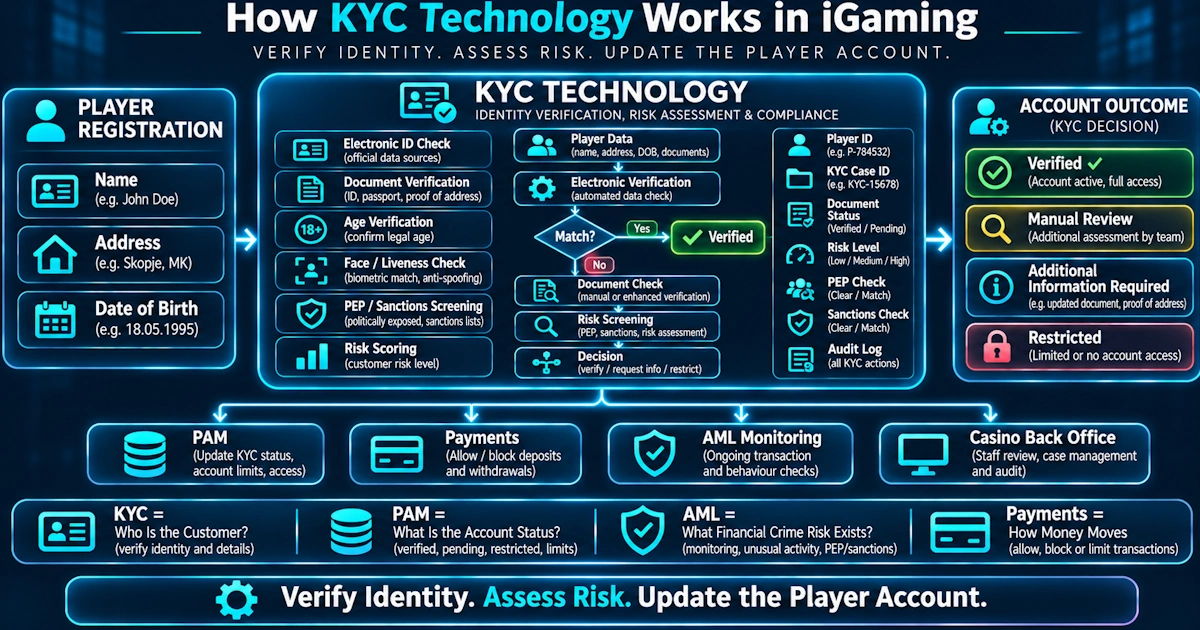
KYC technology in iGaming is the software and data infrastructure used to identify and verify players, assess customer risk and support ongoing compliance throughout the relationship between an online gambling operator and its customers.
KYC stands for Know Your Customer.
A modern KYC process can involve much more than asking a player to upload a passport. Depending on the operator, jurisdiction and risk level, KYC technology can combine:
Electronic identity databases
Document verification
Age verification
Facial comparison
Liveness checks
PEP and sanctions screening
Risk scoring
Source-of-funds workflows
Ongoing monitoring
These systems usually connect directly with the casino’s Player Account Management system, back office, payment infrastructure and AML tools.
The purpose is not simply to collect documents. It is to help the operator answer a much more important question: Do we have sufficient confidence that this customer is who they claim to be, is eligible to use the gambling service and can be managed according to the relevant regulatory requirements?
What Does KYC Mean in iGaming?
KYC stands for: Know Your Customer
It describes the process of identifying customers, verifying relevant information and understanding the risks associated with the relationship.
In an online casino, KYC can support several objectives. These include:
confirming identity
confirming age
preventing underage gambling
reducing identity fraud
detecting duplicate or fraudulent accounts
supporting AML controls
identifying politically exposed persons
identifying sanctioned individuals
supporting responsible gambling controls
KYC therefore sits at the intersection of: Compliance Fraud Prevention Payments Player Protection and: Account Management
What Is KYC Technology?
KYC technology is the software used to automate or support those checks.
Instead of compliance staff manually inspecting every new account, the casino platform can send player information to specialist verification systems.
A simplified flow could look like: Player Registration ↓ PAM ↓ KYC Technology ↓ Identity / Age / Risk Checks ↓ Verification Result ↓ PAM Updated
The result might be: Verified or: Additional Information Required or: Manual Review
The player account can then be treated according to the operator’s rules and regulatory obligations.
Why Is KYC Technology Important in Online Gambling?
An online casino does not meet most customers in person.
The operator needs another way to determine whether: the person exists the person is old enough and: the information supplied belongs to that same individual
That creates a digital identity problem. A customer could theoretically enter: Name A Address B Date of Birth C unless systems exist to verify whether those details belong together.
Good KYC technology helps make that verification faster and consistent. It also allows operators to escalate higher-risk cases rather than treating every customer exactly the same way.
KYC vs Identity Verification
These terms are related but not identical.
Identity Verification Focuses mainly on: Is this person who they claim to be?
KYC Is broader. It may include: Identity Age Risk Profile PEP / Sanctions Screening Source of Funds Ongoing Monitoring
Identity verification is therefore one important part of the wider KYC process.
KYC vs AML
KYC and AML are also frequently confused.
KYC Focuses primarily on: Knowing and verifying the customer
AML Anti-Money Laundering covers the wider framework used to prevent and detect:
money laundering
terrorist financing
related financial crime
AML can include: KYC plus: Transaction Monitoring Risk Assessment Suspicious Activity Investigation Enhanced Due Diligence Source-of-Funds Review
A simple relationship is: KYC is part of the wider AML framework.
Where Does KYC Technology Sit in the iGaming Stack?
A simplified architecture can look like: Player ↓ Registration ↓ PAM ↓ KYC ORCHESTRATION / VERIFICATION ↙ ↓ ↘ Identity Databases — Document Verification — PEP / Sanctions Screening ↓ Result / Risk Status ↓ PAM / Back Office
The KYC layer can also interact with: Payments AML Monitoring Fraud Systems Responsible Gambling Tools
This makes KYC a connected part of the casino ecosystem rather than an isolated compliance screen.
What Information Is Usually Collected?
Requirements vary by jurisdiction. Common information can include: Full Name Date of Birth Residential Address Contact Details
Additional information or documentation can be requested when necessary. For example: Identity Document Proof of Address Financial Information
The amount of information required can depend on:
jurisdiction
player risk
transaction activity
verification result
AML requirements
Operators should not assume that every customer in every market needs exactly the same workflow.
Great Britain: Identity Must Be Verified Before Gambling
Great Britain provides a useful example of how KYC technology affects the customer journey.
Remote gambling licensees must obtain and verify information sufficient to establish a customer’s identity before permitting that customer to gamble.
The required information includes, at minimum: Name Address Date of Birth
The UK Gambling Commission reinforced this point again in August 2026. The Commission explained that the verification process should provide assurance that the customer exists and that the name, address and date of birth all relate to the same individual.
This makes identity verification a pre-gambling control, not merely a withdrawal procedure.
Why Should KYC Not Be Delayed Until Withdrawal?
Historically, customers sometimes experienced substantial verification checks only when trying to withdraw money.
That creates regulatory and customer-experience problems where the operator could reasonably have requested the information earlier.
In Great Britain, information that could reasonably have been obtained earlier should not suddenly be demanded purely as a condition for withdrawal.
Additional checks may still legitimately become necessary later. For example: AML Risk Increases New Source-of-Funds Question Arises Previously Verified Information Becomes Doubtful
The important distinction is between: checks that should have happened earlier and: new checks triggered by later circumstances.
A well-designed KYC system supports both.
What Is Electronic Identity Verification?
Electronic identity verification checks customer information against reliable external data sources.
For example: Name Address Date of Birth may be compared against several independent records.
If the information matches with sufficient confidence, the player may be verified without uploading a physical document.
A simplified process might look like: Player enters details ↓ Electronic Verification Request ↓ Multiple Data Sources Checked ↓ Match Confidence Calculated ↓ Verified / Review Required
This can make onboarding much faster.
What Data Sources Can Electronic KYC Use?
Available data depends on the country and provider. Potential sources can include:
electoral information
credit-reference data
government or trusted identity data
address records
fraud databases
deceased-person records
KYC systems may also check negative-information sources such as: Known Fraud Records PEP Lists Sanctions Lists
The purpose is not merely to find one database containing the same name. It is to establish sufficient confidence using reliable information.
Why Are Multiple Data Sources Better?
One database match can sometimes be wrong. For example, two people may share: the same name or: similar addresses
Using several independent attributes can provide stronger assurance.
Conceptually: Name Match ✓ plus: DOB Match ✓ plus: Address Match ✓ creates stronger evidence than: Name Match Only
The UK Gambling Commission’s current guidance on electronic verification specifically emphasises the importance of using multiple data sources and understanding the reliability of those sources.
What Happens If Electronic Verification Fails?
Failure does not automatically mean the customer is fraudulent. It may simply mean there is insufficient electronic information.
For example: Young Customer may have a limited credit footprint.
A person who recently moved may have: Address Mismatch
A customer from another country may have: Limited Database Coverage
The system can therefore escalate to another verification method. For example: Electronic Verification Failed ↓ Request Identity Document ↓ Document Verification ↓ Verified
This is often called a waterfall or fallback verification process.
What Is Document Verification?
Document verification checks whether an identity document appears genuine and whether the information on it is consistent with the customer.
Documents can include, depending on the operator and market: Passport National Identity Card Driving Licence
The verification technology may analyse:
document type
document number
expiry date
machine-readable data
visual security features
image consistency
The exact checks depend on the document and verification technology.
What Is OCR in KYC?
OCR stands for: Optical Character Recognition
It extracts text from a document image. For example, a passport photograph might contain: Name Date of Birth Document Number
OCR converts those visible fields into structured data. The system can then compare them with: registration information
OCR is useful for automation. But OCR alone does not prove that the document is authentic. A complete document-verification process may apply additional checks.
What Is Document Authenticity Checking?
Document authenticity technology attempts to determine whether the submitted document is genuine rather than altered or fabricated.
Possible checks can include: Expected Layout Document Template Security Features Data Consistency Image Manipulation Indicators Machine-Readable Zone
The available checks vary significantly between document types and providers. A photograph that looks like a passport to a human is not automatically sufficient proof that the document is valid.
What Is MRZ Verification?
MRZ means: Machine Readable Zone
Passports and some identity documents contain machine-readable characters. The system can extract this information and compare it with:
visible document fields
expected formatting
checksums
This provides another way to detect inconsistencies. MRZ validation is one component of document verification. It should not be confused with complete customer verification.
What Is NFC Document Verification?
Some modern identity documents contain NFC-enabled chips. Where supported, a mobile device can read information stored in the document chip.
This can provide stronger evidence than simply photographing the front of the document.
A simplified process can be: Scan Passport ↓ Read NFC Chip ↓ Compare Chip Data With Document ↓ Compare Identity With Customer
Not every device, jurisdiction or KYC workflow uses NFC. It is one possible verification method.
What Is Facial Verification?
Facial verification compares a live or captured image of the customer with the photograph on an identity document or another trusted identity reference.
The system might compare: Document Photo with: Customer Selfie
The result could be expressed as a confidence score. For example: Face Match: Passed or: Manual Review Required
Facial verification is intended to answer a different question from document verification.
Document Verification asks: Is this document credible?
Facial Verification asks: Does the person presenting it appear to be the document holder?
What Is Liveness Detection?
Liveness detection attempts to determine whether the system is interacting with a real person rather than:
a photograph
a recorded video
another spoofing technique
Some systems use: Passive Liveness where the customer simply looks at the camera.
Others may require: Active Actions such as moving the head or following instructions.
Liveness technology can add another defence against impersonation. But it is not universally required for every iGaming KYC process. Whether it is appropriate depends on the operator’s risk model and jurisdiction.
Does Every Player Need to Upload a Selfie?
No. KYC technology should not be understood as: KYC = passport + selfie for everyone
Some players can be verified through reliable electronic data without uploading documents. Others may require: Document Check and some higher-risk or failed-verification scenarios may justify additional identity checks.
The appropriate workflow should reflect:
regulatory requirements
risk
available verification evidence
A strong KYC system therefore supports different verification paths.
What Is Age Verification?
Age verification establishes whether a customer meets the legal minimum age for the gambling service.
The system can use:
verified date of birth
electronic identity data
identity documents
Age verification and identity verification are connected. But simply asking: “Are you over 18?” is not equivalent to verifying age.
The operator needs sufficient evidence according to the relevant rules.
Why Is Age Verification Important Technically?
The result needs to control the player account.
For example: Age Verified = No should prevent: Gambling Allowed = Yes
A simplified flow is: Registration ↓ Age / Identity Check ↓ Pass? No → Account Restricted Yes → Continue Account Activation
The verification result therefore needs to reach the PAM reliably.
What Is a KYC Status?
Instead of every other casino system reading the full KYC file, the KYC platform can provide a status.
For example: Unverified Verification Pending Verified Manual Review Restricted
This status can then be consumed by: PAM Payments Back Office Withdrawal Workflow
The exact terminology differs by platform. The important thing is that other systems know what actions are permitted.
KYC vs PAM
These systems have different responsibilities.
KYC Technology Determines or supports: Identity Verification Status Risk Indicators Screening Results
PAM Manages: Player Account Account State Permissions
The process might be: KYC → Verified ↓ PAM → Account Active
The KYC system produces evidence or a verification result. The PAM applies the account-level consequence.
KYC vs Casino Back Office
The KYC engine performs or coordinates checks. The casino back office allows authorised staff to review the outcome.
For example: KYC Engine returns: Address Match Failed
The back office displays: Manual Review Required
A compliance employee may then:
review documents
request information
record a decision
A good system separates: automated verification from: staff decision workflows while keeping both auditable.
How Does KYC Connect to Payments?
Payment information can provide important identity and risk signals.
For example: Player Name and: Payment Account Holder may need to be consistent.
Operators may also want to understand: Who controls the payment method?
This becomes especially important when unusual financial activity appears. However, a payment provider’s KYC process should not automatically be treated as a substitute for the gambling operator’s own obligations.
The casino remains responsible for ensuring that its customer checks are adequate.
What Is Payment Method Verification?
Payment method verification seeks evidence that the customer has legitimate control over the method being used.
Depending on the method, this can involve:
account-holder information
payment-provider data
bank-account verification
additional documentation
This helps address risks such as: Third-Party Funding Stolen Payment Instruments
Payment verification is closely connected to KYC and fraud controls. It is not identical to verifying the customer’s identity.
What Is PEP Screening?
PEP stands for: Politically Exposed Person
PEPs are individuals who hold or have held prominent public functions, together with relevant family members or close associates under applicable AML frameworks.
A KYC system can screen customer identity against PEP databases.
A possible result could be: Potential PEP Match
That should not automatically mean: Customer Is Criminal
PEP status is a risk factor requiring appropriate due-diligence treatment. The operator needs a process for investigating and resolving potential matches.
What Is Sanctions Screening?
Sanctions screening compares customer information against relevant sanctions lists.
A system may identify: Potential Match because a customer’s name resembles a listed individual.
Again: Potential Match ≠ Confirmed Match
Names can be shared by many people. The operator may need to compare: Date of Birth Nationality Address and other identifying information.
This is why sanctions screening usually requires both technology and review procedures.
Why Are False Positives Important?
Suppose a sanctions list contains: John Smith
The casino also has a customer: John Smith
The name match alone is not enough to conclude that they are the same individual. This is called a potential false positive.
KYC technology should therefore help compliance teams resolve matches rather than simply blocking every customer with a similar name indefinitely.
The same issue can occur with:
PEP lists
fraud databases
adverse-information sources
What Is Adverse Media Screening?
Some KYC and AML systems search public information for potentially relevant negative news about customers. This is commonly called: Adverse Media
Potential topics can include serious financial crime allegations or criminal activity. Adverse-media screening can generate many weak or irrelevant matches.
It therefore requires careful interpretation. A news article mentioning someone with a similar name is not automatically evidence about the customer.
What Is Customer Risk Scoring?
A risk score attempts to classify customers according to relevant risk factors.
A simplified model might contain: Low Risk Medium Risk High Risk
Factors can include:
geography
PEP status
payment behaviour
account activity
customer information
transaction patterns
Higher-risk customers may require more extensive checks. The risk model should reflect the operator’s own AML risk assessment.
Is Risk Scoring Static?
It should not necessarily be.
A customer could begin as: Low Risk and later display activity that changes the assessment.
For example: Registration → Low Risk Later: Unusual Payment Activity ↓ Risk Review ↓ Higher Risk
This is why KYC technology increasingly overlaps with ongoing AML monitoring. KYC is not always finished permanently at registration.
What Is Ongoing KYC Monitoring?
Ongoing monitoring means reviewing the relationship throughout the player’s account lifecycle.
This can include:
keeping identity data current
reviewing transaction behaviour
detecting changes in risk
re-screening relevant watchlists
requesting updated information where necessary
A player verified three years ago is not automatically guaranteed to present exactly the same risk today. The system therefore needs ways to identify when information should be reviewed.
What Is KYC Refresh?
A KYC refresh is a new review of previously collected customer information.
It may be triggered by: Document Expiry Address Change Risk Change Updated Regulation New Information
For example: Passport Expired does not necessarily invalidate everything known about the customer.
But the operator may need updated evidence depending on its requirements and risk assessment.
What Is Perpetual KYC?
The term perpetual KYC, sometimes abbreviated pKYC, describes a more continuous approach to customer information rather than relying only on fixed periodic reviews.
Instead of: Review every three years
the system reacts to events that may change customer risk. For example: New PEP Match Address Changed Risk Pattern Changed ↓ Review Triggered
This is a broader financial-services concept that can also be relevant to sophisticated iGaming compliance architecture.
What Is Customer Due Diligence?
Customer Due Diligence, or CDD, is broader than simply checking a passport.
It involves identifying the customer and understanding enough about the relationship to assess relevant risk. Depending on the situation, CDD can include: Identity Verification Purpose / Nature of Relationship Risk Profile Ongoing Monitoring
For casino operators, CDD is a central part of AML compliance.
KYC vs CDD
These terms are sometimes used interchangeably in casual industry language. A useful distinction is:
KYC is the broader business concept of knowing the customer.
CDD is the formal due-diligence process required within AML frameworks.
In real operational systems, the same technology can support both.
What Is Enhanced Due Diligence?
Enhanced Due Diligence, or EDD, applies additional scrutiny when customer risk is higher.
Depending on the case and jurisdiction, this can involve:
additional identity evidence
additional independent sources
source-of-funds information
source-of-wealth information
senior management approval
enhanced ongoing monitoring
EDD should therefore not be confused with: “ask every customer for more documents.” It is usually risk-driven.
What Is Source of Funds?
Source of Funds, or SOF, asks: Where did the money used for this activity come from?
Examples could include: Salary Savings Investment Proceeds Business Income
The operator may request evidence where necessary. For example: Bank Statement Payslip Sale Documentation
The appropriate evidence depends on the circumstances.
What Is Source of Wealth?
Source of Wealth, or SOW, is broader.
It asks: How did this person acquire their overall wealth? For example: Business Ownership Long-Term Employment Inheritance Investments
SOF and SOW are therefore different. A player might have substantial wealth from business ownership but fund a particular gambling account from a current bank account. The operator may need one or both depending on the risk scenario.
Is Source-of-Funds Checking Part of KYC Technology?
It can be.
A KYC platform may provide a workflow for: Request Information ↓ Upload Evidence ↓ Review ↓ Decision
It may also connect with external data providers. But source-of-funds assessment is not merely: document uploaded = passed
Compliance staff may need to understand whether the evidence is:
credible
consistent
sufficient
Technology supports the process. It does not eliminate professional judgement.
What Is a KYC Case Management System?
Not every verification can be completed automatically.
A case-management workflow can create: Case KYC-92834 Reason: Address Mismatch Status: Manual Review Owner: Compliance Team Priority: Normal
Staff can then:
review evidence
request additional information
add notes
record a decision
This helps prevent compliance cases from being managed through disconnected emails and spreadsheets.
What Is Straight-Through Verification?
Straight-through verification means the customer passes the automated checks without manual intervention.
For example: Registration ↓ Electronic Identity Match ↓ Age Confirmed ↓ No Relevant Screening Alerts ↓ Verified
This can make onboarding extremely fast. The operator can then reserve manual work for: exceptions rather than: every player.
What Is Manual Review?
Manual review occurs when automated systems cannot make a sufficiently reliable decision.
Examples include: Document Image Poor Identity Data Mismatch Potential Sanctions Match PEP Alert Duplicate Account Concern
The objective should not be: automate everything but: automate appropriate cases and escalate the right exceptions.
What Is a KYC Waterfall?
A KYC waterfall runs different verification methods in sequence.
For example: Step 1 — Electronic Database Verification If successful: Verified
If unsuccessful: ↓ Step 2 — Document Verification If successful: Verified
If still uncertain: ↓ Step 3 — Selfie / Additional Check ↓ Step 4 — Manual Review
This approach can reduce unnecessary friction. Not every customer needs to begin with the most intrusive verification method.
What Is KYC Orchestration?
KYC orchestration is a layer that coordinates several identity and compliance providers.
Instead of: Casino → Provider A Casino → Provider B Casino → Provider C
the architecture becomes: Casino → KYC Orchestration → Multiple Verification Services
The orchestration layer might decide: Market A → Identity Database Provider Market B → Document Provider High-Risk Case → Additional Screening
This resembles payment orchestration but applies to identity and compliance workflows.
Why Would an Operator Use Multiple KYC Providers?
One provider may have excellent coverage in: Country A but limited data in: Country B
Another may specialise in: Document Verification while a third provides: PEP / Sanctions Screening
Using multiple providers can improve coverage. But it also creates:
additional integrations
additional contracts
more data flows
reconciliation challenges
KYC orchestration can help manage this complexity.
Does One KYC Provider Work Equally Well Everywhere?
Not necessarily. Identity infrastructure differs significantly by country.
A provider may have access to: strong electronic data in one jurisdiction and rely more heavily on: document checks elsewhere.
B2B operators should therefore evaluate: country coverage rather than simply: number of countries listed on the sales page.
Important questions include: What percentage of players can be verified electronically? Which documents are supported? Which languages are supported? What happens after an automated failure?
How Does API Integration Work?
Modern KYC services commonly connect through APIs.
A simplified request could contain: Player ID Name Date of Birth Address
The provider returns: Verification Status Reference ID Risk Indicators
The casino then updates its PAM.
Sensitive information should be shared only where required. For example, the CRM may need: KYC Complete = Yes It generally does not need: Passport Image
This is an important data-design principle.
What Is a KYC Webhook?
A verification process may not finish immediately.
Suppose: Document Submitted The provider begins analysis.
Later: Verification Completed
The KYC service can send a webhook: KYC_VERIFIED to the casino platform.
The PAM then updates: Verification Status = Verified
This avoids the casino repeatedly asking: “Is it finished yet?”
Why Are Unique KYC Case IDs Important?
A customer may have several verification events.
For example: KYC Case 1 — Initial Identity KYC Case 2 — Address Update KYC Case 3 — Source of Funds
Each should have a unique reference. This helps staff determine:
which evidence belongs to which review
when the review occurred
what result was reached
Auditability is particularly important when compliance decisions affect the player’s ability to use the account.
What Is KYC Auditability?
An operator should be able to understand: What check was performed? Which provider performed it? When? What data was used? What was the result? Who manually reviewed it?
A simple record might show: 14:02 — Electronic Verification Failed 14:05 — Passport Submitted 14:06 — Document Passed 14:07 — Face Match Passed 14:10 — Account Verified
This is much more useful than one field simply saying: KYC = Yes
Why Explainability Matters
KYC vendors may return scores.
For example: Identity Score: 87
That number is meaningless unless the operator understands: What does 87 mean? Which data contributed? What is the decision threshold? What happens below it?
The UK Gambling Commission’s current electronic-verification guidance explicitly stresses that operators should understand what checks a verification provider performs and what the results mean.
B2B buyers should therefore avoid treating proprietary scores as magic answers.
What Is a Confidence Score?
A confidence score estimates how strongly the available evidence supports the match.
For example: Name Match: Strong DOB Match: Strong Address Match: Medium
The provider might convert this into one score.
The operator then applies a rule: High Confidence → Pass Medium → Additional Check Low → Review
The exact scoring model differs between suppliers. It should be calibrated rather than blindly accepted.
What Are False Positives and False Negatives?
False Positive The system flags a legitimate customer incorrectly.
False Negative The system fails to detect a problematic identity or match.
Every verification system has trade-offs. If the rules are too strict: too many legitimate players are blocked
If too loose: more risk can pass through
KYC performance should therefore be assessed using both customer experience and risk outcomes.
Why Is KYC Conversion Important?
From a product perspective, operators often monitor: KYC Completion Rate
For example: 10,000 Started 9,000 Verified Completion: 90%
But a high conversion rate should never be achieved by weakening necessary checks. The goal is: high-quality verification with low unnecessary friction not simply: approve everyone.
What Is KYC Drop-Off?
Drop-off occurs when players abandon the verification process.
Potential reasons can include:
too many steps
unclear instructions
poor mobile experience
unsupported document
slow review
Operators can improve usability while keeping verification requirements intact.
For example: “Upload document” is less useful than: “Upload a clear photo showing all four corners of your passport photo page.”
Good UX can reduce avoidable failure.
How Does Mobile KYC Work?
Most online casino customers can complete verification from a phone.
A mobile KYC flow may use: Camera Document Capture Selfie NFC
The system needs to work across:
different screen sizes
operating systems
camera quality
connection speeds
For operators, mobile performance can materially affect verification completion.
Why Is Document Image Quality Important?
Poor images can cause: OCR Failure Document Authentication Failure Manual Review
Examples include:
glare
blur
cropped document
low light
KYC software often provides capture guidance before the image is submitted. This can reduce unnecessary manual cases.
What Is Duplicate Account Detection?
KYC data can help identify customers attempting to register several accounts.
A system might compare: Name DOB Address Document along with other fraud indicators.
However, duplicate detection needs care. Two members of the same household can legitimately share: Address
The system should therefore not automatically conclude: same address = same person.
Identity resolution should use multiple signals.
How Does KYC Support Self-Exclusion Controls?
Reliable identity information can help an operator identify whether a registering customer appears to match someone who is self-excluded.
For example: New Registration ↓ Identity Verification ↓ Match With Restricted Identity ↓ Account Action
The UK Gambling Commission specifically identifies self-exclusion as one reason why accurate identity verification matters. KYC therefore supports both financial-crime controls and player protection.
KYC and Fraud Prevention
Fraud systems may use identity data alongside:
device information
payment behaviour
login patterns
account relationships
For example: New Account but: Same Identity Document as Existing Account could create a risk alert.
However: KYC technology and: fraud detection are not identical products.
The systems often exchange signals.
KYC vs Device Fingerprinting
Device fingerprinting analyses characteristics of the device or browser.
It might help identify: multiple accounts using same device
But it does not prove identity. A household could share one computer.
Therefore: Device Match ≠ Identity Match
Device intelligence is one input into fraud or risk analysis. KYC establishes identity using stronger evidence.
KYC vs Geolocation
Geolocation answers: Where does the device appear to be?
KYC answers: Who is the customer?
A player can be correctly verified but currently located in a restricted jurisdiction. Conversely, a device can appear in an allowed location while the user’s identity remains unverified.
These are separate compliance controls.
What Is Digital Identity?
Digital identity services allow identity attributes to be verified electronically through trusted systems.
In March 2026, the UK Gambling Commission highlighted new UK government guidance for casinos on using trustworthy digital verification services under the Money Laundering Regulations framework.
This reflects a broader move toward reusable, trusted digital identity infrastructure. For operators, digital identity could potentially reduce repeated document collection where appropriate. But the operator still remains responsible for ensuring that the method satisfies its regulatory obligations.
Can KYC Be Fully Automated?
Some customers can be verified fully automatically. Not every case can.
Automation works best where: Data Is Clear Identity Match Is Strong No Alerts Are Present
Other cases require human review. For example: Potential PEP Unclear Document Source of Funds High-Risk Customer
A realistic KYC architecture therefore combines: Automation + Escalation rather than trying to eliminate compliance staff entirely.
Does AI Perform KYC?
AI and machine-learning techniques can be used in areas such as:
document classification
facial comparison
liveness detection
fraud detection
anomaly detection
But operators should not assume: AI decision = correct decision
Critical decisions still require:
governance
thresholds
monitoring
escalation
audit trails
The more automated the process becomes, the more important it is to understand how errors are handled.
What Happens When KYC Technology Makes a Mistake?
A legitimate player may be incorrectly rejected. Or a fraudulent identity could potentially pass.
Operators therefore need: Appeal / Review Workflow Manual Review Quality Monitoring Vendor Performance Analysis
Simply saying: “The vendor rejected you” is not a complete operational model.
The operator remains responsible for how its verification process works.
Can an Operator Outsource KYC?
The technology and some verification services can be outsourced. Regulatory responsibility generally cannot simply be handed away.
The operator still needs to understand:
which checks occur
which data sources are used
how results are interpreted
what happens on failure
whether the process meets its legal obligations
This is particularly important in gambling because KYC can affect: access to gambling financial transactions AML player protection
What Should Operators Ask a KYC Vendor?
A serious B2B evaluation should include questions such as:
Identity Coverage Which countries and identity types are supported?
Electronic Verification Which markets can be verified without documents?
Document Coverage Which passports and national IDs are supported?
Fraud Detection How are altered or stolen documents identified?
Biometrics Are facial comparison and liveness available?
PEP / Sanctions Which screening sources are supported?
Ongoing Monitoring Can customers be re-screened after onboarding?
API How does the platform integrate with PAM?
Webhooks How quickly are status changes returned?
Case Management How are failed and ambiguous cases handled?
Audit Trail Can the operator see what checks were performed?
Data Security Where are documents and biometric information stored?
Data Retention How long is verification information retained?
Performance What percentage of cases require manual review?
Vendor Exit Can verification records be exported?
A KYC product should not be chosen only because the demo can scan a passport quickly.
What Should Operators Test Before Buying?
A proper proof of concept should include several scenarios. Test:
Successful Electronic Verification Electronic Verification Failure Valid Passport Expired Document Poor-Quality Image Name Mismatch Address Mismatch Potential PEP Match Potential Sanctions Match Duplicate Account Customer Changes Address Manual Review Provider Timeout Webhook Retry KYC Status Sent to PAM Audit Trail
This reveals how the system handles exceptions. The happy path is usually the easiest part.
What KYC Metrics Matter?
Useful operational metrics can include: Automatic Verification Rate Manual Review Rate Verification Completion Rate Average Verification Time Document Failure Rate False Positive Rate Provider Error Rate Country-Specific Success Rate
These metrics need context. For example: 95% automated approval does not automatically mean the system is better than one approving: 90% if the first system has weaker risk controls.
What Is Manual Review Rate?
Manual review rate measures how many cases require staff intervention.
For example: 10,000 KYC Checks 800 Manual Reviews Manual review rate: 8%
Reducing unnecessary reviews can lower operating cost. But trying to eliminate manual review entirely can create risk. Some ambiguous cases genuinely need human judgement.
Why Country-Level Metrics Matter
A KYC provider might show: Global Verification Rate: 92%
But perhaps: Country A = 98% and: Country B = 63%
If the casino plans to enter Country B, the global number is not very useful. B2B buyers should therefore evaluate the countries that matter to their own business.
Why Data Security Matters
KYC systems can process highly sensitive information. Potential data includes: Identity Documents Address Date of Birth Facial Images Financial Documents
A security breach involving this information can be particularly serious.
Operators should therefore assess:
encryption
access controls
staff permissions
retention
deletion
vendor security
incident management
KYC technology should reduce identity risk without creating uncontrolled data risk.
Should the CRM Receive KYC Documents?
Usually there is little reason for a marketing CRM to receive copies of identity documents. The CRM may need only: KYC Status = Verified
The compliance back office may require deeper access. This separation follows a useful architectural principle: Send systems the information they need, not every piece of data available.
Why Role-Based Access Matters
Different employees need different KYC access.
For example: Customer Support may need: Verification Status but not: Full Passport Image
Compliance Analyst may need access to detailed documents.
Marketing may need no KYC documents at all.
The back office should therefore support role-based permissions. Sensitive identity information should not be visible simply because someone has a general casino admin account.
Why Audit Logs Matter
A KYC audit log can show: Who viewed the case? Who changed the status? Who approved the account? Which documents were reviewed?
This supports:
compliance
security
dispute investigation
For example: 16:05 — Automated Check Failed 16:12 — Compliance Analyst Reviewed 16:18 — Additional Evidence Accepted 16:19 — Account Verified
That is much stronger than a system showing only: Verified with no history.
What Happens if a KYC Provider Goes Down?
If identity verification is required before gambling, a KYC outage can directly affect customer onboarding.
A player might register successfully but remain: Verification Pending
The operator needs to decide whether it has:
fallback provider
manual process
queue and retry mechanism
KYC provider availability can therefore become operationally important.
What Is KYC Failover?
A multi-provider architecture could use: Provider A as the primary electronic verification service.
If unavailable: Provider B could potentially be used.
But failover must be carefully designed. Providers may:
use different data
return different statuses
apply different scoring
The casino should not treat two providers as completely interchangeable without validating the workflow.
Why Should Verification Results Be Normalised?
Suppose: Provider A says: PASS Provider B says: VERIFIED Provider C says: GREEN
The PAM should not need custom business logic everywhere. A KYC orchestration layer can normalise the statuses into: Verified
Similarly: REVIEW AMBER INCONCLUSIVE could map to: Manual Review
This simplifies the core platform.
Is KYC Technology Regulated?
There is no universal worldwide licence called a: KYC technology licence
Regulatory treatment depends on:
jurisdiction
service
outsourcing structure
data handled
The gambling operator remains responsible for meeting the gambling and AML requirements that apply to its operation.
A KYC provider may also be subject to:
privacy law
information-security obligations
digital identity frameworks depending on its service and location.
Does GLI Cover Identity Verification?
The current Gaming Laboratories International standards catalogue lists GLI-19 Interactive Gaming Systems v4.0 as the current standard for interactive gaming systems.
Player account registration and verification form part of the interactive-gaming system framework.
This reflects an important principle: identity verification is part of platform control, not merely a customer-service task.
Individual regulators ultimately determine the requirements applying in their jurisdiction.
Malta and Player Verification
Malta also illustrates the relationship between player accounts and verification.
MGA rules require B2C gaming customers to be registered with the operator and require player information to be verified and due diligence performed according to applicable AML requirements.
MGA compliance material also expects operators to be able to display the identity-verification status of players and securely maintain relevant KYC documentation.
This reinforces the importance of connecting: KYC with: PAM / Back Office rather than managing verification entirely outside the gaming platform.
Common KYC Technology Misconceptions
“KYC means uploading a passport.” No. Customers can sometimes be verified electronically without submitting documents.
“KYC and AML are the same thing.” No. KYC supports customer identification and risk understanding. AML is the wider financial-crime framework.
“If the PSP verified the customer, the casino does not need KYC.” Not automatically. Gambling operators remain responsible for satisfying their own regulatory obligations.
“Every player needs facial recognition.” No. Verification methods depend on jurisdiction, evidence and risk.
“A PEP match means the customer has committed a crime.” No. PEP status is a risk factor requiring appropriate due diligence.
“KYC finishes once the player passes registration.” Not necessarily. Ongoing monitoring and updated verification can be required during the customer relationship.
KYC Technology vs Related Systems
System | Main Role KYC Technology | Verifies identity and supports customer due diligence PAM | Manages player account and account status AML System | Monitors wider financial-crime risk and transactions Fraud System | Detects identity, account and payment abuse Payment Platform | Processes deposits and withdrawals Back Office | Gives authorised staff access to compliance workflows CRM | Manages customer communications and lifecycle journeys
These systems frequently exchange data. They should not automatically be treated as one product.
A Simple End-to-End KYC Flow
Consider a new casino player.
Step 1 — Registration Player enters: Name Address Date of Birth ↓ Step 2 — PAM Creates Pending Account Player ID: 48291 ↓ Step 3 — Electronic Verification KYC provider checks trusted data. ↓ Step 4 — Result Identity Match Inconclusive ↓ Step 5 — Document Request Player submits: Passport ↓ Step 6 — Document Check Authenticity ✓ Document Data ✓ ↓ Step 7 — Facial Verification, if required Match ✓ ↓ Step 8 — Screening PEP / Sanctions / Other Relevant Checks ↓ Step 9 — Decision Verified ↓ Step 10 — PAM Update Account Status = Active
Later: Risk changes ↓ KYC / AML Review Triggered
This demonstrates why KYC should be viewed as a connected lifecycle rather than one upload screen.
What Should Operators Look for in KYC Technology?
The strongest KYC solution is not necessarily the one demanding the most information from every player.
A better system should help the operator apply: the appropriate level of verification to the appropriate customer at the appropriate time.
For a B2B operator, the most important areas are:
Verification Quality
Market Coverage
Automation
Fallback Workflows
Risk Screening
Manual Review
Ongoing Monitoring
API Integration
Security
Auditability
Data Governance
Vendor Independence
A good KYC system should allow legitimate customers to complete verification efficiently while giving compliance teams stronger tools when genuine risk appears.
Final Thoughts
So, what is KYC technology in iGaming?
It is the technology used to establish and maintain confidence in the identity and relevant risk profile of online gambling customers.
A modern KYC stack can combine:
Electronic Identity Verification
Document Authentication
Age Verification
Facial Comparison
Liveness Detection
PEP Screening
Sanctions Screening
Risk Scoring
Source-of-Funds Workflows
Ongoing Monitoring
The architecture might look like: Player → PAM → KYC Technology → Identity / Screening Providers → Verification Result → PAM / Back Office
But the most important distinction is: Technology performs or supports the checks. The gambling operator remains responsible for the customer relationship and its regulatory obligations.
A fast verification process is valuable. A high automated approval rate is valuable. But neither is enough on its own.
Strong KYC technology needs to balance: Accuracy Customer Experience Risk Security Compliance Auditability
The goal is not to collect the largest possible number of documents. It is to obtain sufficient, reliable and appropriately risk-based evidence about the customer while keeping the process as efficient as the circumstances allow.
Frequently Asked Questions
What is KYC technology in iGaming? KYC technology is software used by gambling operators to identify and verify players, check identity data and documents, perform relevant risk screening and support ongoing customer due diligence.
Is KYC the same as identity verification? No. Identity verification is one part of KYC. KYC can also include risk assessment, PEP and sanctions screening, enhanced due diligence and ongoing monitoring.
Can online casinos verify players without documents? Yes, in some markets reliable electronic data sources can provide sufficient identity evidence. If electronic verification is inconclusive, the operator may request identity documents or additional checks.
What is the difference between KYC and AML? KYC focuses on knowing and verifying the customer. AML is the wider framework for preventing and detecting money laundering and related financial crime. KYC is one component of AML.
Do all casino players need selfie verification? No. Verification methods depend on the jurisdiction, available identity evidence and the operator’s risk-based process. Facial comparison or liveness checks can be used where appropriate but are not a universal requirement for every player.
Does KYC end after registration? Not necessarily. Operators can need ongoing monitoring, updated customer information and enhanced checks when risk changes during the relationship.