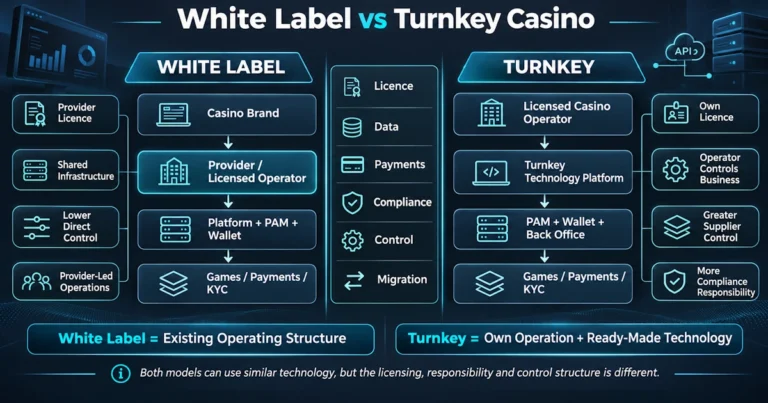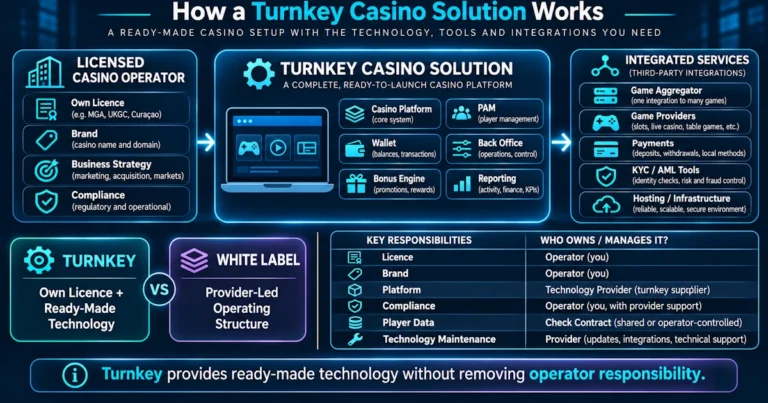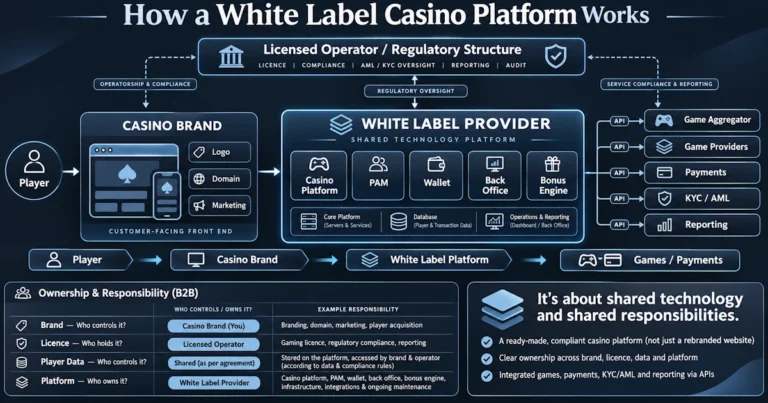
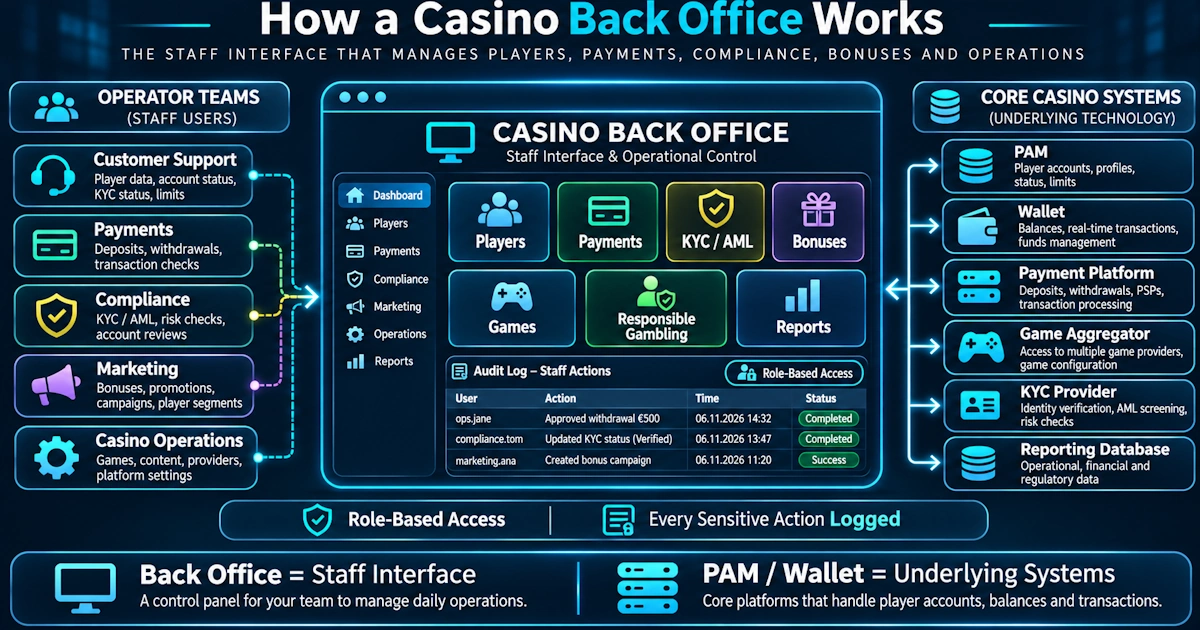
A casino back office system is the staff-facing software used to manage the day-to-day operation of an online casino. Players do not normally see it.
Instead, authorised employees use the back office to work with player accounts, payments, bonuses, games, KYC information, compliance controls, reports and other operational functions.
For example, a customer-support employee might use the back office to review a player’s account history. A payments team could review a withdrawal. A compliance analyst might check verification status, while a marketing team could configure a promotion within the permissions given to them.
The back office usually sits on top of other iGaming systems such as the PAM, wallet, payment platform and bonus engine.
This distinction is important. The PAM and wallet store and enforce important account data. The back office gives authorised staff a controlled way to work with that data.
For B2B buyers, the quality of the back office can have a major effect on how efficiently and safely a casino is operated.
What Is a Casino Back Office System?
A casino back office is the administrative environment used by an operator’s internal teams.
A simplified architecture can look like this:
Player ↓ Casino Website / App ↓ Casino Platform ↓ PAM / Wallet / Games / Payments ↑ BACK OFFICE ↓ Operator Staff
The player interacts with the casino front end. Staff interact with the back office.
The back office can collect information from several underlying systems and present it through dashboards, search tools, reports and operational workflows.
Depending on the platform, it may allow authorised users to:
search player accounts
review deposits and withdrawals
check account balances
inspect KYC status
manage bonuses
control game availability
apply account restrictions
review financial activity
generate reports
investigate incidents
The exact scope varies considerably between suppliers.
Is the Back Office the Same as the Casino Platform?
No. The casino platform is the wider technology environment that operates the online casino.
It may include:
PAM
Wallet
Game Integrations
Payment Systems
Bonus Engine
Reporting
Back Office
The back office is one part of that wider environment.
A useful distinction is:Casino Platform = underlying operational technology Back Office = staff interface for managing it
A platform can theoretically continue processing game transactions even when no employee is looking at the back office dashboard.
Is Back Office the Same as PAM?
No. These terms are closely related, which is why they are often confused.
PAM PAM stands for Player Account Management. It manages the actual player-account state and related rules. For example:
Player ID
Account Status
KYC Status
Limits
Transaction History
Back Office The back office allows staff to view or interact with those records. For example:
Search Player
View Account
Review Verification
Suspend Account
A useful way to think about it is:PAM = account-management engine Back Office = staff control panel
In many commercial platforms they are sold together, but architecturally they are different concepts.
Who Uses a Casino Back Office?
Different operational teams may use the same back office with different permissions. Typical users can include:
Customer Support Support staff may need to:
search accounts
review player history
view account status
investigate basic payment questions
Payments Team Payments staff may review:
deposits
withdrawals
failed transactions
payment methods
Compliance Team Compliance users can work with:
KYC status
AML information
account restrictions
risk alerts
Fraud or Risk Team Risk specialists may investigate:
unusual transactions
multiple accounts
suspicious payment activity
bonus abuse
Marketing Team Marketing users may manage:
promotions
bonuses
campaign configuration
Casino Operations Team Casino managers may control:
game catalogue
provider availability
game categories
market availability
Management Managers may access:
revenue reports
payment performance
player statistics
operational dashboards
Not every employee should have access to every function. That is why user permissions are one of the most important parts of back-office design.
What Does a Casino Back Office Usually Manage?
Functionality differs, but a modern back office can commonly provide tools across several areas. These include:
Player Management
Payments
KYC / AML
Bonuses
Games
Responsible Gambling
Reporting
Risk Management
Staff Administration
Audit Logs
The back office can therefore become the main operational workspace for the casino team.
How Does Player Management Work?
One of the most common back-office functions is player search and account review.
An authorised employee might search using:
Player ID
Name
Email
Account reference
The back office can then display information such as:Account Status: Active KYC: Verified Cash Balance: €125 Bonus Balance: €20 Registration DateRecent TransactionsResponsible Gambling Status
The staff user is viewing data coming from the underlying platform. That does not necessarily mean the back office itself is the source of truth for that information.
What Is a Player 360 View?
Some iGaming systems use the term Player 360 for a consolidated account screen. The idea is to show important player information in one place.
For example:
Profile
Verification
Balances
Payments
Gaming History
Bonuses
Limits
Support Notes
This can help staff avoid switching between many different systems. However, the term is a commercial product label rather than a universal technical standard. One provider’s Player 360 screen may contain much more information than another’s.
How Are Deposits Managed in the Back Office?
The back office can show deposit information received from the wallet and payment systems.
A transaction might display:Deposit: €100 Payment Method: Bank Card Status: Approved Transaction ID: TX-45821 Time: 14:32
Other statuses could include:
Pending
Declined
Reversed
Employees may use this information to investigate player questions or reconcile payment issues. The payment processor still performs the external financial transaction. The back office provides operational visibility into that process.
How Are Withdrawals Managed?
Withdrawal workflows are especially important because money is leaving the casino account.
A back-office screen might show:Withdrawal Request: €250 KYC Status: Verified Payment Method: Verified Bonus Restrictions: None Risk Review: Required
Depending on platform design and permissions, staff may be able to:
review the request
request additional checks
approve it for processing
reject it for a legitimate reason
send it to another team
The exact workflow depends on the operator and jurisdiction. A good system should make it clear:who made each decision and:why
Should Staff Be Able to Change Player Balances?
This is a sensitive function. Sometimes operators need controlled account adjustments.
Examples can include:
correcting a verified technical error
applying an approved goodwill adjustment
resolving a payment issue
But manual financial changes create obvious risk. A strong system should not allow an ordinary employee to casually type a new balance into a database field.
Instead, adjustments should use controlled functions with information such as:
Adjustment Amount
Reason
Staff User
Date / Time
Reference
Potentially, higher-risk actions can also require additional approval. The core principle is:balance adjustments should be controlled and traceable.
Why Are Audit Logs Important?
An audit log records important actions performed in the system.
For example: 10:15 — User A opened Player 123 10:18 — User A changed account status 10:20 — User B approved €200 withdrawal 11:03 — User C changed bonus configuration
Audit logs can help answer:Who made the change?When was it made?What changed?
This is useful for:
compliance reviews
fraud investigation
security incidents
customer complaints
operational mistakes
Gaming standards place significant importance on auditability and traceable player-account and financial activity. GLI currently lists GLI-19 Interactive Gaming Systems v4.0 as its current interactive gaming standard.
How Does the Back Office Work With KYC?
A casino may use a specialist external KYC provider to perform identity verification. The back office can display the result.
For example:Identity: Verified Address: Verified Additional Review: No Or:Verification: Pending Document Review Required
A compliance user might then open the case and review the relevant information according to internal procedures.
The important distinction is: KYC provider performs or supports verification while: back office gives authorised casino staff access to the workflow and status depending on the architecture.
What About AML Reviews?
Anti-money-laundering workflows can also appear in the back office.
For example, a compliance analyst might see:Risk Level: High Unusual Payment ActivityReview Required
The system may combine information from:
PAM
transaction monitoring
KYC
external risk tools
The casino then applies its policies and regulatory procedures.
UK Gambling Commission guidance requires casino operators to take a risk-based approach to customer due diligence and ongoing risk assessment rather than relying only on third-party systems.
This means a back-office dashboard can support AML decision-making. It does not replace the operator’s responsibility to make and document appropriate decisions.
Can a Back Office Detect Fraud?
The back office itself may contain fraud tools, or it may display alerts generated by another system.
Examples can include:
duplicate accounts
unusual login behaviour
third-party payments
repeated failed transactions
bonus abuse indicators
suspicious withdrawal patterns
A risk analyst can then investigate. Automated rules are useful for identifying patterns. They should not be confused with final proof that fraud has occurred.
How Are Bonuses Managed?
The casino back office can provide an interface for configuring promotions.
A marketing or operations employee might create:Welcome Bonus 100% up to €100
Then configure:
Start Date
End Date
Eligible Players
Eligible Games
Wagering Requirement
Maximum Bonus
The actual bonus engine then applies the rules to eligible players.
This distinction is useful:Back Office → staff configure the promotion Bonus Engine → system enforces the rules
Some platforms combine these layers closely enough that they appear to staff as one product.
Why Bonus Permissions Matter
Bonus configuration can directly affect money and regulatory compliance.
An employee who can freely create: €10 bonus might theoretically also create: €100,000 bonus unless controls exist.
Sensitive promotional settings can therefore require:
permission limits
approval workflows
audit logs
configuration validation
The larger the financial or compliance impact of a back-office action, the stronger the control should generally be.
How Are Casino Games Managed?
Casino operations teams may use the back office to control the game catalogue.
For example, staff could manage:
Provider
Game Name
Category
Status
Market Availability
Currency
A game could be:Active or:Disabled
The operator may also arrange games into categories such as:
Slots
Live Casino
Jackpots
New Games
The actual game is normally hosted or supplied through a game provider or RGS. The back office controls how that content is made available through the casino platform.
Can Staff Change a Game’s RTP From the Back Office?
This should not be assumed.
Some game providers can support multiple approved game configurations. However, staff should not be able to arbitrarily invent a new RTP value.
Available configurations depend on:
provider mathematics
certified game versions
technical integration
regulatory requirements
Where configuration choices exist, they should be controlled and traceable. The back office is an administrative interface. It does not give the casino unrestricted power to rewrite game mathematics.
How Does Responsible Gambling Appear in the Back Office?
Responsible gambling controls often affect player accounts.
A back-office user may be able to see information such as:
Deposit Limit
Time-Out
Self-Exclusion
Account Restriction
Depending on permissions and jurisdiction, specialised staff may also perform actions connected with customer interactions or restrictions.
The UK Gambling Commission requires gambling systems to support relevant customer-protection controls and maintain records where needed for investigation and compliance.
A key principle is that sensitive safer-gambling controls should not be casually removable by ordinary staff.
What Is a Case Management Workflow?
Large operators can have thousands or millions of player accounts. Compliance and risk issues therefore need structured workflows.
A case-management system might create:Case #KYC-48321 with: Owner: Compliance Team Status: Under Review Priority: High Next Action: Request Document
The workflow can help ensure that a case does not disappear inside an email inbox. Depending on the platform, case management may be built into the back office or connected through a separate compliance tool.
What Reports Can a Back Office Provide?
Reporting is another major function. Possible operational reports include:
Player Reports
registrations
active accounts
verified accounts
Payment Reports
deposits
withdrawals
failed transactions
payment-method performance
Game Reports
wagers
payouts
game activity
provider activity
Bonus Reports
bonuses issued
bonus cost
promotional usage
Operational Reports
account restrictions
staff activity
case volumes
Some information may also support regulatory reporting.
The Malta Gaming Authority specifically treats software that generates, captures, controls or processes essential regulatory records as potentially falling within its B2B Critical Gaming Supply framework. That shows how important back-office and record-processing technology can become from a regulatory perspective.
What Is a Regulatory Record?
The precise definition depends on the jurisdiction.
Broadly, gaming operations can need records connected with areas such as:
players
transactions
game activity
financial information
account changes
The MGA’s B2B framework specifically covers software used to generate, capture, control or otherwise process essential regulatory records, as well as the control systems on which such software operates.
So back-office software should not always be thought of as a generic business dashboard. Some back-office functions can form part of the regulated gaming system itself.
Is Casino Back Office Software Regulated?
Potentially. There is no universal worldwide licence simply called a casino back office licence.
Regulatory treatment depends on:
jurisdiction
software functionality
which records it controls
supplier responsibilities
Malta provides a particularly clear example. The MGA says a B2B critical gaming software supply licence can apply to software that generates, captures, controls or processes essential regulatory records and to the control system on which that software resides. Its reporting framework also expressly identifies B2B relationships involving the licensable supply and management of back-office software.
Other jurisdictions use different licensing structures.
Is Every Admin Dashboard a Regulated Back Office?
No. A simple generic business tool does not automatically become gambling software just because a casino company uses it.
For example:Office HR System and:Generic Accounting Software are different from software that directly controls critical player, transaction or gaming records.
The regulatory question depends on what the software actually does. This is a recurring principle in iGaming:Function matters more than the marketing name.
Why Are User Roles Important?
Imagine an operator has 200 employees. They should not all have identical system access.
A customer-support agent may need:View Player Account but not:Change Wallet Balance
A marketing employee may need:Create Promotion but not:Approve Withdrawal
A compliance manager may need:View KYC Documents but not necessarily:Edit Game Configuration
This is known as role-based access control, or RBAC. A good back office should allow permissions to be designed around job responsibilities.
What Is Least-Privilege Access?
The principle of least privilege means a user receives only the access needed to perform their job.
For example:Support Agent might be allowed to:
view account details
read transaction history but not:
change financial balances
download the complete player database
modify system security settings
This reduces the damage that can result from:
employee error
compromised accounts
insider misuse
The UK Gambling Commission’s security requirements specifically include access control, identity management, access rights, privileged access, authentication and information-access restrictions.
Should Back-Office Staff Use MFA?
For sensitive systems, strong authentication is highly relevant.
A back-office login can provide access to:
personal information
player balances
payment activity
compliance records
A stolen staff password can therefore create serious risk.
UKGC security requirements include controls concerning authentication information, secure authentication and privileged access rights for critical systems. The exact implementation depends on the organisation and applicable security framework.
Why Is Privileged Access Different?
Some users need more powerful permissions.
For example:System Administrator might be able to:
create staff accounts
change roles
configure integrations
These are privileged functions. They should generally be more tightly controlled than ordinary account access.
The UKGC’s security framework explicitly includes controls for privileged access rights, access restrictions and logging. This is particularly relevant to casino back offices because one admin account can potentially affect many customer accounts.
What Happens When an Employee Leaves?
Access should not remain active indefinitely.
When a staff member leaves the organisation or changes role, their permissions may need to be:
removed
reduced
reassigned
The UKGC’s ISO/IEC 27001:2022-based security controls include responsibilities after termination or changes in employment.
This sounds like an HR issue. But if the employee has access to a casino back office, it is also a system-security issue.
Why Should Sensitive Actions Require Extra Approval?
Some operators use a four-eyes principle for high-risk actions. This means one user performs or requests the action and another authorised user confirms it.
For example:User A → Requests Large Balance Adjustment User B → Approves
This can be useful for areas such as:
high-value manual adjustments
sensitive account changes
large withdrawal exceptions
Not every action requires two people. The level of control should reflect the financial and regulatory risk.
Why Is Logging Critical?
A secure back office should record important system activity.
The UKGC’s current security requirements specifically include logging among the relevant ISO/IEC 27001:2022-based technological controls.
For example, logs can record:
Staff User
Action
Player
Time
Result
This makes operational activity easier to investigate later. A system that allows high-impact actions without traceability creates significant governance risk.
Back Office vs CRM
CRM stands for Customer Relationship Management. The systems can overlap, but they have different primary purposes.
Back Office Used to operate the casino. It can cover:
player accounts
payments
KYC
games
reports
CRM Used to manage customer communications and marketing activity. It can cover:
segmentation
campaigns
emails
notifications
retention journeys
A CRM may consume information from the casino platform. A back office may even contain basic CRM tools. But the terms should not automatically be treated as identical.
Back Office vs Business Intelligence
Business Intelligence, or BI, focuses more heavily on analysing data.
BI tools can help answer questions such as:Which market generates the highest GGR?Which payment method has the highest failure rate?Which games are most active?
The back office is more operational. For example:Review this withdrawalSuspend this accountConfigure this promotion
Some platforms combine operational dashboards and BI. But analysis and operational control are different functions.
Back Office vs Payment Platform
A payment platform connects to external financial services. The casino back office may display payment data and provide workflows around it.
For example:Back Office → Withdrawal Approval then:Payment System → External Transfer
The back office does not necessarily move the bank funds itself. It controls or displays the operator-side workflow.
Back Office vs Game Aggregator
A game aggregator connects the casino to multiple game providers. The back office might allow staff to manage the game catalogue delivered through that aggregator.
So:Aggregator → delivers game connectivity Back Office → gives staff operational control over available content
They perform different functions.
Can One Back Office Manage Multiple Casino Brands?
Yes, depending on the platform.
A multi-brand environment might look like:Back Office ↙ ↓ ↘ Brand A Brand B Brand C
A staff member might be allowed access to: all brands or: only Brand B
This introduces additional permission requirements. The platform needs to prevent employees from accessing data they are not authorised to see.
What About Multiple Jurisdictions?
A multi-jurisdiction casino can be more complicated.
For example:Market A may have one responsible-gambling workflow.Market B may require another.
The back office may therefore need configurable:
account statuses
reporting
game availability
KYC workflows
limits
payment rules
A system designed for one jurisdiction may not automatically be suitable for another.
Why Does Data Export Matter?
Operators should not be trapped inside the back-office interface.
They may need data for:
finance
BI
regulatory reporting
audits
migration
B2B buyers should therefore understand whether data can be accessed through:
reports
CSV exports
data warehouse feeds and what restrictions apply.
If the operator cannot retrieve its own operational records in a usable form, platform migration can become much harder.
What Is a Back-Office API?
A platform can expose administrative functions through APIs instead of requiring every action to be performed manually in the interface.
For example, an internal system could request: Get Player Account or: Get Transaction History
This can support custom internal tools. However, administrative APIs can be highly sensitive. They should use strong authentication, authorization and logging because they may provide access to critical casino functions.
Why Is Back-Office Security So Important?
The back office can become one of the most powerful access points in the casino environment.
It may connect directly to systems holding:
personal information
authentication data
balances
transaction histories
regulatory records
The UK Gambling Commission applies security requirements to critical systems that record, process or transmit sensitive customer information, authentication information and customer account balances, as well as systems that can communicate directly with those critical systems.
That means a back office connected to those systems can be highly security-sensitive.
The UKGC framework includes controls covering areas such as:
access rights
privileged accounts
secure authentication
logging
network security
cryptography
backups
secure development
change management
Is ISO 27001 Relevant?
For Great Britain, yes, in a specific regulatory context.
The Gambling Commission’s RTS security requirements are based on selected controls from ISO/IEC 27001:2022. The Commission’s requirements apply to defined critical systems and include annual third-party security-audit requirements for specified remote gambling licence categories.
This does not mean every casino back-office vendor automatically needs a full ISO 27001 certification. The exact scope depends on the operator, licence category, system and regulatory responsibilities.
What Happens If the Back Office Goes Offline?
The impact depends on the architecture.
The customer-facing casino might continue running while staff temporarily lose administrative access. Or important operational processes might be affected.
Potential problems include:
withdrawal reviews delayed
support unable to inspect accounts
compliance cases inaccessible
game configuration unavailable
A serious platform provider should therefore consider:
availability
backups
disaster recovery
monitoring
incident management
A back office is an internal system, but it can still be operationally critical.
Why Does Performance Matter?
Staff need to search and review accounts quickly.
Imagine a support team handling hundreds of customer requests while every player search takes: 15 seconds
That creates major operational inefficiency. A strong back office should remain responsive even with:
large player databases
long transaction histories
multiple brands
multiple currencies
Back-office performance directly affects staff productivity.
Why Search Quality Matters
Staff often begin with incomplete information.
A customer may provide only: email address or: transaction reference
A useful back office should make it possible to locate the correct record efficiently.
Search functions might support:
Player ID
email
name
payment transaction
game round ID
Poor search tools increase both handling time and the risk of staff working with the wrong account.
Why Data Presentation Matters
Displaying too much information can be almost as bad as displaying too little.
A strong interface should make important information visible without forcing staff to read hundreds of fields.
For example: Account Status KYC Balance Restrictions Recent Transactions could appear prominently.
More detailed history could remain available when required. Back-office design is therefore not only a technical issue. It affects operational accuracy.
What Should Operators Look for in a Casino Back Office?
B2B buyers should test the back office with the teams that will actually use it.
Important areas include:Player Search Can staff find the correct account quickly?
Player Overview Is important account information clearly presented?
Payments Can deposits and withdrawals be investigated efficiently?
KYC and Compliance Can authorised staff manage verification and case workflows?
Games Can operators control content by brand and market?
Bonuses Can promotions be configured safely?
Reporting Can teams access useful operational data?
User Permissions Can access be limited according to job role?
Audit Logs Are sensitive staff actions traceable?
APIs and Data Export Can information be integrated with other systems?
Multi-Brand Support Can users be restricted to relevant brands?
Multi-Jurisdiction Support Can regulatory workflows be configured correctly?
Security Does the platform protect powerful administrative access?
A beautiful dashboard is not enough. The back office needs to work under real operational pressure.
What Should Operators Test Before Buying?
A sales demonstration can make almost any software look easy. A better evaluation uses realistic tasks.
For example, ask the vendor to show:
Find a player with only a transaction ID
Investigate a failed deposit
Review a withdrawal
Apply an account restriction
Create a bonus with limited permissions
Show who changed a player’s account
Export transaction data
Restrict an employee to one brand
Show an audit trail for a financial adjustment
These workflows reveal much more than a static feature list.
What Are Common Back-Office Red Flags?
Potential warning signs include:
Everyone Gets Admin Access This creates unnecessary risk.
No Clear Audit Trail Sensitive changes become hard to investigate.
Balances Can Be Edited Directly Financial adjustments should be controlled.
No Multi-Brand Permission Separation Staff may see data they should not access.
Poor Data Export Migration and reporting become harder.
No Clear API Documentation Integration flexibility may be limited.
Critical Changes Are Not Logged Accountability becomes weak.
Compliance Data Is Spread Across Many Unconnected Screens Operational errors become more likely.
These issues can become much more serious as the casino grows.
Does a Better Back Office Improve Player Experience?
Indirectly, yes.
Players rarely see the back office. But they feel the results of how well it works.
A good system can help staff resolve:
payment questions
account verification
technical disputes
withdrawal issues more efficiently.
Poor internal tools can lead to slow support, inconsistent decisions and unnecessary manual work. The back office is invisible to players. Its effects are not.
Common Casino Back Office Misconceptions
“The back office is the PAM.” No. The PAM manages underlying player-account state. The back office is the staff-facing interface used to work with platform systems.
“The back office is only for customer support.” No. Payments, compliance, risk, marketing, casino operations and management can all use it.
“Admin users should have access to everything.” No. Sensitive systems should use controlled permissions and least-privilege access.
“A balance adjustment is just changing a number.” No. Financial adjustments should be authorised, recorded and traceable.
“Back office software is never regulated because players do not see it.” Not necessarily. Malta, for example, can regulate B2B software that processes essential regulatory records.
“A good back office is mainly about having lots of reports.” No. Operational workflows, security, permissions and auditability can be equally important.
The Core B2B Question: What Can Each Staff Role Actually Do?
When evaluating a back office, create a permissions matrix.
For example:
| Function | Support | Payments | Compliance | Marketing | Admin |
| View Player Profile | ✓ | ✓ | ✓ | Limited | ✓ |
| View Payment History | ✓ | ✓ | ✓ | — | ✓ |
| Approve Withdrawal | — | ✓ | Limited | — | ✓ |
| Review KYC | — | Limited | ✓ | — | ✓ |
| Create Bonus | — | — | — | ✓ | ✓ |
| Change Balance | — | Restricted | Restricted | — | Restricted |
| Manage Staff Roles | — | — | — | — | ✓ |
The exact matrix will differ by operator. The important point is that access should be intentional.
If the answer to:“Who can do this?” is:“Everyone with a back-office login” the access model probably needs improvement.
Final Thoughts
So, what is a casino back office system?
It is the internal software environment that allows authorised casino staff to manage and monitor the operation.
A back office can bring together functions for:
Player Accounts
Payments
Withdrawals
KYC / AML
Bonuses
Game Management
Responsible Gambling
Reporting
Risk
Audit Logs
The simplest architecture is:Player → Casino Front End → Platform / PAM / Wallet while:Operator Staff → Back Office → Platform / PAM / Wallet
The back office is therefore the bridge between the casino’s internal teams and the systems running behind the player-facing website. But it should not be confused with the underlying PAM or wallet.
The strongest back-office systems do more than display data. They provide controlled operational workflows with:
Role-Based Access
Auditability
Security
Accurate Data
Clear Approval Processes
Useful Reporting
For B2B operators, that matters because much of the real work of running a casino happens after the player-facing website has already been built.
The front end is where players experience the casino. The back office is where the operator actually runs it.
Frequently Asked Questions
What is a casino back office system? A casino back office system is the staff-facing administrative software used to manage areas such as player accounts, payments, bonuses, games, compliance and reporting.
Is a casino back office the same as a PAM? No. The PAM manages the underlying player account and related state. The back office is the interface authorised staff use to view and manage information from the PAM and other systems.
Who uses an iGaming back office? Users can include customer support, payments teams, compliance staff, risk analysts, marketing teams, casino operations and management.
Can back-office staff change player balances? Some systems allow authorised financial adjustments, but these should be tightly controlled, justified and logged. Ordinary staff should not have unrestricted ability to alter player balances.
Is casino back office software regulated? Potentially. Requirements vary by jurisdiction and software function. Malta, for example, can require B2B authorisation for software that generates, captures, controls or processes essential regulatory gaming records.
What should operators look for in a casino back office? Important areas include player search, payment workflows, KYC tools, game and bonus management, reporting, role-based permissions, audit logs, security, APIs and data-export capabilities.