A white label casino platform is a ready-made iGaming technology and operational setup that allows a business to launch a casino under its own brand without building the full gambling infrastructure from the ground up.
Depending on the arrangement, the provider may supply the casino platform, Player Account Management system, wallet, game integrations, payments, back office, KYC tools, bonus systems, reporting and other operational services.
In some markets and commercial models, the gambling service may also operate under a licence held by the white-label provider or another licensed operator. In others, the brand owner may need its own licence.
That distinction is critical. A white label is not a universal type of gambling licence. It is a business arrangement, and the exact legal and operational responsibilities depend on the jurisdiction and contract.
For B2B buyers, the important question is therefore not simply:“How quickly can we launch?” It is:“Who controls the platform, licence, player relationship, money, compliance, data and brand?”
What Is a White Label Casino Platform?
The term generally describes a pre-built online casino environment that another business can launch under its own branding.
Instead of developing:
wallet
game integrations
KYC infrastructure
bonus technology
reporting systems
independently, the business uses an existing technology and service stack.
The visible casino might carry:Brand A while much of the technology underneath is operated by:Provider B
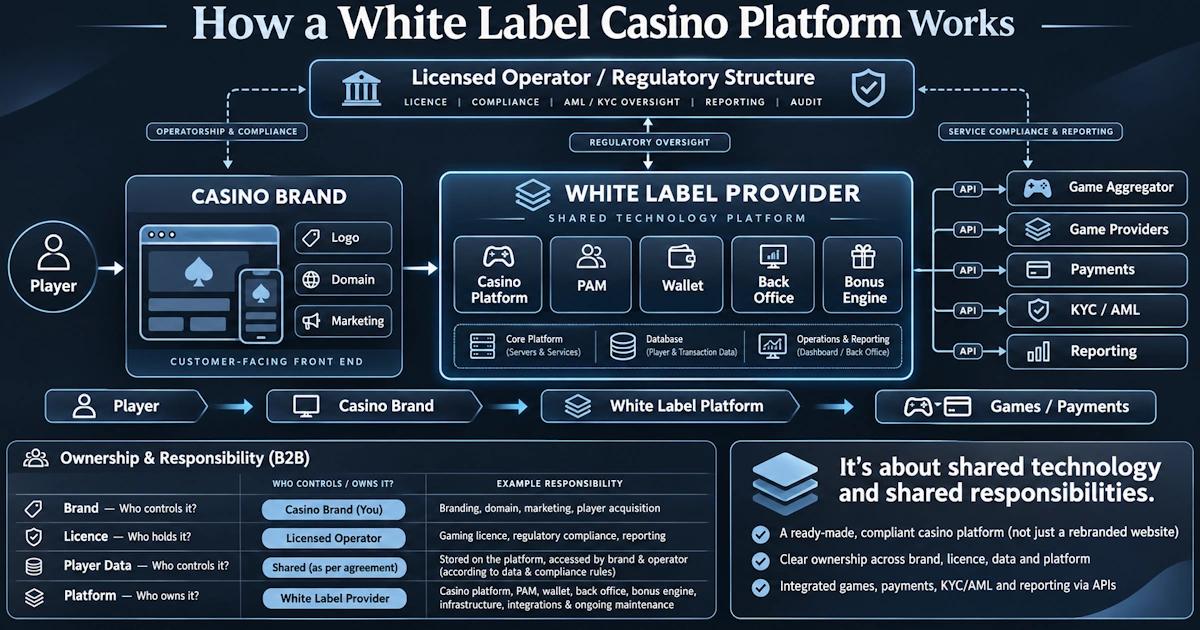
A simplified model looks like:Player ↓ Casino Brand ↓ White Label Provider ↓ Casino Platform / PAM / Wallet ↓ Games / Payments / KYC / Reporting
The player interacts with the branded casino. The provider supplies much of the infrastructure behind it.
Is “White Label” a Type of Gambling Licence?
No. This is one of the most important points to understand.
The UK government’s gambling reform white paper describes white label as a commercial arrangement rather than a statutory term. In the British model discussed there, a licensed operator can provide remote gambling under branding supplied by a third party that does not itself hold the operating licence. The licensed operator remains the entity providing the gambling facilities to customers.
The UK Gambling Commission is equally clear that it licenses the operator, not the white-label domain itself. It describes a white-label domain as one operated by a licensed operator in partnership with another organisation.
This distinction matters because phrases such as:“white label licence” are often used commercially even though the legal structure can be more complicated.
A more accurate question is:Which licensed entity is legally providing the gambling service?
How Does a White Label Casino Work?
A basic white-label launch can be understood as several layers.
1. The Brand The white-label partner creates or controls the customer-facing brand. This may include:
casino name
domain
logo
visual identity
marketing strategy
2. The Casino Technology The provider supplies an existing technology stack. This can include:
front end
PAM
wallet
cashier
game integrations
bonus engine
back office
reporting
3. External Services The platform may already be connected to:
game aggregators
individual game providers
payment providers
KYC services
AML tools
CRM
analytics
4. Licensing and Compliance The legal structure determines which entity holds the relevant gambling licence and who carries regulatory responsibility.
5. Operations Depending on the agreement, functions such as customer support, payments, fraud review, compliance and player management may be handled by the provider, the brand partner or a combination of both.
This is why two products both marketed as white label casino platforms can be very different.
What Technology Is Usually Included?
There is no universal package, but a white-label casino platform can include several core systems.
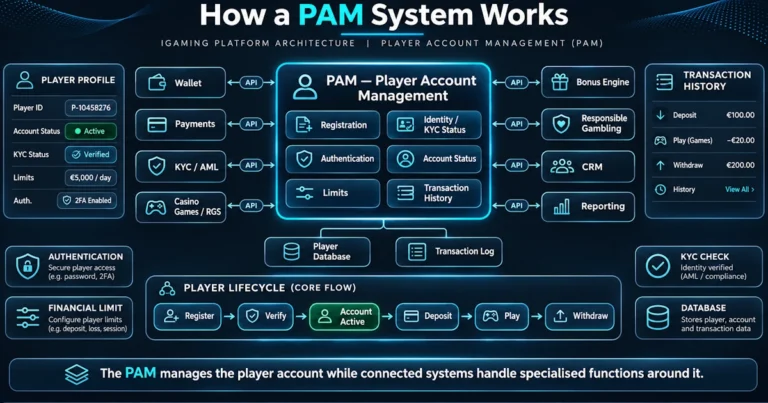
Player Account Management The PAM manages player registration, account status, authentication and other account-level information.
Wallet The wallet manages cash and bonus balances and records financial transactions.
Casino Games The provider may offer access to games through direct game integrations or a casino game aggregator.
Payment Integration The platform can connect the casino with payment gateways, processors, banks, e-wallets or other permitted payment methods.
KYC and AML Identity-verification and transaction-monitoring services may be built into the operating environment.
Bonus Engine The system can manage welcome offers, free spins, wagering requirements and other promotions.
Back Office Authorised employees can manage player accounts, games, transactions, bonuses and operational settings.
Reporting The platform records operational and financial data for business management and, where required, regulatory reporting.
The key advantage is that these components are already connected rather than being assembled separately by a new operator.
Is the Front End Included?
Often, yes.
The provider may supply a ready-made casino website that can be modified with:
logo
colours
navigation
banners
content
domain
selected games
Some solutions offer more front-end flexibility than others. This is an important B2B issue.
A white-label brand can look unique to customers while still using the same underlying platform as several other brands. That is not necessarily a problem. But a business that depends heavily on differentiated user experience should understand how much front-end control it actually receives.
Who Owns the Casino Platform?
Usually the technology provider retains ownership or control of the platform itself. The white-label partner receives the right to use the technology under the commercial agreement.
This is fundamentally different from developing a proprietary casino platform.
For example:White Label Partner may control:
brand
marketing
domain, depending on contract
while:Technology Provider may control:
software
infrastructure
integrations
releases
core platform configuration
The actual division must be checked contractually. Never assume that branding a platform means owning its underlying technology.
Who Holds the Gambling Licence?
There is no universal answer. This depends on the market.
In the British white-label model, the licensed operator remains responsible for providing the gambling facilities even where another organisation supplies the brand. The Gambling Commission states that compliance responsibility for white-labelled gambling websites remains with the licence holder and cannot simply be transferred to the partner.
Other jurisdictions can structure white-label relationships differently.
Denmark, for example, distinguishes between the licensed white labeller and the white-label buyer. Danish guidance says the licence holder remains responsible for the gambling operation, while the white-label buyer’s role is limited primarily to marketing and should not extend into general player-account or operational control.
The important lesson is: Do not assume a white-label structure that works in one market is automatically valid in another.
Who Is Legally Responsible for the Players?
Again, this depends on the legal structure.
In Great Britain, the Gambling Commission says the licensee is the party offering facilities for gambling and remains responsible for activity on white-labelled websites.
That includes regulatory responsibilities connected with areas such as:
customer protection
AML
customer interactions
marketing controls
responsible gambling
The brand partner cannot simply become the regulated operator without holding the relevant licence.
This difference between: customer-facing brand and: licensed operator is one of the most important concepts in white-label iGaming.
Why Do Companies Use White Label Casino Platforms?
The main attraction is that the underlying infrastructure already exists.
Building an online casino independently can require integrations with:
games
payments
KYC
AML
wallets
bonuses
reporting systems
A white-label setup can reduce the amount of initial technical work by providing an already integrated operating environment.
This can make the model attractive to businesses that primarily want to focus on areas such as:
branding
customer acquisition
marketing
market positioning rather than building an entire technology stack.
White Label vs Building a Casino From Scratch
Consider two simplified approaches.
White Label The business starts with an existing platform. It configures: Brand + Domain + Content + Selected Services while much of the infrastructure already exists.
Build From Scratch The business needs to develop or procure: PAM Wallet Games Payments KYC Back Office Reporting and integrate them into one operation.
Building independently provides more architectural control. It also creates much more development and integration responsibility.
Neither model is automatically better. They solve different business problems.
White Label vs Standalone Casino Platform
A casino platform is primarily technology. A white-label solution is usually a broader commercial and operational arrangement.
For example:Casino Platform May provide: PAM + Wallet + Games + Back Office The operator uses the technology under its own legal and operating structure.
White Label May provide: Platform + Games + Payments + Operational Framework + Licensing Structure depending on the market and contract.
So: Casino platform = technology layer while: White label = broader operating model
The white-label package normally contains or relies on a casino platform.
White Label vs Turnkey Casino
The terminology is not completely standard across suppliers, so buyers need to examine the actual commercial structure.
A common distinction is:
White Label The operator launches using much of the provider’s existing regulatory and technology infrastructure.
Turnkey The supplier provides a ready-made technology stack, but the customer operates it through its own gambling licence and business structure.
This distinction is common in commercial iGaming usage, but the exact meaning can differ by vendor.
Therefore, never decide based only on:“White Label” versus:“Turnkey”
Ask instead:
Whose licence is used?
Who contracts with players?
Who owns the player database?
Who controls payments?
Who carries compliance responsibility?
Those answers reveal the real model.
White Label vs Own-Licence Model
The biggest strategic distinction can be ownership of the regulated operation.
White Label Model A business can depend heavily on another licensed entity and its infrastructure.
Own-Licence Model The operator obtains the relevant licence itself and contracts directly for much of its technology and services.
An own-licence structure can provide greater control. It also creates greater responsibility for:
regulatory applications
compliance
policies
reporting
technology governance
banking and payments
A white label shifts some of that operational complexity into an existing structure. It does not make regulatory requirements disappear.
How Do Games Work in a White Label Casino?
The provider may already have integrations with:
casino game aggregators
slot studios
live casino providers
table-game suppliers
The white-label brand can then select from the available catalogue.
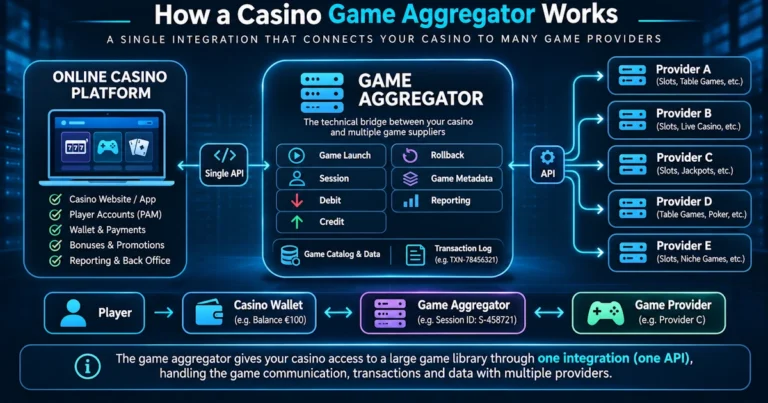
A simplified architecture might look like:White Label Brand ↓ Provider Casino Platform ↓ Game Aggregator ↓ Multiple Game Providers
This reduces the need for the brand partner to independently integrate every game supplier.
However, access to a game does not automatically mean it can be offered in every jurisdiction. Market availability can depend on:
supplier approvals
certification
licensing
regulatory restrictions
How Do Payments Work?
The white-label provider may already have payment-service integrations.
A deposit might follow: Player ↓ Branded Casino ↓ White Label Platform ↓ Payment Provider ↓ Casino Wallet
Withdrawals move in the opposite direction, with additional account and compliance checks where required.
The important commercial questions include:
Whose payment account processes the transaction?
Who handles chargebacks?
Who manages payment fraud?
Which party pays processing fees?
Who controls withdrawal approvals?
These details can materially affect the economics and risk of the business.
Who Handles KYC?
The platform may include integrated KYC services.
A typical flow could be: Player Registration ↓ White Label Platform ↓ KYC Provider ↓ Identity Result ↓ Player Account Updated
The technology can therefore be standardized across several brands. But legal responsibility for customer verification depends on the licensed operating structure.
In markets such as Great Britain, the licence holder cannot transfer its ultimate compliance responsibility to the white-label partner.
Who Handles AML?
The same principle applies to anti-money-laundering controls.
The provider may supply:
transaction monitoring
risk rules
compliance tools
source-of-funds workflows
case-management systems
But technology alone does not transfer the regulator’s expectations.
The UK Gambling Commission has repeatedly warned that white-label arrangements can create risk where licence holders fail to properly investigate and oversee their business partners.
In 2025, TGP Europe left the British market after a Gambling Commission investigation identified failures including insufficient due diligence on third-party business partners and weaknesses in considering money-laundering risks.
This demonstrates why white-label compliance is not merely a contractual formality.
Why Does Due Diligence Matter?
White-label arrangements connect several businesses. The licence holder therefore needs to understand who it is working with.
The UK Gambling Commission expects operators to carry out risk-based due diligence on prospective white-label partners and continue monitoring those relationships after the agreement begins.
Relevant questions can involve:
ownership
funding
reputation
competence
AML risk
marketing practices
jurisdictions of activity
The same principle applies in the opposite direction. A white-label buyer should also investigate the provider before becoming dependent on its licence, platform and financial infrastructure.
How Are Bonuses Managed?
The provider’s bonus engine may allow the brand to configure promotions such as:
welcome bonuses
deposit matches
free spins
cashback
The white-label partner may be able to choose parameters within predefined limits. For example: Bonus: 100% up to €100 Eligible Games: Slots Expiry: Defined Period
But the provider may restrict certain configurations to maintain regulatory or technical compliance. This is another example of the trade-off between: speed and standardisation versus: complete control
Can a White Label Brand Choose Its Own Games?
Usually it can choose from the catalogue available through the provider. But full freedom is not guaranteed.
Games may be limited by:
provider contracts
jurisdiction
certification
platform integration
commercial terms
If the white-label partner wants a provider that is not already integrated, adding it may require approval, development and commercial negotiations. A large existing game catalogue is therefore one potential advantage of an established white-label ecosystem.
Can the Brand Create Its Own Front End?
Sometimes. White-label solutions differ significantly in how much design freedom they provide.
One may offer mainly: Logo + Colours + Banners
Another may allow deeper customization of:
layouts
navigation
game lobby
CMS
user journeys
For a business building a differentiated consumer brand, this should be evaluated before signing. A platform can be technically strong but commercially unsuitable if every site built on it looks almost identical.
Who Owns the Player Data?
This is one of the most important contractual questions in a white-label arrangement. Do not assume the answer.
The licensed operator may hold the operational customer relationship while the brand partner may receive limited access to player information.
Data access can also be affected by:
regulatory obligations
privacy law
contract terms
system architecture
Danish regulatory guidance provides a useful example of how restrictive some white-label structures can be: it says the white-label buyer should not own the registered player database during the arrangement and should receive only customer information necessary for its permitted marketing role.
Other markets and agreements may differ.
For B2B buyers, the contract should clearly state:
Who controls the database?
What data can the brand access?
Can the data be exported?
What happens when the partnership ends?
What Happens to the Players If the White Label Agreement Ends?
This question should be answered before launch, not during termination.
Potential issues include:
remaining player balances
pending withdrawals
open bonuses
regulatory records
customer communications
data transfer
migration to another platform
The contract should define who handles each obligation.
A brand that has spent years acquiring customers can face serious commercial problems if it discovers that moving those customers to another operating structure is difficult or prohibited.
For commercial research, exit terms can be as important as launch terms.
What Is Vendor Lock-In?
Vendor lock-in occurs when moving away from the provider becomes difficult or expensive.
A white-label business can become dependent on the provider for:
platform
licence structure
game contracts
payments
player database
hosting
reporting
The deeper that dependency becomes, the harder migration may be. This does not automatically make white label a poor model. But the business should understand the dependency before it grows.
Important questions include:
Can player data be exported?
Who owns the domain?
Who owns custom front-end work?
Can game-provider agreements move with the brand?
What happens to payment accounts?
What termination notice is required?
Who Owns the Domain and Brand?
These should be explicitly defined.
A business should not assume that because it created the casino name, every related digital asset automatically belongs to it.
Contracts should clarify ownership of:
domain
logo
trademarks
website content
custom design
player database
Losing access to an established domain can be commercially serious. Domain and brand ownership therefore deserve the same attention as software fees.
What Does a White Label Casino Cost?
There is no standard industry price. Commercial structures vary significantly.
A white-label agreement can potentially involve:
setup fee
platform fee
monthly minimum
revenue share
game-provider charges
payment fees
KYC costs
support fees
marketing-related costs
Some commercial models rely heavily on revenue sharing. Others use combinations of fixed and variable fees.
For this reason, comparing only the initial setup cost can be misleading. A lower launch fee can be offset by higher ongoing revenue share.
B2B buyers should model the economics at several revenue levels rather than judging only the first invoice.
What Is Revenue Share?
Revenue share means the provider receives an agreed percentage of a defined revenue measure.
The contract must define exactly what the percentage is applied to. Terms can involve concepts such as: Gross Gaming Revenue and: Net Gaming Revenue but definitions can differ between agreements.
For example, a contract may deduct certain items before calculating the share.
Do not assume that two offers advertising:20% revenue share necessarily calculate the percentage from the same base.
The commercial definition matters as much as the headline percentage.
What Other Costs Can Affect the Business Case?
Beyond the core white-label fee, operators may need to consider:
payment processing
game-provider fees
KYC verification
fraud services
chargebacks
marketing
affiliates
customer support
localization
tax
regulatory costs
Some may be bundled into the white-label agreement. Others may be separate.
The correct B2B question is therefore:What is the total operating cost per active customer or per unit of revenue? not simply:What is the setup price?
What Are the Advantages of a White Label Casino Platform?
The model can offer several practical benefits.
Existing Technology The core platform already exists.
Existing Integrations Games, payments and verification services may already be connected.
Reduced Development Work The brand does not need to build every system internally.
Operational Support The provider may manage hosting, updates and certain operational processes.
Easier Content Expansion Existing game integrations can make it simpler to expand the catalogue.
Standardised Infrastructure Several difficult platform functions have already been implemented and tested.
These benefits explain why white-label arrangements continue to exist across regulated gambling markets.
What Are the Main Disadvantages?
The same model also creates trade-offs.
Less Technology Control The brand relies on the provider’s roadmap.
Less Customisation Some platforms restrict how much can be changed.
Provider Dependency A provider outage or regulatory problem can affect multiple white-label brands.
Ongoing Commercial Costs Revenue share can become significant as the business grows.
Data and Migration Questions Moving customers to another platform can be complicated.
Regulatory Dependency Where the business depends on another entity’s operating licence, problems affecting that licensee can directly affect the brand.
These are strategic issues, not minor technical details.
What Happens If the Provider Loses Its Licence?
This is one of the biggest concentration risks in some white-label models.
If several brands depend on one licensed operator, regulatory action against that operator can affect all of them.
The 2025 TGP Europe case shows the importance of this dependency in the British market. The company surrendered its UK licence after regulatory action concerning, among other things, insufficient due diligence on white-label partners and AML weaknesses.
A brand using another operator’s licence should therefore understand: What happens if the provider’s licence is suspended, restricted or surrendered?
This should form part of business-continuity planning.
Does White Label Mean the Casino Is Less Legitimate?
Not automatically.
The commercial structure itself does not determine whether the gambling operation is legitimate. The important questions are:
who is the licensed operator?
is the relevant domain connected to that operator?
does the operation comply with the market’s rules?
The UK Gambling Commission explicitly distinguishes between the domain and the operator. It notes that the operator is licensed, not the white-label brand itself.
So a white-label casino can operate legitimately under a permitted structure. But the brand should not falsely present itself as holding a licence that actually belongs to another entity.
Can a White Label Casino Operate in Every Country?
No. A white-label arrangement is not a global passport.
Market access depends on:
local gambling law
licence scope
player location
operator permissions
game approvals
payment availability
A provider saying:“We have a licence” does not automatically mean:“You can legally target every market.”
The specific licence and target jurisdiction need to be assessed.
How Does Malta Treat B2B Casino Technology?
Malta distinguishes between B2C gaming services and B2B critical gaming supply.
The Malta Gaming Authority describes a Gaming Service licence as the B2C authorisation for offering gaming services, while a Critical Gaming Supply licence can cover B2B supply and management of material gaming elements or certain systems that process essential regulatory records.
This demonstrates another important point: technology supplier licensing and consumer-facing operator licensing are not the same thing.
A supplier may be properly authorised as a B2B technology company without that licence itself authorising a separate brand to offer gambling directly to consumers.
How Should a Business Compare White Label Providers?
A large game count and attractive website demo are not enough. A B2B evaluation should examine the full operating model.
Technology Evaluate:
PAM
wallet
API quality
back office
bonus system
uptime
scalability
Games Check:
providers
aggregators
market availability
game configuration
Payments Understand:
supported methods
settlement
fees
chargeback handling
withdrawal process
Compliance Determine:
licensed entity
KYC responsibilities
AML responsibilities
responsible gambling controls
reporting
Data Clarify:
ownership
access
portability
retention
Commercial Terms Model:
setup costs
fixed fees
revenue share
third-party costs
Exit Understand:
termination rights
player migration
data export
domain ownership
This provides a much stronger basis for comparison than asking only:“How fast can you launch my casino?”
What Should Be in the Contract?
A white-label agreement should make operational responsibilities clear. Important areas can include:
Licence and regulatory responsibilities
Technology scope
Service levels
Payments
Player funds
KYC and AML
Customer support
Marketing responsibilities
Data ownership
Intellectual property
Revenue calculation
Third-party costs
Termination
Migration
Business continuity
Legal advice is appropriate when evaluating these agreements because the exact contractual and regulatory implications can be substantial.
Why Service-Level Agreements Matter
The casino depends on the provider’s infrastructure. An SLA can define expectations around:
platform availability
support
incident response
recovery
maintenance
If the platform fails: Brand A Brand B and: Brand C may all be affected if they share the same infrastructure.
A white-label buyer should therefore understand not only the platform’s normal performance, but also what happens during failures.
Why Reporting Access Matters
A business needs visibility into its operation. The back office should provide reliable information about:
registrations
deposits
withdrawals
wagers
winnings
bonuses
payment activity
game performance
If the brand receives only a basic summary from the provider, it may struggle to understand its own business.
B2B buyers should check whether data is available:
in real time
through reports
through APIs or:
through exports
Reporting access becomes especially important when planning future migration away from the white-label model.
When Does a White Label Model Make Sense?
White label can make sense when a business values:
existing infrastructure
reduced technical development
integrated suppliers and:
a more standardised operating model
It may be less attractive when the business needs:
extensive technical control
highly customised platform behaviour
direct control of supplier contracts
independent licensing
full infrastructure ownership
The decision depends on the business strategy rather than one model being universally superior.
When Might an Operator Outgrow a White Label?
As a brand becomes larger, priorities can change.
Initially: speed and simplicity may matter most.
Later: control and economics may become more important.
A larger business may eventually want:
its own licence
direct game-provider contracts
direct payment relationships
custom PAM features
independent infrastructure
At that point, moving toward a turnkey or more independently controlled platform model may become attractive. This is why migration rights should be considered before the white-label business becomes large.
Common White Label Casino Misconceptions
“White label means I own the casino platform.” Not usually. You normally use a provider’s technology under a commercial agreement.
“A white label licence is a special gambling licence.” Not generally. White label describes a commercial arrangement. The actual gambling licence belongs to the relevant licensed entity.
“The white-label provider is responsible for everything.” Not automatically. Responsibilities depend on the market and contract. In Great Britain, ultimate regulatory responsibility stays with the licence holder.
“White label and turnkey mean exactly the same thing.” No. Industry usage often distinguishes them based on licensing, ownership and operational control, although supplier terminology varies.
“Once the site launches, I can target any country.” No. Market access depends on the licence and local law.
“The player database automatically belongs to my brand.” Do not assume this. Data ownership and access need to be established contractually and within applicable regulation.
The Biggest B2B Question: What Do You Actually Control?
Before choosing a white-label casino platform, create a control map. For every important asset, identify the responsible party.
For example: Brand — You Domain — ? Gambling Licence — ? Casino Platform — Provider PAM — Provider Wallet — Provider Player Funds — ? Player Database — ? Games Contracts — ? Payments — ? KYC — ? AML — ? Customer Support — ? Marketing — You / Shared Reporting — ? Exit / Migration — ?
Every question mark should be resolved before the agreement is signed. That simple exercise often reveals more about a white-label offer than a long sales presentation.
Final Thoughts
So, what is a white label casino platform?
It is a ready-made iGaming technology and service environment that allows another business to operate a consumer-facing casino brand without independently building the full infrastructure behind it.
The model can combine:
Casino Platform
PAM
Wallet
Game Integrations
Payments
KYC / AML
Bonuses
Back Office
Reporting and, depending on the jurisdiction and agreement, a wider licensed operating structure.
The important point is that white label is a business model, not a universal gambling licence category.
A simple architecture may look like: Player → Branded Casino → White Label Provider → Platform → Games / Payments / Compliance
The commercial attraction is clear: much of the underlying technology and operational framework already exists.
The trade-off is dependence. The brand may depend on the provider for its technology, licence structure, payments, supplier integrations and access to player data.
For that reason, the strongest white-label evaluation should not begin with:“How many games do you offer?”
It should begin with:“Who owns and controls every critical part of the business?”
That includes the licence, platform, money, player relationship, data, domain and exit process. Those answers determine whether a white-label arrangement is simply convenient at launch or sustainable as the business grows.
Frequently Asked Questions
What is a white label casino platform? A white label casino platform is a ready-made iGaming technology and service environment that another business can brand and use to launch an online casino without building the complete infrastructure independently.
Does a white label casino need its own gambling licence? It depends on the jurisdiction and operating model. In some permitted white-label structures, the gambling service operates under the licence of the licensed operator providing the gambling facilities. Other markets or business models may require the brand owner to hold its own licence.
What is the difference between white label and turnkey casino software? A white-label arrangement commonly relies more heavily on the provider’s existing operating and licensing structure. A turnkey platform is often provided for an operator using its own licence. However, commercial terminology varies, so the actual contract and responsibilities matter more than the label.
Who owns the players in a white label casino? There is no universal answer. The licensed operator, brand partner and technology provider can have different rights and responsibilities. Player data ownership, access and migration rights should be defined clearly in the agreement and must comply with applicable law.
Is a white label casino platform the same as a casino platform? No. A casino platform is primarily the underlying technology. A white-label solution is a broader commercial arrangement that uses platform technology and may also include games, payments, compliance services and an operating-licence structure.
What should I check before choosing a white label casino provider? Check the licence structure, technology, games, payment setup, compliance responsibilities, commercial fees, data ownership, domain ownership, service levels and what happens to players and data if the agreement ends.