A turnkey casino solution is a ready-made iGaming technology package that allows a licensed operator to launch and run an online casino without building the entire technical stack from scratch.
Depending on the provider, the solution can include the casino platform, Player Account Management system, wallet, game integrations, payment connections, bonus engine, back office, reporting tools, hosting and technical support.
The operator then adds its own brand, business strategy and market-specific operating setup.
In common B2B usage, one of the biggest differences between turnkey and white label is regulatory independence. A turnkey operator normally holds or obtains its own gambling licence rather than operating under the licence structure of the platform provider.
That distinction gives the operator more control, but also more responsibility.
A turnkey solution can provide much of the technology needed to operate a casino. It does not mean that licensing, compliance, banking, marketing and all other business responsibilities automatically disappear.
What Does “Turnkey” Mean in iGaming?
The word turnkey comes from the idea of receiving something that is largely ready to operate.
In iGaming, the term generally refers to a pre-integrated casino technology environment that can be configured for an operator rather than developed from the beginning.
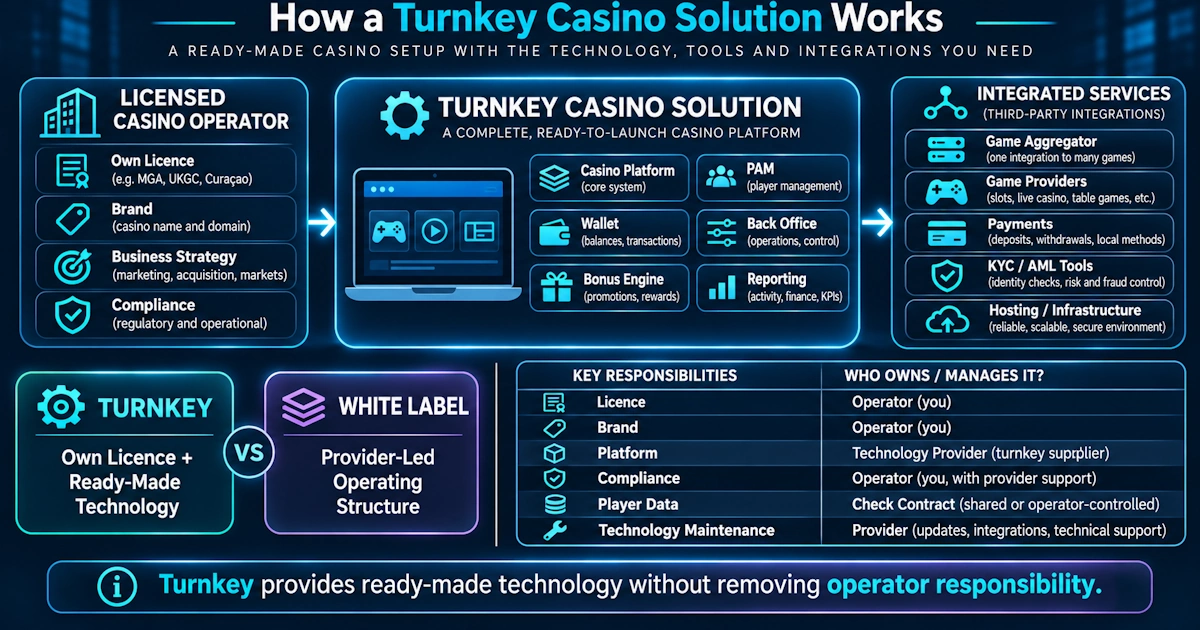
A simplified model looks like:
Licensed Casino Operator ↓ Turnkey Casino Solution ↓ PAM / Wallet / Back Office ↓ Games / Payments / KYC / Reporting
The provider supplies the technical foundation. The operator uses that foundation to operate its own gambling business.
However, turnkey is a commercial industry term, not one universal regulatory category. Different vendors can include different services in what they call a turnkey solution.
For example, SOFTSWISS currently describes its turnkey product as a solution for casino licence holders seeking operational independence, while Slotegrator describes its turnkey service as a technical platform and B2B support package where obtaining the licence and managing the project remain the operator’s responsibility.
That illustrates an important rule for B2B buyers: Never evaluate a turnkey solution by the label alone. Check exactly what is included.
How Does a Turnkey Casino Solution Work?
A typical turnkey project has several layers.
1. The Operator
The operator owns or establishes the gambling business. Depending on the market, it may be responsible for:
gambling licence
corporate entity
compliance framework
market strategy
brand
customer acquisition
banking relationships
2. The Technology Provider
The turnkey supplier provides a pre-built casino technology environment. This can include:
PAM
wallet
back office
game integrations
bonus system
payment integrations
reporting
hosting
3. Third-Party Services
The solution may already connect with:
game aggregators
individual game providers
payment service providers
KYC suppliers
AML tools
CRM systems
analytics services
4. Configuration
The operator and supplier configure the environment for the target business. This may involve:
currencies
languages
games
payment methods
responsible gambling settings
bonus rules
reporting
jurisdiction-specific requirements
5. Launch
Once the relevant legal, technical, commercial and regulatory requirements are complete, the casino can go live.
The important point is that the operator is not starting with an empty software project. The main technical components already exist.
What Technology Is Usually Included?
There is no universal package, but a turnkey solution commonly combines several core systems.
Casino Platform The platform connects the main operational systems. It may coordinate:
players
games
financial transactions
payments
bonuses
compliance tools
reporting
The platform is the central technology layer.
Player Account Management The PAM, or Player Account Management system, manages the player’s account lifecycle. This can include:
registration
authentication
identity status
account state
account restrictions
transaction history
The PAM connects one customer identity with the rest of the casino ecosystem.
Wallet The wallet manages financial balances. It may track:
Cash Balance
Bonus Balance and transactions such as:
deposits
wagers
winnings
withdrawals
bonus credits
Accurate wallet technology is essential because the platform handles real-money transactions.
Back Office The back office is the administrative interface used by authorised staff. It may provide access to:
player accounts
transactions
games
withdrawals
bonuses
account restrictions
reporting
configuration
The supplier may provide one integrated interface even though several systems operate underneath it.
Game Integration A turnkey package may already connect to game suppliers. This can happen through:
direct game integrations or:
a casino game aggregator
The operator can then select from the game catalogue available through the solution.
Payment Integration The platform may already support connections to various payment systems. However, a technical integration does not always mean the operator automatically receives a commercial account with that payment provider.
SOFTSWISS, for example, states that its turnkey platform includes integrated payment systems but clients need agreements with the payment services they want to use.
This distinction is important: Payment integration ≠ payment-provider contract.
Bonus Engine The bonus engine can support promotions such as:
welcome bonuses
free spins
reload bonuses
cashback
loyalty mechanics
The operator can configure promotions within the capabilities and compliance controls of the platform.
Reporting and Analytics A turnkey platform should provide information about areas such as:
registrations
deposits
withdrawals
wagers
payouts
bonuses
game performance
player activity
Some systems also provide BI or analytics tools.
Hosting and Infrastructure Some turnkey providers also supply:
servers
hosting
monitoring
maintenance
infrastructure support
This reduces the amount of infrastructure the operator needs to manage directly.
Does a Turnkey Casino Include a Gambling Licence?
Usually, the term turnkey does not mean that the provider’s gambling licence automatically covers the customer.
In common B2B usage, the operator normally uses its own gambling licence.
SOFTSWISS currently describes its turnkey model as operating under the operator’s licence, while Slotegrator similarly states that obtaining the gambling licence remains the operator’s responsibility.
This is one of the clearest commercial differences between:Turnkey and:White Label
But because terminology varies between suppliers, the contract and jurisdiction always matter more than the marketing term.
Why Does the Operator Need Its Own Licence?
Because supplying technology and offering gambling to consumers are legally different activities.
Great Britain provides a clear example.
The UK Gambling Commission has separate licensing frameworks for supplying gambling software and for offering remote casino games directly to customers.
A remote gambling software licence permits activities such as manufacturing, supplying, installing or adapting gambling software. It does not, by itself, authorise the supplier to provide gambling facilities directly to consumers.
A business offering online casino games to customers in Great Britain needs the relevant remote casino operating licence.
The Malta Gaming Authority uses a similar functional distinction between a B2C Gaming Service licence and a B2B Critical Gaming Supply licence.
This distinction is central to the turnkey model: The supplier can provide the technology. The operator remains the regulated gambling business.
Turnkey Casino vs White Label Casino
These two models are often compared. The exact terminology varies, but a useful general distinction is:
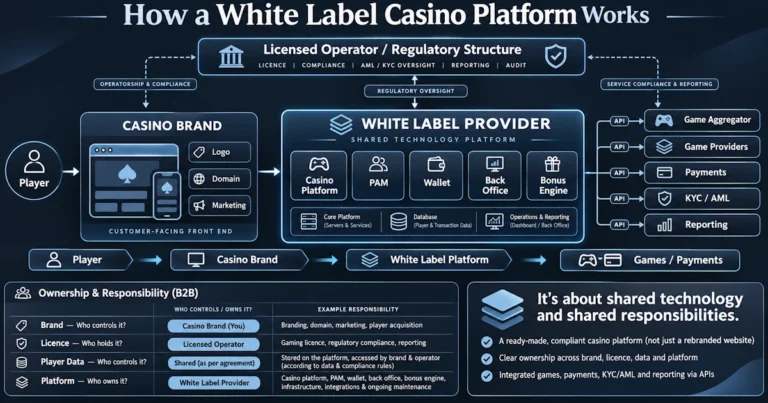
White Label The brand relies more heavily on another operator’s existing regulatory and operational framework. Depending on the arrangement, the provider may control or manage:
licence structure
core technology
player operations
payments
compliance processes
Turnkey The supplier provides ready-made technology, while the casino operator generally operates through its own licence and corporate structure. The operator therefore has greater direct responsibility for:
regulatory relationship
compliance
strategy
market entry
supplier governance
SOFTSWISS currently characterises the turnkey approach in this way: the provider supplies a licence-ready technology stack, while the operator maintains responsibility for its own gambling licence and business strategy.
A simple comparison is: White Label → Shared / Provider-Led Operating Infrastructure Turnkey → Operator-Led Business Using Third-Party Technology
But this is a commercial shorthand, not a universal legal rule.
Turnkey vs Online Casino Platform
A casino platform is mainly a technology product. A turnkey solution is normally a broader package built around that platform.
For example:Casino Platform Could include: PAM + Wallet + Back Office
Turnkey Solution Could include: Platform + Games + Payments + Hosting + Technical Support + Launch Configuration
The platform therefore forms the technical core of the turnkey package. A supplier can offer its casino platform independently or package it as part of a larger turnkey solution.
Turnkey vs Building a Casino From Scratch
An operator has another option: build its own technology.
Turnkey Model The operator purchases or licenses a pre-built ecosystem. It avoids building every core system internally.
In-House Model The operator develops or directly assembles:
PAM
wallet
integrations
back office
reporting
infrastructure
The in-house route can offer maximum technology control. But it also requires substantial:
development
testing
maintenance
security
infrastructure
compliance engineering
A turnkey model sits between: high dependence on a white-label provider and: building everything internally
That middle position is one reason it is attractive to established licensed operators.
What Does the Operator Control?
Control is one of the main reasons businesses choose a turnkey model.
Depending on the agreement, the operator may directly control:
Brand
Business Strategy
Marketing
Customer Relationships
Compliance Strategy
Selected Supplier Agreements
Bonus Strategy
Market Expansion
The supplier still controls its underlying software product and roadmap. So turnkey does not mean: complete technology ownership
It generally means: greater operating independence while using third-party technology.
Who Owns the Platform?
Usually the software provider. The operator receives contractual rights to use the system.
For example:Operator owns or controls:
casino business
brand
licence
domain, depending on agreement
Provider owns or controls:
platform code
software architecture
core releases
underlying technology
This is important when assessing long-term strategic control. Using software is not the same as owning it.
Who Owns the Player Relationship?
In a conventional own-licence turnkey model, the operator usually has the direct customer relationship because it is the licensed gambling operator.
That can provide more control over:
customer accounts
support
marketing
data strategy
However, actual data ownership and processing rights must still be defined contractually and comply with privacy law.
A turnkey operator should therefore confirm:
Who controls the player database?
Who is the data controller?
Can data be exported?
What happens during migration?
These issues should never be assumed.
How Do Games Work in a Turnkey Solution?
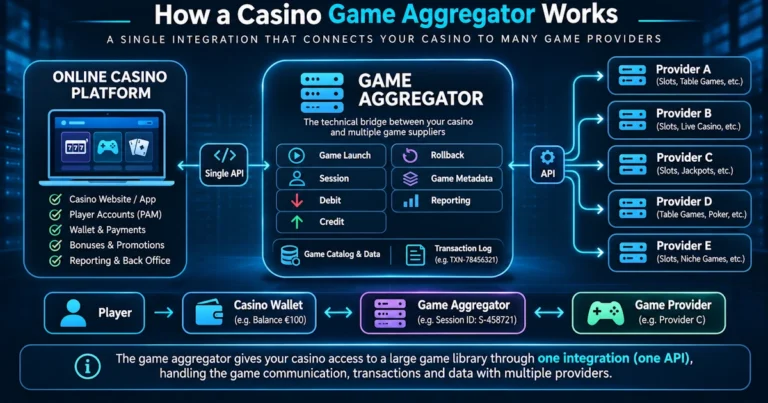
The turnkey provider may already have access to a game aggregator or direct integrations with suppliers.
A simplified setup could be:Operator ↓ Turnkey Casino Platform ↓ Game Aggregator ↓ Game Providers
This can save considerable integration work. The operator can select games available for its target markets.
However, content availability can still depend on:
jurisdiction
supplier licence
game certification
commercial agreements
technical configuration
A game existing in the provider’s catalogue does not automatically mean it can be launched everywhere.
Can the Operator Add Its Own Game Providers?
Potentially. Turnkey platforms differ in integration flexibility.
A provider may allow:
existing catalogue only
additional provider integrations
direct contracts with selected studios
custom API integrations
SOFTSWISS currently states that some vendors can be accessed through its aggregation relationships while certain suppliers may require direct operator agreements.
This is worth checking early. If a strategic game supplier cannot be added, the platform may limit future product strategy.
How Do Payments Work?
Turnkey providers can offer pre-built payment integrations.
A deposit can follow: Player ↓ Operator Casino ↓ Turnkey Platform ↓ Payment Provider ↓ Casino Wallet
But the operator may still need its own commercial agreement with the payment company.
Important B2B questions include:
Who signs the PSP contract?
Whose merchant account receives the money?
Who handles settlements?
Who manages chargebacks?
Who pays payment fees?
Who controls withdrawal approvals?
Turnkey technology simplifies the connection. It does not automatically remove the commercial and compliance relationship between operator and payment provider.
Who Handles KYC?
The turnkey platform may already integrate with specialist KYC providers.
A typical flow could be: Player Registration ↓ Operator Platform ↓ KYC Provider ↓ Verification Result ↓ PAM Updated
The provider supplies technical connectivity. The licensed operator remains responsible for ensuring that the verification process meets the rules of its jurisdiction.
Who Handles AML?
Turnkey technology may provide tools for:
transaction monitoring
player risk indicators
payment monitoring
source-of-funds workflows
case management
But software does not replace the operator’s regulatory responsibility. The operator needs appropriate:
policies
procedures
staff
escalation rules
reporting processes
This is another major difference from thinking of turnkey as an “all-inclusive licence solution.” The technology can support compliance. The operator still has to operate compliantly.
Who Handles Responsible Gambling?
The platform may contain controls such as:
deposit limits
time-outs
self-exclusion
session controls
account restrictions
But the correct configuration depends on the jurisdiction.
An operator entering several regulated markets may therefore need different rules in different deployments. A strong turnkey platform should support market-specific configuration rather than assuming one global responsible-gambling model.
How Does Regulatory Reporting Work?
The operator may need to submit information to its regulator.
The platform therefore needs reliable records covering areas such as:
player accounts
wagers
winnings
game activity
account restrictions
A turnkey supplier can provide the underlying reporting tools. The operator remains responsible for understanding what must be reported and ensuring submissions are accurate.
This is another area where B2B technology and B2C regulation meet.
Is Turnkey Really “Ready to Launch”?
The phrase can be misleading if taken literally.
The software may be largely ready. The business may not be.
Before launch, the operator may still need:
corporate structure
gambling licence
bank accounts
payment-provider agreements
compliance policies
game approvals
KYC configuration
responsible gambling configuration
customer support
marketing setup
The provider can often help with the technical implementation. But the operator cannot simply purchase software on Monday and assume it can legally start accepting players on Tuesday.
Does Turnkey Reduce Time to Market?
Usually, it can reduce the technology-development part of the project.
Instead of developing: PAM then: Wallet then: Game Integration then: Back Office
the operator begins with systems that already exist and work together.
However, total launch timing still depends heavily on:
licensing
banking
payment setup
market certification
operator readiness
Vendor claims about launch speed should therefore be read carefully. SOFTSWISS, for example, explicitly separates its technical setup period from the independent time required to obtain a gambling licence. That is a useful distinction for commercial planning.
Can a Turnkey Solution Support Multiple Jurisdictions?
Potentially. A platform may support several regulated markets. But “supports many jurisdictions” should be examined carefully.
Different markets may require different:
account-registration rules
KYC processes
responsible gambling controls
reporting
game configurations
payments
hosting requirements
The Malta Gaming Authority, for example, regulates B2B critical gaming technology separately from B2C gambling services, while Great Britain has its own operating, software and technical requirements.
A serious multi-jurisdiction platform should support regulatory configuration rather than simply translating the website.
What Does “Licence-Ready” Mean?
Some providers describe technology as licence-ready.
This should not be interpreted as: licence guaranteed or: licence included
It usually means the platform has technical capabilities or existing deployments that can support particular regulatory requirements.
The operator still needs to satisfy the regulator’s requirements for its own business.
For example, a UK operating-licence application can require information covering the applicant’s operational model, system architecture, software suppliers, business plan, funding and regulatory procedures.
Technology is one part of that application. The regulator also evaluates the operator.
Is Turnkey Software Automatically Compliant?
No. A platform can provide compliance-related features. That does not make every possible deployment compliant.
Imagine the platform supports: deposit limits but the operator configures them incorrectly for a target market.
Or: KYC technology is available, but the operator applies the wrong workflow.
Compliance depends on: Technology + Configuration + Procedures + People + Regulatory Structure not technology alone.
What Does Turnkey Cost?
There is no universal price. Commercial models can include:
setup fee
monthly platform fee
minimum fee
revenue share
hosting fees
game fees
payment costs
KYC costs
support charges
custom development
Different suppliers bundle these costs differently. For that reason, comparing only: Setup Fee A vs Setup Fee B can be misleading.
B2B buyers should model total cost over several scenarios. For example: Launch Stage Growth Stage High-Revenue Stage
A revenue-share model that seems inexpensive initially may become much more significant as the casino scales.
What Is Revenue Share in a Turnkey Agreement?
The provider may receive a percentage linked to casino revenue. The contract needs to define exactly which revenue measure is used.
Possible commercial concepts include: GGR or: NGR but contract definitions can differ.
For example, one NGR calculation might deduct:
bonuses
game-provider charges
payment fees while another does not.
Therefore: 15% revenue share from one supplier is not automatically cheaper than: 20% from another supplier.
The underlying calculation matters.
What Other Costs Should Operators Model?
A realistic commercial model can include:
Platform
Games
Payments
KYC
AML Tools
Hosting
Customer Support
Affiliates
Marketing
Regulatory Fees
Legal Advice
Tax
Localization
Some costs may be bundled. Others remain entirely with the operator.
A turnkey solution reduces technology-building costs. It does not eliminate the economics of running a regulated casino.
What Are the Main Advantages of a Turnkey Casino Solution?
Faster Technical Deployment The main systems already exist.
Lower Development Burden The operator does not need to build a complete platform internally.
Existing Integrations Games, payments and other services may already be connected.
Own-Licence Independence The operator can maintain its direct regulatory relationship.
Greater Brand Control Turnkey commonly allows more independence than a provider-led white-label arrangement.
Scalability The platform may already support large transaction volumes and multiple markets.
Technical Support The supplier maintains its core software product.
These advantages can make turnkey attractive to businesses that want operational independence without becoming a software-development company.
What Are the Main Disadvantages?
Licence Responsibility The operator must obtain and maintain its own regulatory authorisation where required.
More Compliance Responsibility The operator owns more of the regulatory burden.
Higher Initial Complexity Than White Label Corporate, regulatory, payment and operational structures need to be established.
Supplier Dependency Still Exists The operator still depends on the platform provider for core technology.
Limited Roadmap Control The operator does not normally control the supplier’s core development roadmap.
Customisation Limits Not every requested feature may be possible.
Turnkey provides more independence than white label. It is still not the same as owning the full technology stack.
What Is Vendor Lock-In in a Turnkey Model?
Turnkey can still create platform dependency.
For example, the operator may rely on the provider for:
PAM
wallet
integrations
reporting
game distribution
infrastructure
Changing platform can therefore become a major project.
Before signing, the operator should understand:
Can player data be exported?
Can transaction history be migrated?
Who owns custom code?
Can game contracts survive migration?
Can payment integrations be moved?
What termination notice applies?
What support is provided during migration?
Exit planning matters even when the operator holds its own licence.
Who Owns the Data?
This needs to be defined contractually.
An own-licence operator may have a stronger direct relationship with its customers than a brand in some white-label structures. But the software provider still processes or stores important data.
The agreement should define:
data ownership
data access
export formats
retention
privacy responsibilities
termination procedures
A casino can become highly dependent on years of historical player and transaction data. Data portability is therefore a strategic issue.
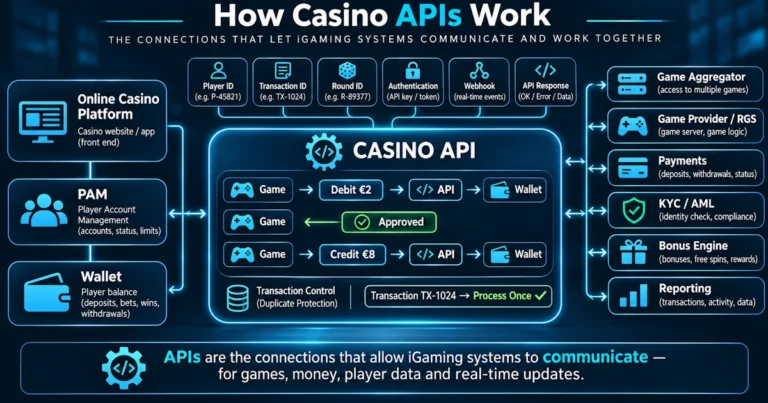
How Important Are APIs?
Very.
A turnkey operator may eventually want to add:
new KYC provider
new CRM
payment system
analytics platform
game supplier
A flexible API architecture can make this easier. A closed platform can make every new integration dependent on the supplier’s roadmap.
B2B buyers should therefore ask:
Which APIs are available?
Can we build our own integrations?
What data can we access?
Are there additional API fees?
Does the supplier need to approve every integration?
This can make a major difference as the operator grows.
How Important Is the Back Office?
The back office is where the operator’s teams may spend much of their working day.
It should support functions such as:
player search
account review
withdrawal management
payment review
bonus management
game management
reporting
user permissions
A visually impressive front end does not compensate for a poor operational back office. B2B evaluation should therefore include actual operational teams, not only management and marketing.
Why Role-Based Access Matters
Different employees need different access.
For example:Customer Support may need to view player accounts.
Payments Team may need withdrawal information.
Compliance may need KYC and AML records.
Marketing may need campaign data.
None of those roles necessarily needs full system administration. Good turnkey platforms should support appropriate user permissions and audit trails. This reduces both operational and security risk.
Why Reporting Access Matters
An operator using its own licence needs strong visibility into its own business.
Reports should help answer questions such as:
How much was deposited?
How much was withdrawn?
What is game turnover?
What bonuses were issued?
Which payment methods are performing poorly?
Which markets are growing?
The operator should also understand whether information is available through:
dashboards
downloadable reports
APIs
data warehouse feeds
A business should not become dependent on asking the provider every time it needs its own operational data.
What Should Operators Check in the SLA?
A Service-Level Agreement can cover areas such as:
platform uptime
incident severity
response times
support coverage
maintenance
recovery procedures
The operator’s business depends on the platform. If the platform stops: Players may not log in Games may not launch Deposits may fail Withdrawals may be affected
The commercial contract should therefore address technical failure, not only normal operation.
What Should Operators Check Before Choosing a Turnkey Provider?
A structured review should cover several areas.
Technology Check:
PAM
wallet
API architecture
back office
bonus engine
hosting
scalability
Games Check:
providers
aggregators
game catalogue
jurisdiction availability
direct-provider options
Payments Check:
supported PSPs
currencies
settlement model
integration flexibility
Compliance Check:
supported jurisdictions
KYC integration
AML tools
responsible gambling controls
regulatory reporting
Data Check:
ownership
access
exports
APIs
migration rights
Commercial Terms Check:
setup fees
fixed fees
minimum fees
revenue share
third-party charges
Support Check:
SLA
escalation
incident management
account management
Exit Check:
termination
data migration
player migration
custom development
transition support
The most important lesson is: Do not buy a feature list. Evaluate the operating model.
When Does a Turnkey Casino Solution Make Sense?
Turnkey can be a strong fit when an operator wants:
its own gambling licence
more regulatory independence
faster technology deployment
less internal software development
greater control than white label
It can also suit businesses expanding from one market into several regulated jurisdictions.
The operator can focus on:
brand
acquisition
compliance
customer experience
commercial strategy while the technology provider maintains much of the software infrastructure.
When Might Turnkey Not Be the Best Choice?
Turnkey may be less suitable when a company wants:
full ownership of source code
complete technology roadmap control
highly unusual product architecture
extensive proprietary integrations
internal infrastructure ownership
A large technology-led operator may eventually decide that developing more components internally provides strategic advantages. But that requires substantial engineering and compliance resources.
Turnkey vs In-House: Control Is Not Binary
It is useful to avoid thinking only in extremes. A turnkey operator can still build proprietary components around the supplier platform.
For example: Third-Party Turnkey Core plus: Custom Front End Own CRM Own Data Platform Own Recommendation Engine Custom Marketing Systems
The result can be a hybrid architecture. This allows the business to differentiate where it matters while avoiding the cost of rebuilding every core gambling function.
Common Turnkey Casino Misconceptions
“Turnkey means the gambling licence is included.” Not generally. In common industry usage, the operator normally uses its own licence.
“Turnkey means absolutely everything is managed for me.” No. The provider supplies technology and defined services. The operator still has business and regulatory responsibilities.
“Turnkey and white label are the same.” No. A common distinction is that turnkey operators hold their own licence and have greater operational independence, while white-label structures can rely more heavily on the provider’s licensed operating framework.
“Turnkey means I own the software.” Usually not. The technology remains the provider’s product.
“Every turnkey package includes the same services.” No. Vendor scope varies substantially.
“If the platform supports a country, I automatically have permission to operate there.” No. Market access depends on the operator’s licence and local regulatory rules.
The Biggest B2B Question: What Still Belongs to the Operator?
Before choosing a turnkey solution, create a responsibility map.
For example:
Gambling Licence — Operator
Brand — Operator
Domain — Operator / Confirm Contractually
Business Strategy — Operator
Casino Platform — Provider
PAM — Provider
Wallet — Provider
Games — Provider / Aggregator / Direct Suppliers
Payment Agreements — Operator / Confirm
KYC Technology — Provider / Third Party
AML Responsibility — Operator
Responsible Gambling — Operator + Platform Controls
Player Data — Confirm Contractually
Marketing — Operator
Customer Support — Operator / Managed Service
Regulatory Reporting — Operator, supported by platform
Platform Maintenance — Provider
Exit / Migration — Contract
Every unclear item should be resolved before signing. This is much more useful than asking whether a package is “full turnkey.”
Final Thoughts
So, what is a turnkey casino solution?
It is a pre-built iGaming technology environment designed to let an operator launch and manage an online casino without developing every major system internally.
A typical turnkey package can contain:
Casino Platform
PAM
Wallet
Game Integrations
Payments
Bonus Engine
Back Office
KYC Integrations
Reporting
Hosting and Technical Support
The operator then uses this technology as the foundation for its own gambling business.
The main strategic distinction from many white-label models is that a turnkey operator normally operates through its own gambling licence and regulatory relationship. That creates greater independence. It also creates greater responsibility.
A simple model is:Licensed Operator → Turnkey Platform → Games / Payments / KYC / Technology Services
The attraction is that the operator does not need to reinvent the core technology. The trade-off is that it still depends on a technology provider while taking greater responsibility for licensing, compliance, business operations and market strategy.
For B2B buyers, the most important question is therefore not:“Is this a turnkey solution?” It is:“Exactly which parts of the casino operation are ready-made, and which responsibilities still belong to us?”
That distinction determines the true cost, control and long-term value of the solution.
Frequently Asked Questions
What is a turnkey casino solution? A turnkey casino solution is a ready-made technology package that gives an online casino operator access to core systems such as PAM, wallet, games, payments, bonuses, back office and reporting without building them all internally.
Does a turnkey casino solution include a gambling licence? Usually not in the common B2B model. Turnkey solutions are generally designed for operators using their own gambling licence. Always verify the specific supplier model and jurisdiction.
What is the difference between turnkey and white label? A turnkey operator generally uses its own gambling licence and retains greater regulatory and business independence. A white-label model can rely more heavily on another licensed operator’s infrastructure. Commercial terminology varies, so contracts and responsibilities should always be checked.
Is turnkey the same as buying a casino platform? Not exactly. The casino platform is the main technology product. A turnkey package can add games, payment integrations, hosting, support and other services around that platform.
Who handles compliance with a turnkey casino? The licensed operator retains its own regulatory responsibilities. The technology provider can supply compliance tools and technical support, but it does not automatically replace the operator’s legal duties.
Who owns player data in a turnkey casino? The answer depends on the contract, privacy framework and system architecture. Operators should confirm data control, access, export and migration rights before choosing a provider.