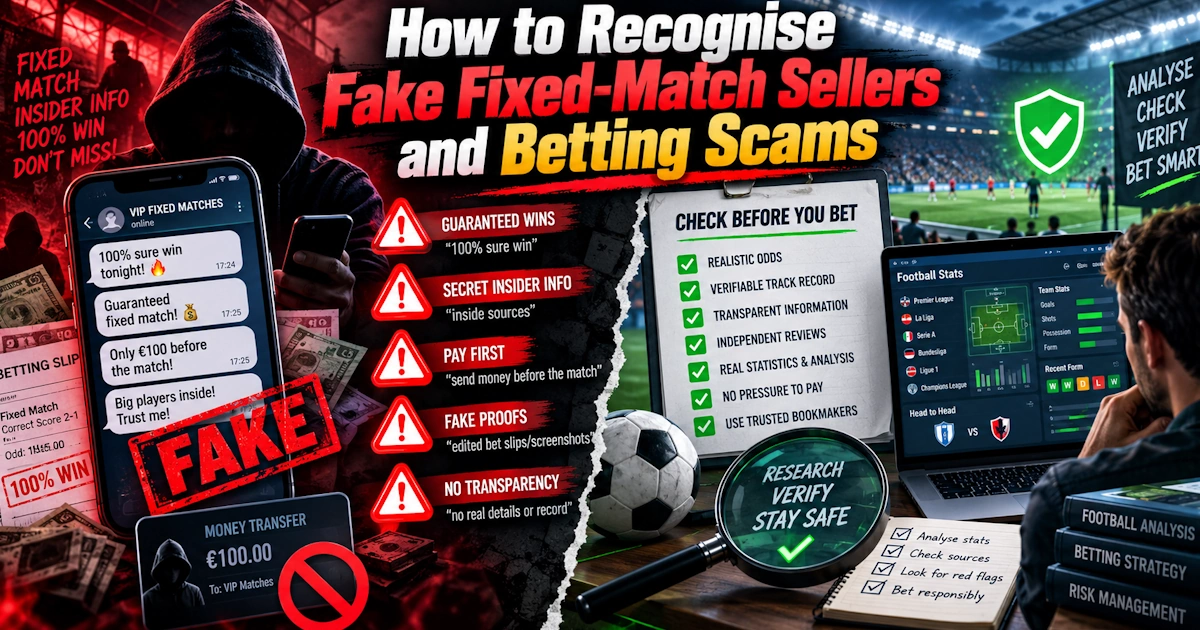
“100% fixed match.” “Guaranteed correct score.”
“Pay after win.” “Insider information from a player.”
If you follow football betting pages on Telegram, WhatsApp, Facebook, Instagram or TikTok, you have probably seen messages like these. They usually come with impressive screenshots.
The seller may show winning betting slips, messages from supposedly happy customers and large cash balances. Sometimes they claim to know a referee, player, club employee or bookmaker insider.
Then comes the offer: Pay €100 now and receive today’s fixed match. The safest assumption is simple.
Someone publicly selling guaranteed fixed matches to strangers online is very likely trying to sell you a story, not privileged information. Real match manipulation does exist.
FIFA defines it as unlawfully influencing a match or an aspect of a match, often for financial gain through betting. UEFA and FIFA actively monitor betting markets for suspicious activity.
But genuine criminal match-fixing and someone advertising “VIP fixed games” on Telegram are two very different things. Understanding that difference can save you a lot of money.
Real Match Fixing Exists—But That Does Not Make the Seller Genuine
It is important not to make the opposite mistake and claim football matches are never manipulated. They sometimes are.
Europol has investigated organised criminal networks involving players, club officials and betting activity. In one Spanish case, police arrested 17 people suspected of manipulating lower-league football matches and placing large bets on the outcomes.
FIFA and UEFA therefore use specialist betting-monitoring systems to identify unusual betting patterns. FIFA says its monitoring covers international tournaments, confederation competitions and betting-relevant domestic matches.
That tells us something important. Real match manipulation is:
Illegal and secretive
Investigated by authorities
Monitored through betting markets
Extremely risky for those involved
Now ask yourself: If someone genuinely possessed reliable criminal inside information worth thousands of euros, why would they advertise it publicly to hundreds of strangers for €50? That is the first question every potential customer should ask.
“100% Guaranteed” Is the Biggest Red Flag
No legitimate football prediction can honestly promise a 100% result. Football contains uncertainty.
Even an extremely strong favourite can:
Miss a penalty
Receive a red card
Suffer an injury
Concede from a set piece
Lose despite dominating
Normal professional betting analysis therefore talks about probability rather than certainty. A genuine analyst might say: “I estimate Over 2.5 at around 60%.”
A scammer says: “100% fixed. Cannot lose.”
The second statement sounds more attractive, and that is exactly why it is used.
Social Media Is a Major Scam Channel
The problem goes far beyond football betting. According to the US Federal Trade Commission, nearly 30% of people who reported losing money to a scam in 2025 said the scam started on social media.
Reported losses from social-media scams reached approximately $2.1 billion, around eight times the amount reported in 2020. Those figures cover many types of fraud rather than betting scams specifically, but they show why scammers like social platforms.
Creating a professional-looking profile is cheap. A scammer can easily create:
Fake followers
Fake comments
Fake testimonials
Fake winning screenshots
Multiple Telegram channels
A polished account does not prove legitimacy.
Fake Winning Slips Are Easy to Create
One of the most common pieces of “proof” is a screenshot of a winning betting ticket. Unfortunately, screenshots prove very little.
Images can be edited, recreated, cropped, taken from another account, or posted only after the result is known. A scammer can also place several different small bets before a match.
For example:
Ticket 1: 2-0
Ticket 2: 2-1
Ticket 3: 1-2
Ticket 4: 3-1
Ticket 5: 1-1
After the match finishes 2-1, only Ticket 2 appears on social media. The losing tickets disappear.
Followers see: “Another fixed correct score won!” They never see the other predictions.
Deleted Losing Predictions Create Fake Winning Records
Telegram and similar platforms make selective presentation very easy. Imagine a seller posts predictions to several private groups.
Group A receives a home win, Group B receives a draw, and Group C receives an away win. After the match, one group contains the correct prediction.
Members of that group may genuinely believe the seller knew the result. The seller can then screenshot their reactions: “Amazing!” “You did it again!” “Thank you boss!”
Those screenshots become advertising material for the next group of victims. This is sometimes called selective prediction or result filtering.
It creates the illusion of impossible accuracy without requiring any special football knowledge. A real bettor knows how to review a losing football prediction properly instead of hiding it.
Be Suspicious of “Insider” Stories
A seller may claim that their cousin works at the club, they know the goalkeeper personally, or they have information directly from UEFA. These stories are designed to make normal verification impossible.
If you ask for evidence, the response is usually: “I cannot reveal my source.” Convenient.
FIFA rules actually require people involved in football to report approaches or information connected with possible match manipulation. FIFA also operates confidential reporting systems for such cases.
Someone casually distributing genuine manipulation information to random bettors would be taking enormous personal and legal risks. That should make public “inside information” claims even less believable.
Pressure and Urgency Are Classic Scam Techniques
Scammers do not want you to think for long. Messages often say:
“Only 5 spots left”
“Payment closes in 10 minutes”
“Odds are dropping”
“Last VIP ticket”
“You will regret missing this”
“Send payment now”
Why the rush? Because time gives you an opportunity to check the seller.
Pressure is intended to move you from analysis to emotion. A genuine service should allow you to understand what you are buying, who is selling it, what the refund terms are, and what previous results really were.
Urgency combined with guaranteed profit is a major warning sign.
Watch for the Second Payment Scam
Some scams do not stop after the first payment. Imagine you pay €100 for a supposed fixed match.
Then the seller replies: “This is Level 1 information. The exact score costs another €150.”
You pay, and then you are told the match has been upgraded to premium protection, so you must send €200. Or after the match wins, they demand a €300 commission before releasing your withdrawal.
This is a classic escalation pattern. Each payment is justified by a new excuse.
The victim thinks: “I already paid €250. I cannot stop now.” That is the sunk-cost trap.
The correct response to an unexpected extra fee is not another payment. It is to stop.
Cryptocurrency Payments Deserve Extra Caution
A seller may insist on cryptocurrency, direct transfers, gift cards, or other difficult-to-reverse payment methods. That does not prove fraud by itself.
But irreversible payment is extremely attractive to scammers. FTC data show that bank payments and cryptocurrency have accounted for some of the largest aggregate fraud losses reported by consumers.
A scammer may say cryptocurrency is needed because the information is confidential. The real reason may simply be that recovering the payment is difficult.
Fake Identity Is Another Warning Sign
Look carefully at the seller. Do they provide:
Real business name?
Verifiable address?
Clear terms and customer support?
Company registration?
Gambling or tipster credentials where required?
Or is everything based on “Mr Fixed 100% VIP” with a Telegram username and profile photo? The UK Gambling Commission warns that unauthorised gambling businesses may use false names, addresses and contact details.
A profile photo is not an identity check. Neither is a picture of a passport sent through WhatsApp, as that document could belong to someone else.
Fake Testimonials Are Cheap
Testimonials feel convincing because they appear to come from other customers. But consider how easily they can be created.
A scammer controls the seller account and three other “winning customer” accounts. The seller then creates conversations where a customer celebrates a €5,000 profit and the seller congratulates them.
Screenshot. Advertisement complete.
Followers, comments and reactions can also be purchased. Social proof is useful only when it comes from sources the seller does not control.
Be Careful With “Pay After Win”
This sounds safer. Sometimes it is simply another sales technique.
The seller may send a broad selection such as Team Total Goals Explained: Over 0.5, 1.5 and 2.5 to thousands of people. After it wins, they demand payment for the next “fixed” match.
Or different users may receive different predictions, and only the winners are contacted afterwards. The first free winner establishes trust.
The real scam begins with the expensive VIP package. One winning prediction proves nothing.
Correct-Score Guarantees Are Particularly Suspicious
Correct scores are difficult to predict because many outcomes are possible. A normal analyst might identify 2-1 as the most likely score.
That does not mean 2-1 has a 70% or 80% probability. Its actual individual probability may still be relatively low.
So when someone claims “100% correct score 3-1,” you should demand an extraordinarily high standard of proof. A long-term independently verified record would be required.
A screenshot of yesterday’s 3-1 ticket is not enough.
Real Betting-Market Monitoring Makes the Story Even Less Convincing
Major football competitions are actively monitored for suspicious betting movements. For the World Cup, FIFA’s Integrity Task Force monitored all 104 matches in real time and reported no suspicious betting activity or indications of match manipulation in any fixture.
UEFA also uses betting-fraud detection technology to analyse global betting markets and trigger investigations when suspicious patterns appear. This does not mean manipulation can never occur.
It means the idea that someone can repeatedly sell dozens of guaranteed Champions League, Premier League or World Cup results publicly without attracting attention is extremely difficult to believe.
Practical Example: The Typical Scam Funnel
Imagine you receive a Telegram message offering a 100% fixed Champions League game for a €50 entry. You pay €50.
Then you are told the correct score is premium and you must send another €100. You refuse, and the seller sends screenshots showing five previous winning scores.
You pay, but the match loses. Now the explanation arrives that the club changed the arrangement, and you must pay a €75 activation fee for tomorrow’s free recovery match.
At this point the seller is not trying to predict football. They are trying to keep you paying.
The safest action is to end contact.
What Does a Legitimate Prediction Service Look Like?
A legitimate football prediction service does not need to claim matches are fixed. It can explain:
Statistical methodology
Markets covered
Historical results
Average odds
Strike rate
Profit or loss and sample size
Most importantly, it acknowledges losses. A genuine betting record might show 120 selections, 66 wins, 54 losses, and average odds of 1.90.
That is believable. A channel showing 37 bets and 37 wins with no independently verifiable history should create suspicion, not excitement.
How to Check a Seller Before Paying
Ask yourself:
Is the seller promising guaranteed profit?
Do they claim secret player or referee information?
Can old predictions be checked before matches happened?
Are losing bets still visible and is there an independently verified track record?
Is the person’s identity verifiable?
Are unexpected extra payments required?
Are you being pressured to act immediately?
Do they insist on irreversible payment?
Are testimonials controlled by the seller?
Are results suspiciously perfect?
One warning sign may have an innocent explanation. Five or six together should tell you to walk away.
What to Do If You Already Paid
Do not send more money simply to recover the first payment. Save messages, usernames, screenshots, payment details, transaction IDs, and advertisements.
Contact your bank or payment provider quickly to ask whether any transaction can be stopped or challenged. Report the account to the platform where you found it.
If fraud is involved, report it through the appropriate police, consumer-protection or gambling-regulatory channels in your country. And if someone claims genuine knowledge of match manipulation rather than simply selling fake tips, football authorities such as FIFA and UEFA have dedicated integrity reporting mechanisms.
Most importantly: Do not pay a “recovery fee” to the same person who already took your money.
Frequently Asked Questions
Are all fixed-match sellers scammers? You should treat anyone publicly selling guaranteed fixed-match information with extreme scepticism. Real match manipulation exists, but it is illegal, secretive and actively investigated by football authorities and law enforcement.
Can winning betting-slip screenshots be trusted? Not by themselves. Screenshots can be edited, selectively posted or created from multiple different bets. Independently verifiable records are much more meaningful.
Is “pay after win” safe? Not necessarily. It can be used to build trust before selling expensive packages, and different customers may receive different predictions.
Why do scammers prefer Telegram and social media? Social platforms make it easy to reach large audiences, create fake identities and display fake social proof. FTC data show social-media scams caused $2.1 billion in reported losses in 2025.
What should I do if someone genuinely approaches me with match-fixing information? Do not participate in manipulation or use illicit inside information. Relevant football authorities, including FIFA and UEFA, provide confidential integrity-reporting channels.
Final Thoughts
Fake fixed-match sellers succeed because they sell something every bettor would love to have: certainty. No difficult analysis, no losing streaks, and no implied probability.
Just send the money and collect the guaranteed win. That is exactly why the offer should make you suspicious.
Real football betting does not work that way. Matches contain uncertainty, and legitimate prediction services lose bets.
Real match manipulation can occur, but it is a serious integrity offence connected to investigations, betting-market monitoring and sometimes organised crime. It is not a normal product that strangers openly sell through Telegram for €100.
When you see “100% fixed,” “Guaranteed correct score,” “Inside source,” or “Pay immediately,” do not ask how much you could win. Ask: Why would someone with guaranteed information need my €50?
That single question can expose a surprising number of betting scams.
Responsible betting: Never pay for supposed guaranteed results or borrow money to purchase betting information. Genuine football predictions involve uncertainty, and no seller can legitimately guarantee that a bet will win.