
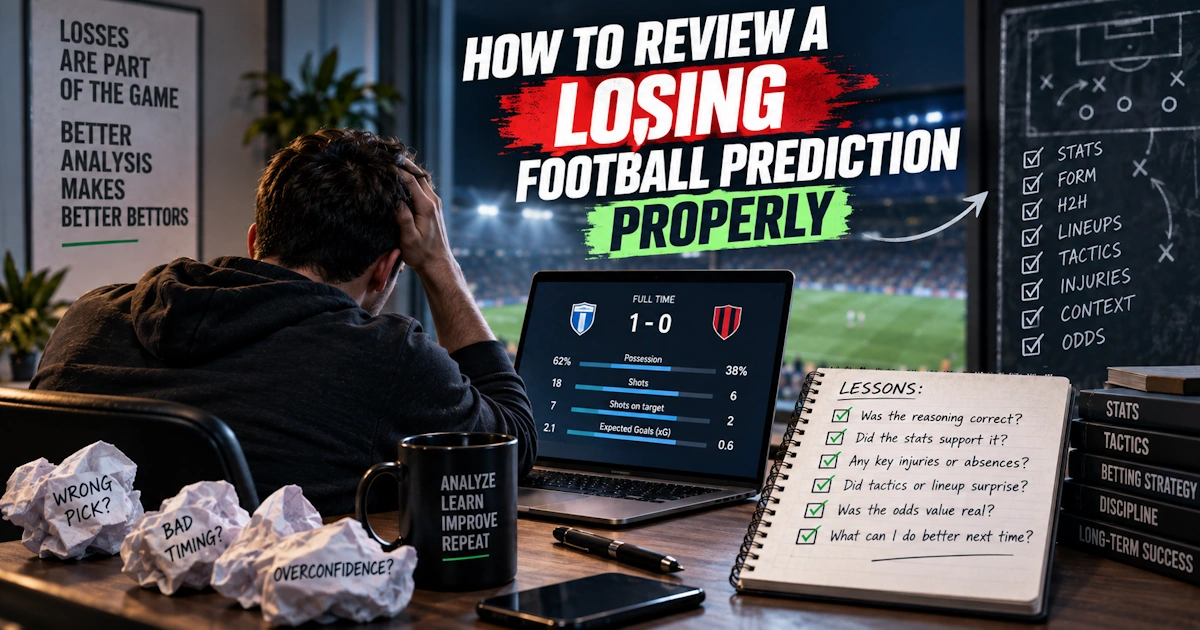
Every bettor gets predictions wrong.
The important part is what happens next.
A losing football prediction can be useful if you review it properly. It can show whether your analysis missed something important, whether the match developed in an unexpected way, or whether the original selection was actually reasonable and simply lost because football is unpredictable.
The worst approach is to judge everything by the final score.
If you backed Over 2.5 and the match finished 1-0, that does not automatically mean the analysis was poor. The teams may have created enough chances for four goals and simply finished badly. On the other hand, a losing Over bet in a match with two shots on target and almost no penalty-area action probably deserves a very different review.
The goal is not to prove that you were “unlucky”. It is to understand whether the decision-making process was good enough to repeat.
Start With the Prediction You Actually Made
Before reviewing the match, go back to the original reasoning.
What exactly made you choose the bet?
For example, an Over 2.5 selection may have been based on:
- Strong home scoring form
- High away conceding numbers
- BTTS trends
- Recent xG
- Defensive injuries
- Tactical mismatch
Write down the main reasons.
This prevents hindsight from changing the story.
After a 0-0 draw, it is easy to suddenly remember every reason the match could have been low-scoring. But if those factors were not part of the original analysis, they should not be used to rewrite your decision after the event.
A proper review compares what you expected before kick-off with what actually happened.
Separate the Result From the Quality of the Bet
This is one of the most important habits in betting analysis.
A good prediction can lose.
A bad prediction can win.
Imagine you back Over 2.5 at odds of 1.90.
The match finishes 1-1, so the bet loses.
However, the match produces:
- 3.1 combined xG
- 11 shots on target
- 5 big chances
- Two missed one-on-one opportunities
- One goal disallowed narrowly
The result is disappointing, but the process may still have been strong.
Now consider another Over 2.5 bet that wins 3-0.
The match produces:
- 1.4 combined xG
- Four shots on target
- One penalty
- One own goal
- One long-range strike
The bet won, but the match did not necessarily validate the analysis.
If you only review losing bets and celebrate winning ones, you miss half the information.
Use Expected Goals Carefully
Expected goals are useful when reviewing predictions because they help separate chance quality from finishing.
Suppose you predicted BTTS – Yes.
The match finished 1-0.
Before deciding the pick was poor, check the losing team’s attacking output.
If it produced:
- 1.5 xG
- Four shots on target
- Two big chances
then the team had a realistic scoring route.
The bet failed because the chances were not converted.
Now imagine the same 1-0 result, but the losing team produced:
- 0.25 xG
- One shot on target
- No big chances
That is more concerning.
The underlying performance did not support the prediction.
Expected goals are not perfect, but they are useful for asking one simple question:
Did the match create the kind of chances your prediction depended on?
Our expected goals guide explains how xG and xGA can distinguish genuine chance creation from final scores influenced by finishing, goalkeeping or short-term variance.
Review Shots, Not Just Goals
Goals are rare events.
Shots and attacking pressure provide a larger sample within one match.
For a goal prediction, check:
- Total shots
- Shots on target
- Shots inside the box
- Big chances
- Corners
- Dangerous set pieces
- Penalty-area touches
Imagine you backed Home Team Over 1.5.
The home side scored only once.
But it had:
- 18 shots
- 7 on target
- 2.2 xG
- 10 touches in dangerous central positions
- A missed penalty
That is very different from a team scoring once from three total attempts.
The first situation may justify keeping similar selection criteria in future.
The second may suggest you overestimated the attack.
Look at Game State
The score changes how teams play.
This means a prediction can be affected by an early event that completely changes the tactical pattern.
Suppose you back Over 2.5 because both teams are normally aggressive.
Then the underdog receives a red card after 12 minutes.
The favourite scores once and controls possession without taking many risks.
The match ends 1-0.
Should the Over prediction be considered poor?
Not necessarily.
The red card created a match that was very different from the one you analysed.
Other game-state factors include:
- Early goals
- Red cards
- Injuries
- Missed penalties
- VAR decisions
- Tactical substitutions
The question is whether the match failed because your original read was wrong or because something unusual changed the environment.
Our guide to how red cards affect Over/Under goal bets explains why a dismissal can increase one team’s attacking advantage while simultaneously reducing the other side’s scoring threat, completely changing the original match pattern.
Do Not Use Bad Luck as an Excuse for Everything
This is where reviews can become dishonest.
It is easy to label every losing bet unlucky.
“The striker missed.” “The goalkeeper played amazingly.” “They hit the post.”
All of that may be true, but repeated losses cannot always be explained by variance.
Suppose ten consecutive Over 2.5 bets lose, and every review says the same thing: “unlucky finishing”.
That should raise a question.
Maybe the selection model is consistently overestimating chance quality.
A single missed chance is variance.
A pattern of weak performance across many selections is information.
This is why reviews should be done across a sample, not only one match at a time.
Track Predictions in Groups
One prediction tells you very little.
Twenty or fifty predictions tell you much more.
Suppose your last 50 Over 2.5 selections produced:
- 24 winners
- 26 losers
- Average odds: 1.85
A 48% strike rate at average odds of 1.85 is not enough to break even, because the implied probability of 1.85 is about 54.1%.
That suggests the selection process may need improvement.
Now suppose another set of 50 predictions produced:
- 30 winners
- 20 losers
- Average odds: 1.90
That is a 60% strike rate.
At those odds, the performance is much more encouraging.
Do not judge a strategy from one Saturday.
Review a meaningful sample.
Compare Your Expected Probability With the Odds
One useful way to review a losing bet is to ask whether the price was still good.
Suppose you backed BTTS at 2.00.
Odds of 2.00 imply a probability of 50%.
If your analysis suggested the true probability was around 58%, the bet may have been sensible even though it lost.
Now imagine you backed the same market at 1.55.
That price implies roughly 64.5%.
If the real chance was only around 55%, the selection may have been poor even if the teams had a strong BTTS trend.
The objective is not to predict every match correctly.
It is to find bets where your estimated probability is higher than the price implies.
Closing Odds Can Provide Useful Feedback
Another useful review tool is the closing price.
Suppose you backed Over 2.5 at 2.00 and, by kick-off, the market moved to 1.75.
That does not guarantee you were right, but it suggests the market eventually valued the Over outcome more highly than when you placed the bet.
Now suppose you backed at 1.70 and the odds drifted to 2.05.
That movement may indicate that important information emerged against your selection.
Examples include:
- A striker being ruled out
- A defensive formation
- Heavy weather
- Unexpected rotation
Closing line movement is not a perfect judge, but over a large sample it can help show whether you are consistently taking competitive prices.
Practical Example: Losing Bet, Good Process
You back BTTS – Yes at 1.90.
Your reasoning:
- Home team scored in 9 of 10 home matches
- Visitors scored in 8 of 10 away matches
- Both teams averaged above 1.4 xG
- Neither defence kept many clean sheets
The match finishes 1-0.
Review:
- Home xG: 1.6
- Away xG: 1.4
- Total shots on target: 9
- Away team missed two clear chances
The bet lost, but the match still broadly followed the expected pattern.
This is probably not a selection method you should abandon.
Practical Example: Losing Bet, Weak Process
You back Over 2.5 because both teams had recorded Over in four of their last five matches.
The match finishes 1-0.
The deeper review shows:
- Combined xG: 1.0
- Only three shots on target
- Both teams had low season-long xG
- Previous Overs were heavily influenced by penalties and red cards
- One team was missing its main striker
The problem was not simply finishing.
The original analysis relied too heavily on recent results and ignored stronger indicators.
That is exactly the type of losing bet that should change future decisions.
For future selections, our guide on how to predict Over 2.5 goals explains how goal averages, venue splits, xG, shots on target, defensive records and team news can be combined instead of relying mainly on a short run of recent results.
Practical Example: Correct Analysis, Wrong Market
Sometimes the general idea is right but the chosen market is wrong.
Suppose you correctly expect the home team to dominate.
You choose Over 2.5 match goals.
The match finishes 2-0.
The home side performs exactly as expected, but the visitors create almost nothing.
The review may show that Home Team Over 1.5 was a better market than full-match Over 2.5.
This is valuable information.
You may not need to change the match analysis. You may need to improve market selection.
Our team total goals guide explains how to choose between Team Over 0.5, 1.5 and 2.5 when your confidence is mainly in one attack rather than the full-match goal total.
Keep a Simple Review Record
You do not need a complicated spreadsheet.
For each prediction, record:
- Match and market
- Odds taken
- Main reasons
- Final result
- xG
- Shots on target
- Major match events
- Whether the expected tactical pattern appeared
- Whether you would place the same bet again at the same odds
That final question is particularly useful.
If you could replay the match 100 times with the same pre-match information and price, would you still want the bet?
If yes, the loss may simply be part of normal variance.
If no, identify what you missed.
Avoid Changing Your Method After Every Loss
Overreaction is one of the biggest dangers.
Suppose you have a well-tested method for Over 2.5 selections and lose three bets in a row.
That is frustrating, but three results are not enough evidence to rebuild everything.
Short losing runs are normal even for strategies with a genuine edge.
For example, even if a selection has a true 60% chance of winning, there is still a 40% chance of losing each individual bet. Losing three in succession is entirely possible.
The solution is to change your method when a larger sample reveals a repeatable weakness, not when one weekend goes badly.
Review Winners Too
A proper review system should include winning predictions.
A lucky winner can teach you just as much as an unlucky loss.
If you backed Over 2.5 and won because of two penalties and an own goal despite a low-quality match, note it.
If you backed Under 2.5 and won despite 4.0 xG and numerous missed chances, note that too.
This prevents results from making the analysis look better than it really was.
Good betting review is about process, not self-congratulation.
Frequently Asked Questions
Does a losing bet mean the prediction was wrong?
The outcome was wrong, but the analysis may still have been reasonable. Review chance quality, match events and the odds before judging the process.
Is xG the best way to review goal bets?
It is useful, but it should be combined with shots, big chances, tactical context and game state.
How many bets should I review before changing a strategy?
A larger sample is much more useful than a few matches. Twenty to fifty selections can begin to reveal patterns, although more data is better.
Should winning bets be reviewed too?
Yes. Some winning predictions are supported by good analysis, while others succeed through unusual events.
What is the most important review question?
Ask whether you would make the same selection again at the same odds using only the information available before kick-off.
Final Thoughts
A losing football prediction is not automatically a mistake.
Sometimes the analysis is good and the result simply goes the other way. Sometimes unusual events change the match. And sometimes the loss exposes a genuine weakness in the original reasoning.
The best reviews separate those situations.
Go back to the original prediction, check whether the expected match pattern appeared, compare goals with xG and shots, consider game state and evaluate whether the odds offered value.
Most importantly, look for patterns across many bets.
One loss tells you what happened in one match. A structured review of 20, 50 or 100 predictions can tell you whether your approach is actually improving.
The goal is not to eliminate losing bets. That is impossible.
The goal is to make sure each loss gives you information you can use the next time.
Explore our football betting resources for more guides covering goal markets, team statistics, tactical analysis and match selection strategies.
Responsible betting: Losses are part of betting and should never be chased with larger stakes. Use a fixed budget, review decisions calmly and never bet money you cannot afford to lose.