The UEFA Nations League can produce almost every type of football match. One night brings a cautious 1-0 between two evenly matched nations.
Another produces a 4-2 or 5-1 because one team cannot cope with the opponent’s attacking quality. That makes a simple question surprisingly difficult: When should you expect a high-scoring Nations League match?
The answer is not simply: when two attacking teams meet. High-scoring matches often require several factors to combine: strong chance creation, defensive weaknesses, a meaningful quality gap, a game state that forces one team forward, or a table situation where a draw becomes increasingly useless.
Through the first four matchdays of the current 2026/27 Nations League, UEFA has recorded 256 goals, an average of 2.47 per match, or roughly one goal every 37 minutes. That average provides useful context, but it also shows why blindly backing Over 2.5 across the competition is not enough.
The real task is finding the individual matches that have a better chance than average of becoming open.
Start With Attacking Quality, Not Recent Scores
The first question should always be: Can these teams consistently create good chances? A useful Nations League goal analysis should include:
Big chances
Penalty-area entries
Recent scoring output
Suppose Team A has scored nine goals in four games. That sounds excellent.
But if those nine goals came from only 4.8 xG, the finishing may be unusually efficient. Now imagine Team B scored only six times but generated 8.2 xG.
The second team may actually have the stronger underlying attacking process. For future goal predictions, how chances are created often matters more than the recent final scores.
Current Nations League Scoring Varies Dramatically Between Teams
The overall tournament average is 2.47 goals per match, but some teams are scoring much more frequently. After four matchdays, UEFA’s current statistics list:
England – 14 goals
Spain – 12 goals
Switzerland – 11 goals
with Austria, Slovakia and Finland among the teams on nine. Those differences are useful.
A team that repeatedly generates goals deserves more attention for Over and team-total markets than a side producing very little attacking threat. But even here, you need context.
Check: Who were those goals scored against? Fourteen goals against weaker opposition may be less impressive than ten scored against several strong defences.
Quality Gaps Can Produce High Scores
One of the clearest high-scoring situations occurs when a strong attacking nation faces a much weaker defence. The 2026/27 competition has already provided dramatic examples.
England beat Croatia 7-0, while Finland won 7-0 away to San Marino. UEFA lists both among the largest winning margins in Nations League history.
These matches remind us that Over 2.5 does not require both teams to score. One dominant team can produce almost the entire total.
This is why you should separate high-scoring match from BTTS match. A fixture can be excellent for Over 2.5 but poor for BTTS.
Practical Example: Over Without BTTS
Imagine a favourite with 2.3 xG per game, 6.5 shots on target, and a strong home attack. The underdog has 0.7 xG, 2.1 shots on target, and concedes many big chances.
Possible scores include: 3-0, 4-0, 4-1. Here, Over 2.5 may be attractive.
But BTTS – Yes could be much weaker. The favourite may be capable of covering the goal line almost by itself.
Team Totals Can Be Better Than Full-Match Overs
In quality-mismatch situations, a team total can sometimes provide cleaner logic. Suppose you expect the favourite to score two or three goals, but the underdog offers little attacking threat.
Instead of needing three total goals from either side, you might analyse Favourite Over 1.5 Team Goals. This focuses the prediction on the strongest part of your analysis.
The same principle applies when considering Over 3.5. If you need the weak team to contribute, ask whether it genuinely has a realistic scoring route.
High-Scoring Matches Become More Likely When Both Teams Create
The classic Over 2.5 scenario is different. Suppose Team A has 1.8 xG, 5.3 shots on target, and weak defensive transition.
Team B has 1.6 xG, 4.8 shots on target, and concedes regularly. Now both teams have a route to score and a reason to concede.
Possible results include: 2-1, 2-2, 3-1. This is usually a stronger Over environment than relying entirely on one dominant team.
It may also support BTTS.
Weak Defences Can Be More Important Than Strong Attacks
Bettors naturally focus on goals scored. Goals conceded can be just as useful.
Suppose a team has scored only five goals in four Nations League matches. That does not scream Over.
But what if it has also conceded ten? Its games may still be highly suitable for goal markets because the defence creates instability.
Look at xGA, big chances conceded, shots on target allowed, errors leading to shots, and set-piece weakness. High-scoring matches do not always involve two elite attacks.
Sometimes one or both defences simply cannot control the game.
Defensive Absences Can Change the Goal Environment
International football squads can change significantly between windows. A team may lose its first-choice goalkeeper, central defender, defensive midfielder, or starting full-back.
That can matter more than the season-long goal average. Imagine a defence has strong historical numbers, but both regular centre-backs are unavailable.
The replacement partnership has little international experience. The old defensive average may no longer describe the team taking the field today.
For Nations League goal predictions, confirmed squad news can be particularly important because national teams have less training time to rebuild defensive partnerships.
An Early Goal Can Transform the Match
Game state is one of the strongest drivers of high-scoring football. Imagine two teams begin cautiously.
Then the home team scores after 12 minutes. The visitor must change its approach.
It pushes more players forward, creating more possession in advanced areas, higher defensive positioning, and greater counterattacking space. A match that looked relatively balanced before kickoff can quickly become open.
This is why live goal analysis can sometimes be more useful than trying to predict everything beforehand.
The Trailing Team Matters
Not every early goal creates the same effect. Suppose the underdog scores first against a strong favourite.
That can be particularly interesting. The favourite is now forced to attack, while the underdog can counter.
Both teams suddenly gain clear scoring routes. Possible development: 0-1 → 1-1 → 2-1 → 2-2.
Now compare that with a strong defensive favourite scoring first. It may control the remainder of the match and win 1-0 or 2-0.
So do not simply say: Early goal = Over. Ask: Who scored it and what does the other team need to do now?
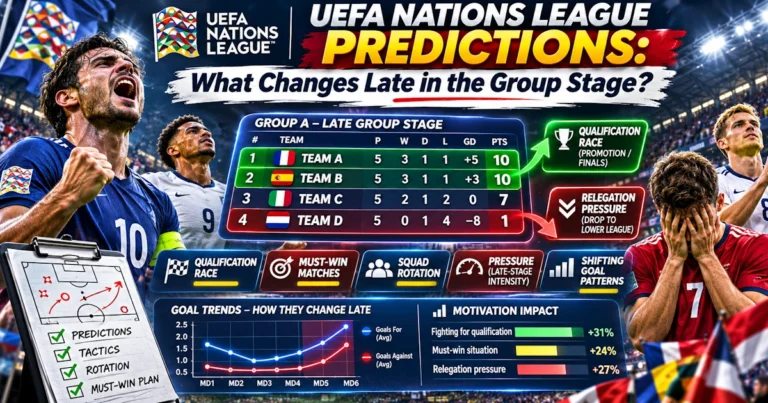
Must-Win Situations Can Increase Goals—Especially Late
The 2026/27 Nations League league phase reaches Matchdays 5 and 6 from 12 to 17 November 2026. Teams in Leagues A, B and C generally play six group matches, so qualification, promotion and relegation scenarios become much clearer in those final rounds.
This can create excellent late-goal conditions. Suppose a team needs victory.
The score is 1-1 after 70 minutes. A draw is not enough.
The manager may introduce another striker, push full-backs forward, increase pressing, and leave fewer players behind the ball. That increases the attacking team’s chance of scoring.
But it can also increase the opponent’s counterattacking chances. This is why must-win situations can sometimes improve both teams’ goal probability.
But Must Win Does Not Automatically Mean Over
The first 60 minutes may look completely different. A team needing victory may still start cautiously because conceding first would make the situation worse.
Possible pattern: First half controlled, second half increasingly open. For this reason, a table-driven match may be more interesting for Second-Half Over 1.5 or a live late-goal market than for an aggressive first-half Over.
Timing matters.
When Both Teams Need Victory, Risk Can Multiply
One of the strongest late-group scenarios occurs when neither team benefits much from a draw. Imagine a final-round match.
Team A needs a win for promotion. Team B also needs victory to secure a play-off position.
At 1-1 after 75 minutes, there is little reason for either side to protect the result. Both may attack.
That creates higher lines, more transitions, more set pieces, and more counterattacking opportunities. This can be an excellent environment for another goal.
When a Draw Helps Both Teams, Expect the Opposite
Now imagine both teams know a draw achieves their objective. At 1-1 after 75 minutes, the incentives are completely different.
Neither side needs to increase risk. The match can slow down dramatically.
This is why goal predictions late in the Nations League require more than looking at average goals. You need to understand what the score means.
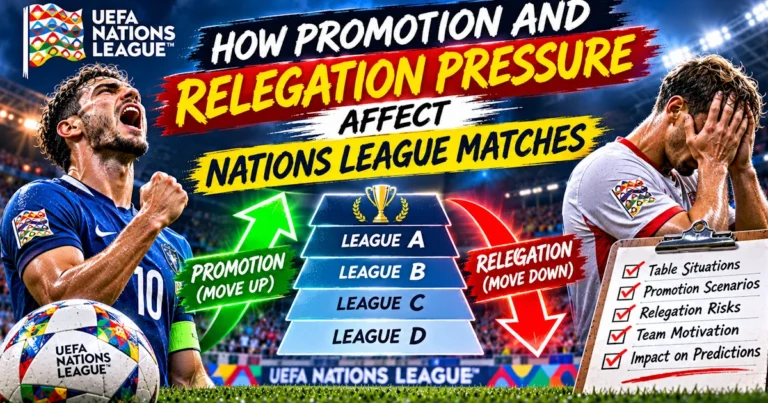
Promotion and Relegation Can Change Goal Probability
The current 2026/27 Nations League uses an adjusted promotion and relegation system because UEFA plans to move to three leagues from 2028/29. League B and League C group winners gain automatic promotion, while other positions can lead to promotion/relegation play-offs.
League A also contains quarter-final, survival and relegation incentives. That creates meaningful pressure across many groups.
A match between third and fourth may be just as tactically important as a top-of-the-table game. For goal predictions, check the consequence of every position rather than focusing only on first place.
High-Scoring Matches Can Appear When One Team Has Nothing to Protect
A team already eliminated or safe can be unpredictable. Sometimes motivation falls, but sometimes the opposite happens.
Without pressure, a manager may use younger attackers, play a more aggressive formation, and experiment tactically. The result can be a freer match.
Meanwhile, the opponent may desperately need victory. That combination can produce open football.
Do not automatically assume: Nothing to play for = low intensity = Under. The tactical setup matters more.
Rotation Can Produce Goals in Two Different Ways
Rotation can lower attacking quality. If a team rests its main striker, creative midfielder, and best winger, its scoring expectation may fall.
But defensive rotation can do the opposite. If a manager changes the goalkeeper, both centre-backs, and defensive midfielder, the opponent may find far more opportunities.
Heavy rotation can also reduce defensive coordination. That is particularly important in international football because replacement players have relatively little training time together.
Practical Example: Rotation Supports Over 2.5
Imagine Team A has already achieved its group objective and rotates heavily in defence. Team B still needs a win.
The lineup shows a backup goalkeeper, new centre-back partnership, and young full-back. Team B has a strong attack.
Meanwhile, Team A still fields talented forwards. Possible result: 2-2 or 3-1.
The rotation has not necessarily weakened the whole match. It has made the game less defensively stable.
Set Pieces Can Push Tight Matches Over the Line
High-scoring predictions should not focus entirely on open play. International teams often rely heavily on rehearsed set pieces because they have limited training time for complex possession patterns.
If both teams are strong from corners, dangerous from free kicks, and weak aerially in defence, there may be additional scoring routes. A match projected around 2.4 or 2.5 expected total goals can become more interesting when both sides have strong set-piece matchups.
Penalties and Red Cards Add Variance
High-scoring matches sometimes come from unexpected events. A penalty creates a high-quality scoring opportunity, while a red card can radically change the tactical balance.
You should never predict a red card. But teams that defend aggressively, commit many fouls, and face quick dribblers may carry greater disciplinary risk.
Once a red card occurs, reassess the goal market rather than relying on the original prediction.
The 2024/25 Nations League Showed How High the Ceiling Can Be
The previous edition provided several dramatic examples. Spain’s 5-4 victory over France in the 2025 semi-final became the highest-scoring game in Nations League history.
Spain scored 25 goals in ten matches across the 2024/25 competition, the most by any team in a single edition at that point. The same tournament also featured high-scoring knockout ties such as Portugal 5-2 Denmark and Spain 3-3 Netherlands.
These examples show what can happen when elite attacking quality combines with game-state pressure. They should not be treated as normal results.
They show the upper end of the distribution.
Look for Several Independent Goal Signals
A strong Over 2.5 prediction should ideally contain more than one reason. For example: High home xG plus weak away xGA plus both teams need a result plus defensive absences.
That is more convincing than: “Their last three matches went Over.” The best predictions occur when team quality, statistical trends and tactical incentives point in the same direction.
Practical Example: Strong Over 2.5 Profile
Imagine the home side has 1.9 xG, 5.6 shots on target, and scores regularly at home. The away side has 1.6 xG, concedes 1.8 xGA, and has a dangerous counterattack.
Group situation: Both need victory. Team news: One starting centre-back missing for each team.
Now there are several independent reasons for expecting chances. Possible scores: 2-1, 2-2, 3-1.
This is a much stronger high-scoring profile than simply seeing two recent Over results.
Practical Example: Looks Like an Over, But Is Not
Now imagine the home side scored eight goals in its last two matches. The public sees: Goals!
But closer analysis shows:
One match was against ten men
Three goals came from penalties
Combined xG was only 3.5
Today’s opponent has an elite defence
A draw suits both teams
The recent scorelines may be misleading. This is where deeper analysis can stop you from chasing yesterday’s goals.
Over 3.5 Requires a Higher Standard
Over 2.5 needs three goals. Over 3.5 requires four.
That difference is substantial. Do not treat an attractive Over 2.5 match as automatically suitable for Over 3.5.
For the higher line, look for exceptional conditions such as:
Major quality gap
Both teams with strong attacks
Very weak defensive structure
Must-win late-stage scenario
Significant defensive absences
The price may be bigger. The probability is also much lower.
Live Statistics Can Confirm the Prediction
Suppose your pre-match analysis supported Over 2.5. After 30 minutes the score is still 0-0.
Do not panic, but check what is happening.Strong live profile: 1.3 combined xG, 6 shots on target, 3 big chances.
The score may simply be lagging behind the performance.Weak live profile: 0.25 combined xG, 1 shot on target, no big chances.
The original prediction may be wrong. Good live analysis updates the pre-match opinion instead of defending it blindly.
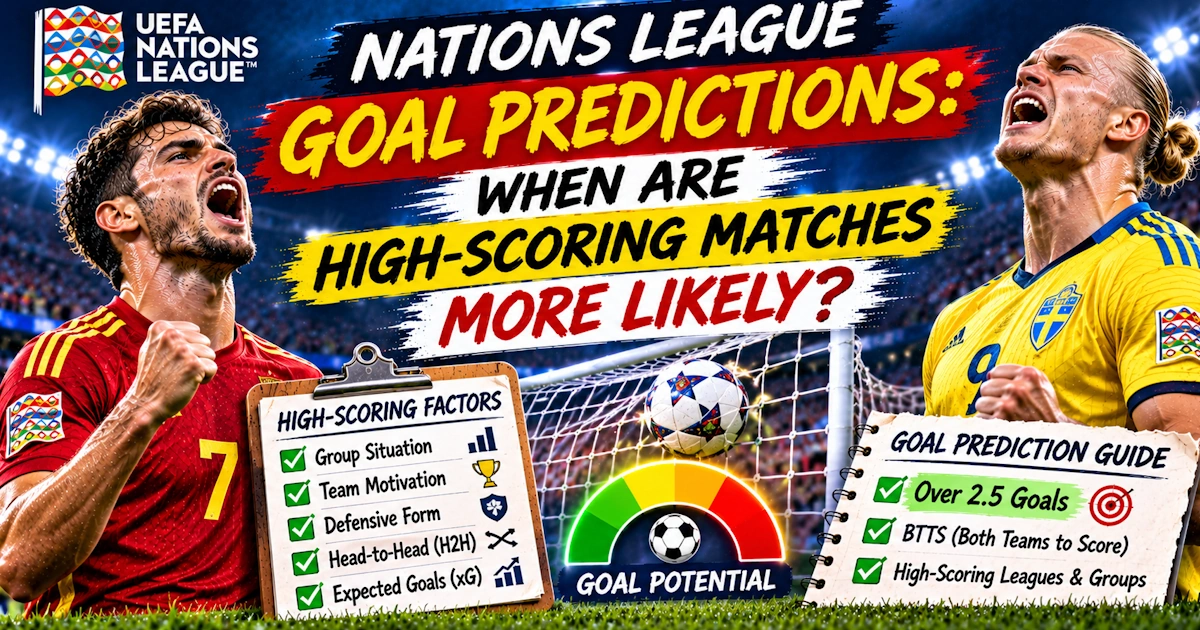
Nations League High-Scoring Match Checklist
Before choosing an Over or other goal market, check:
Current xG and xGA, shots on target, and big chances
Quality gap and home-away performance
Defensive absences, goalkeeper availability, and expected rotation
Set-piece strength
Current group position and whether both teams need victory
Whether a draw benefits either side
What happens tactically after the first goal
Recent results adjusted for opponent strength
Whether the odds already reflect obvious scoring trends
The more independent factors pointing towards goals, the stronger the case.
Frequently Asked Questions
How many goals are being scored in the 2026/27 Nations League? After the first four matchdays, UEFA records 256 goals at an average of 2.47 per match.
Does a big quality gap make Over 2.5 more likely? It can. A strong favourite may score three or more goals without much help from the underdog. However, team-total markets can sometimes fit this situation better than full-match Overs.
Are must-win Nations League matches usually high scoring? Not automatically. Teams can begin cautiously, but the game may become much more open later if a draw is not enough.
Is BTTS good when both teams need to win? It can be, especially when both teams already create strong xG and have defensive weaknesses. Motivation alone is not enough.
What statistics are most useful for Nations League goal predictions? xG, xGA, shots on target, big chances, home-away performance, opponent strength and current team news are particularly useful. Group scenarios become increasingly important on Matchdays 5 and 6.
Final Thoughts
High-scoring Nations League matches rarely happen because of one statistic. The strongest goal predictions usually combine several conditions.
A quality gap can allow one powerful team to dominate. Two aggressive attacks can create BTTS and Over potential.
A weak defence can turn an otherwise ordinary match into a high-scoring one. And late in the group stage, a draw that helps nobody can force both teams to take increasingly large risks.
The current 2026/27 competition is averaging 2.47 goals per match, which is useful as a baseline—not as a prediction for every fixture. Instead of asking: “Does the Nations League produce many goals?” ask: “What are the realistic scoring routes in this specific match?”
Can the favourite score three on its own? Can both teams create big chances? Will the trailing team be forced forward? Does a draw become useless late in the match? Are important defenders missing?
Those questions tell you much more than a simple Over percentage. And when several answers point in the same direction, you may have found the type of Nations League fixture where a high-scoring match is genuinely more likely.
Responsible betting: Goal statistics and group scenarios can improve probability estimates but cannot guarantee a high-scoring match. Compare your analysis with the available odds, use controlled stakes and never bet money you cannot afford to lose.