
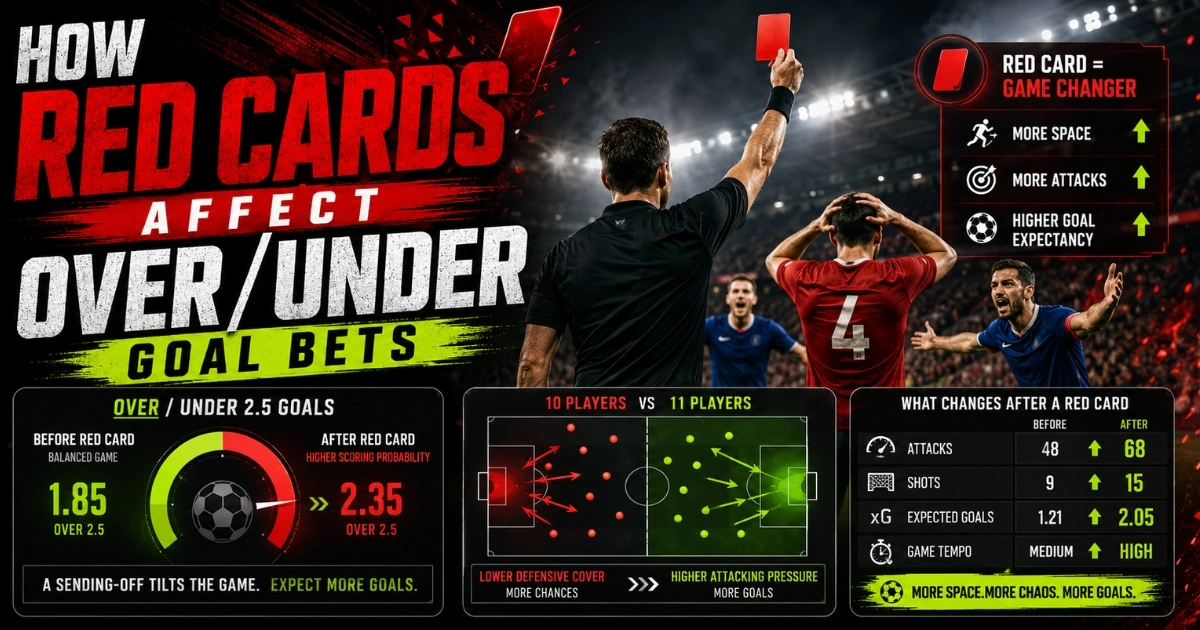
A red card can transform a football match in seconds. A team that was pressing high may suddenly retreat into a compact defensive block. The opposition may gain possession, create more chances and push extra players forward.
It is tempting to assume that playing against ten men automatically means more goals. Sometimes it does. A dominant team can use the extra space to turn a narrow lead into a comfortable victory. In other matches, however, the sending-off makes the game slower because the penalised team stops attacking and focuses entirely on defending.
That is why a red card should not be treated as an automatic signal for an Over bet. Its impact depends on when it happens, which team loses a player, the current score and how both managers respond.
Red cards are only one part of football goal prediction analysis, which should also consider scoring form, defensive records, venue splits, tactics and match context.
What Usually Happens After a Red Card?
The team reduced to ten players normally has to change its structure. A forward may be replaced by a defender, a winger may drop into midfield or the entire team may defend closer to its own penalty area.
These changes usually reduce the penalised team’s attacking threat. At the same time, the opposition gains more possession and space.
Research supports this general pattern, although the size of the effect varies between competitions. A study of World Cup matches from 1998 to 2014 estimated that the scoring rate of the penalised team fell by approximately 47%, while its opponent’s scoring rate increased substantially.
A separate analysis of 1,826 matches from Europe’s five major leagues also found that a dismissal significantly damaged the penalised team’s scoring rate while improving the opponent’s.
However, this does not necessarily mean the total number of goals will rise. One team’s attacking output may increase while the other side almost completely stops creating chances.
Why a Red Card Does Not Always Mean Over
Over 2.5 goals requires at least three total goals, regardless of which team scores them.
After a red card, the team with eleven players may dominate without converting its possession into clear chances. The ten-man side may defend with two narrow lines and offer almost nothing going forward.
A match that looked open at eleven against eleven can therefore become extremely one-sided but still finish:
- 1–0
- 2–0
- 1–1
All three results stay Under 2.5.
A model using eight seasons of Brazilian Série A data estimated that receiving a red card reduced the penalised team’s own goal intensity by more than 30%. That reduction matters when an Over prediction originally depended on both teams contributing.
The correct question is not simply, “Will the team with eleven players attack more?”
It is: Will the attacking advantage be large enough to compensate for the reduced scoring threat of the ten-man team?
The Timing of the Red Card
Timing is one of the most important factors.
Early red card
A dismissal in the first 20 or 30 minutes leaves plenty of time for the numerical advantage to influence the match.
The team with eleven players can:
- Tire the opponent through prolonged possession
- Create overloads in wide areas
- Introduce extra attackers later
- Benefit from defensive fatigue during the second half
An early red card can therefore strengthen an Over selection, particularly when the stronger team keeps attacking.
However, it can also destroy a BTTS prediction if the penalised side abandons its attacking plan.
The remaining playing time is central to the decision. Our guide to goal timing in football explains why match conditions, fatigue and tactical urgency often change as the game progresses.
Second-half red card
A dismissal after the 60th minute leaves less time for the match to change.
The impact depends heavily on the current score and tempo. If the score is already 2–0 and the losing team receives a red card, one additional goal may be realistic.
If the match is 0–0 with few chances and the red card arrives in the 78th minute, there may not be enough time for Over 2.5, even with a numerical advantage.
Very late red card
A dismissal in the final minutes may have little influence on the goal total. The bookmaker may still adjust the live odds, but only a limited amount of playing time remains.
The match situation should carry more weight than the card itself.
When a dismissal occurs during the closing stages, our guide to predicting late goals after the 75th minute explains how the score, remaining time, attacking pressure, substitutions and counterattacking space should be assessed.
Which Team Received the Red Card?
A red card has a different effect depending on the relative quality of the teams.
The underdog receives a red card
This is often the clearest situation for an Over bet.
A strong favourite already controlling possession may now face an even weaker defence. If the card arrives early enough, results such as 3–0, 4–0 or 4–1 become more realistic.
Over 2.5 can be stronger than BTTS because the favourite may cover the goal line alone.
The favourite receives a red card
This situation is more complicated.
The favourite may still have enough individual quality to score, but it will probably create fewer chances than expected. If it was responsible for most of the pre-match goal expectation, the dismissal may weaken an Over selection.
For example, suppose a strong home team was expected to win comfortably against a visitor that rarely scores away. If the favourite loses a player after 25 minutes, the match may become much closer and less productive.
The underdog gains an advantage, but that does not guarantee it has the attacking quality to use it.
The Score at the Time of the Card
The same red card can produce completely different consequences depending on the score.
The penalised team is losing
A team already behind and then reduced to ten players faces a serious problem. It may need to continue attacking despite the numerical disadvantage.
This can leave large spaces for the opponent and support additional goals.
Example: The favourite leads 1–0 after 30 minutes, and the underdog receives a red card. The underdog cannot simply defend the result forever, while the favourite now has greater control. Over 2.5 becomes more attractive if the attacking statistics are already strong.
The penalised team is winning
A team leading 1–0 may immediately retreat after losing a player.
It may remove an attacker, slow down restarts and defend close to its penalty area. The opposition will attack, but the game could still finish 1–0 or 1–1.
Under markets may remain reasonable when the team with eleven players lacks creativity against deep defences.
The match is level
A red card at 0–0 or 1–1 can create uncertainty.
One manager may attack aggressively to use the advantage. Another may remain patient and avoid exposing the team to counterattacks.
Look at the teams’ tactical tendencies rather than assuming an immediate wave of goals.
The Position of the Dismissed Player
Not every red card affects the team in exactly the same way.
Losing a central defender can immediately weaken defensive organisation. The manager may need to remove an attacking player to introduce another defender, reducing attacking strength as well.
Losing a striker has a more direct effect on the team’s ability to hold the ball and create chances. The defence may remain structurally intact, but the side can become trapped near its own penalty area.
A goalkeeper’s dismissal often causes the most obvious reorganisation. An outfield player must usually be sacrificed for the substitute goalkeeper, meaning the team loses both its original goalkeeper and another tactical option.
Consider the role of the player rather than focusing only on the number of players remaining.
For a broader explanation of how losing an established defender or goalkeeper can affect organisation, replacement quality and tactical structure, read our guide to how missing defenders affect football goal predictions.
How Red Cards Affect Different Goal Markets
Over 2.5 goals
This becomes more attractive when:
- The dismissal happens early
- The stronger team retains eleven players
- The match already contains a goal
- The penalised side must continue attacking
- The team with the advantage creates many chances
Before treating the dismissal as support for the market, compare it with the wider attacking and defensive evidence in our guide on how to predict Over 2.5 goals.
Under 2.5 goals
This can remain suitable when:
- The favourite receives the card
- The penalised team protects a lead
- The opposition struggles against defensive blocks
- The card happens late
- The match was already producing few chances
When the red card reduces attacking ambition or creates a deep defensive block, our guide on how to predict Under 2.5 goals explains which low-scoring indicators should confirm the selection.
Both Teams to Score
BTTS – Yes often becomes weaker when one team loses a player, particularly if it was already struggling offensively.
The match can still produce several goals, but they may all come from the team with the numerical advantage.
This is an important distinction between the markets. Our BTTS vs Over 2.5 goals comparison explains why a 3–0 result supports Over but not Both Teams to Score.
Team total goals
Team totals can sometimes reflect the new situation more accurately than the full-match line.
If a dominant favourite is playing against ten men, its individual Over 1.5 or Over 2.5 team total may be more logical than BTTS or a broad match-total selection.
Our guide to team total goals explains how Over 0.5, 1.5 and 2.5 lines differ and how much attacking evidence is normally required before moving to a higher individual-team total.
Practical Examples
Example One: Red card supports Over
The home favourite leads 1–0 after 22 minutes. The visitors receive a red card and had already been allowing several shots on target. The home side averages more than two goals per home match and continues pressing.
Over 2.5 has a clear route: the favourite needs only two more goals, and there is plenty of time remaining.
Example Two: Red card supports Under
The match is 0–0 after 65 minutes. The stronger home team receives a red card, while the visitors have scored fewer than one goal per away match. The home team becomes cautious, and the visitors lack the quality to dominate.
The red card has changed the balance, but it has not necessarily created a strong route to three goals.
Example Three: Over improves but BTTS weakens
The favourite leads 2–0 when the underdog loses a defender early in the second half.
A third goal looks possible, supporting Over 2.5. However, BTTS – Yes becomes less attractive because the underdog now has fewer opportunities to attack.
Red-Card Goal-Betting Checklist
After a dismissal, check:
- Which team received the card?
- What was the score at the time?
- How many minutes remain?
- Which position was affected?
- Does the penalised team still need to attack?
- Can the team with eleven players break down a deep defence?
- Was the match producing good chances before the card?
- Is the Over prediction dependent on both teams scoring?
- Have the live odds already fully adjusted?
Expected goals can help show whether the match was already producing genuine scoring opportunities before the dismissal. Our expected goals guide explains how xG and xGA can distinguish sustained pressure from possession and shots that create little real danger.
Do not make the decision from the red card alone. Combine it with the score, team quality and actual match performance.
Frequently Asked Questions
Does a red card always increase the chance of Over 2.5?
No. It increases the attacking advantage of one team but normally reduces the penalised team’s scoring threat. The effect on total goals depends on which change is stronger.
Is an early red card more important?
Usually, because more playing time remains for the numerical advantage to affect the match. The score and team quality still matter.
Is BTTS a good bet after a red card?
It can be, but the penalised team may stop attacking. BTTS becomes risky when that team did not score before the dismissal.
Should I immediately place a live bet after a red card?
Not necessarily. Bookmakers adjust their odds quickly. First check the score, timing, tactical response and whether the new price still offers reasonable value.
Final Thoughts
Red cards create opportunities in Over/Under markets, but they also create traps.
The team with eleven players normally becomes more likely to score, while the penalised team’s attacking output usually falls. Whether the match moves towards Over or Under depends on timing, score, team strength and tactical response.
An early dismissal for a struggling underdog can strongly favour additional goals. A red card for the main attacking favourite may have the opposite effect.
Rather than following a simple “red card means goals” rule, picture how the remaining minutes are likely to be played. That gives you a much stronger basis for assessing Over 2.5, Under 2.5, BTTS and team-goal markets.
Explore our football betting resources for more guides covering goal markets, match statistics and prediction strategies.
Responsible betting: Use a fixed budget, avoid chasing losses and never stake money you cannot afford to lose.