
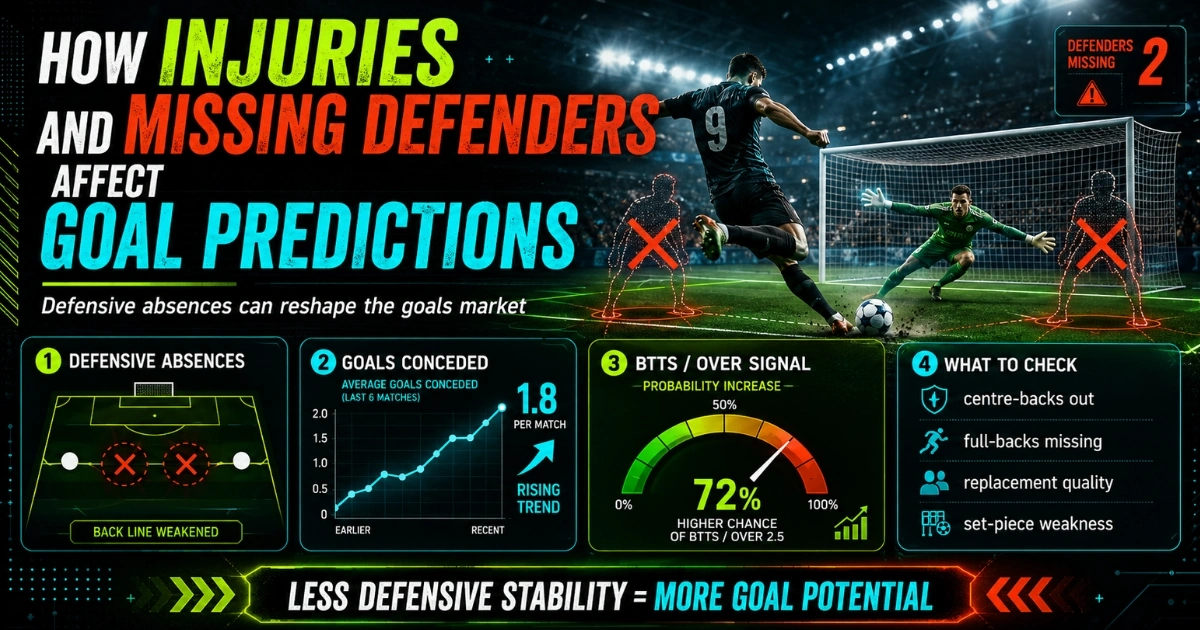
Team news can completely change a football goal prediction.
A match may initially look suitable for Under 2.5 because both teams defend well. Then one side loses its first-choice goalkeeper and two central defenders. Suddenly, its season-long clean-sheet record may no longer reflect the defence that will actually start the match.
However, missing defenders do not automatically guarantee goals. Some teams have strong replacements, while others respond by playing more cautiously. A defensive injury can even reduce the total number of goals if the affected manager abandons an attacking system and protects the replacement back line.
The important question is not simply how many defenders are unavailable. You need to understand who is missing, how important they are and what the team is likely to change without them.
Team news should therefore be combined with the wider factors covered in our complete guide to football goal predictions, including scoring form, defensive statistics, venue records and match context.
Why Defensive Partnerships Matter
Defending is not only about individual quality. It also depends on organisation, communication and familiarity.
Central defenders must coordinate:
The defensive line
Offside decisions
Marking at set pieces
Cover behind the full-backs
Pressure on opposing forwards
Communication with the goalkeeper
A replacement may be individually talented but unfamiliar with the player beside him. Small misunderstandings can create large opportunities.
One defender may step forward while the other drops back, leaving space for a striker. A substitute centre-back may also react more slowly to crosses or fail to track a runner during a counterattack.
This is why losing two regular defenders can be much more serious than losing only one. The team is not merely replacing individuals; it may be rebuilding the entire defensive partnership.
Not Every Missing Defender Has the Same Impact
The position and role of the absent player matter.
Central defenders
Missing centre-backs can affect aerial duels, marking, defensive positioning and build-up play. The risk becomes greater when both regular central defenders are unavailable.
Full-backs
An absent full-back can create problems against teams that attack through wide areas. The replacement may struggle with pace, one-against-one defending or positioning at the back post.
However, an attacking full-back’s absence could also reduce the team’s own forward threat. The effect may therefore influence both goals scored and conceded.
Defensive midfielders
A defensive midfielder may not appear in the back four, but his absence can expose the defence. He may normally block passing lanes, stop counterattacks and protect the central defenders.
A team missing its main holding midfielder can allow more shots even when all regular defenders are available.
Goalkeepers
A goalkeeper change deserves special attention. A reserve may be weaker at shot-stopping, crosses or communication. Defenders may also behave less confidently when the usual goalkeeper is unavailable.
Goalkeeper quality can be particularly important in closely balanced matches where only a few shots on target are expected.
Replacement Quality Is More Important Than the Name Missing
The absence of a first-choice defender sounds significant, but the quality of the replacement determines the practical impact.
A club with a deep squad may replace an injured defender with an experienced international. The structure may remain largely unchanged.
A smaller club may have to use:
A young player with little senior experience
A full-back as a centre-back
A midfielder in defence
A player returning before full fitness
A new signing unfamiliar with the system
Check how often the replacement has played and whether he has previously started beside the other defenders.
One useful comparison is the team’s performance with and without the absent player. Look at goals conceded, expected goals against, clean sheets and shots allowed. Be careful with small samples, though. Two matches without a defender are not enough to prove a reliable trend.
How Missing Defenders Affect Over 2.5 Goals
Over 2.5 becomes more attractive when defensive absences increase the number or quality of chances likely to be created.
Useful warning signs include:
Two or more first-choice defenders missing
A reserve goalkeeper starting
An unfamiliar centre-back partnership
A high defensive line facing fast attackers
Poor set-piece replacements
Several players absent from the same defensive area
Imagine a team normally concedes 1.0 goal per match and allows 1.1 expected goals against. Its first-choice centre-backs are then ruled out, and the likely replacements have started together only once.
The opponent averages 1.8 goals and creates several chances from crosses and set pieces. The original defensive average may now underestimate the risk.
Over 2.5 could deserve more attention, especially if the affected team also scores regularly.
However, avoid assuming the opponent will automatically score three or four goals. It still needs the attacking quality to exploit the weakness.
Our guide on how to predict Over 2.5 goals explains how defensive absences should be combined with scoring averages, expected goals, shots on target and the opponent’s attacking form.
How Defensive Injuries Affect BTTS
Missing defenders can strengthen a BTTS – Yes prediction when both teams already have credible attacking routes.
Suppose the home team has scored in nine of ten home fixtures. The visitors also score regularly away but are missing their first-choice goalkeeper and one central defender.
The home side now has an even stronger chance of scoring. BTTS remains dependent on the visitors contributing, so their own attacking record still matters.
This is an important distinction.
If the visitors rarely score away, defensive injuries may support Over 2.5 more than BTTS. The home team could win 3–0, which wins the Over but loses BTTS – Yes.
Always decide whether the expected goals are likely to come from both teams or mainly from one side.
Our BTTS vs Over 2.5 comparison explains how to choose between the markets when defensive injuries improve one team’s scoring chances but the opponent may still fail to contribute.
Can Missing Defenders Support Under 2.5?
Surprisingly, yes.
A manager dealing with defensive injuries may change the team’s approach by:
Defending deeper
Using an extra holding midfielder
Reducing the full-backs’ attacking freedom
Slowing the tempo
Prioritising possession and risk control
Removing an attacker to strengthen midfield
The team may become less dangerous offensively but harder to attack than expected.
For example, a side normally plays an aggressive 4-3-3 formation. After losing two defenders, it switches to a compact back five and creates very little itself. The match could become slower rather than more open.
Under 2.5 may still be reasonable when the opponent struggles against deep defensive blocks and the affected team offers little attacking threat.
For a complete low-scoring assessment, read our guide on how to predict Under 2.5 goals using attacking output, defensive structure, xG and tactical context.
Team selection and formation are therefore essential.
Look at the Statistics Behind the Defence
Goals conceded alone do not explain whether a team is defending well.
Check:
Expected goals against
Shots on target allowed
Big chances conceded
Clean-sheet percentage
Goals conceded from set pieces
Errors leading to shots or goals
Opposition touches inside the penalty area
Suppose a team has conceded only three goals in five matches, but its average xGA is 1.8 per game. It may already be allowing dangerous chances and surviving through good goalkeeping or poor finishing.
If key defenders are then ruled out, the defensive record could become even less sustainable.
Our guide to expected goals explains how xGA and chance quality can reveal defensive weakness that is not yet visible in the goals-conceded record.
The opposite is also possible. A team may have conceded several goals from difficult shots while continuing to limit clear opportunities. One missing defender may not be enough to turn it into an automatic Over selection.
Clean-sheet records also need additional context. Our guide to clean-sheet statistics and goal markets explains how goalkeeper performance, xGA and shots allowed affect their reliability.
Set Pieces Can Become More Dangerous
Defensive absences are particularly important when the opponent is strong from corners and free kicks.
A centre-back may be the team’s best aerial defender. Removing him changes marking assignments and may leave smaller players responsible for dangerous opponents.
Check whether the missing player normally:
Marks the opposition’s main aerial threat
Defends the near post
Organises zonal marking
Wins a large percentage of aerial duels
Clears second balls around the penalty area
A team that is already vulnerable at set pieces may become significantly weaker without its most dominant defender.
This matters even in otherwise cautious matches. One corner can open the scoring and completely change the goal pattern.
Practical Example: Over 2.5 Goals
Consider the following hypothetical match.
Home team
Averages 1.9 goals at home
Has scored in nine of ten home matches
Produces 1.8 home xG
Regularly creates chances from crosses
Away team
Missing both first-choice centre-backs
Reserve goalkeeper expected to start
Concedes 1.6 goals per away match
Allows more than five shots on target away
Still scores in seven of ten away fixtures
The defensive absences strengthen an existing statistical argument. The home team already creates chances, while the visitors remain capable of scoring.
The relevance of those numbers depends on the venue. Our guide to home and away form for goal bets explains how the host’s home attack should be compared with the visitor’s away defence and scoring record.
Results such as 2–1, 3–1 and 2–2 now have a clear route, making Over 2.5 and possibly BTTS – Yes worth analysing.
Practical Example: Do Not Overreact
Now imagine a team is missing one first-choice full-back.
Its replacement has started 15 league matches, the regular centre-backs are available and the manager uses a conservative system. The opponent averages only 0.8 away goals and produces few shots on target.
Calling this an automatic Over match would be an overreaction.
The absence matters, but the remaining defence, replacement quality and opposition attack do not support a major change in expectation.
When to Wait for Confirmed Line-Ups
Predicted line-ups can be wrong, particularly during busy schedules.
Waiting for confirmed teams can reveal:
Whether the defender has recovered
Which replacement starts
Whether the formation has changed
Whether an extra defensive midfielder is included
Whether the opponent selects its strongest attackers
Confirmed line-ups are especially important when your prediction depends heavily on one or two absences.
The odds may move after team news, but a slightly lower price can be preferable to betting on an incorrect assumption.
Quick Defensive-Injury Checklist
Before changing a goal prediction, check:
Which defenders are unavailable?
Are several players missing from the same area?
How experienced are the replacements?
Has the new defensive partnership played together?
Is the first-choice goalkeeper available?
Will the formation change?
Can the opponent exploit the specific weakness?
Are defensive problems supported by xGA and shot data?
Does the affected team still have a credible scoring route?
Have the odds already adjusted to the news?
The strongest betting case appears when injuries confirm weaknesses already visible in the statistics.
Frequently Asked Questions
Does one missing defender automatically favour Over 2.5?
No. Replacement quality, team structure and the opponent’s attacking ability matter more than the number of absences alone.
Are missing centre-backs more important than missing full-backs?
Not always, but an unfamiliar central partnership can seriously affect organisation, aerial defending and communication.
How does a reserve goalkeeper affect goal predictions?
A weaker goalkeeper may concede more from the same number of shots, while communication with the defence may also suffer. The quality gap between the two goalkeepers should be assessed.
Can defensive injuries weaken BTTS – Yes?
Yes. If the affected team becomes more cautious and stops attacking, it may concede but fail to score itself.
Should I wait for confirmed line-ups?
When the prediction depends heavily on reported absences or tactical changes, waiting for confirmation is usually sensible.
Final Thoughts
Injuries and missing defenders can significantly affect football goal predictions, but the impact is rarely as simple as “defenders out, back the Over”.
The role of the missing player, replacement quality, defensive partnerships and tactical reaction all matter. Multiple absences in central defence or goalkeeper can be particularly important, especially against an opponent already creating strong chances.
Use team news alongside expected goals, shots on target, clean sheets and venue-specific records. When the injuries strengthen an existing statistical weakness, the prediction becomes more convincing.
When they are the only argument for expecting goals, caution is usually the better approach.
Explore our football betting resources for more guides covering goal markets, team news, football statistics and match analysis.
Responsible betting: Team news can improve analysis but cannot guarantee an outcome. Use a fixed budget and never stake money you cannot afford to lose.