
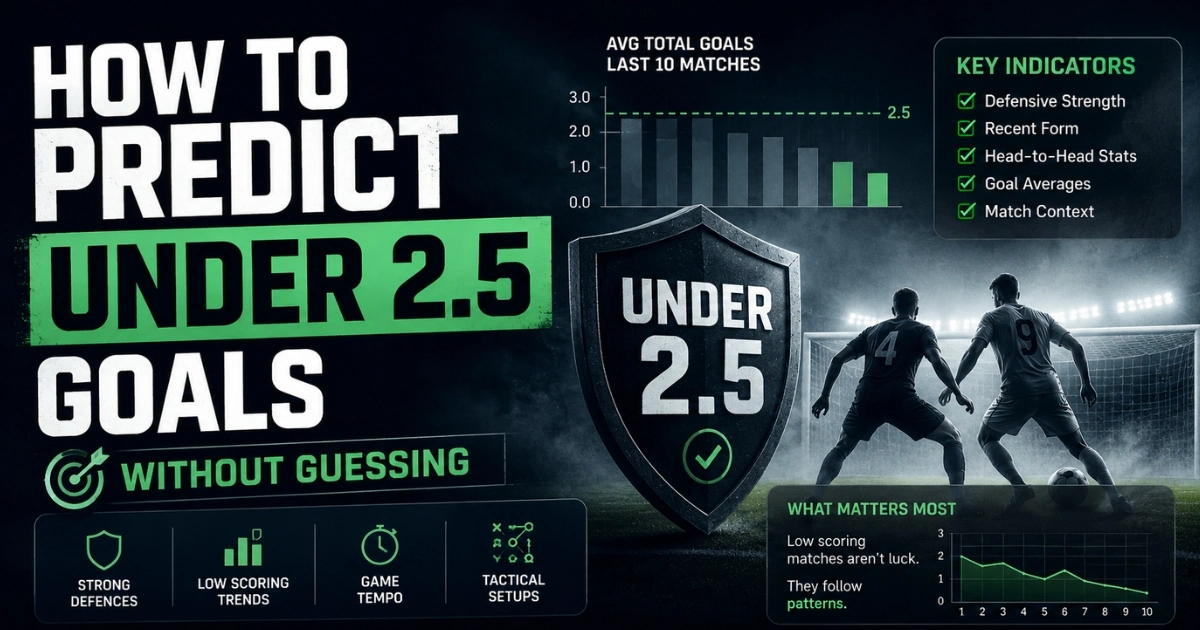
Under 2.5 goals is one of the most popular football betting markets, but it is also one of the easiest to misunderstand.
The selection wins when a match finishes with no more than two goals. Results such as 0–0, 1–0, 0–1, 1–1 and 2–0 all qualify. It loses as soon as a third goal is scored.
That sounds simple, yet many Under predictions are based on little more than a feeling that a match will be “tight”. A low league position, one defensive team or a recent 0–0 result may look encouraging, but none of those factors is enough on its own.
A better approach is to look for several signs pointing towards limited chance creation, cautious tactics and a low probability of either team scoring freely.
The aim is not to guess the exact score. It is to decide whether the match has enough realistic routes to three goals. Under 2.5 is part of the wider football goal predictions market, which also includes Over lines, Both Teams to Score and first-half goal selections.
1. Start With Average Total Goals
The first statistic to check is the average number of total goals in each team’s matches. This combines goals scored and conceded.
For example, if a team’s previous ten matches contained 19 goals, its average is 1.9 goals per match. That is naturally more supportive of Under 2.5 than a team whose fixtures average 3.4 goals.
Useful benchmarks may include:
- Below 2.0 total goals: strong low-scoring tendency
- Around 2.2 to 2.4: potentially suitable
- Above 3.0: usually requires caution
However, averages can be misleading.
A sequence containing one 5–2 result may inflate the number, even if most other matches finished 0–0, 1–0 or 1–1. Always check the individual scores rather than relying only on the average.
A possible 1–1 result also shows why total-goal and both-teams-to-score markets should be analysed separately. Our BTTS vs Over 2.5 comparison explains the difference between the two selections.
2. Review the Under 2.5 Percentage
The Under 2.5 percentage shows how often a team’s matches have finished with two goals or fewer.
If seven of the previous ten matches stayed below three goals, the Under rate is 70%.
That is a useful starting point, especially when both teams have similar records. But the sample must be relevant.
Compare:
- The full-season Under percentage
- The last five to ten matches
- The home team’s home record
- The away team’s away record
A club may have an overall Under rate of 60% but an away rate of 80%. If it is playing away again, that venue-specific figure deserves more attention.
The strongest cases normally involve both teams showing regular low-scoring patterns in the relevant setting.
3. Check Goals Scored, Not Just Goals Conceded
Many people focus only on strong defences when predicting Under 2.5. Limited attacking quality can be just as important.
A team averaging only 0.8 goals per match is unlikely to contribute heavily unless it faces an unusually weak defence.
Look at:
- Average goals scored
- Failure-to-score percentage
- Number of matches with no more than one goal scored
- Home and away attacking records
- Dependence on one main goalscorer
A match involving two teams averaging close to one goal each may naturally lean towards scores such as 0–0, 1–0 or 1–1.
The selection becomes more difficult when one side regularly scores two or three goals by itself.
4. Study Defensive Records Properly
Goals conceded per match is important, but clean-sheet data often gives a clearer picture.
Useful defensive indicators include:
- Average goals conceded
- Clean-sheet percentage
- Matches conceding no more than one goal
- Shots on target allowed
- Expected goals conceded
- Performance against teams of similar quality
A team may concede only one goal per match on average but still allow many high-quality chances. Strong goalkeeping or poor opposition finishing may be hiding a vulnerable defence.
On the other hand, a side consistently limiting opponents to few shots and low-quality opportunities has a more sustainable defensive record.
For an Under prediction, organised defending is more convincing than a few fortunate clean sheets.
Our guide to clean-sheet statistics and goal markets explains how defensive records should be assessed alongside xGA, shots on target, goalkeeper performance and the quality of opposition.
5. Use Home and Away Splits
Overall season data can hide completely different home and away patterns.
Some teams attack confidently at home but become conservative on the road. Others are difficult to break down in their own stadium but defend poorly away.
For the home side, check:
- Home goals scored
- Home goals conceded
- Home Under 2.5 percentage
- Home clean sheets
For the visitors, use the equivalent away statistics.
Practical example: The home team averages 1.1 goals scored and 0.8 conceded at home. The visitors average 0.7 goals scored and 1.0 conceded away.
Those numbers create a realistic low-scoring range. Results such as 1–0, 1–1 and 2–0 all fit the statistical profile. Venue-specific numbers are often more useful than the broad league table.
Our guide to home and away form for goal bets explains how the home team’s home scoring and defensive record should be compared directly with the visitor’s away profile.
League reputation should be treated with the same caution. Our Serie A goal predictions guide explains why a competition often associated with defensive football can still contain individual fixtures suited to Over, BTTS or team-goal markets.
6. Look at Expected Goals
Expected goals, or xG, can help identify whether recent low scores are genuine or misleading.
A match may finish 0–0 despite both teams creating several clear chances. That result supports Under historically, but the performance itself may not.
Another match may finish 1–1 with very few dangerous opportunities. That is a more convincing low-scoring performance.
For Under 2.5 analysis, look for:
- Low xG created by both teams
- Low xG conceded
- Few big chances
- Limited penalty-area activity
- Reliance on difficult long-range shots
Suppose a team has scored only three goals in five matches but averaged 1.8 xG. Its finishing may improve soon, so the low-scoring record could be less reliable than it appears. xG helps separate low scores caused by poor chance creation from low scores caused by temporary poor finishing.
For a fuller explanation of xG, xGA and the difference between actual results and underlying chance quality, read our expected goals guide.
7. Check Shots on Target
Total shots can create a false impression.
A team may take 15 shots, but if only two are on target and most come from outside the penalty area, the attacking threat may be limited.
For Under predictions, favourable signs include:
- Few shots on target
- Low-quality shooting positions
- Slow attacking tempo
- Limited touches inside the box
- Few clear one-on-one opportunities
A match where both teams average only two or three shots on target may be more suitable than one involving constant pressure at both ends.
Shot quality matters more than raw volume.
8. Consider the Likely Match Situation
Statistics provide the foundation, but the tactical context can decide whether they remain relevant.
Ask:
- Would a draw suit both teams?
- Is it a first leg of a knockout tie?
- Is one side protecting an aggregate lead?
- Are the teams involved in a relegation battle?
- Is the favourite likely to dominate or play cautiously?
- Does either side need to attack from the beginning?
A first-leg cup match between evenly matched teams may begin carefully. A team needing only one point to qualify may also prioritise control.
Return fixtures require separate analysis because the aggregate score can either encourage caution or force one team to attack. Our guide to second-leg goal patterns explains how those situations affect the expected total.
By contrast, two teams that must win can turn a normally low-scoring fixture into an open match.
Our guide to must-win matches explains when result pressure genuinely increases attacking risk and when motivation is not enough to create more goals.
The same teams can produce very different goal totals depending on what they need from the game.
9. Check Team News
The absence of an important striker can strengthen an Under prediction. Missing defenders may weaken it.
Pay attention to:
- Leading goalscorers
- Creative midfielders
- First-choice centre-backs
- Goalkeepers
- Suspensions
- Rotation
- Recent formation changes
A team missing one attacker may still cope. A side without its main striker and primary creator may struggle significantly. Similarly, several defensive absences can make old clean-sheet statistics much less relevant.
Our guide to how missing defenders affect football goal predictions explains how reserve goalkeepers, unfamiliar centre-back partnerships, replacement quality and tactical adjustments can strengthen or weaken an Under selection.
Team news should confirm the statistical picture, not be treated as a minor detail.
10. Watch for Set-Piece Risk
Even a cautious match can produce goals from corners, penalties and free kicks. This matters because Under 2.5 can lose without either side creating much from open play.
Check whether:
- The teams concede often from set pieces
- One side has strong aerial players
- The referee awards many penalties
- Defenders commit frequent fouls near the box
- The match is likely to be physical
A low-tempo game can still finish 2–1 through two corners and a penalty. Set-piece vulnerability does not automatically rule out Under, but it adds risk that ordinary attacking statistics may not show.
Corner counts need their own context as well. Our guide to whether more corners mean more goals explains why repeated corners should be assessed together with shots on target, xG, chance quality and attacking pressure rather than treated as direct evidence that a goal is coming.
Practical Example
Imagine a match with these numbers:
Home team:
- Under 2.5 in 7 of 10 home matches
- Average of 1.2 goals scored at home
- Average of 0.9 goals conceded
- Five home clean sheets
- Only three shots on target per match
Away team:
- Under 2.5 in 8 of 10 away matches
- Average of 0.8 goals scored away
- Failed to score in four away games
- Average away xG of 0.9
The match is also a first leg, and neither team needs to take major early risks.
Several independent indicators now support the same scenario: limited attacking production, reliable defensive numbers and cautious match context. That is much stronger than choosing Under simply because both teams drew 0–0 in their last match.
Under 2.5 does not require an exact goalless result. When the evidence points specifically towards neither team scoring, our guide explains how to identify matches that could finish 0–0.
Previous meetings can provide supporting evidence, but our guide to using H2H statistics for goal predictions explains why one result, an old fixture or a small sample should not determine the selection.
Common Mistakes
One common mistake is assuming that two defensive teams automatically guarantee a low total. If both are weak at defending set pieces or regularly make individual errors, the match can still reach three goals.
Another mistake is following recent results blindly. Three consecutive Under matches do not prove the next one will be low-scoring.
Check whether those results were influenced by unusual events. Our guide to how red cards affect Over/Under goal bets explains why a dismissal can either reduce one team’s attacking threat or create additional scoring opportunities for the opponent.
Ignoring the favourite’s scoring ability is also risky. A team that averages 2.5 goals at home can defeat an Under prediction even if the opponent contributes nothing.
Finally, do not assume low odds mean safety. A heavily backed Under selection can still offer poor value if the price is too short.
Quick Under 2.5 Checklist
Before making the prediction, check:
- Average total goals
- Under 2.5 percentages
- Home and away splits
- Goals scored and conceded
- Clean sheets and failure-to-score rates
- xG created and allowed
- Shots on target
- Team news
- Match importance and tactics
- Set-piece risk
- Whether the odds justify the bet
The best selections normally have several of these factors pointing in the same direction.
If the analysis supports a low-scoring match but you want to compare different settlement points, our guide to Asian goal lines explains totals such as 2.0, 2.25, 2.75 and 3.0, including when a bet can be fully won, partially won, refunded or partially lost.
Frequently Asked Questions
What scores win Under 2.5 goals?
Any result with zero, one or two total goals, including 0–0, 1–0, 0–1, 1–1 and 2–0.
Is Under 2.5 safer than Over 2.5?
Not automatically. It depends on the teams, tactics and available odds. Neither market is inherently safe.
To assess the opposite side of the market, read our guide on how to predict Over 2.5 goals using attacking, defensive and chance-creation statistics.
How many recent matches should I analyse?
The latest five to ten matches are useful, but they should be compared with the broader home and away record.
Is a high clean-sheet percentage enough?
No. Also check chance quality, xG, opponent strength and whether important defenders are available.
Are first-leg matches good for Under 2.5?
They can be, especially when both teams prioritise avoiding mistakes. However, a large quality gap can still produce a comfortable 3–0 result.
Final Thoughts
Predicting Under 2.5 goals should be based on evidence, not simply the feeling that a match will be tight.
Low scoring averages, strong defensive records, high Under percentages, limited xG and cautious tactics can all support the selection. Home and away splits, team news and match context then help determine whether those trends are relevant to the specific fixture.
The key is to look for a match with few credible routes to a third goal.
No statistic can remove uncertainty, but combining several independent indicators gives you a far stronger basis than guessing from the league table or one recent score.
Explore our football betting resources for more guides covering goal markets, football statistics and prediction strategies.
Responsible betting: Set a fixed budget, avoid chasing losses and never stake money you cannot afford to lose.