
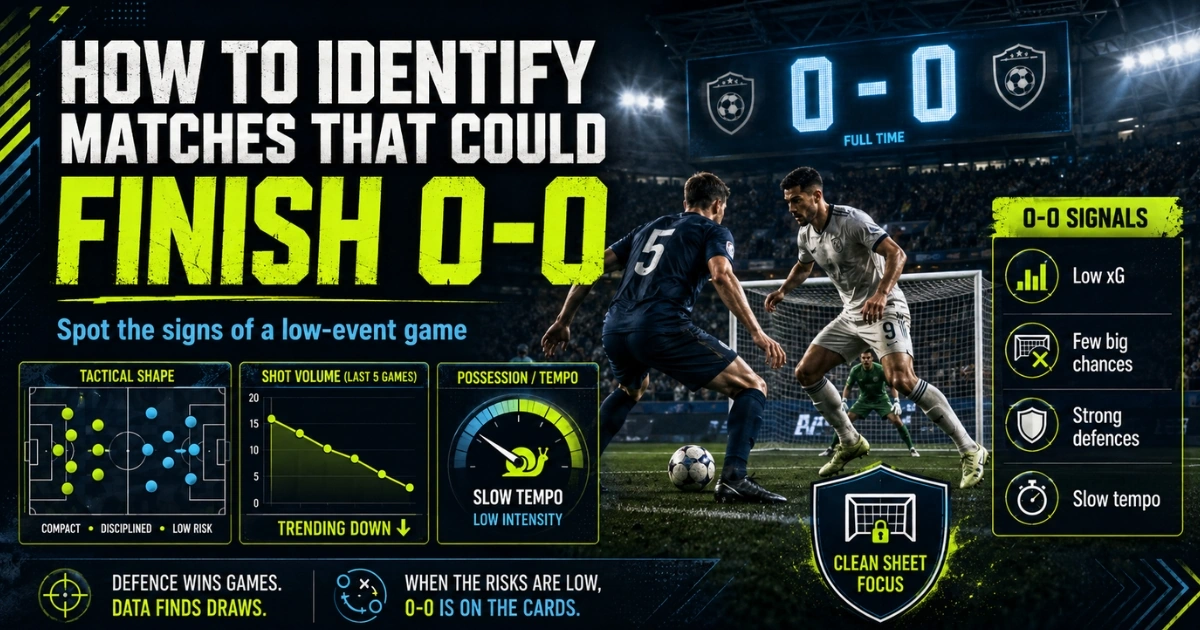
How to Identify Matches That Could Finish 0-0
August 3, 2026
9:43 am
https://nicefixedmatches.com/how-to-identify-matches-that-could-finish-0-0/
A 0-0 draw is one of the most difficult football results to predict. Unlike Under 2.5 goals, which can win with several scorelines, a 0-0 selection loses as soon as either team scores.
That means identifying a potentially low-scoring match is not enough. A fixture could look ideal for Under 2.5 and still finish 1-0, 0-1 or 1-1.
To build a realistic case for 0-0, you need evidence that both teams may struggle to score. Strong defending helps, but limited attacking quality is usually just as important. The likely tactics, team news, venue-specific form and set-piece threat must also support a match with very few clear chances.
No statistic can guarantee a goalless draw. The aim is to find fixtures with fewer credible routes to a goal than the market price suggests.
This exact-score assessment should begin with the broader factors covered in our complete guide to football goal predictions, including attacking form, defensive records, venue splits and match context.
Start With Failure-to-Score Statistics
The most useful starting point is how often each team fails to score.
Suppose the home team has failed to score in four of its previous ten home matches. The visitors have failed to score in six of ten away fixtures. Neither figure guarantees a 0-0, but together they show that both attacks regularly produce nothing.
Use the relevant venue split:
The home team’s failure-to-score rate at home
The away team’s failure-to-score rate away
Overall figures can be misleading. A club may score regularly in its own stadium but struggle badly on the road. Another may be productive away because its counterattacking style works better when the opponent takes the initiative.
A potential 0-0 becomes more interesting when both teams have high failure-to-score rates in the same conditions as the upcoming match.
Our guide to home and away form for goal bets explains why the home team’s home record should be compared directly with the visitor’s away performance.
Check Clean-Sheet Percentages
A team cannot contribute to a 0-0 prediction only by having a weak attack. Its defence must also be capable of preventing the opponent from scoring.
Look at:
Clean sheets
Goals conceded per match
Matches allowing no more than one goal
Expected goals conceded
Shots on target allowed
Imagine the home side has kept six clean sheets in ten home games, while the visitors have kept five in ten away matches. If both also struggle to score, the two defensive records support the same low-scoring scenario.
However, clean sheets should not be followed blindly. A team may have avoided conceding despite allowing several clear opportunities. Strong goalkeeping, missed penalties or poor finishing can create a defensive record that is difficult to repeat.
The strongest clean sheets are supported by low-quality chances, few shots on target and organised defending.
For a deeper assessment, read our guide to clean-sheet statistics and goal markets, including xGA, goalkeeper influence and venue-specific defensive records.
Compare Goals Scored per Match
Average scoring numbers help show whether either team is capable of breaking the pattern alone.
For a possible 0-0, you generally want low attacking averages from both sides. A team scoring 0.7 goals per away match naturally presents less danger than one averaging 1.8.
Useful indicators include:
Goals scored per match
Percentage of matches scoring zero goals
Percentage scoring no more than one
Number of matches scoring twice or more
Dependence on penalties or set pieces
A team averaging below one goal does not automatically support 0-0. It may still score once in most matches. Check the distribution.
For example, two teams may both average 0.8 goals:
Team A regularly scores one goal but rarely scores two.
Team B produces several 0-0 results but occasionally wins 3-0.
The same average hides two different patterns. Team B’s profile may be more relevant to a 0-0 prediction.
Use Expected Goals to Measure Chance Quality
Expected goals, or xG, can help separate genuinely poor attacking performances from temporary bad finishing.
A team may have failed to score in three consecutive matches but produced:
1.8 xG
1.6 xG
2.0 xG
Those results look favourable for a 0-0 prediction, but the underlying performances suggest the team is creating enough chances to score.
Another side may have scored once in each of its last three matches while producing only:
0.5 xG
0.6 xG
0.4 xG
Its recent goals may have come from difficult shots or defensive errors. The attack could be less reliable than the final scores suggest.
For a potential 0-0, look for:
Low xG created by both teams
Low xG conceded
Few big chances
Limited touches inside the penalty area
Attacks relying heavily on long-range efforts
Low actual scoring supported by low xG is much more convincing than low scoring accompanied by strong chance creation.
Our guide to expected goals explains how xG and xGA can reveal whether low-scoring results reflect limited chance quality or only temporary poor finishing.
Review Shots on Target
Total shots can exaggerate attacking threat.
A team may attempt 14 shots, but if only two are on target and most come from outside the box, the goalkeeper may rarely be under serious pressure.
For 0-0 analysis, favourable signs include:
Few shots on target
Low-quality shooting positions
Slow build-up play
Limited penalty-area entries
Few one-on-one chances
Attacks that rely on crosses without strong aerial forwards
If both teams regularly produce only two or three shots on target, a goalless result becomes more realistic.
Still, one accurate shot can be enough to destroy the bet. That is why 0-0 normally requires a higher price than broader Under markets.
Separate Home and Away Form
Venue-specific form is especially important.
Some teams are cautious away but more adventurous at home. Others struggle to create chances when expected to control possession in front of their own supporters.
For the home side, check:
Home goals scored
Home clean sheets
Home failure-to-score percentage
Home xG
Home 0-0 frequency
For the visitors, use the equivalent away data.
Practical example: The home team has:
Failed to score in five of ten home matches
Kept six clean sheets
Averaged 0.8 goals scored
Produced only 0.9 home xG
The visitors have:
Failed to score in six of ten away games
Kept five away clean sheets
Averaged 0.7 goals scored
Recorded four 0-0 half-time results in their last five away fixtures
The venue-specific profiles create a stronger case than broad season averages.
Consider the Tactical Matchup
Some matches naturally produce few spaces.
Two teams may both:
Defend in compact shapes
Press cautiously
Avoid committing full-backs forward
Attack through slow possession
Prioritise avoiding mistakes
Lack pace in transition
The tactical interaction matters more than simply calling both teams “defensive”.
A counterattacking side can be dangerous against an attacking opponent but ineffective when facing another team that refuses to take risks. If neither side wants to dominate possession or leave space, the match may become slow and fragmented.
By contrast, two weak attacks do not automatically create 0-0. Poor defending can still provide easy chances.
The ideal scenario combines limited attacks with reasonably reliable defences.
Match Importance and Motivation
The competition situation can influence risk levels.
A draw may suit both teams in:
A group-stage match
The final round of a league or tournament
A first leg between evenly matched sides
A relegation battle where avoiding defeat is the priority
A match between teams protecting their league positions
However, do not assume every important match will be cautious. A must-win situation can produce the opposite pattern, particularly late in the game.
Ask what happens if the match remains 0-0 after 60 or 70 minutes. Would both teams accept the result, or would one be forced to attack?
When one team eventually needs a winner, the closing stages may follow a completely different pattern. Our guide explains how to predict late goals after the 75th minute.
A goalless prediction becomes stronger when neither side has a tactical reason to chase the match aggressively.
Check Attacking and Defensive Absences
Team news can significantly change a 0-0 assessment.
Missing attackers may strengthen the prediction, especially when a team is without:
Its leading scorer
Its main creative midfielder
A regular set-piece taker
Several wide players
Its preferred centre-forward
Defensive absences create the opposite concern. If both first-choice centre-backs or the main goalkeeper are unavailable, historical clean-sheet data may no longer be reliable.
Our guide to how missing defenders affect football goal predictions explains how replacement quality, defensive partnerships and tactical changes should alter the assessment.
A weak attack against a weakened defence may still find one decisive opportunity.
Do Not Ignore Set Pieces
A match can produce almost nothing from open play and still contain a goal from a corner, free kick or penalty.
Check whether either team:
Scores regularly from corners
Has a strong aerial striker
Concedes many set-piece goals
Commits frequent fouls around the penalty area
Relies heavily on penalties
Set pieces are one of the biggest threats to a 0-0 selection because they can create a high-quality chance without sustained attacking pressure.
Practical Match Example
Consider this profile:
Home team
Scored 0.9 goals per home match
Failed to score in 5 of 10
Kept 6 clean sheets
Averaged 0.8 xG
Produced only 2.6 shots on target
Away team
Scored 0.6 goals per away match
Failed to score in 6 of 10
Kept 5 clean sheets
Averaged 0.7 away xG
Recorded Under 2.5 in 8 of 10 away fixtures
Both teams would accept a draw, neither has major defensive absences and their main strikers are out of form.
This does not make 0-0 likely in an absolute sense, but it creates a logical case: both attacks are limited, both defences are reasonably reliable and the match context discourages risk.
Common Mistakes
The biggest mistake is selecting 0-0 simply because both teams have strong Under 2.5 percentages. Many Under matches still contain one or two goals.
Another mistake is focusing only on poor attacks. Weak defences can gift chances even when neither team creates much.
Recent 0-0 results can also be overvalued. Two consecutive goalless draws may be coincidence, especially if the matches contained high xG and several missed opportunities.
Finally, remember that the price matters. A possible result is not automatically a valuable bet.
Frequently Asked Questions
Is Under 2.5 safer than predicting 0-0?
It covers more scorelines, including 1-0, 0-1, 1-1 and 2-0. The odds are therefore usually lower.
For the broader low-scoring market, read our guide on how to predict Under 2.5 goals using scoring averages, defensive statistics, xG and tactical context.
How many matches should I analyse?
Use at least five to ten relevant home or away matches and compare them with the broader season record.
Is a high clean-sheet percentage enough?
No. Both teams must also show limited attacking threat. A strong favourite can keep a clean sheet and still win 3-0.
Does 0-0 at half-time support a full-time 0-0 bet?
It can, but the second-half tactical situation matters. One team may increase its attacking risk as time runs out.
Are first-leg knockout matches good candidates?
Some are cautious, but quality gaps and tactical styles still matter. A favourite may dominate even if the opponent defends deeply.
For a competition-specific framework, read our Champions League play-off first-leg goals guide, which explains how financial pressure, quality differences and tactical caution can affect Over, Under and BTTS markets.
Final Thoughts
Identifying a potential 0-0 requires more than finding two teams involved in low-scoring matches.
Look for high failure-to-score rates, reliable clean sheets, low xG, few shots on target and tactical conditions that discourage risk. Home and away splits, team news and set-piece strength then help test whether the pattern is relevant to the specific fixture.
The most important question is whether both teams lack a credible route to goal.
Even strong analysis cannot remove the possibility of a penalty, deflection or individual mistake. Treat 0-0 as a high-variance prediction, compare the estimated probability with the available odds and keep stakes within a fixed budget.
Explore our football betting resources for more guides covering goal markets, football statistics and match analysis.
Responsible betting: Use statistics as a guide rather than a guarantee, avoid chasing losses and never stake money you cannot afford to lose.