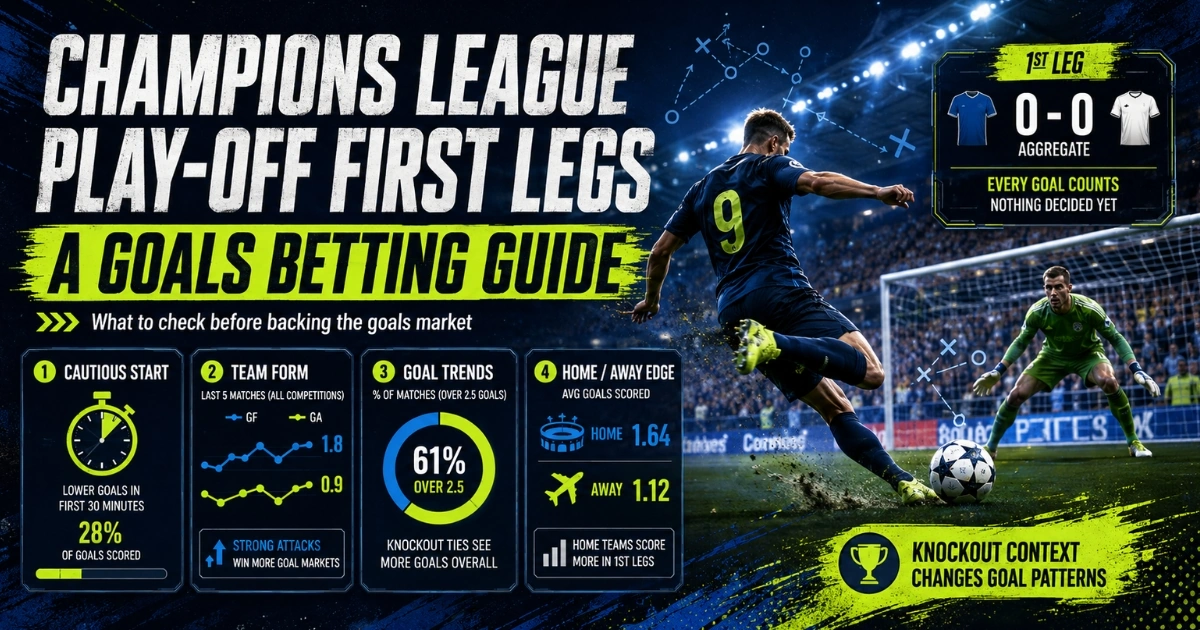
Champions League play-off first legs are among the most difficult European matches to assess for goal betting.
The teams are only two matches away from reaching the league phase, so the financial and sporting pressure is enormous. A strong domestic champion may be expected to attack, yet still prioritise avoiding a damaging first-leg defeat. An underdog may have an impressive scoring record at home but become far more cautious against higher-level opposition.
This creates a common betting trap: assuming that quality attacking teams will automatically produce Over 2.5 goals.
Some first legs become open because both teams believe they can gain an advantage. Others develop into controlled tactical contests in which neither side wants to take the first major risk.
The best approach is to examine the likely match pattern before choosing between Over, Under, Both Teams to Score or a first-half goal market.
That match pattern should be assessed through the broader factors covered in our complete guide to football goal predictions, including scoring form, defensive records, venue splits and tactical context.
Why First Legs Are Different
A first leg is not a normal 90-minute match. It is the opening half of a two-match contest.
The tactical calculation changes again in the return fixture, when the aggregate score becomes known. Our guide to second-leg goal patterns explains how that score affects urgency, risk and late attacking pressure.
Neither team can qualify on the night, but one poor result can make the return fixture extremely difficult. This often influences the level of attacking risk.
The home team may want to build a lead, but conceding can remove much of its advantage. The visiting side may accept long periods without possession if it can keep the tie close.
That does not mean all first legs are low-scoring. A clear quality difference, an early goal or a tactically aggressive matchup can still produce three or four goals.
The key question is: Will the teams treat the first leg as an opportunity to attack, or as a match they must avoid losing?
For the wider qualification-stage framework, read our Champions League qualifier goal predictions guide, which covers quality differences, match fitness, domestic-season timing and European experience.
Start With the Genuine Quality Difference
Reputation alone is not enough.
A well-known club may come from a stronger league, but the opponent could already be several weeks into its domestic season, have a settled starting eleven and possess considerable European experience.
When comparing the teams, check:
The standard of their domestic leagues
Previous results against similar opposition
Squad depth
European experience
Home and away performance
Recent changes in management or personnel
A large quality gap can support Over 2.5 when the favourite is capable of scoring three goals alone.
However, if the underdog defends deeply and the favourite is still building fitness, a controlled 1–0 or 2–0 result may be more realistic.
Do not ask only which team is better. Ask how easily the stronger side can turn that advantage into clear chances.
Compare Home and Away Goal Form
Venue-specific statistics are especially important in play-off first legs.
For the home team, examine:
Goals scored per home match
Goals conceded at home
Home Over 2.5 percentage
Home BTTS percentage
First-half scoring rate
Home expected goals
For the visitors, use the equivalent away figures.
Suppose the home team averages 2.1 goals in domestic home matches, while the visitors concede 1.8 goals away. Those numbers support home scoring.
But domestic averages need context. If the hosts normally dominate weaker opponents and the visitors are accustomed to defending against stronger teams, the gap may be smaller than the statistics suggest.
A useful working pattern for an Over selection might be:
Home side scoring around two goals per home match
Visitors conceding regularly away
Both teams producing Over 2.5 in at least six of ten relevant matches
Strong recent xG and shots-on-target numbers
No individual percentage should decide the bet by itself.
Our guide to home and away form for goal bets explains how the host’s home scoring profile should be compared directly with the visitor’s away attack and defensive record.
Check Where the Clubs Are in Their Seasons
August play-offs often bring together teams at very different stages of preparation.
One side may already have played ten competitive matches. Another may have completed only a few league fixtures after pre-season.
A team in full domestic rhythm may benefit from:
Better match fitness
Sharper attacking movement
A settled defensive line
More reliable recent statistics
A club early in its campaign may still be integrating new signings or adjusting to tactical changes.
However, the mid-season side may also be tired or dealing with injuries from a congested schedule. The better-prepared team is not automatically the one that has played more matches.
Check minutes played, recent rotation and whether the strongest line-up has been used consistently.
Decide Where the Goals Could Come From
Before choosing a goal market, picture the likely scorers.
For Over 2.5, one team can cover the entire line. Results such as 3–0 and 4–0 are successful.
BTTS – Yes requires both teams to contribute. A dominant 3–0 home win would lose.
This distinction is crucial in Champions League play-offs.
Over 2.5 may be more suitable when:
The favourite averages more than two goals at home
The underdog frequently concedes away
One side can realistically score three alone
The weaker team has a high failure-to-score percentage
The match is likely to open after the first goal
BTTS – Yes may be more suitable when:
Both teams score consistently
Neither keeps many clean sheets
The underdog has a strong counterattack
The favourite uses a high defensive line
A 1–1 result appears realistic
A useful habit is to list the most likely scorelines before making the selection. If 1–1 appears prominent, BTTS may be safer than Over 2.5. If 3–0 looks more realistic than 2–1, the Over market may fit better.
Our BTTS vs Over 2.5 comparison provides a fuller method for choosing between the markets based on whether both teams have a credible scoring route or one side may produce the total alone.
Analyse Expected Goals and Chance Quality
Recent results can exaggerate or hide attacking form.
A team may have won 4–0 after scoring from nearly every shot on target. Another may have drawn 1–1 despite creating several clear opportunities.
Expected goals can help reveal which performance is more repeatable.
Useful indicators include:
xG created
xG conceded
Non-penalty xG
Shots on target
Big chances
Touches inside the penalty area
Chances allowed from counterattacks
For example, a team averaging 1.9 home xG and facing an opponent allowing 1.7 away xGA has a reasonable statistical route to multiple goals.
For Under 2.5, look for teams producing low xG totals, allowing few clear chances and relying heavily on long-range shooting.
Do not simply add two xG averages and treat the result as a projected score. Opponent quality and tactics still influence how many chances will be created.
For a complete explanation of xG, xGA and the difference between chance quality and actual results, read our expected goals guide.
First-Half Goal Markets
First-leg caution can make first-half markets particularly interesting.
Over 0.5 first-half goals requires only one goal before the interval, but it still needs evidence that at least one team usually starts aggressively.
Check:
First-half Over 0.5 percentage
0–0 half-time rate
First-half goals scored and conceded
Average timing of the opening goal
First-half shots on target
A team may have a high full-match Over percentage while regularly reaching half-time at 0–0. Its goals could be concentrated after the 60th minute.
That profile may support second-half goals more strongly than an early-goal selection.
Our guide on how to predict Over 0.5 first-half goals explains how early scoring rates, 0–0 half-time percentages, venue splits and first-half chance creation should be evaluated.
First-half Under 1.5 can also be worth considering when both sides are expected to begin cautiously. It allows one early goal while still winning if the score at the break is 0–0, 1–0 or 0–1.
Team News Can Change the Market
Play-off squads can still be affected by summer transfers, registration issues and incomplete preparation.
Before betting, check whether either side is missing:
Its leading striker
A creative midfielder
First-choice central defenders
The regular goalkeeper
A defensive midfielder
Several players in the same position
Missing attackers may weaken Over and BTTS selections. Defensive absences can increase goal potential, particularly when the replacements have little experience together.
The tactical response also matters. A team without two defenders may use an extra holding midfielder and play more cautiously. Injuries do not automatically lead to an open match.
Our guide to how missing defenders affect football goal predictions explains how replacement quality, unfamiliar defensive partnerships and tactical reactions can increase or reduce the expected total.
Confirmed line-ups are valuable when the prediction depends heavily on particular players.
Travel, Weather and Playing Surface
European play-offs can involve difficult journeys and unfamiliar conditions.
A visiting favourite may have to deal with:
Long travel
Extreme heat
Artificial turf
A narrow pitch
Strong wind
Limited recovery time
These conditions can reduce tempo and make fluent attacking football more difficult.
An artificial surface may also give the home side an advantage if it plays on it every week. The visitor may need time to adjust to the ball’s speed and bounce.
Weather and pitch conditions should not decide the bet alone, but they can weaken a marginal Over selection.
Practical Example: Over 2.5 Goals
Imagine a first leg with the following profile.
Home team
Scores 2.2 goals per home match
Produces 1.9 home xG
Over 2.5 in seven of ten home fixtures
Scored before half-time in six of ten
Away team
Concedes 1.8 goals per away match
Scores in seven of ten away fixtures
Allows more than five shots on target away
Missing one first-choice centre-back
The home team is likely to attack, but the visitors also have a credible route to goal.
Possible results include 2–1, 3–1 and 2–2. Over 2.5 has support from attacking, defensive and venue-specific statistics.
Practical Example: Under 2.5 Goals
Now consider:
Home team
Scores 1.1 goals per home match
Keeps five clean sheets in eight
Produces only 1.0 home xG
Away team
Has failed to score in four of seven away matches
Concedes only 0.9 goals per away fixture
Regularly uses a compact defensive system
Both teams would likely accept a narrow result before the return leg.
The most realistic scores may be 0–0, 1–0 or 1–1. Under 2.5 has a clearer foundation than Over, even if both clubs have strong domestic reputations.
Quick Play-Off First-Leg Checklist
Before selecting a goal market, check:
Genuine difference in team quality
Home and away goal averages
Over 2.5 and BTTS percentages
Failure-to-score and clean-sheet rates
xG and shots on target
First-half goal patterns
Stage of domestic-season preparation
Injuries and expected line-ups
Travel and playing conditions
Whether the match scenario supports the available odds
The strongest bets normally have several independent factors supporting the same conclusion.
Frequently Asked Questions
Are Champions League play-off first legs usually low-scoring?
Not always. Tactical caution can reduce goals, but large quality gaps and early goals can create open matches.
Is Under 2.5 better than Over 2.5 in first legs?
Neither is automatically better. The decision should depend on team quality, attacking numbers, tactics and the likely level of risk.
Should domestic league statistics be trusted?
They are useful, but they must be adjusted for opponent strength. Dominating a weaker league does not guarantee the same attacking output in Europe.
Is BTTS suitable when the favourite is much stronger?
Only when the underdog has a reliable scoring route. Otherwise, Over 2.5 or a favourite team-total market may be more logical.
Should I wait for confirmed line-ups?
It is sensible when injuries, rotation or new signings could significantly affect the expected goal pattern.
Final Thoughts
Champions League play-off first legs require a different approach from normal league matches.
The pressure of the tie can encourage caution, but it can also create attacking urgency when one team believes it must build a home advantage. The quality gap, match fitness, venue form and tactical matchup all help determine which pattern is more likely.
Start by identifying where the goals could come from. Then test that scenario using xG, scoring rates, defensive statistics, team news and first-half trends.
The best goal-market selection is not always the most obvious one. It is the market that most accurately reflects how the first leg is likely to be played.
Once the first-leg result is known, our Champions League play-off second-leg guide explains how the aggregate score changes each team’s attacking requirement and the most relevant goal markets.
Responsible betting: Use statistics as a guide rather than a guarantee, keep stakes within a fixed budget and never bet money you cannot afford to lose.