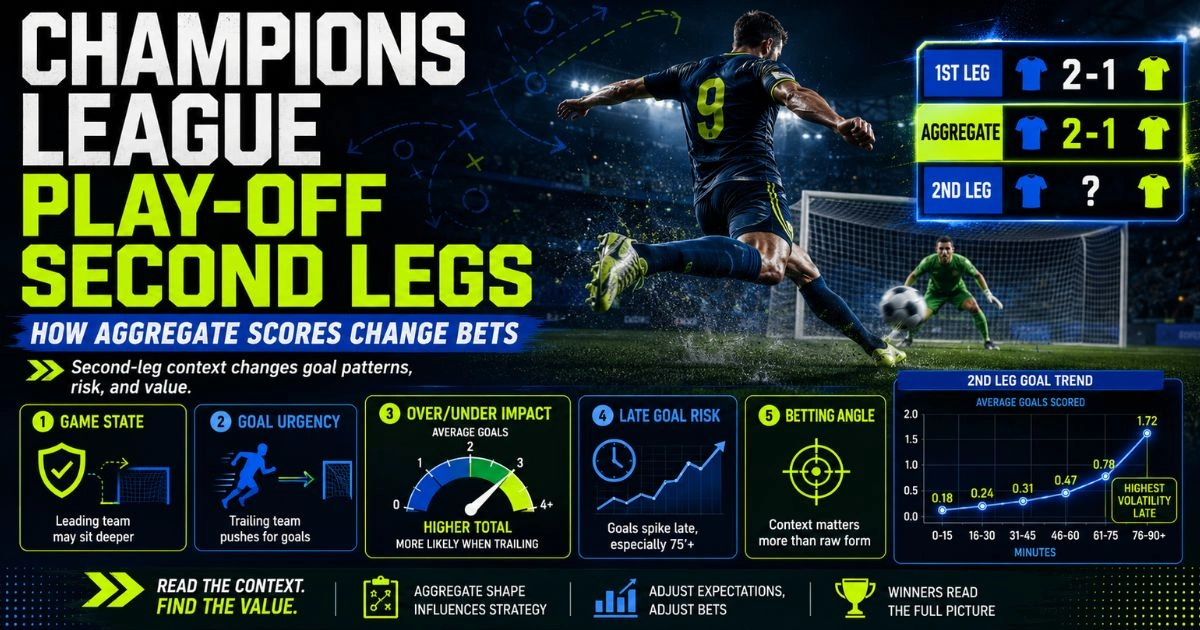
Champions League play-off second legs cannot be analysed like ordinary football matches.
The teams may begin the night at 0–0, but the real score already includes the first leg. A side can win the second match and still be eliminated. Another can lose by one goal and qualify comfortably.
That aggregate position affects almost every betting market. It changes how urgently teams attack, how carefully they defend and whether a result such as 1–0 is enough or practically useless.
For goal predictions, the most important question is not simply which team is stronger. It is what each side needs to progress—and how that requirement may change after the next goal.
For the broader principles behind knockout return matches, read our guide to second-leg goal patterns and how aggregate scores change urgency, risk and scoring behaviour.
Begin With the Aggregate Score
The first-leg result should be the starting point of every second-leg analysis.
To understand how that aggregate position was created, our Champions League play-off first-leg guide explains how tactical caution, qualification pressure and quality differences can shape the opening match of the tie.
The most common situations are:
- The tie is level.
- One team leads by one goal.
- One team leads by two goals.
- One team holds a comfortable three-goal advantage.
Each situation creates a different tactical problem.
A level tie may begin cautiously because both teams know one mistake could decide qualification. A side trailing by one goal can remain patient because a single goal restores balance. A team three goals behind has far less time for control and may need to attack immediately.
Do not treat “second leg” as a single betting category. The size of the deficit matters enormously.
A Level Tie Can Be More Cautious Than Expected
When the first leg ends level, neither team begins the return match needing to chase.
That can produce a careful opening period, particularly when the teams are evenly matched. Both managers may prioritise structure, knowing that conceding first would immediately change the tie.
Useful statistics to check include:
- First-half Under 1.5 percentage
- Frequency of 0–0 half-time results
- First-half goals scored and conceded
- Average time of the opening goal
- First-half shots on target
A level aggregate score does not automatically support Under 2.5 for the whole match. The game may remain controlled for an hour before becoming much more open.
If the score is still level after 70 minutes, both teams may begin to worry about extra time. One may take greater risks to settle the tie before the additional 30 minutes.
That is why a cautious first-half prediction and a late-goal prediction can both make sense in the same fixture.
A One-Goal Deficit Keeps the Tie Competitive
A one-goal gap often creates the most balanced second-leg scenario.
The trailing team must attack, but it does not need to become reckless from the first minute. One goal is enough to level the aggregate score, so the manager can use a controlled attacking plan.
The side protecting the lead has two choices:
- Defend compactly and protect the advantage.
- Continue attacking to score the goal that forces the opponent to chase even harder.
The second approach can create a more open game.
Practical example Suppose the first leg finished 1–0. The trailing team is now at home and has:
- Scored in nine of its previous ten home matches
- Averaged 1.8 home goals
- Produced strong home expected-goals numbers
- Recorded Over 2.5 in six of ten home fixtures
The visitors have:
- Scored in seven of ten away matches
- Conceded regularly away
- Created chances effectively on counterattacks
- Kept only three away clean sheets
The home team must push forward, while the visitors can attack the space left behind. Our guide to home and away form for goal bets explains how the home side’s relevant attacking record should be compared directly with the visitor’s away scoring and defensive profile.
Possible scores include 2–0, 2–1, 1–1 and 1–2. Both Teams to Score and Over 2.5 may therefore deserve attention.
A Two-Goal Lead Can Create Two Opposite Patterns
A two-goal advantage looks comfortable, but it does not automatically produce a quiet second leg.
The leading team may defend deeply, reduce the tempo and allow the opponent to have harmless possession. That can lead to results such as:
- 0–0
- 1–0
- 1–1
- 0–1
However, the trailing side must eventually take risks. If it pushes full-backs, midfielders and central defenders forward, the team protecting the lead may find excellent counterattacking opportunities.
This can produce:
- 2–1
- 1–2
- 1–3
- 2–2
The key question is whether the chasing team can attack without losing defensive control.
Look at its previous performances when trailing. Some teams continue building patiently. Others become disorganised and allow repeated transitions.
Large First-Leg Advantages Can Be Misleading
A three-goal lead appears to favour a controlled second leg, but squad rotation and reduced intensity can change the match.
The leading team may:
- Rest important attackers
- Use reserve defenders
- Avoid aggressive pressing
- Protect players from injury
- Accept a narrow defeat
The trailing side may play with greater freedom because expectations are low. Alternatively, belief may disappear if it fails to score early.
This makes team news particularly important. When rotation changes the back line, our guide to how missing defenders affect football goal predictions explains how reserve goalkeepers, unfamiliar centre-back partnerships and replacement quality can alter the expected total.
If the stronger club rotates most of its attack but retains an experienced defence, Under markets may become more attractive.
If it uses an unfamiliar back line while keeping quick forwards, the match may still produce goals at both ends.
Do not assume that a large aggregate lead means the favourite will dominate the second match.
The First Goal Changes More Than the Score
In a second leg, the opening goal can transform the tactical situation immediately.
Imagine a team begins with a 2–1 aggregate advantage.
If it scores first, the opponent now needs at least two goals. The trailing side may become much more aggressive, creating space for further attacks.
If the opponent scores first, the aggregate score becomes level. The team that planned to protect its lead must suddenly become more adventurous.
This is why pre-match analysis should include several possible game states.
Ask:
- What happens if the leading team scores first?
- What happens if the trailing team scores early?
- Which team is more comfortable at a level aggregate score?
- How do both sides perform when forced to chase?
A betting prediction becomes stronger when it remains logical under more than one realistic scenario.
Over 2.5 Goals in Second Legs
Over 2.5 may be attractive when:
- The aggregate gap is small.
- The trailing side has strong attacking numbers.
- The leading team is dangerous on counterattacks.
- Both sides score regularly at the relevant venue.
- Defensive injuries weaken either team.
- An early goal would force an immediate tactical change.
Look beyond the overall Over percentage.
Check:
- Home and away goals scored
- Expected goals and expected goals against
- Shots on target
- Big chances
- Late goals scored and conceded
- Performance when leading or trailing
A match involving two productive attacks may be more suitable for Over 2.5 than one where the chasing side needs to score but lacks the quality to create chances.
Urgency is useful only when the team can turn it into attacking threat.
Our guide on how to predict Over 2.5 goals explains how attacking output, defensive weakness, venue form, xG and shots on target should confirm that higher-scoring scenario.
Under 2.5 Goals in Second Legs
Under 2.5 can be suitable when:
- The leading team has a strong defence.
- The trailing side struggles to create chances.
- A draw or narrow defeat is enough for the favourite.
- The first leg produced few dangerous opportunities.
- Both teams begin cautiously.
- The side ahead is good at controlling possession.
A low-scoring second leg becomes more likely when the leading team can protect central areas and force the opponent into weak crosses or long-range shots.
For a structured low-scoring assessment, read our guide on how to predict Under 2.5 goals using attacking limitations, defensive organisation, xG and tactical control.
However, one early goal can completely weaken the Under position. If the trailing team scores, the tie may become level. If the leading team scores, the opponent may need several goals and start taking greater risks.
This is why timing matters as much as the pre-match statistics.
BTTS in Second-Leg Matches
BTTS – Yes works best when both teams have a realistic scoring route.
The chasing side may score through sustained pressure, while the team protecting the lead can exploit counterattacking space.
BTTS becomes weaker when:
- The trailing team has a high failure-to-score rate.
- The leading team keeps frequent clean sheets.
- One side is expected to dominate the scoring.
- The stronger club can progress without attacking aggressively.
- Important forwards are unavailable.
For example, a 3–0 favourite win supports Over 2.5 but not BTTS. A 1–1 result wins BTTS but stays Under 2.5.
Picture the likely scorelines rather than treating the two markets as identical.
Our BTTS vs Over 2.5 comparison explains how to choose between the markets when both teams have a realistic scoring route or one side may cover most of the total alone.
First-Half and Late-Goal Markets
Second-leg matches often change character over time.
The first half may be controlled because the chasing team still has 90 minutes to solve the problem. After the 70th or 75th minute, that patience may disappear.
Useful first-half indicators include:
- 0–0 half-time rates
- First-half xG
- First-half goals scored
- Opening-goal timing
- Early pressing patterns
For late goals, check:
- Aggregate urgency
- Recent shots and corners
- Attacking substitutions
- Defensive fatigue
- Counterattacking space
- Expected stoppage time
A match can be a poor Over 0.5 first-half candidate but a strong option for a goal after the 75th minute.
Our guide to predicting late goals after the 75th minute explains how aggregate urgency, recent pressure, substitutions, fatigue, counterattacking space and stoppage time should be assessed live.
A Second-Leg Betting Checklist
Before choosing a goal market, ask:
- What is the aggregate score?
- How many goals does each team need?
- Can the trailing team remain patient?
- Is the leading team likely to defend or counterattack?
- What changes if either side scores first?
- Do home and away statistics support goals?
- How do the teams perform when leading or trailing?
- Are important attackers and defenders available?
- Is rotation likely?
- Do late-goal statistics support an open finish?
- Do the odds reflect the tactical situation?
The aggregate score provides the context. The team statistics show whether the expected scenario is realistic.
Frequently Asked Questions
Are Champions League second legs usually higher-scoring than first legs?
Not always. They can become more open because one team must chase, but a strong side protecting a lead may control the match successfully.
Is Over 2.5 better when one team is behind?
Only when the trailing team has enough attacking quality to create chances. Urgency without creativity does not guarantee goals.
Does a large first-leg lead support Under 2.5?
It can, particularly when the leading team is defensively reliable. Rotation and counterattacking space can still create a higher total.
Are late-goal markets useful in second legs?
Yes, especially when qualification remains undecided and one team urgently needs a goal. Recent pressure and substitutions should support the bet.
Should I wait for confirmed line-ups?
It is sensible when rotation, injuries or tactical changes could significantly affect the expected goal pattern.
Final Thoughts
Champions League play-off second legs are shaped by the aggregate score rather than the score shown at kick-off.
A team winning the match may still need another goal. A side losing narrowly may be satisfied because it remains ahead across the tie. One early goal can reverse both teams’ tactical priorities.
Start with what each side needs to qualify. Then combine that information with home and away form, expected goals, team news, counterattacking ability and late-match statistics.
The best market is the one that matches the likely development of the tie—not simply the reputation of the teams or the result of the first leg.
For the wider framework behind Over/Under, BTTS, team news, venue form and match context, read our complete football goal predictions guide.
For teams that progress into the league phase, our guide to analysing the Champions League draw explains how the eight opponents, home-away placement and fixture order can shape future goal predictions.
Responsible betting: Use match context and statistics as analytical tools rather than guarantees. Keep stakes within a fixed budget and never bet money you cannot afford to lose.