
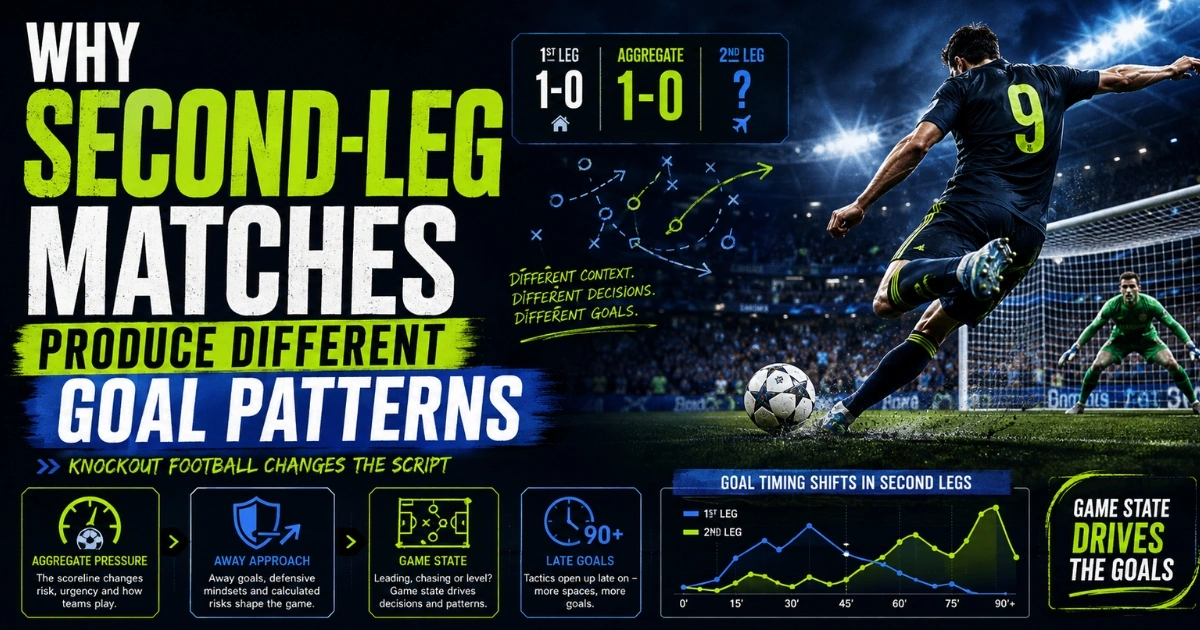
Second-leg matches are not ordinary football fixtures.
In a league game, both teams usually begin at 0–0 with the same basic objective: earn the best possible result over 90 minutes. In a second leg, the real score already includes what happened in the first match. A team can win on the night and still be eliminated, while another can lose narrowly and progress.
That changes everything from the opening whistle.
The aggregate score affects how urgently each side attacks, how much defensive risk it accepts and whether the match is likely to remain controlled or become chaotic. It also explains why the goal pattern in a second leg can look completely different from the first.
For goal predictions, the key is not simply asking whether the teams are attacking or defensive. You need to understand what each team requires to qualify and how that need may change as the match progresses.
This match context should be combined with the broader factors covered in our complete guide to football goal predictions, including scoring form, defensive records, venue splits and tactical expectations.
The Aggregate Score Is the Starting Point
The first-leg result provides the tactical foundation for the second match.
Consider three different situations:
The tie is level.
One team leads by one goal.
One team has a comfortable two- or three-goal advantage.
These scenarios can produce very different matches, even when the same two teams are involved.
A level tie may begin cautiously because neither side wants to make the first major mistake. A team trailing by one goal may attack with patience, knowing that one goal can restore balance. A side three goals behind may have no realistic choice but to play aggressively from the beginning.
The larger the deficit, the greater the likelihood that the trailing team will eventually leave space behind its attack.
These scenarios are especially important when analysing Champions League qualifier goal predictions, where differences in team quality, match fitness and European experience can influence how aggressively each side responds.
For a competition-specific application of these principles, our Champions League play-off second-leg guide explains how aggregate positions affect Over, Under, BTTS and late-goal markets.
Similar aggregate-score analysis is required for Europa League qualifier betting, although squad rotation, travel and competition priorities may create different match patterns.
That space can create goals at both ends.
A Team Can Be Winning but Still Need to Attack
One of the biggest mistakes in second-leg analysis is focusing only on the score of the current match.
Suppose Team A lost the first leg 2–0. It then leads the second leg 1–0 after 50 minutes.
Team A is winning the match, but it is still losing the tie 2–1 on aggregate. It cannot simply defend its lead. It needs at least one more goal to stay alive.
This creates an unusual situation in which the team ahead on the night must continue taking risks.
That matters for live goal markets. A 1–0 score might normally suggest the leading side will slow the game down. In this case, the aggregate position encourages it to keep attacking.
Always separate:
the score in the second leg;
the aggregate score across both matches.
The aggregate score is usually more important.
Why Second Legs Can Begin Cautiously
Second legs are often described as open or dramatic, but they do not always start that way.
A team protecting a first-leg lead may defend compactly and avoid unnecessary possession in dangerous areas. The trailing team may also remain patient, particularly when one goal is enough to level the tie.
An early mistake can be extremely costly, so the opening 20 or 30 minutes may contain more control than risk.
This can support markets such as:
Under 1.5 first-half goals;
Under 2.5 goals;
No goal in the opening 15 minutes.
However, a cautious start does not mean the entire match will stay quiet.
When the aggregate situation encourages control and neither team needs to take immediate risks, our guide on how to predict Under 2.5 goals explains which defensive, attacking and tactical indicators should support the selection.
If the trailing team has not scored by the final half-hour, its risk level normally increases. Full-backs push higher, midfielders make more forward runs and defensive protection becomes weaker.
A match can therefore move from slow to highly open without much warning.
Why Late Goals Are Important
Second-leg matches often become more volatile near the end because the time remaining directly affects qualification.
A team that needs one goal with 30 minutes left may continue with its normal structure. With ten minutes left, the same team may introduce another striker and send central defenders forward for set pieces.
The urgency increases with every minute.
Our guide to goal timing in football explains why fatigue, substitutions, tactical urgency and additional stoppage time often make the closing stages more productive.
This can create:
more crosses and corners;
additional shots;
dangerous counterattacks;
defensive mistakes caused by pressure;
longer periods of stoppage time.
Imagine the aggregate score is 2–1 and the trailing team needs an equaliser. In the 85th minute, it may have seven or eight outfield players positioned in attacking areas. If it loses possession, the opponent can attack a poorly protected defence.
A late goal may therefore come from either team, not only the side chasing the tie.
Our guide to predicting late goals after the 75th minute explains how the aggregate score, current pressure, substitutions, fatigue and counterattacking space should be assessed during the closing stages.
One Goal Can Completely Change the Pattern
Goals carry extra tactical weight in a second leg because they alter the aggregate position.
Suppose a team starts the match with a 1–0 advantage from the first leg. It intends to defend carefully and counterattack.
If the opponent scores early, the aggregate score becomes level. The team that originally planned to protect its lead now needs to become more ambitious.
The entire tactical balance changes.
Alternatively, if the team already leading on aggregate scores first, the opponent’s task becomes much harder. It may need two or three goals, depending on the competition rules and score.
That can force an immediate attacking response and make Over 2.5 more attractive.
Before selecting the market, use our guide on how to predict Over 2.5 goals to check whether scoring averages, xG, shots on target and defensive records support the new match scenario.
This is why second-leg predictions should be flexible. The original plan may become irrelevant after one goal.
The Removal of the Away-Goals Rule
In many major European competitions, away goals are no longer used as a tiebreaker.
Previously, a goal scored away from home could carry additional value. Teams sometimes approached second legs differently because one away goal could force the opponent to score twice.
Without that rule, the aggregate calculation is simpler: goals have equal value regardless of venue.
However, the tactical importance of home and away conditions has not disappeared. Home support, travel, familiarity with the pitch and team style still matter.
The main difference is that teams no longer need to make special calculations based on away-goal advantages. A level aggregate score is genuinely level, rather than being influenced by where the goals were scored.
How Team Quality Changes the Goal Pattern
The aggregate score should always be interpreted alongside team strength.
A strong favourite trailing by one goal may still remain patient because it trusts its ability to create chances. A weaker side in the same position may attack more directly because it expects fewer opportunities.
Likewise, a two-goal lead is not equally secure for every team.
A defensively organised club with strong game management may protect it successfully. A team that regularly concedes chances may struggle to survive sustained pressure.
Check:
goals scored and conceded;
expected goals created and allowed;
shots on target;
home and away records;
clean-sheet percentage;
previous performances while protecting leads.
The aggregate situation explains what the team needs to do. Team quality helps determine whether it can do it.
When the leading team intends to protect its advantage, our guide to clean-sheet statistics and goal markets explains how to assess whether its defensive record is sustainable or supported by goalkeeping, missed chances and favourable opposition.
Practical Example: A One-Goal Deficit
Imagine the first leg finished 1–0.
The trailing team is now at home and has:
scored in nine of ten home matches;
averaged 1.8 goals at home;
recorded Over 2.5 in six of ten home fixtures.
The visitors have:
conceded in seven of ten away games;
scored regularly on counterattacks;
kept only three away clean sheets.
The home side needs to attack, but the visitors have a credible scoring route if space appears.
Possible scorelines include:
2–0;
2–1;
1–1;
1–2.
BTTS and Over 2.5 may both deserve attention, particularly if the home team starts aggressively.
Our BTTS vs Over 2.5 goals comparison explains how to choose between the markets when both teams have a credible scoring route or when one side may produce most of the total alone.
However, if the visitors rarely score away and defend very deeply, a home-team goal market may be more logical than BTTS.
Practical Example: A Comfortable First-Leg Lead
Now imagine the first leg finished 3–0.
The leading team has little reason to take risks in the return match. It may rotate players, defend in a compact shape and allow the opponent to have possession in less dangerous areas.
The trailing team must attack, but three goals are difficult to recover. If it fails to score early, belief and intensity may decline.
This situation can create two very different patterns.
The match may stay controlled and finish 0–0, 1–0 or 1–1.
When both the aggregate situation and the attacking data suggest that neither side has a strong incentive or reliable route to score, use our guide to identifying matches that could finish 0–0.
Alternatively, the trailing side may commit so many players forward that the opponent scores repeatedly on counterattacks, producing a result such as 1–3.
The deciding factor is whether the chasing team can create genuine pressure without becoming tactically reckless.
Statistics to Check Before Predicting Goals
For a second-leg match, useful statistics include:
First-leg score and aggregate position
Goals required by each team
Home and away scoring averages
Over 2.5 and BTTS percentages
First-half and second-half goal records
Goals scored and conceded after the 60th minute
Expected goals and shots on target
Performance when leading or trailing
Clean sheets
Failure-to-score rates
Second-half statistics are particularly valuable because many second legs become more open as time runs out.
You should also check team news. A club protecting a lead may rotate attackers, while the trailing side may select a more aggressive formation.
Defensive personnel also matter. Our guide to how missing defenders affect football goal predictions explains how reserve goalkeepers, unfamiliar centre-back partnerships and replacement quality can change a team’s ability to protect an aggregate lead.
Choosing the Right Goal Market
Over 2.5 may be attractive when:
the trailing team must attack;
both teams have a credible scoring route;
the first-leg gap is small enough to keep the tie competitive;
the team protecting the lead is dangerous on the counterattack;
both defences allow regular chances.
Under 2.5 may be more suitable when:
the leading team is defensively strong;
the trailing side struggles to create chances;
the first leg produced few opportunities;
a level or narrow result suits the team ahead;
neither side needs to take immediate risks.
BTTS – Yes may work when the chasing team attacks well and the leading side can exploit space.
BTTS – No may be stronger when one team is likely to dominate scoring while the other offers little threat.
Frequently Asked Questions
Are second-leg matches always higher scoring?
No. Some become open because one team must chase the tie, while others remain cautious because the side protecting the lead controls the tempo.
Is Over 2.5 better when one team is behind?
Not automatically. The trailing team must also have enough attacking quality to create chances. Otherwise, the leading team may defend comfortably.
Are late-goal markets useful in second legs?
They can be, especially when qualification remains undecided. Check the aggregate score, current pressure and whether one team urgently needs a goal.
Should the first-leg result be treated as the most important statistic?
It is the most important contextual factor, but it should be combined with current form, team quality, tactics and venue-specific data.
Does a large first-leg lead guarantee a low-scoring second leg?
No. The trailing team may attack recklessly and leave space for counterattacks. A large advantage can produce either a controlled match or a one-sided high score.
Final Thoughts
Second-leg matches produce different goal patterns because the teams are not starting from equal positions.
The aggregate score influences urgency, risk and tactical decisions. A team winning on the night may still need to attack, while a team losing narrowly may be completely satisfied because it remains ahead overall.
The most important task is to understand what each side needs at every stage of the match.
Combine the aggregate situation with home and away statistics, expected goals, late-scoring patterns and team news. Then choose the market that best matches the likely scenario rather than assuming all second legs will be open.
Explore our football betting resources for more guides covering goal markets, match statistics and prediction strategies.
Responsible betting: Use a fixed budget, avoid chasing losses and never stake money you cannot afford to lose.