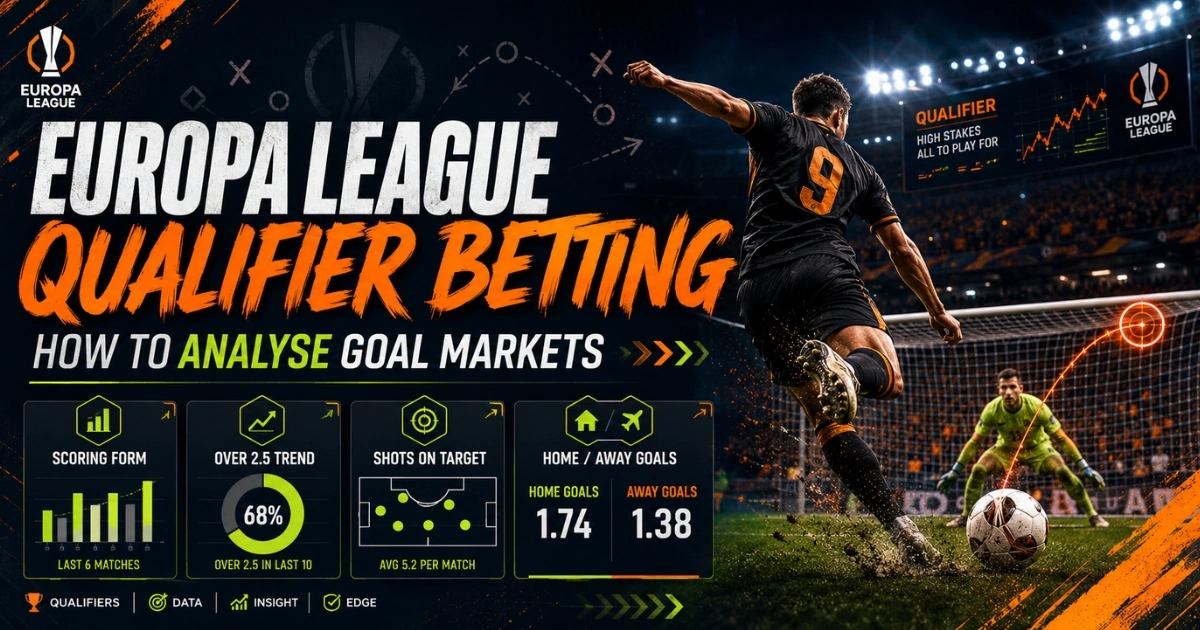
Europa League Qualifier Betting: How to Analyse Goal Markets
Europa League qualifiers can offer interesting opportunities in goal markets, but they are rarely as straightforward as they first appear.
A strong club from a major league may face an unfamiliar opponent from a smaller competition. One team may already be several weeks into its domestic season, while the other is still rebuilding fitness after summer preparation. Add long-distance travel, squad changes and the pressure of a two-legged tie, and normal league statistics suddenly need much more context.
When two qualifier opponents have never played each other, our guide on how to predict goals when two teams have never met explains how home-away form, xG, league strength and tactical comparisons can replace traditional H2H data.
This is why betting on Over 2.5 goals or Both Teams to Score should involve more than comparing recent scores. You need to understand the likely match pattern, how each club approaches European qualifiers and whether the expected goals can realistically come from both teams.
For a broader explanation of Over/Under, BTTS and the statistics used in goal-market analysis, read our complete Football Goal Predictions guide.
Here are the main factors to check when analysing Europa League qualifier goal markets.
Start With the Type of Goal Market
Before studying the teams, be clear about what your selection actually requires.
The most common goal markets include:
Over or Under 2.5 total goals
Both Teams to Score
Over 1.5 goals
Over 0.5 first-half goals
Team total goals
Combined BTTS and Over 2.5 selections
Each market needs a slightly different type of evidence.
For Over 2.5 goals, the match needs at least three goals, but one team can score all of them. A 3–0 result is enough.
BTTS – Yes requires both teams to score, even if the match finishes with only two goals. A 1–1 result wins BTTS but loses Over 2.5.
The first question should therefore be:
Do both teams have a realistic route to goal, or is one side more likely to produce most of the scoring?
That distinction can prevent you from choosing the wrong market in an otherwise promising fixture.
Our BTTS vs Over 2.5 goals comparison explains how to choose between the markets when both teams may contribute or when one favourite could score most of the goals alone.
Check Whether It Is the First or Second Leg
Europa League qualifiers are often played over two matches, and the stage of the tie can significantly influence the number of goals.
First legs may begin cautiously. The home team wants an advantage but may also be determined not to concede. The visitors may be satisfied with keeping the result close before playing at home.
Second legs are more dependent on the aggregate position.
A team trailing by two goals may need to attack early, creating space for counterattacks. A club protecting a comfortable lead may defend deeper and reduce the tempo.
However, it is dangerous to assume that every second leg will be open. If the leading team is strong defensively and the trailing side lacks creativity, the game may still remain controlled.
Always consider what each team needs from the match rather than analysing it as a normal league fixture.
For a deeper look at aggregate scores, tactical urgency and changing risk levels, read our guide to second-leg goal patterns.
Compare the Genuine Difference in Quality
A recognisable name does not automatically guarantee goals.
The favourite may dominate possession but struggle to break down an opponent defending with ten players behind the ball. A one-sided match can still finish 1–0 or 2–0.
When assessing the quality gap, ask:
Can the favourite score three goals without help?
Does the underdog have enough pace or technical quality to counterattack?
How strong is the favourite’s starting line-up?
Does the weaker team regularly defend deep?
Has either side faced similar opposition recently?
A large difference in reputation may support a home-team total such as Over 1.5 goals more strongly than BTTS.
For example, if the visitors rarely score away and the home side regularly wins comfortably, a 2–0 or 3–0 result may be more realistic than 2–1.
Analyse Domestic Form Carefully
Domestic statistics are useful, but they should not be copied directly into European qualifiers.
A club that scores three goals per match in a weaker national league may not create the same number of chances against better-organised European opposition.
Similarly, a team with modest domestic numbers may be more dangerous when playing as an underdog. It can sit deep, absorb pressure and attack the space left behind by a stronger side.
Compare:
Goals scored and conceded
Strength of recent opponents
Home and away performance
Chance creation rather than final scores alone
Previous European qualifying results
A 4–0 domestic win does not necessarily provide stronger evidence than a 1–1 match in which the team created several clear chances against a difficult opponent.
Check Where Each Team Is in Its Season
Qualifiers often bring together teams at very different stages of preparation.
One club may already have played eight competitive matches. Another may have completed only pre-season friendlies.
A team already in domestic competition may have:
Better match fitness
More settled attacking combinations
Stronger defensive organisation
More reliable recent statistics
A team at the beginning of its season may still be integrating new players or experimenting with its formation.
That does not mean the mid-season club is automatically the better choice. It could be dealing with fatigue, injuries or a crowded schedule.
Check how many competitive matches each team has played and whether its recent results came in meaningful fixtures or low-intensity friendlies.
The same seasonal and match-fitness considerations apply when analysing Champions League qualifier goal predictions, although the quality gap and tactical expectations may differ.
Use Relevant Home and Away Statistics
Overall season averages can hide major differences between venues.
For the home team, review:
Goals scored per home match
Goals conceded at home
Home Over 2.5 percentage
Home BTTS percentage
First-half scoring rate
Clean-sheet percentage
For the visitors, use the equivalent away figures.
Suppose a team averages 1.8 goals overall but 2.4 at home. That home figure is much more relevant to a qualifier played in its own stadium.
The same applies to defensive performance. A club may look organised overall but concede close to two goals per away match.
Venue-specific data usually provides a clearer picture than broad seasonal statistics.
Our guide to home and away form for goal bets explains how the host’s home attack and defensive record should be compared directly with the visitor’s relevant away profile.
Look Beyond Over 2.5 Percentages
An Over 2.5 rate is useful, but it should not be used alone.
Imagine a team has recorded Over 2.5 goals in seven of its previous ten matches. That sounds encouraging, but the details may show:
Two matches were affected by red cards
Several goals came from penalties
Most opponents were significantly weaker
The team has since changed manager
Its leading striker is unavailable
Unusual match events should also be separated from repeatable trends. Our guide to how red cards affect Over/Under goal bets explains why a dismissal can increase or reduce the expected total depending on its timing and the score.
Instead of relying only on the final percentage, combine it with:
Average total goals
Expected goals created and conceded
Shots on target
Big chances
Clean sheets
Failure-to-score rates
The strongest goal predictions normally have several different statistics supporting the same conclusion.
Our guide on how to predict Over 2.5 goals explains how to combine goal averages, venue splits, expected goals, shots on target and defensive records.
Expected Goals and Chance Creation
Expected goals can help identify whether recent scores reflect sustainable performances.
A team may win 3–0 despite creating chances worth only around one expected goal. That level of finishing may not continue.
Another side may draw 1–1 while producing several strong chances. Its attack may have performed better than the final score suggests.
Useful indicators include:
Expected goals created
Expected goals conceded
Shots on target
Chances created inside the penalty area
Corners and sustained attacking pressure
Chances allowed from counterattacks
Corner volume can add useful context, but it should not be treated as a direct goal signal. Our guide to whether more corners mean more goals explains how corner counts should be interpreted alongside shots on target, xG, chance quality and sustained pressure.
Where detailed xG data is unavailable, use shot statistics, match reports and video highlights to understand how the chances were created.
For a fuller explanation of xG, xGA and how chance quality can expose misleading scorelines, read our expected goals guide.
Review Squad Changes and Team News
Summer qualifiers are often played while squads are still changing.
A team may have lost its leading goalscorer, first-choice goalkeeper or most creative midfielder. New signings may be available but not yet fully integrated.
Before betting, check:
Striker availability
Injuries in central defence
Goalkeeper changes
Suspensions
Rotation after the first leg
Whether new players are registered
Possible tactical changes
Several absences in one position are more significant than one isolated injury.
For example, a team missing both regular centre-backs may become a stronger BTTS or Over candidate. A favourite resting two attacking players may be less likely to cover a high team-goal line.
Our guide to how missing defenders affect football goal predictions explains how replacement quality, reserve goalkeepers, unfamiliar defensive partnerships and tactical reactions can alter the expected market.
Consider Travel, Weather and the Pitch
Europa League qualifiers can involve long journeys and unfamiliar conditions.
Possible influences include:
Extreme heat
Strong wind
Artificial pitches
Poor playing surfaces
Short recovery periods
Long flights or difficult travel schedules
These factors may reduce the tempo and weaken an Over selection. They can also increase defensive mistakes if one side becomes tired late in the match.
An artificial surface may provide a meaningful home advantage when the visiting team has little experience playing on it.
Conditions should not be the main reason for a prediction, but they can help confirm or challenge the statistical picture.
Practical Example: Choosing Between BTTS and Over 2.5
Imagine a home team with these statistics:
Scored 2.2 goals per home match
Recorded Over 2.5 in seven of ten home fixtures
Kept five home clean sheets
Allowed relatively few shots on target
The visitors have:
Conceded 1.9 goals per away match
Failed to score in five of ten away fixtures
Recorded BTTS in only four of ten away matches
Struggled against stronger opposition
These numbers support goals, but they do not strongly support the visitors scoring.
Over 2.5 may be more logical than BTTS because a 3–0 result fits the evidence. A home-team Over 1.5 goals selection could also match the expected pattern.
Now imagine the visitors have scored in nine of ten away matches, while the home side has kept only one clean sheet. In that case, BTTS – Yes becomes much more attractive.
Our guide to clean-sheet statistics and goal markets explains how defensive records influence BTTS, Under 2.5 and one-sided Over scenarios such as 3–0.
A Simple Goal-Market Checklist
Before betting on a Europa League qualifier, check:
Is it the first or second leg?
What does each team need from the match?
How large is the genuine quality difference?
Are the clubs at the same stage of their domestic seasons?
Do the relevant home and away records support goals?
Can both teams score, or must one side cover the total?
Are the recent scoring numbers supported by xG and chances?
Are important attackers and defenders available?
Could travel or conditions reduce the tempo?
Do the available odds offer reasonable value?
A strong prediction should have a clear match scenario behind it, not merely an attractive trend.
Frequently Asked Questions
Are Europa League qualifier matches usually high-scoring?
Some are, particularly when there is a large quality difference or one team must attack in a second leg. Others can be cautious because clubs are protecting their position in the tie.
Is BTTS better than Over 2.5 in qualifiers?
Neither is automatically better. BTTS suits matches where both teams have a reliable scoring route. Over 2.5 can be stronger when one favourite is capable of scoring three goals alone.
Should friendly matches be included in the analysis?
Friendlies can provide information about fitness and tactics, but they should carry less weight than competitive matches because intensity, substitutions and motivation are different.
How many matches should I review?
Check at least the latest five competitive fixtures, then compare them with a broader sample of home, away and European results.
Are second legs always better for goal betting?
No. A second leg can become open when one team is chasing the tie, but a strong side protecting a lead may control the match and limit chances.
Final Thoughts
Europa League qualifier betting requires more context than analysing an ordinary league game.
The aggregate situation, quality difference, match fitness, home advantage and squad preparation can all affect how the match develops. Domestic goal statistics are valuable, but they must be adjusted for the level of opposition and the tactical pressure of European competition.
Start by deciding where the goals are likely to come from. Then use home and away data, expected goals, scoring rates, team news and playing conditions to test that idea.
No statistic guarantees a winning selection. The goal is to build a logical match scenario and decide whether the available odds offer enough value for the risk involved.
Explore our football betting resources for more guides covering goal markets, football statistics and prediction strategies.
Responsible betting: Use a fixed budget, avoid chasing losses and never stake money you cannot afford to lose.