
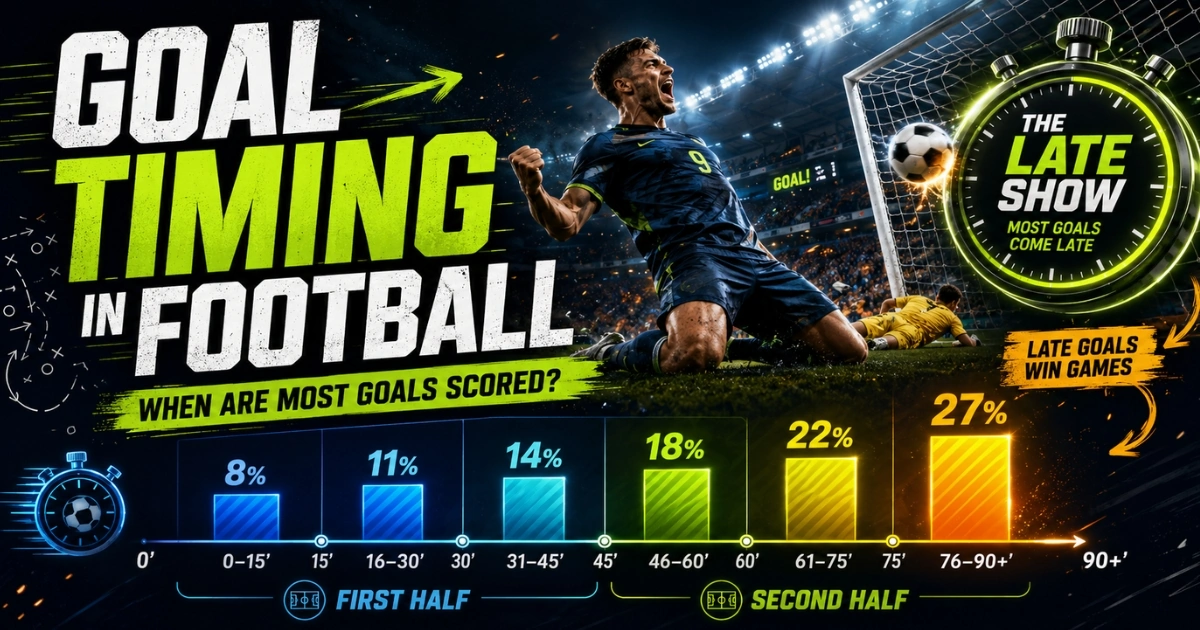
Football goals are not distributed evenly across 90 minutes. A goal in the third minute counts exactly the same as one in stoppage time, but the conditions that produce those goals can be very different.
At the beginning of a match, teams are usually organised, physically fresh and still following their original tactical plan. By the final 15 minutes, defenders may be tired, substitutes have changed the balance of the game and a team chasing the result may be taking much greater risks.
This helps explain why football matches tend to produce more goals later rather than earlier.
Understanding goal timing can be useful when analysing first-half goals, second-half totals, late-goal markets and live betting opportunities.
Goal timing should be used together with broader football goal prediction analysis, including scoring form, defensive records, venue splits and match context.
However, the broad trend should never replace match-specific analysis. Some teams start aggressively, while others regularly need time to create meaningful chances.
When Are Most Football Goals Scored?
The final 15 minutes of normal time generally contain the largest share of goals.
A study covering the English, French, Italian and Spanish top divisions across three seasons divided goals into six 15-minute periods. The distribution was:
- Minutes 0–15: 13.7%
- Minutes 16–30: 15.1%
- Minutes 31–45: 16.2%
- Minutes 46–60: 17.7%
- Minutes 61–75: 17.2%
- Minutes 76–90: 20.2%
In that sample, approximately 45% of goals were scored in the first half and about 55% in the second. The final period had the highest individual share.
These percentages should be treated as a useful general pattern rather than a fixed rule for every league or season. Goal distributions change according to competition, playing style, team quality and the amount of stoppage time.
A more recent analysis of 3,433 matches from 21 leagues and competitions also found that the probability of scoring generally increased as matches progressed. It identified fewer goals than expected during the early minutes of each half.
For a complete method focused specifically on early scoring, read our guide on how to predict Over 0.5 first-half goals.
Why Are More Goals Scored Late in Matches?
There is no single explanation. Late goals usually result from several factors appearing at the same time.
Physical fatigue
Defending requires concentration, communication and repeated movement. As players become tired, defensive lines can lose their shape, midfielders may stop tracking runners and individual reactions become slower.
A pass that would have been intercepted in the 20th minute may reach the striker in the 82nd. A full-back who comfortably followed a winger early in the match may struggle after repeated sprints.
Fatigue does not affect every team equally. Squad depth, fitness, weather and the intensity of the match all matter.
Recovery before the match can also influence how quickly those physical effects appear. Our guide to rest days and recovery explains how short turnarounds can affect attacking intensity, defensive organisation and goal expectations.
Teams take more risks
The score has a growing influence on tactics as full-time approaches.
A team losing 1–0 in the 80th minute cannot continue playing patiently as though the match were level. It may push its full-backs forward, add another striker and leave fewer players behind the ball.
This creates two routes to another goal:
- The trailing team may equalise through increased attacking pressure.
- The leading team may exploit the additional space on a counterattack.
That is why a tight match can suddenly produce two goals in a short period.
Attacking substitutions
Managers frequently introduce fast wingers, creative midfielders or additional forwards during the second half.
Fresh attackers can face defenders who have already played for an hour or more. A substitute may also change the tactical structure, turning a cautious formation into a much more aggressive one.
Substitutions do not automatically create goals, but they can increase the tempo and change where space appears.
Longer effective match time
The final interval is not always exactly 15 minutes. Goals recorded in the 90th minute or later are normally included in the last period, even when several minutes of stoppage time are played.
Modern matches can contain significant added time because of substitutions, injuries, goal celebrations, disciplinary incidents and video reviews. This gives the final interval more actual playing time than some earlier 15-minute periods.
That is one reason why raw goal percentages should be interpreted carefully.
What Happens During the First 15 Minutes?
The opening period generally produces the smallest share of goals, but early goals are far from unusual.
Teams often begin by assessing the opponent, protecting their defensive shape and avoiding an immediate mistake. Both sides are physically fresh, and the tactical plan has not yet been disrupted.
However, certain fixtures are naturally more suitable for an early goal:
- A strong favourite that presses immediately at home
- A visiting team with a poor record of conceding early
- Two teams that regularly create first-half chances
- A must-win match in which one side cannot afford a slow start
- A mismatch where the underdog struggles under sustained pressure
For example, suppose a home team has scored within the first 30 minutes in seven of its previous ten home matches. Its opponent has conceded before half-time in six of ten away fixtures. Those figures provide more useful evidence than the general statement that early goals are less common.
Our guide to home and away form for goal bets explains how venue-specific scoring and conceding records should be compared instead of relying on broad overall averages.
Are Goals Common Just Before Half-Time?
The period from the 31st minute to half-time generally produces more goals than either of the first two 15-minute periods.
By then, teams have had time to identify weaknesses. The match may also become stretched if one side has already fallen behind.
Goals recorded around the 45th minute can receive additional attention because they appear psychologically important. However, the belief that scoring immediately before half-time has a uniquely powerful effect is not as simple as football folklore suggests. Research examining the idea has found that the value of such a goal depends heavily on the score and wider match context.
For goal-market analysis, the more practical question is whether the teams regularly create pressure during the closing stages of the first half.
Useful statistics include:
- Over 0.5 first-half goal percentage
- Average first-half goals
- Goals scored between minutes 31 and 45
- First-half shots on target
- Frequency of 0–0 half-time scores
Why Can the Start of the Second Half Be Important?
The first 15 minutes after half-time can be productive because managers have had an opportunity to make tactical adjustments.
A team that struggled during the opening half may:
- Press higher
- Attack through a different side
- Move another player into midfield
- Replace an injured or ineffective defender
- Increase the speed of its passing
The interval can therefore reset the match.
For the much stricter market where both sides must contribute on each side of the interval, our guide to Both Teams to Score in Both Halves explains why strong scoring patterns from both teams are required in both the first and second half.
An early second-half goal is particularly possible when one team finished the first half strongly but failed to score. Continued pressure after the restart may eventually create the breakthrough.
However, the opposite can happen when both teams are satisfied with the score. A cautious restart may slow the game temporarily.
The Final 15 Minutes
Minutes 76 to full-time are often the most eventful part of the match.
By this stage, the tactical situation is clear. A team may be protecting a lead, chasing an equaliser or desperately searching for the goal needed to progress in a knockout tie.
These situations become especially important in return fixtures, where the aggregate score can completely change the final stages. Our guide to second-leg goal patterns explains how urgency and tactical risk develop across the tie.
Before predicting a late goal, check:
- Is either team required to attack?
- Would a draw suit both sides?
- Are fresh attacking players available?
- Has the match produced shots and dangerous chances?
- Is one defence visibly tiring?
- Has a red card changed the balance?
- How much stoppage time is likely?
Our guide to predicting late goals after the 75th minute provides a complete live-analysis method covering urgency, substitutions, recent pressure, shots, xG, fatigue and counterattacking space.
A dismissal can alter the expected timing and number of goals in different ways. Read our guide on how red cards affect Over/Under goal bets for a more detailed explanation.
A 0–0 score after 75 minutes does not automatically mean a late goal is likely. If both teams have created little and are comfortable with a draw, the historical pattern becomes less relevant.
When the lack of attacking threat is also supported by low xG, few shots on target and cautious tactics, the match may instead fit the profile explained in our guide to identifying fixtures that could finish 0–0.
In contrast, a match with 20 attempts, several saves and one team urgently needing a win may remain a strong late-goal candidate despite the current score.
How the First Goal Changes the Match
The timing of the opening goal can alter everything that follows.
For predictions focused on which side will score that opening goal, our first-team-to-score guide explains how early scoring rates, first-half xG, venue form and tactical starts should be assessed.
An early goal may make the match more open because the trailing side has plenty of time to respond. It can also make the game quieter if the leading team controls possession and protects its advantage.
A late opening goal gives the opponent less time to react, but it may trigger an immediate period of desperate pressure.
Research into consecutive goals suggests that scoring events are not always independent. Goals can cluster because the first goal changes tactics, confidence and risk-taking. When an early goal is likely to make the match more open, our guide on how to predict Over 2.5 goals explains which attacking, defensive and chance-creation statistics should support that expectation. The team that has just scored may also find another opening before the opponent has reorganised.
This is why live analysis should be updated after every goal rather than continuing to rely entirely on the pre-match prediction.
A Practical Goal-Timing Checklist
Before using goal-timing statistics, review:
- Goals scored and conceded by 15-minute interval
- First-half and second-half goal percentages
- Home and away timing patterns
- Average time of the first goal
- Frequency of 0–0 half-time scores
- Late goals scored and conceded
- Shots, expected goals and dangerous chances
- Substitution options
- Current score and team motivation
- Likely stoppage time
The strongest prediction combines historical timing data with what the teams need from the match.
Frequently Asked Questions
Are most football goals scored in the second half?
Generally, yes. Studies across major leagues have commonly found a greater share of goals after half-time, although the exact percentage varies between competitions and seasons.
Which 15-minute period produces the most goals?
The final period, from the 76th minute through stoppage time, frequently records the highest share.
Why are fewer goals scored in the opening minutes?
Teams are fresh, organised and often cautious while assessing the opponent. There has also been less playing time for attacks and errors to develop.
Does a 0–0 half-time score mean a second-half goal is likely?
Not necessarily. Check whether the first half contained genuine chances. A goalless half with strong xG and several shots on target is different from one with almost no attacking threat.
Our expected goals guide explains how xG and xGA can help distinguish genuine attacking pressure from possession or shot totals that create little real scoring danger.
Are late-goal markets safer?
No football market is automatically safe. Late goals are relatively common, but the remaining time is limited and some matches have little tactical reason to become open.
Final Thoughts
Football goals become more frequent as matches progress, with the final 15 minutes often producing the largest share. Fatigue, substitutions, tactical urgency and additional stoppage time all contribute to this pattern.
Still, averages describe thousands of matches rather than predicting one particular fixture.
For practical analysis, combine the general timing trend with team-specific data. Check when each side scores and concedes, how the match situation may affect its tactics and whether the performance on the pitch supports the historical numbers.
Goal timing is most useful when it helps explain the likely development of the match—not when it is treated as a guarantee.
Explore our football betting resources for more guides covering goal markets, match statistics and prediction strategies.