
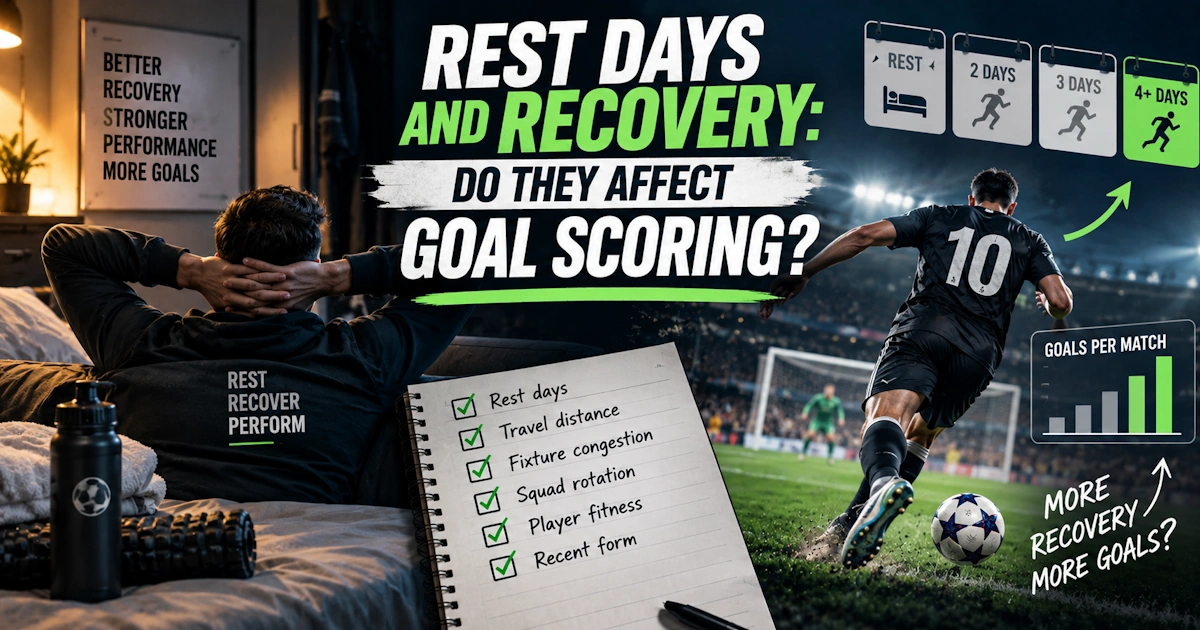
Football schedules can change quickly. One team may enter a weekend fixture after six days without a match, while its opponent played a demanding cup tie three nights earlier.
That difference naturally attracts bettors.
The rested side should be fresher. The team with less recovery should be slower, less organised and perhaps more likely to concede. It sounds straightforward.
In reality, the relationship between rest and goals is much more complicated.
Short recovery can affect muscle soreness, tactical coordination and injury risk, but professional players do not necessarily stop running simply because they played three days earlier. Strong clubs also rotate heavily, meaning the players starting the second match may be relatively fresh.
For goal predictions, the useful question is not simply which team had more rest?
It is which players had more rest, what type of match they played, and whether fatigue is more likely to affect the attack or the defence.
When the short turnaround follows a UEFA fixture specifically, our guide to goal predictions after European matches explains how recovery time, travel, rotation and squad depth should be assessed together.
How Much Recovery Do Footballers Need?
A professional football match creates considerable physical stress.
Research into post-match recovery suggests that some physiological effects can remain for at least 72 hours. A systematic review of team sports found that underlying muscle-recovery processes may continue beyond three days even when some measures of physical performance recover sooner.
This helps explain why a Sunday match after a Thursday night fixture can be important.
The players may be capable of completing another 90 minutes, but that does not mean every part of their physical and tactical performance has completely returned to normal.
Recovery also differs between players.
A centre-back covering relatively little high-speed distance may recover differently from a winger who repeatedly sprinted. Age, previous minutes, injuries and individual fitness all matter.
That is why simply counting days between matches is only the first step.
Three Days of Rest Does Not Automatically Mean Fewer Goals
One common assumption is that tired teams attack less effectively.
There is some logic to this. Fatigue can affect repeated runs, pressing and movement away from the ball. A midfielder may be less willing to make another run into the penalty area in the 80th minute after playing twice in a week.
However, research on fixture congestion does not show a simple collapse in football performance.
A systematic review and meta-analysis covering congested schedules found no significant overall reduction in total distance covered when matches were played with short recovery. Some individual studies did find reductions in certain low- and moderate-intensity movements, and tactical coordination may also be affected.
For bettors, that distinction is important.
A tired team may still cover roughly the same distance while performing those movements less efficiently.
That could affect goals in either direction.
Fatigue Can Reduce Attacking Quality
There are situations where limited recovery can support a lower-goal prediction.
Consider a team that played a difficult European away match on Thursday and returns to domestic action on Sunday.
Its attackers may have:
- Played 90 minutes
- Travelled overnight
- Completed a high-intensity pressing match
- Had only one proper tactical training session
- Another important match coming soon
The manager may deliberately reduce the tempo.
Instead of pressing aggressively and attacking with six players, the team may control possession, choose its moments and protect energy.
That can produce a match where the stronger side still wins but does so 1-0 or 2-0 rather than 4-1.
This is particularly relevant when the opponent also defends deeply.
Short rest plus a low defensive block can reduce the number of clean attacking sequences even when there is a significant quality gap.
When reduced attacking intensity is supported by low chance creation and a compact opponent, our guide on how to predict Under 2.5 goals explains which attacking, defensive and tactical indicators should confirm the lower-total scenario.
Fatigue Can Also Create More Goals
This is the part bettors sometimes miss.
A tired team does not only attack.
It also has to defend.
Defensive football depends on repeated concentration, coordinated movement and rapid recovery after losing possession.
Fatigue can produce:
- Slower defensive transitions
- Poorer tracking of runners
- Gaps between midfield and defence
- Mistimed pressing
- Late tackles
- Set-piece mistakes
- More space in the final 20 minutes
So a congested schedule can actually strengthen Over 2.5 or BTTS when defensive fatigue is more important than attacking fatigue.
The closing stages deserve particular attention when those problems begin to appear. Our guide to predicting late goals after the 75th minute explains how fatigue should be combined with recent pressure, substitutions, xG, remaining time and counterattacking space.
Imagine a strong team keeps its main forwards but rotates two defenders after a European fixture.
Its attack remains dangerous, while the back line is less familiar.
A 2-1 or 3-1 match becomes entirely plausible.
In that situation, fewer recovery days may increase rather than decrease goal potential.
Look at Who Actually Played
Team-level rest statistics can be misleading.
Suppose Club A played on Wednesday and again on Saturday.
At first glance, it has only two full recovery days.
But the manager rested six first-choice players in the Wednesday match.
Club B has had a full week without a fixture, but several starters recently returned from international duty and travelled thousands of kilometres.
Which side is actually fresher?
For betting purposes, check individual minutes.
Pay particular attention to:
- Goalkeeper
- Centre-backs
- Full-backs
- Defensive midfielder
- Creative midfielder
- Main striker
If the same core players have completed three full matches in eight days, congestion becomes much more meaningful.
If the squad has been rotated intelligently, the headline schedule may exaggerate the fatigue risk.
Consecutive Matches Can Increase Injury Risk
Recovery also matters indirectly through injuries.
An 11-season study involving 27 professional European teams found that matches played with four or fewer recovery days were associated with a 32% higher muscle-injury rate than matches following at least six days of recovery. The same research found relatively little consistent effect on team results.
That is an important distinction for bettors.
Short recovery does not automatically make the team lose or fail to score.
But repeated congested periods can gradually remove important players from the squad.
A missing winger may reduce chance creation. A centre-back injury can weaken clean-sheet probability for several weeks.
The effect of fixture congestion may therefore become more visible across a month than in one isolated match.
Travel Changes the Meaning of Rest Days
Four days of recovery at home are not the same as four days containing a long journey.
Travel can reduce effective recovery through:
- Late-night arrivals
- Interrupted sleep
- Time-zone changes
- Airport time
- Different climates
- Reduced training time
Suppose one team plays a European match at home on Tuesday and then has a domestic match on Sunday.
Another plays away on Thursday, returns early Friday morning and plays away domestically on Sunday.
Both technically have a short turnaround.
The second schedule is clearly more demanding.
Travel should therefore be included whenever comparing rest periods.
Extra Time Is Easy to Overlook
A team may officially have four days between matches, but its previous fixture lasted 120 minutes.
That changes the calculation.
Cup matches and European knockout ties can add:
- 30 minutes of extra time
- Penalty shoot-outs
- Greater emotional stress
- Fewer opportunities for early substitutions
A player completing 120 minutes has effectively played one-third of another match compared with someone substituted after 60.
When comparing schedules, minutes played are more informative than the fixture date alone.
Rest Can Help Pressing Teams More Than Passive Teams
Playing style also determines how valuable additional recovery is.
A team built around aggressive pressing may depend heavily on:
- Repeated sprints
- Rapid counter-pressing
- High defensive positioning
- Constant midfield movement
Freshness is central to that system.
A side defending in a low block may require less repeated high-intensity running.
Therefore, six days of recovery versus three may matter more when analysing a high-pressing team.
If its press becomes half a second slower, the opponent can suddenly play through midfield and attack an exposed defence.
This can increase BTTS and Over potential.
Practical Example: Extra Rest Supports the Favourite
Imagine the home team has enjoyed six days of preparation.
It averages:
- 1.9 home goals
- 1.8 home xG
- Five shots on target per match
The visitors played a European away fixture three days earlier.
Seven of their expected starters played at least 80 minutes, and they have conceded regularly during the final 30 minutes of recent matches.
The home team also attacks aggressively with fresh wingers.
Here, the recovery advantage supports the home scoring statistics.
Home Team Over 1.5 could be more interesting than simply backing the home win.
Practical Example: Short Rest Supports Under
Now imagine a heavy favourite played away in Europe on Wednesday and has another major match next week.
Its main striker completed 90 minutes, and two attacking midfielders are expected to be rested.
The domestic opponent:
- Uses a deep defensive block
- Creates little attacking threat
- Rarely plays open matches
- Would be satisfied with a narrow defeat
The favourite should still control possession.
But results such as 1-0 or 2-0 may be more realistic than a high-scoring match.
Here, Under 3.5 could fit the schedule and tactical context better than Over 2.5.
Practical Example: Fatigue Creates BTTS Potential
Consider another congested side that retains its main attack but rotates both centre-backs.
The opponent is well rested and dangerous on the counterattack.
The congested favourite may still score because its attacking quality remains intact.
However, the combination of tired midfielders and an unfamiliar defence gives the underdog a credible scoring route.
When rotation creates a new centre-back partnership, our guide to how missing defenders affect football goal predictions explains why communication, replacement quality and defensive structure can matter as much as the individual ability of the players involved.
Possible results include 2-1, 3-1 or 2-2.
Short recovery in this case strengthens BTTS – Yes rather than an Under selection.
When both Over 2.5 and BTTS appear possible, our BTTS vs Over 2.5 comparison explains how to decide whether both teams need to contribute or one attack can produce most of the total.
What Statistics Should Bettors Check?
Rest-day analysis works best when combined with ordinary performance data.
Useful numbers include:
- Days since previous match
- Minutes played by expected starters
- Number of matches in the previous 10–14 days
- Goals scored and conceded late
- Second-half xG and xGA
- Pressing intensity
- Shots allowed
- Defensive errors
- Home and away splits
- Player rotation
- Travel distance
- Extra-time involvement
Avoid treating “three days rest” as a standalone statistic.
It only becomes meaningful when you know what happened during those three days.
Frequently Asked Questions
Do teams score fewer goals with short rest?
Not consistently. Short recovery can reduce attacking intensity, but it can also weaken defending and increase scoring opportunities.
Is three days enough recovery for footballers?
Players can compete again after three days, but research suggests some physiological recovery processes may still be incomplete at around 72 hours.
Does fixture congestion always reduce performance?
No. Research has found little consistent reduction in total distance covered, although some physical and tactical measures may be affected.
Should I back Over goals against tired teams?
Only when there is evidence that fatigue is likely to hurt their defensive structure and the opponent is capable of exploiting it.
Is six days of rest always an advantage?
It is generally useful, but team quality, injuries, tactics and match fitness matter more than rest days alone.
Final Thoughts
Rest days matter, but not in the simple way that “fresh team equals more goals” or “tired team equals fewer goals”.
Short recovery can reduce pressing intensity and attacking movement, which may support lower totals. It can also weaken defensive organisation and create late mistakes, which can push a match towards Over 2.5 or BTTS.
The most important details are minutes played, travel, rotation, playing style and which positions are fatigued.
A team with three days of rest but six fresh starters may be in better condition than a team with a week off but several players returning from demanding international matches.
Use recovery as an adjustment to your prediction rather than the prediction itself.
When rest patterns, tactical style and the underlying goal statistics all point in the same direction, the information becomes much more valuable.
Explore our football betting resources for more guides covering goal markets, team statistics, tactical analysis and match prediction strategies.
Responsible betting: Rest and recovery can influence performance but cannot predict individual results with certainty. Keep stakes within a fixed budget and never bet money you cannot afford to lose.