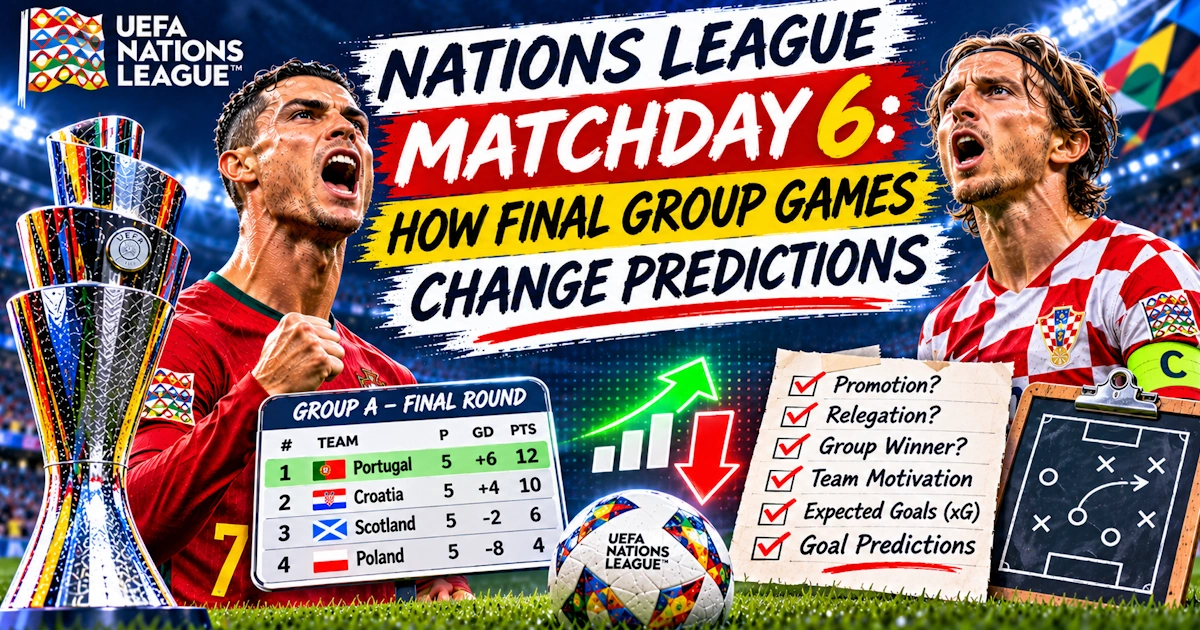
Nations League Matchday 6 is not simply another international fixture. It is the point where possibilities become consequences.
Before Matchday 5, a team can often say: “We still have another game.” On Matchday 6, there is no next group match.
A draw can secure qualification. A single goal can decide promotion. A defeat can mean relegation or a difficult play-off. Some teams have already achieved their objective and can rotate heavily, while others enter the final 20 minutes knowing they must score.
That makes final-round football very different to the opening Nations League matchdays.
The key is not simply to find the team with the most motivation. You need to understand what every possible score actually means.
For the 2026/27 Nations League, Matchday 6 is scheduled for 15–17 November 2026, completing the league phase before the knockout-stage and promotion/relegation play-off draw. For football predictions, this is the round where table mathematics can become almost as important as recent form.
Matchday 6 Removes the Safety Net
In a normal league match, dropping two points can be repaired next weekend. There is no such luxury in a final Nations League group game.
Imagine a team enters Matchday 6 two points behind the position it needs. A draw changes nothing. At 0-0 after 75 minutes, it knows exactly what must happen: it needs a goal.
That can force changes that would be unnecessary earlier in the competition:
Another striker
Higher full-backs
More direct passes
Aggressive pressing
Centre-backs attacking set pieces
Fewer players protecting against counterattacks
This is where Matchday 6 can create excellent late-goal conditions, even if the first half was cautious.
First Work Out the Exact Scenario
Before looking at Over 2.5, BTTS or match-winner odds, calculate the table. Do not settle for: “They need a result.”
Work out whether the team needs a win, a draw, a particular winning margin, or help from another match. These situations are completely different.
Suppose:
Team A: 10 points
Team B: 8 points
Team C: 7 points
If Team B needs only a draw to secure its objective, its tactics may be conservative. If Team C must win and hope Team B loses, it may eventually have to become much more aggressive.
The word motivation is too vague. The actual score requirement is what matters.
Tiebreakers Can Completely Change the Prediction
Nations League groups are not separated by overall goal difference first. Under the 2026/27 regulations, teams level on points are initially separated by their matches against one another:
Head-to-head points
Head-to-head goal difference
Head-to-head goals scored
Only later do overall group goal difference, overall goals scored and additional criteria enter the calculation. This matters enormously on Matchday 6 and completely changes how to use H2H statistics for goal predictions.
Imagine Team A lost the first meeting against Team B 2-0. A simple 1-0 victory in the return fixture may not produce the same ranking outcome as a 3-0 win.
That can create situations where a team leading the match still has reason to attack. The scoreboard says they are winning, but the group mathematics say it is not enough yet.
Do Not Assume Every Team Needs Goals
The opposite situation is just as important. Suppose Team A qualifies with a draw, and the match reaches 1-1 after 65 minutes.
Why would they transform the match into an end-to-end contest? They may instead:
Slow possession
Protect central areas
Make defensive substitutions
Take fewer risks from full-back
Keep extra players behind the ball
Matchday 6 can therefore produce both excellent Over opportunities and excellent Under opportunities. It depends entirely on what the current score means.
The Previous Final Round Shows Both Extremes
The 2024/25 Nations League Matchday 6 is a useful example.
From UEFA’s published results, the 26 final-round matches produced 75 goals, an average of approximately 2.88 per game. Fourteen of the 26 matches (about 54%) contained at least three goals, while 16 (roughly 62%) saw both teams score.
But the scorelines varied enormously. England beat the Republic of Ireland 5-0, Norway defeated Kazakhstan 5-0 and Sweden beat Azerbaijan 6-0. At the same time, Serbia–Denmark and Malta–Andorra finished 0-0.
That is exactly why “final round = goals” is not a reliable strategy. Some scenarios create chaos; others create caution.
A Draw That Helps One Team Creates Asymmetric Risk
Imagine Team A needs only one point, but Team B must win. After 70 minutes, the score is 0-0.
Team A wants the match to stay exactly as it is. Team B cannot accept it. As the clock runs down, Team B may push more players forward.
That can increase two probabilities simultaneously: Team B scoring, and Team A scoring on the counterattack. This is one of the most interesting Matchday 6 patterns. The team taking the risk is not always the only team that benefits from a more open game.
Practical Example: Late Over Becomes Stronger
Imagine a home team that needs victory, averages 1.7 xG per match, and has a strong home attack. The away team qualifies with a draw, has a dangerous counterattack, but is weak when defending crosses.
The score is 1-1 after 68 minutes. The home side now has to increase risk. Its full-backs move higher, and a second striker enters. The away team suddenly has more counterattacking space.
Possible results: 2-1, 1-2, 2-2, 3-1.
This may be a much better situation for a live Over 2.5 or Over 3.5 than the pre-match market was. The group scenario has changed the game, showing exactly how to predict late goals after the 75th minute.
Practical Example: The Final Score Can Become Protected
Now imagine both teams effectively achieve their objective with a draw. The score reaches 1-1 after 75 minutes.
Neither side wants to make the mistake that ruins everything. Attacks become less ambitious, full-backs stop overlapping, and possession becomes safer.
In this situation, another goal may become less likely despite the match having already produced two. A late Under can sometimes make more tactical sense than chasing a third goal.
When Both Teams Need to Win
This is one of the strongest potential goal environments. Imagine both teams know a draw eliminates them.
At 0-0 after 65 minutes, neither has achieved anything. At 1-1 after 75 minutes, the situation is almost the same.
That can produce:
Higher defensive lines
Extra attackers
More crosses and corners
Faster transitions
These fixtures can become especially interesting for Second-Half Over 1.5, Late Goal markets, or when deciding between BTTS vs Over 2.5 Goals. But this only applies if both teams possess enough attacking ability. Two weak attacks remain two weak attacks, no matter how badly they need to score.
Motivation Cannot Replace Quality
Suppose a team desperately needs three points. Its first five Nations League matches show:
0.8 Expected Goals (xG) per match
2.5 shots on target
Few big chances
Its opponent has one of the strongest defensive records in the group. The table says “must win,” but the statistics say they struggle to create chances.
Do not automatically choose Over 2.5. Motivation changes the team’s incentives; it does not suddenly give the players better finishing, passing, or movement.
A Strong Attack Plus Must-Win Pressure Is Different
Now imagine a team with 1.9 xG per match, 5.8 shots on target, and several big chances per game. They also must win.
Now the evidence is much stronger. The attack already creates chances, and Matchday 6 pressure gives it an additional reason to increase risk if the score is not favourable.
This is how you answer the question: Do must-win matches really produce more goals? Motivation should be used as an amplifier of existing football evidence, not a replacement for it.
Qualification Can Reduce the Importance of the Result
Some teams enter Matchday 6 with their main objective already achieved. That creates another challenge: How strong will the lineup be?
A manager may rest their first-choice striker, an important midfielder, a senior defender, or the goalkeeper.
Do not automatically oppose the qualified team, as elite nations may have excellent replacements. Instead, ask where the rotation occurs. If several attackers are missing, team-goal expectations may fall. If the defence is heavily rotated but the attack remains strong, BTTS or Over markets may actually improve.
Rotation Can Increase Uncertainty
A heavily changed national team often has less tactical familiarity than a heavily rotated club side. Club players train together almost every day; national-team substitutes may have only a few sessions together.
A new centre-back pairing or inexperienced goalkeeper can therefore matter. Rotation may produce defensive mistakes, poor pressing coordination, missed marking, and faster transitions.
“Six changes” is not automatically an Under signal. You need to see which six players changed.
Simultaneous Results Can Change Motivation During the Match
Final group rounds can contain another variable: the other game.
Suppose Team A begins knowing a draw might be enough if Team C fails to win elsewhere. After 60 minutes, news arrives that Team C is now winning.
Suddenly Team A needs a goal. Its tactical incentives can change without anything happening in its own match. This is one reason live standings are particularly valuable on Matchday 6. The pre-match scenario can become obsolete during the game.
Do Not Assume Players Ignore the Other Score
Modern benches have immediate access to information, and managers know what is happening elsewhere. If another result changes qualification, promotion, or relegation requirements, tactical decisions can follow.
The important thing for the bettor is not merely watching the score of the match being analysed. You must watch the group.
The First Goal Can Change Everything
Suppose Team A must win, and it scores after eight minutes. Its problem is largely solved—for now.
The team no longer needs to play with the same urgency, and Team B may become the side forced forward. This is why a must-win argument should never remain fixed for 90 minutes.
After every goal ask: Who now needs the next goal? That question is often more useful than asking which team was more motivated before kickoff.
Goal Difference Can Keep a Favourite Attacking
Sometimes taking the lead is not enough. If the ranking depends on a tiebreak situation, a team may need another goal.
Suppose they lead 2-0 after 70 minutes but need a three-goal victory to reach their objective. The market may assume the match is finished, but tactically, it is not. The favourite may continue pressing, using attacking substitutes, and taking risks. That can create opportunities for both another home goal and an opposition counterattack.
Set Pieces Become More Important Late
When a team desperately needs a goal, attacks often become more direct. Corners and free kicks gain importance, centre-backs move forward, and more players attack the penalty area. A goalkeeper may even join a final corner.
This means set-piece strength can be especially relevant in Matchday 6 analysis. If a team has excellent delivery and strong aerial players against an opponent weak at defending corners, its late scoring potential may be better than open-play statistics alone suggest.
Cards Can Also Matter
Final group games can become emotional, as players know a single mistake can decide promotion or relegation.
A red card can completely destroy the original prediction. If a must-win team goes down to ten players, understanding how red cards affect Over/Under goal bets becomes crucial. Do not automatically assume the Over becomes stronger; their own attacking probability may collapse while the opponent’s increases. Recalculate the match rather than relying on the pre-match scenario.
Use the First Five Matches Carefully
By Matchday 6, you finally have five current Nations League matches to analyse. That is useful, but it is still not a huge sample.
A team showing 4 Overs from 5 has an 80% rate. One additional Under changes the six-match record to 66.7%.
Check what produced the trend using statistical databases like soccerprediction.io. Were there red cards? Penalties? Weak opponents? Unusually efficient finishing? Current competition data should inform your prediction, not dictate it.
Matchday 6 Prediction Checklist
Before choosing a final-round market, check:
Current group points and exact result each team needs
Head-to-head tiebreakers and required winning margins
Whether a draw helps either side
The other match in the group
Current xG, xGA, shots on target, and big chances
Injuries, suspensions, and expected rotation
Set-piece strength
What happens at 0-0 after 70 minutes
What happens if either team scores first
Whether the bookmaker has already priced in the obvious scenario
Matchday 6 predictions should be dynamic.
Frequently Asked Questions
When is Nations League Matchday 6 in 2026? The 2026/27 Nations League Matchday 6 is scheduled from 15 to 17 November 2026.
Does the final group match usually produce more goals? Not automatically. The 2024/25 Matchday 6 produced 75 goals across 26 games, roughly 2.88 per match, but the round included both large wins and 0-0 draws.
Is goal difference the first Nations League tiebreaker? No. UEFA first uses head-to-head points, followed by head-to-head goal difference and head-to-head goals scored. Overall group goal difference comes later.
Is a must-win team a good Over 2.5 selection? Not necessarily. A team needs enough attacking quality to create chances. Must-win pressure often becomes most relevant later in the match if the score remains unfavourable.
Should I bet against a team that has already qualified? Not automatically. Check the lineup. Rotation may weaken the team, but strong nations can have excellent replacements, and defensive rotation can sometimes create more goal opportunities rather than fewer.
Final Thoughts
Nations League Matchday 6 changes prediction analysis because there is no longer time for teams to repair a mistake later. Every point has a final value. Every tiebreaker can matter. And every goal can change not only the match score but the group table.
That makes the final round particularly useful for bettors who understand scenarios rather than slogans.
Do not stop at: “They must win.” Ask: How many goals do they need? Does a draw help the opponent? What happens if another group result changes? Who needs the next goal if this match reaches 1-1 after 75 minutes?
Then combine those answers with the normal football evidence: xG, shots, defensive quality, lineups, set pieces and home-away performance.
A strong attacking team that cannot accept a draw can become a compelling late-goal candidate. Two teams satisfied with the current score can produce exactly the opposite environment. And a team leading 2-0 may still attack if the tiebreak mathematics says it needs three.
That is what makes Matchday 6 different. The final group game is not simply about determining who wants to win. It is about understanding what every possible score means—and how that meaning changes the football being played.
Responsible betting: Final-round group scenarios can alter tactical behaviour but cannot guarantee goals or results. Confirm the latest standings and UEFA tiebreak rules, combine them with current team data, keep stakes controlled and never bet money you cannot afford to lose.