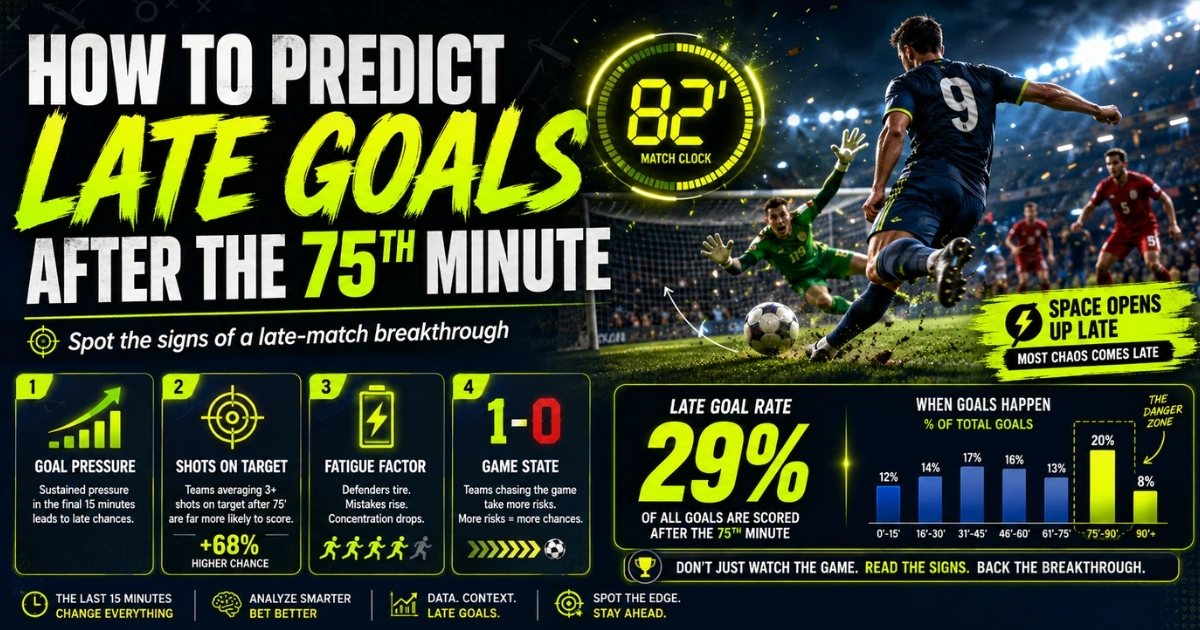
The final 15 minutes can completely change a football match. A controlled 1–0 may become 2–1 within a few attacks, while a quiet 0–0 can suddenly open when one team realises that a draw is no longer enough.
Late goals are not simply the result of tired defenders. They are often created by changes in tactics, motivation and space. Losing teams push more players forward, managers introduce fresh attackers and the side protecting a lead becomes increasingly focused on defending its own penalty area.
This makes late-goal markets attractive, particularly for live betting. However, backing a goal after the 75th minute purely because “late goals happen” is still a guess.
The strongest predictions combine the current score with match pressure, chance quality, substitutions and what each team needs from the remaining minutes.
These live indicators should be interpreted alongside the broader factors covered in our complete guide to football goal predictions, including team strength, scoring form, defensive records and match context.
Start With the Match Situation
The score alone does not tell you whether a late goal is likely. You also need to understand what that score means to both teams.
A 0–0 draw can produce very different endings.
In one match, both teams may need a victory to qualify or avoid relegation. In another, a draw may suit both sides perfectly.
The same applies to a 1–0 score. The losing team may urgently need an equaliser, or it may be satisfied with a narrow defeat in the first leg of a two-match tie.
Before considering a late-goal bet, ask:
Does either team need to score?
Would a draw be acceptable?
Is one team protecting an aggregate advantage?
Does goal difference matter?
Is the losing side still showing ambition?
Is the leading team dangerous on the counterattack?
Aggregate situations require additional context because a team losing on the night may still be satisfied with the overall score. Our guide to second-leg goal patterns explains how qualification pressure changes urgency and late attacking risk.
Late goals become more plausible when the score forces at least one side to take greater risks.
Look for Increasing Attacking Pressure
A team having more possession does not necessarily mean it is close to scoring.
The important question is whether possession is becoming dangerous.
Positive signs include:
Repeated attacks around the penalty area
Several corners in a short period
Crosses reaching dangerous areas
Shots from inside the box
Goalkeeper saves
Blocked attempts
Free kicks close to goal
Sustained pressure without long breaks
Suppose the home team has had 68% possession but has produced only two shots on target. That may simply indicate slow, harmless control.
Now imagine the same team has generated four shots, three corners and several penalty-area touches during the last ten minutes. The pressure is becoming much more relevant.
Late-goal analysis should focus on the direction of the match, not only the full-match totals.
Check Shots on Target
Shots on target provide a simple way to measure whether the goalkeepers are being tested.
As a practical benchmark, a match with eight or more combined shots on target by the 75th minute normally offers a stronger attacking profile than one with only two or three.
However, the timing of the attempts matters.
Seven shots on target during the first hour followed by no attacking threat may be less encouraging than three recent saves in the last five minutes.
Look at:
Total shots on target
Shots on target since half-time
Attempts during the last 10–15 minutes
Which team is producing them
Whether the chances are improving in quality
A goalkeeper repeatedly making comfortable saves from long range is different from one stopping close-range headers and one-on-one attempts.
Use Live Expected Goals Carefully
Live expected goals can help show whether the match has produced genuine opportunities.
A 0–0 game with combined xG of 0.7 may simply lack quality. A goalless match with combined xG above 2.0 may have included missed chances, strong saves or poor finishing.
This does not guarantee that a goal will arrive late, but it provides evidence that the match is capable of producing one.
Recent xG can be even more valuable than the full-match total. If most of the chance quality was created early and the match has since slowed down, the headline figure may be misleading.
Useful late-goal indicators include:
Rising second-half xG
A major chance missed recently
Several shots from central positions
Increasing penalty-area entries
A defence allowing repeated chances
Treat xG as a measure of chance quality rather than a countdown to an inevitable goal.
For a fuller explanation of xG, xGA and the difference between chance quality and actual goals, read our expected goals guide.
Watch the Substitutions
Substitutions often reveal a manager’s intentions more clearly than possession statistics.
A losing team may replace a defensive midfielder with a striker or move from one forward to two. A winger with fresh pace can attack a full-back who has already played for 75 minutes.
Attacking substitutions can support a late-goal prediction when they change the shape of the match.
Look for changes such as:
An additional centre-forward
Fresh wingers
A creative midfielder replacing a defensive player
Full-backs being pushed higher
A switch to a back three
Central defenders moving forward for set pieces
However, substitutions can also reduce goal potential.
A team protecting a lead may introduce another defender, slow the tempo and close central spaces. If the opponent struggles to break down a compact block, the final minutes may remain controlled.
Do not simply count the substitutions. Consider what they change tactically.
Fatigue and Defensive Errors
Tired players make slower decisions.
By the final 15 minutes, defenders may struggle to track runners, close down crosses or maintain the correct distance between the defensive line and midfield. Players who pressed aggressively earlier may no longer reach the ball in time.
Fatigue is more likely to matter when:
The match has been played at a high tempo
The weather is hot
One team has had limited recovery time
The defence has faced sustained pressure
A team is playing with ten men
The squad has few reliable substitutes
A fresh attacker facing a tired defender can create a clear advantage, particularly in wide areas.
Still, fatigue alone is not enough. A slow match with little intensity may leave both teams relatively comfortable late on.
Limited recovery before the match can make that fatigue more relevant. Our guide to rest days and recovery explains how short turnarounds can affect attacking intensity, defensive organisation and goal expectations before the game even reaches its closing stages.
Our guide to goal timing in football explains the wider reasons goals become more frequent later, including fatigue, tactical urgency, attacking substitutions and additional stoppage time.
Consider Counterattacking Space
The team chasing the result is not the only possible source of a late goal.
When it pushes full-backs and midfielders forward, the leading side may find large areas to exploit on the counterattack.
This is why late goals often come from the team already ahead.
Imagine the score is 1–0 after 80 minutes. The losing side sends seven players into attacking positions. One unsuccessful corner leaves only two defenders protecting half the pitch. A single clearance can create a three-against-two counterattack.
This pattern may support:
Over 1.5 match goals
Over 2.5 match goals
Another goal in the match
The leading team to score next
A team total for the side ahead
Do not assume the equaliser is the only logical outcome.
Red Cards Change the Calculation
A red card can create more space, but it does not automatically guarantee a late goal.
The effect depends on:
Which team received the card
The current score
How much time remains
The dismissed player’s position
Whether the penalised team still needs to attack
If the trailing team receives a red card, its attacking threat may decline sharply. The leading side may control possession without taking unnecessary risks.
If the leading team goes down to ten players, the opponent may generate heavy pressure. Yet the penalised team may also defend extremely deep, making central space difficult to find.
After a red card, watch the next few minutes before deciding. The tactical response matters more than the card itself.
Our guide to how red cards affect Over/Under goal bets explains why a dismissal can increase one team’s scoring potential while reducing the other side’s attacking threat.
Set Pieces Become More Important
Late pressure often produces corners, free kicks and long throws.
Even when a team is struggling to create from open play, repeated set pieces can provide a realistic route to goal. Goalkeepers and central defenders may also join the attack in the final minutes.
Check whether the attacking team has:
Strong aerial players
Accurate set-piece delivery
A high corner count
A recent pattern of set-piece goals
An opponent that struggles to defend crosses
A match with little flowing football can still produce a late goal through one well-delivered corner.
Account for Stoppage Time
The final 15-minute period often includes more than 15 minutes of actual match time.
Substitutions, injuries, disciplinary incidents, goals and video reviews can all increase stoppage time. A match with seven added minutes gives a late-goal selection significantly more opportunity than one with only two.
Before betting close to the 90th minute, consider:
Number of second-half substitutions
Injury delays
Time spent on video reviews
Goal celebrations
Time-wasting warnings
Recent interruptions
Do not assume the match will end immediately when the clock reaches 90:00.
Practical Example: Strong Late-Goal Candidate
Consider a match that is 1–1 after 76 minutes.
The home side needs a victory and has:
Produced seven shots on target
Created approximately 2.0 xG
Won three corners in the previous eight minutes
Introduced a second striker
Forced two recent goalkeeper saves
The visitors are also dangerous on the counterattack and have already created several good chances.
The score does not suit the home team, the match is open and both sides have a credible scoring route. A late goal has a logical basis.
Practical Example: Weak Late-Goal Candidate
Now imagine a 0–0 match after 78 minutes.
The teams have:
Produced only three combined shots on target
Created very little second-half pressure
Recorded low xG
Made defensive substitutions
Shown no urgency
Accepted a draw as a useful result
The fact that the match remains goalless does not create value by itself. The live performance provides few signs that the pattern will change.
Late-Goal Checklist
Before backing a goal after the 75th minute, check:
What does each team need from the result?
Is the match becoming more open?
Are recent chances genuinely dangerous?
How many shots on target have been produced?
Is second-half xG increasing?
Have attacking substitutions changed the formation?
Is either defence visibly tiring?
Is there counterattacking space?
Are corners and set pieces increasing?
Has a red card changed the balance?
How much stoppage time is likely?
Have the live odds already shortened too far?
Several positive indicators are stronger than one dramatic attack.
Frequently Asked Questions
Are most late goals scored by the losing team?
No. The losing team may attack more, but the leading side can exploit the space left behind on counterattacks.
Is 0–0 after 75 minutes a good late-goal opportunity?
Only when the match is producing chances and one or both teams need to win. A quiet 0–0 can remain goalless.
When neither team shows urgency and the match contains low xG, few shots on target and limited attacking threat, our guide to identifying matches that could finish 0-0 explains which indicators support the opposite scenario.
Are shots on target more useful than possession?
Usually, because possession may be harmless. Recent shots, xG and penalty-area pressure provide better evidence of scoring threat.
Does an attacking substitution guarantee more chances?
No. The new player and tactical change must improve the attack. Poor team structure can make the side less effective despite using more forwards.
Should stoppage time be considered?
Yes. A match expected to have significant added time offers more opportunity for a late goal than the standard clock suggests.
Final Thoughts
Predicting late goals requires reading the match rather than following a single statistic.
The strongest opportunities appear when the score creates urgency, attacking pressure is increasing and both teams have realistic routes to goal. Shots on target, live xG, substitutions, fatigue, set pieces and likely stoppage time can all help confirm the pattern.
A quiet match does not automatically become a good late-goal bet simply because the clock has reached the 75th minute.
Focus on what is happening now, why the teams need to take risks and whether the available odds still reflect the true chance of another goal.
Explore our football betting resources for more guides covering goal markets, live-match analysis and football statistics.
Responsible betting: Live markets move quickly and can encourage impulsive decisions. Use a fixed budget, avoid chasing losses and never stake money you cannot afford to lose.