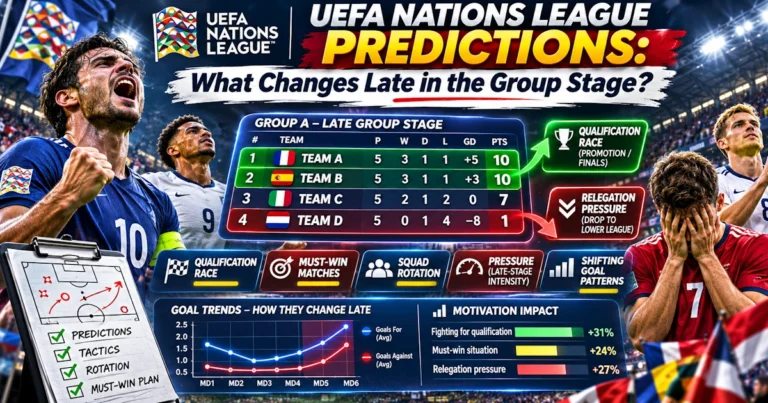

By Nations League Matchday 5, the table finally starts to mean something serious. Four matches have been played, and only two remain for teams in Leagues A, B and C.
Qualification, promotion and relegation scenarios are becoming clearer, while some nations can no longer afford another poor result. This makes Matchday 5 one of the most interesting rounds for football predictions.
It also creates a common trap. Bettors see a team that “needs to win” and immediately assume: More motivation = more attacking football = Over 2.5 Goals.
Real matches are rarely that simple. A team desperate for three points may actually begin cautiously because conceding first would make its situation much worse.
Another nation may need only a draw and deliberately reduce the tempo. A third may already have achieved its objective and rotate several important players.
Matchday 5 predictions therefore require two types of analysis:
How good are the teams?
What does the group situation actually require them to do?
Why Matchday 5 Is Different
The 2026/27 Nations League Matchday 5 takes place from 12 to 14 November 2026, followed almost immediately by Matchday 6 from 15 to 17 November. Teams in Leagues A, B and C play six group matches, meaning Matchday 5 begins with approximately two-thirds of the league phase already completed.
That changes the importance of the table. After Matchday 2, a team can recover from almost anything.
After Matchday 5, only one match remains. A defeat can suddenly become very expensive.
Start With the Exact Group Mathematics
Before analysing xG or goals, work out what every team actually needs. Do not settle for vague descriptions such as: “They need points.”
Almost every team wants points. Instead ask:
Can they qualify with a draw?
Do they need to win?
Can they still finish first?
Can they still be relegated?
Would victory guarantee promotion?
These are much more useful questions.
For example, imagine the table is:
Team A: 10 points
Team B: 7 points
Team C: 5 points
Team D: 1 point
If Team A plays Team B on Matchday 5, the teams may approach the game very differently. Team A might view a draw as perfectly acceptable.
Team B may see three points as extremely valuable. That difference can become more important as the match develops.
Understand What the Positions Mean
The 2026/27 Nations League has an unusual promotion and relegation structure because UEFA is preparing to move towards a three-league system from 2028/29. In League A, group winners and runners-up progress to the quarter-finals. Third and fourth positions can also affect survival or entry into League A/B play-offs.
In League B, group winners gain promotion to League A, while runners-up enter promotion/relegation play-offs. Fourth-placed teams face League B/C play-offs. League C winners are promoted, while runners-up reach play-offs.
League D is different again: all teams are promoted to League C under the transitional format. That means two teams sitting second in different leagues may have completely different objectives.
You need the current competition rules before trying to interpret motivation.
“Must Win” Is Often Used Too Easily
Suppose a team sits third before Matchday 5. The commentary says: “They must win tonight.”
Check the mathematics yourself. If a draw still leaves them only two points behind second place before the final round, it may not genuinely be a must-win situation.
That matters tactically. A team that really needs victory has less ability to accept 0-0 after 75 minutes.
A team that would prefer to win but can survive with a draw may behave very differently. The stronger your understanding of the table, the less likely you are to overrate dramatic pre-match narratives.
Motivation Does Not Create Attacking Quality
This is one of the most important rules for Matchday 5. Imagine Team A desperately needs three points.
Its attacking numbers are:
0.9 xG per match
2.7 shots on target
Few big chances
Its opponent has one of the strongest defensive records in the group. Team A may be highly motivated, but that does not magically turn it into an elite attacking side.
Possible results can still include 0-0, 1-0, or 0-1. Motivation can change risk-taking.
It cannot create technical quality that does not exist.
Practical Example: Motivation Strengthens an Existing Over Case
Now imagine another team needs victory. Its numbers are:
1.8 xG per match
5.4 shots on target
Strong home attack
Its opponent concedes 1.7 xGA, struggles away, and allows many transition chances. Here the table situation strengthens an existing attacking case.
If the match is level after an hour, the home team may take even more risks. Possible scores include 2-1, 3-1, or 2-2.
In this situation, Matchday 5 motivation can support Over 2.5 or a home team-total market. The important difference is that the underlying football statistics already pointed towards goals.
A Team Needing Only a Draw Can Change the Entire Match
Suppose Team A qualifies with a draw, while Team B needs victory. At 0-0 after 60 minutes, their incentives become increasingly different.
Team A may keep more players behind the ball, slow restarts, reduce full-back runs, and protect central areas. Team B may gradually push its defensive line higher, add another attacker, and commit more players to crosses and set pieces.
This can produce a strange game. The first hour may be cautious, while the final 20 minutes may become extremely open.
That is why Matchday 5 scenarios can be particularly useful for live goal predictions.
Match State Matters More Late in the Group Stage
Suppose a team needs to win. Before kickoff, that information is useful.
Now suppose it leads 1-0 after 25 minutes. The entire motivational picture changes.
It no longer needs to chase the game, so it may become more conservative. Meanwhile, the opponent becomes the team that must react.
This is why you should never continue using the pre-match motivation argument without updating it after goals are scored. The table tells you the objective.
The score tells you who currently needs to take the risk.
Tiebreakers Can Matter as Much as Points
UEFA does not immediately use overall goal difference when teams finish level on points. For teams tied within a group, the first criteria are:
Points earned in matches between the teams concerned
Goal difference in those head-to-head matches
Goals scored in those head-to-head matches
Only after those criteria fail to separate teams does UEFA move to wider group statistics such as overall goal difference and goals scored. This is extremely important.
A bettor who only checks the overall table may misunderstand what a team needs.
Practical Example: Why the Previous Meeting Matters
Imagine Team A and Team B are level on points. Their first meeting ended: Team B 2-0 Team A.
They meet again on Matchday 5. A simple 1-0 victory for Team A gives it three points, but depending on the final tie situation, the earlier head-to-head result can remain important.
That means Team A may have more incentive to keep attacking after taking the lead. This is one of the few situations where recent head-to-head data has genuine mathematical importance.
It is very different from saying: “Team A has not beaten Team B since 2012.” Old H2H history may mean little, but the current group meeting can matter directly.
Goal Difference Still Matters—Just Later in the Tiebreak Process
Overall goal difference is still important. It simply comes after the relevant head-to-head criteria when teams are level on points.
Suppose a team is comfortably winning 3-0. Should it stop attacking? Not necessarily.
An additional goal may eventually help with group ranking or comparisons between teams in similar positions. But do not blindly assume every favourite will chase goal difference.
Managers also care about injuries, energy conservation, and the final Matchday 6 fixture. The tiebreak situation has to be specific enough to justify the extra attacking incentive.
The Current Competition Is Averaging Around 2.5 Goals
Through the first four matchdays of the 2026/27 Nations League, UEFA lists 256 total goals at an average of 2.47 goals per match, with a goal approximately every 37 minutes. That gives us useful background.
The tournament has not been an automatic Over competition. An average around 2.5 goals means individual match selection remains critical.
Some Matchday 5 fixtures will open dramatically because of group scenarios. Others can become tighter precisely because the stakes are higher.
Current Goal Totals Show Large Differences Between Teams
The same UEFA statistics show that after four matchdays, England had scored 14 goals, Spain 12 and Switzerland 11, while several other nations had produced much lower totals. This illustrates why a competition-wide goal average should not dominate your analysis.
A strong attacking national team and a low-scoring defensive side are not interchangeable simply because both play in the Nations League. Matchday 5 analysis needs team-level statistics.
Home Advantage Still Deserves Attention
The home team may have another advantage late in the group stage: the crowd understands the stakes. A nation playing for qualification or promotion at home can experience an intense atmosphere.
That can increase pressing intensity, early attacking pressure, and emotional momentum. But home advantage can work the other way too.
If the favourite fails to score, supporters can become anxious and players may begin forcing passes. So use home advantage as context rather than assuming it guarantees better performance.
Check What Happened in the First Four Matches
By Matchday 5 you have four current Nations League games to analyse. That is much more useful than entering Matchday 1 with no competition-specific evidence.
Look at xG and xGA, shots on target, big chances, and goals scored and conceded. But four games are still a small sample.
Suppose a team has 4 Overs from 4, giving a 100% Over 2.5 record. One Under immediately changes it to 4 from 5 (80%).
Do not turn a four-match trend into a near-certain probability.
Look at the Quality of Those Four Opponents
Suppose Team A has scored nine goals, which is excellent. But perhaps six came against the weakest nation in the group.
Now it faces the strongest defence, meaning that nine-goal total needs context. Similarly, a team may have scored only four times after facing the two strongest sides away from home.
Its attacking prospects in a more favourable Matchday 5 fixture may be better than the raw total suggests.Strength of schedule still matters in international football.
International Breaks Can Change Form Completely
There is another challenge with the 2026/27 schedule. The first four Nations League matchdays were played between late September and early October, while Matchday 5 does not begin until 12 November.
That gives players several weeks back with their clubs, and a lot can change. A striker who looked poor in October may have scored repeatedly in domestic football since then.
A key defender may now be injured, or a goalkeeper may have lost his starting place. Do not treat the squad that played Matchday 4 as automatically identical to the Matchday 5 team.
Club Minutes Can Be More Useful Than Club Results
When players return to national teams, check whether important squad members have actually been playing. Suppose a striker has appeared in ten club matches.
Sounds fine, but perhaps eight appearances came from the bench. Another striker may have started every game and played almost 900 minutes.
Match fitness matters. For national-team predictions, individual minutes can sometimes provide more useful information than the club’s recent win-loss record.
Rotation Can Appear Even Before Matchday 6
Bettors often expect rotation only after qualification is secured. But managers may also manage players strategically.
Matchday 5 and Matchday 6 are only a few days apart. If one opponent is much stronger than the other, a coach may decide which fixture deserves the strongest XI.
That can affect team totals, BTTS, match winner, and first-half goals. Confirmed lineups become especially valuable late in the group stage.
Already Qualified Teams Are Difficult to Price
Suppose a League A team has already guaranteed a top-two position but still plays Matchday 5. Does motivation disappear? No.
It may still care about winning the group, seeding, maintaining momentum, or giving fringe players competitive minutes. But the starting XI may change, which creates uncertainty.
Instead of simply opposing the qualified team, check the replacements. A rotated elite national team can still contain extremely strong players.
Teams With Nothing to Lose Can Become Dangerous
Imagine a nation can no longer reach its target. The assumption might be: “They have nothing to play for.”
But removing pressure can sometimes create more attacking freedom. Young players may receive chances, the manager may experiment, and a conservative team could become more adventurous.
That means an eliminated or safe team is not automatically an Under selection. Motivation affects football in more than one direction.
Practical Example: A Draw Helps Both Teams
This is the scenario bettors should always check. Imagine Team A and Team B both know a draw leaves them in excellent positions before Matchday 6.
The game reaches 1-1 after 72 minutes. What happens? Neither team may want to take unnecessary risk, and the tempo can collapse.
A match that looked open for the first hour can suddenly become highly controlled. Late Under markets may become more attractive.
This is why group mathematics can matter more than season-long scoring averages late in matches.
Practical Example: A Draw Helps Nobody
Now reverse the situation. At 1-1 after 72 minutes, Team A needs victory to stay in contention and Team B also needs three points.
Neither benefits from the existing score. Now you may see extra attackers, higher lines, more direct passes, and more transition opportunities.
A late goal becomes more plausible. Same score, same minute, completely different group situation.
Set Pieces Can Become More Important Under Pressure
Late in a must-score match, tactical sophistication sometimes becomes simpler. Teams push centre-backs forward, more players into the penalty area, and full-backs higher.
Corners and wide free kicks become more important. If a team has strong aerial players, this provides another scoring route.
Likewise, the opponent may gain counterattacking opportunities after defensive players move forward. Set-piece quality therefore deserves extra attention in matches where one team may be chasing a late goal.
Be Careful With “Motivation Rankings”
You will sometimes see analysis such as: Team A motivation 10/10, Team B motivation 4/10. This creates false precision, as motivation cannot be measured that cleanly.
A better approach is to identify concrete incentives. For example: Team A requires a win to remain in promotion contention.
That is factual, and then you analyse how that incentive might affect tactics. Do not pretend you can measure emotional desire with an exact percentage.
Separate Motivation From Ability
A useful mental model is: Probability = team quality + matchup + venue + current form + team news + motivation context.
Motivation belongs in the equation; it should not become the equation. If San Marino desperately needs a result against an elite nation, the motivation gap does not erase the football-quality gap.
The stronger team remains stronger.
Nations League Matchday 5 Checklist
Before placing a Matchday 5 prediction, check:
Current group points and positions
What each team mathematically needs
Whether a draw is useful
Head-to-head tiebreak situation and overall goal difference
Matchday 6 opponent
Current xG and xGA, shots on target and big chances
Strength of the first four opponents
Injuries since the October window and recent club minutes for key players
Expected rotation and home advantage
Set-piece strength
Whether the bookmaker has already priced in the obvious motivation story
The final point matters: if everybody knows a team desperately needs a win, that information is not hidden from the betting market.
Frequently Asked Questions
When is Nations League Matchday 5 in 2026? Matchday 5 is played from 12 to 14 November 2026, with Matchday 6 following from 15 to 17 November.
Does a team needing to win make Over 2.5 more likely? Not automatically. Some teams begin cautiously and only increase their attacking risk later. The effect depends on attacking quality, opponent strength and game state.
What are the first Nations League tiebreakers? For teams level on points in the same group, UEFA first uses head-to-head points, then head-to-head goal difference and head-to-head goals scored.
How many goals have been scored in the 2026/27 Nations League so far? After the opening four matchdays, UEFA’s tournament statistics list 256 goals, averaging 2.47 per match.
Should I avoid teams that have already qualified? No. Check their likely lineup and remaining objectives first. Rotation can reduce performance, but a strong national team may still field high-quality replacements.
Final Thoughts
Nations League Matchday 5 is where motivation becomes genuinely useful for football predictions, but only when you define it properly. Do not settle for: “They need the win.”
Work out exactly what the table says: Can the team qualify with a draw? Does it need to overturn a head-to-head disadvantage? Can victory guarantee promotion? What happens if the match is still level after 70 minutes? Then combine those answers with the football itself.
Look at xG, shots, defensive quality, home advantage, current squads and player availability. A strong attacking team that genuinely needs victory can become an interesting goal-market selection.
A weak attack does not suddenly become dangerous because the table says three points would be useful. And a team that needs only a draw may turn an apparently exciting fixture into a cautious tactical contest.
Matchday 5 therefore rewards bettors who understand something simple: Motivation is most valuable when you can explain how it changes behaviour on the pitch. That is much more useful than simply deciding who “wants it more.”
Responsible betting: Group scenarios can influence tactical decisions but cannot guarantee a result or goal total. Confirm the latest standings and competition rules, combine motivation with current performance data, keep stakes controlled and never bet money you cannot afford to lose.