The final two matchdays of the UEFA Nations League are very different from the opening rounds. In September, teams still have time to recover from a poor result.
Managers can experiment with formations, new players can be integrated, and the group table is only beginning to take shape. By Matchdays 5 and 6, almost everything changes.
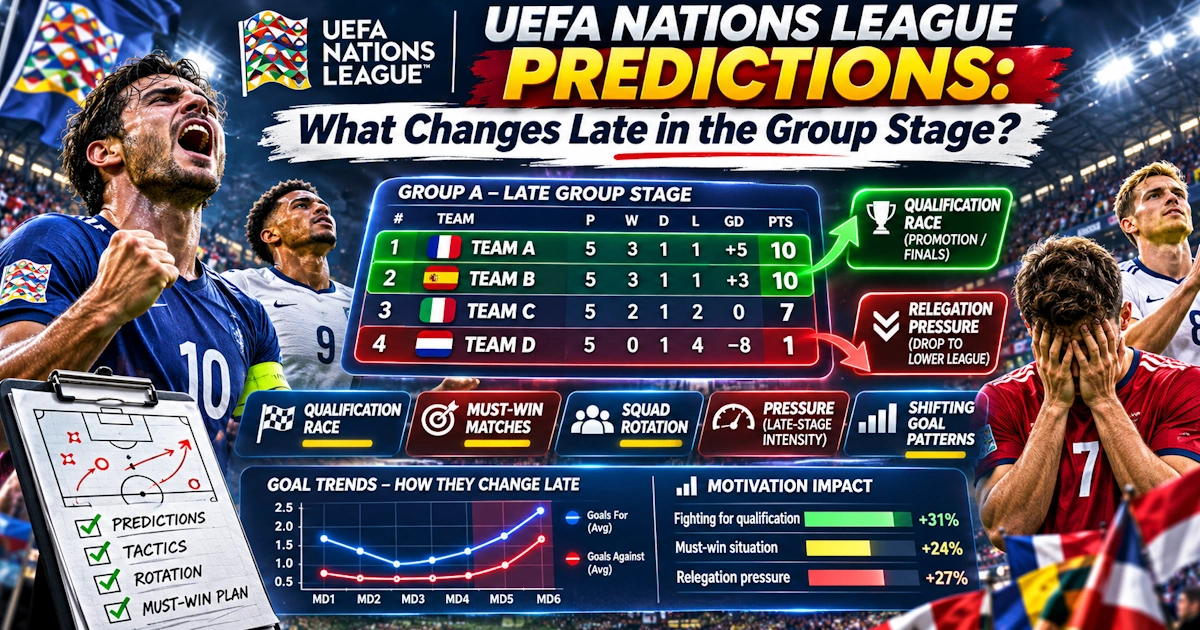
Some nations need a victory to reach the quarter-finals. Others are fighting for promotion or trying to avoid relegation.
A draw may be extremely valuable to one team but almost useless to the other. That changes the way matches should be analysed.
The biggest mistake is assuming that: “Team needs to win = lots of goals.” Sometimes that happens, but sometimes the team that needs three points starts cautiously because conceding first would make its situation even worse.
For late Nations League predictions, you need to combine normal football statistics with table mathematics, tiebreakers, squad motivation and game state.
The Final Two Matchdays Carry Much More Information
In the current 2026/27 Nations League, Matchdays 5 and 6 take place from 12 to 17 November 2026. Most teams in Leagues A, B and C play six group matches, meaning the last two rounds account for one-third of the entire group campaign.
By that point, we know much more than we did before Matchday 1. We have:
Four competitive Nations League matches
Current goal difference
Scoring and defensive trends
A clearer qualification picture
More information about the manager’s preferred XI
That makes late-stage analysis less dependent on reputation and more dependent on evidence.
First Understand What Each Team Is Playing For
The Nations League is not simply about winning a group. Different league positions can have completely different consequences.
For the 2026/27 competition, League A group winners and runners-up qualify for the quarter-finals. Because UEFA is moving to a three-league Nations League system from 2028/29, this edition also uses a special promotion and relegation structure.
League B group winners are promoted, League B runners-up enter promotion/relegation play-offs, while League C winners are promoted and League C runners-up can also reach play-offs. That means you cannot analyse every group using the same rule.
Before making a prediction, establish exactly what each position means.
A Draw Can Be Excellent for One Team and Terrible for the Other
Imagine the group table before Matchday 6:
Team A – 11 points
Team B – 9 points
Team C – 6 points
Team D – 2 points
Team A plays Team B. A draw may guarantee Team A the position it needs.
Team B may require a victory. That creates an asymmetric match.
If the score is 1-1 after 70 minutes, Team A may become increasingly conservative while Team B must take more risks. That can create a completely different final 20 minutes from the opening hour.
For live goal predictions, this information can be extremely valuable.
“Must Win” Does Not Automatically Mean Over 2.5
This is one of the most common prediction mistakes in international football. A team needs three points. Therefore: Over 2.5 must be good.
Not necessarily. Suppose the team knows that conceding first would allow the opponent to defend deep for the rest of the match.
Its manager may begin cautiously. The first half could involve controlled possession, few players ahead of the ball, and limited counterattacking risk.
Only later does the match open up. In such situations, the table may support Second-Half Over 1.5 more than First-Half Over 1.5.
Motivation tells you why a team needs to attack. It does not tell you when it will attack aggressively.
Tiebreakers Become Extremely Important
Late in the group stage, points alone are not enough. Under the 2026/27 UEFA Nations League regulations, when teams finish level on points within a group, UEFA first considers results between the teams involved.
The order begins with:
Head-to-head points
Head-to-head goal difference
Head-to-head goals scored
If teams still cannot be separated, UEFA moves to overall group goal difference, overall goals scored and further criteria. This matters enormously for predictions.
A team may not simply need a win. It may need a win by two goals or a particular scoreline depending on the head-to-head situation.
That can change late-match behaviour dramatically.
Goal Difference Can Create Extra Attacking Motivation
Imagine Team A is winning 2-0 after 75 minutes. In an ordinary league fixture, the manager might simply close the game.
But suppose another goal improves Team A’s tiebreak position. The attacking incentives change.
Fresh forwards may enter and the team may continue pressing. That can make markets such as Over 2.5 Team Goals or Late Goal – Yes more interesting.
But always check the actual tiebreak mathematics first. Do not assume a team needs extra goals merely because goal difference exists.
Head-to-head criteria come before overall goal difference in Nations League group standings.
Current Nations League Goal Numbers Provide Useful Context
Through the current 2026/27 competition statistics available after the opening four matchdays, UEFA records 256 goals at an average of 2.47 goals per match. That is useful context.
It tells us that the Nations League is not automatically an extreme high-scoring competition. The average is comfortably above two goals per game, but it does not justify blindly backing Over 2.5.
Late-stage table conditions can push individual matches far away from that average in either direction.
Different Leagues Need Different Expectations
A League A match between elite European nations is not directly comparable with a League C fixture. League A may contain world-class defenders, elite goalkeepers, and tactical control.
Lower leagues can sometimes feature larger quality gaps, more defensive errors, and less reliable possession structures. But even that is not a universal rule.
A tightly matched League C group can produce extremely cautious football, while a League A match between aggressive attacking teams can become a goal fest. Always analyse the teams rather than treating the competition level as a prediction by itself.
Qualification Pressure Can Help BTTS
Suppose both teams need to win and neither benefits much from a draw. That can create an interesting scenario.
At 1-0, the trailing team must attack. At 1-1, both may still need another goal.
That gives the match several opportunities to remain open.BTTS can become particularly attractive when both teams already have good scoring records, reasonable xG, strong shots-on-target numbers, and weak defensive transitions.
The table situation strengthens an existing statistical case; it should not create the case from nothing.
Practical Example: Both Teams Need Three Points
Imagine Team A has 7 points, 1.7 xG per game, and a strong home attack. Team B has 6 points, 1.5 xG, and a dangerous counterattack.
A draw may leave both vulnerable to another result in the group. If the match reaches 1-1 after 65 minutes, neither team has much reason to settle.
Possible outcomes include 2-1, 1-2, 2-2. Here BTTS or a second-half goal market may make more sense than before the table situation became clear.
Practical Example: One Team Needs Only a Draw
Now imagine Team A has 10 points and Team B has 8 points. Team A needs one point to secure its objective, while Team B needs to win.
At kickoff, bettors may see an important match and immediately expect goals. But Team A may approach the first hour conservatively.
Possible halftime scores include 0-0 or 1-0. If the game remains level late, Team B must open up, creating a better live-goal opportunity than a pre-match Over.
Already Qualified Teams Require Extra Caution
Late in the group stage, some teams may already have secured their target. This creates a different uncertainty: rotation.
A manager may rest the main striker, first-choice goalkeeper, key midfielder, or senior centre-back. Younger players may receive opportunities, which can change goal predictions in either direction.
If attacking stars are rested, scoring potential may fall. If the defensive structure is heavily rotated, BTTS or the opponent’s team total may become more attractive.
Always wait for team news where possible.
Do Not Assume an Already Qualified Team Does Not Care
Another common mistake is thinking: “They have qualified, so they will not try.” Professional international players do not normally walk onto the pitch intending to lose.
There may still be incentives involving group position, seeding, national ranking, competition prestige, or players competing for future selection. The intensity may change, but the motivation does not disappear entirely.
A rotated side can also contain young players who are extremely motivated to impress.
Squad Rotation Can Increase Variance
Imagine a top nation replaces six regular starters. People often assume that automatically makes the team weaker.
Perhaps. But replacements may bring fresh legs, aggressive pressing, less tactical familiarity, or more individual mistakes.
The match can therefore become less predictable rather than simply lower quality. This matters for goal markets.
A rotated attack can reduce chance creation, while a rotated defence can increase the opponent’s chances. You need to see where the rotation happens.
International Teams Have Less Preparation Time
Club managers work with their players almost every day; national-team coaches do not. This becomes especially relevant when important tactical changes are required late in the group stage.
A national coach may have only a few training sessions to adjust defensive shape, pressing triggers, set pieces, or new player combinations. That can make experienced international lineups more valuable.
It can also make heavy rotation riskier than it would be for a club team.
The 2026/27 Schedule Adds Another Interesting Factor
The current Nations League season has an unusual structure. The first four matchdays were played in a concentrated window between 24 September and 6 October 2026, while Matchdays 5 and 6 come in November.
That means the final window arrives after players have returned to club football for several weeks. Form can change, and players can become injured.
A striker who was struggling in October may arrive in November in excellent club form. Do not simply continue the conclusions you reached after Matchday 4; reassess the squad.
Club Form Can Matter, but Use It Carefully
Suppose a national striker has scored 7 goals in his last 8 club matches. That is encouraging, but international football may give him different teammates, different service, and a different tactical role.
Likewise, a centre-back struggling for his club may perform well inside a more conservative national-team system. Club form is useful information, but it is not automatically transferable.
Head-to-Head Matters More Than Usual Near the End
Normally, old H2H statistics can be overrated. Late Nations League group matches are different because the current campaign’s head-to-head result can directly influence the standings.
Suppose Team A lost the first meeting 2-0. Now the teams are level on points.
That earlier match can become mathematically relevant because UEFA prioritises head-to-head criteria between tied teams. This is very different from quoting a friendly played seven years ago.
Use current-group H2H and avoid ancient football history.
Practical Example: A Team Needs More Than a Simple Win
Imagine Team A lost the first meeting 3-1. The teams enter Matchday 6 level on points.
Depending on the wider group situation, Team A may need a substantial win to overturn the relevant head-to-head advantage. Now suppose Team A leads 2-0 after 70 minutes.
In a normal match, that looks comfortable, but in this situation, it may continue attacking. This is exactly where understanding the regulations can provide information that the scoreboard alone does not reveal.
Promotion and Relegation Change Motivation Outside League A
The biggest Nations League mistake is focusing only on the elite teams. League B and League C can contain extremely meaningful late fixtures.
In the current 2026/27 system:
League B group winners are promoted
League B runners-up enter A/B play-offs
League C group winners are promoted
League C runners-up enter B/C play-offs
The format has been adjusted because UEFA plans to move to three leagues for the 2028/29 edition. That means mid-table positions may have very different value from what bettors remember from earlier Nations League editions.
Always check the rules for the current season.
League D Is Particularly Different in 2026/27
The current transition also makes League D unusual. UEFA states that all League D teams will be promoted to League C as part of the restructuring.
That can change the motivational picture considerably. A bettor using the previous competition format from memory could completely misread the importance of a late League D fixture.
Competition rules are part of prediction analysis.
Watch for Teams That Cannot Change Their Position
The most difficult matches to analyse can involve a team with little left to gain. Suppose one nation is mathematically fixed in third place and its opponent desperately needs victory.
The motivated side may appear obvious, but be careful. The team with nothing at stake can play without pressure, counterattack freely, and give young players opportunities.
Meanwhile, the desperate team may become nervous. This is why motivation should modify your probability rather than completely replace normal team-strength analysis.
First Goals Become More Important Late in Groups
Imagine a team that needs to win concedes after 20 minutes. Its planned cautious approach disappears.
It may have to press higher, push full-backs forward, and add another attacker. That can create a much more open match.
The first goal therefore has greater tactical importance when teams have clearly defined table objectives. For live predictions, ask: What does this score mean for both teams?
That question can be more useful than the pre-match goal average.
Late Goals Can Become Especially Relevant
Late group-stage football often produces situations where one side simply cannot accept the existing score. At 0-0 after 75 minutes, a team needing victory has little reason to protect the draw.
At 1-1, the same may apply. That can produce extra attackers, higher defensive lines, a goalkeeper joining late corners, and counterattacking opportunities.
This is where late goals or similar live markets can become interesting when the underlying match data also supports pressure.
But Some Final-Round Matches Can Become Extremely Cautious
The opposite scenario also exists. Suppose a draw qualifies both teams.
Now neither side has much incentive to increase risk. If the score is 0-0 or 1-1 late in the match, the tempo may collapse.
That can strengthen an Under position. This is why “important match” does not automatically mean high-scoring match.
Sometimes importance creates caution.
Nations League Late-Stage Prediction Checklist
Before predicting a Matchday 5 or 6 fixture, check:
Current group points and exact qualification possibilities
Promotion and relegation situation
Whether a draw is useful
Head-to-head result, goal difference, and relevant tiebreakers
Confirmed or expected rotation and recent injuries
Recent club form
Current Nations League xG and shot numbers
Home and away performance
Whether either team has already achieved its objective
What happens tactically if the game is level late
The closer you get to the final matchday, the more important the table mathematics becomes.
Frequently Asked Questions
When are the final 2026/27 Nations League group matches? Matchday 5 runs from 12–14 November 2026 and Matchday 6 from 15–17 November 2026.
Do League A’s top two teams qualify? Yes. The winners and runners-up from each League A group advance to the quarter-finals.
Does a must-win match usually mean Over 2.5? No. Teams can start cautiously because conceding first would make their situation worse. Must-win pressure often becomes more important for second-half and live goal markets.
What is the first Nations League tiebreaker when teams finish level on points? UEFA first uses points obtained in the matches between the tied teams, followed by head-to-head goal difference and head-to-head goals scored.
How many goals have been scored in the current Nations League? UEFA’s current tournament statistics list 256 goals at an average of 2.47 per match through the competition’s first four matchdays.
Final Thoughts
Late Nations League group matches require a different type of prediction analysis. By Matchdays 5 and 6, the question is no longer simply: Which team is better?
You also need to know: What result does each team actually need? A draw can be perfect for one side and disastrous for the other.
A 2-0 lead can be enough in one group but leave another team still chasing an additional goal because of tiebreakers. An already qualified team may rotate heavily.
A team fighting promotion may field its strongest possible XI. That is why the group table becomes a genuine prediction tool late in the competition.
But motivation should never replace football quality. A weak attack does not suddenly become elite because it needs three points.
A strong defence does not automatically disappear because the opponent is desperate. Start with team strength, xG, shots, defensive performance and current personnel.
Then add points, tiebreakers, promotion, relegation and match-state incentives. When those factors point in the same direction, late Nations League matches can become much easier to understand.
The key is to stop thinking only about who wants to win. Everybody wants to win. The useful question is: Who actually needs to change the way they play because of the table?
That is where late group-stage prediction value often begins.
Responsible betting: Group-stage mathematics can change tactical incentives but cannot guarantee goals or results. Confirm the current table and competition rules, use them alongside team performance data, keep stakes controlled and never bet money you cannot afford to lose.