
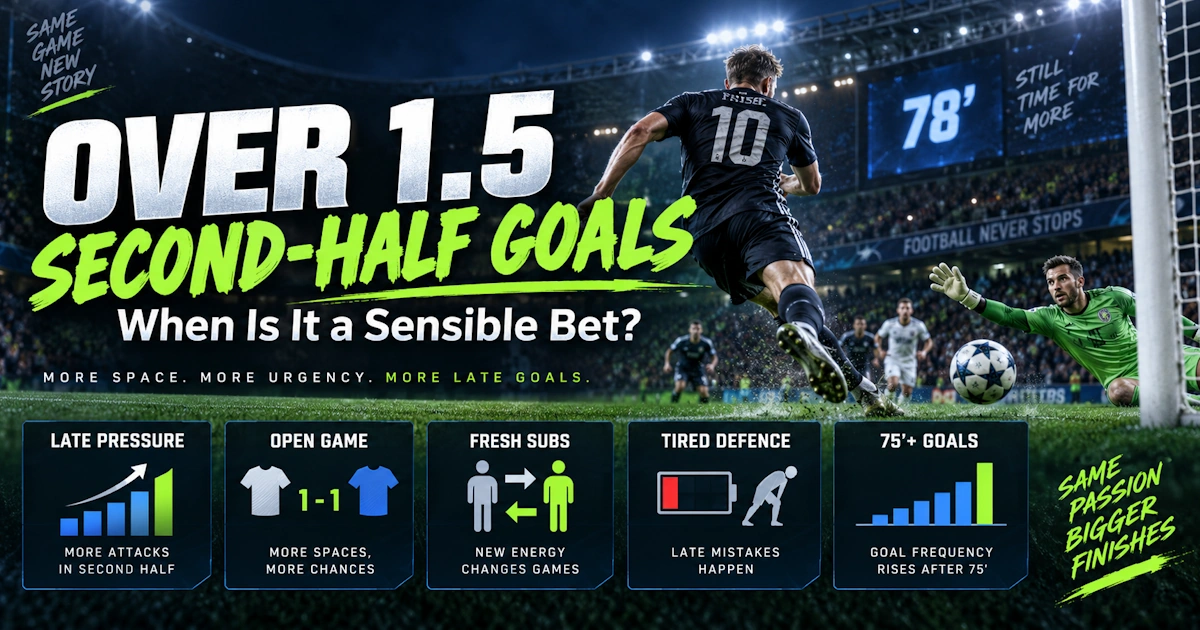
Over 1.5 Second-Half Goals is a much more demanding market than simply backing one goal after half-time.
You need at least two goals between the 46th minute and the final whistle.
That means a match can finish 2-0 and still lose this bet if both goals were scored in the first half. It can also finish 3-1 and lose if only one of those four goals came after the break.
Because of that, this market should not be selected simply because two teams have high full-time scoring averages.
The key question is: Does the match have a strong reason to become more open after half-time?
That reason may come from late-scoring patterns, tired defences, aggressive substitutions, a must-win game state or teams that regularly create more xG in the second half.
When several of those factors line up, Over 1.5 Second-Half Goals can become a sensible option.
Understand Exactly What the Bet Requires
Over 1.5 Second-Half Goals wins if at least two goals are scored after half-time.
Examples:
- 0-0 HT → 2-0 FT = Win
- 1-0 HT → 2-1 FT = Win
- 1-1 HT → 2-2 FT = Win
- 2-0 HT → 2-1 FT = Lose
- 0-0 HT → 1-0 FT = Lose
This is why the half-time score matters so much.
You are not just predicting a high-scoring match. You are predicting that a large enough share of the scoring will happen late.
Second Halves Often Become More Open
Many football matches change significantly after the break.
Teams have already spent 45 minutes adjusting to each other. Managers make tactical changes. Players tire. The score starts to influence decision-making more strongly.
A team trailing 1-0 cannot usually spend the entire second half protecting its shape.
At some point it has to attack.
That creates more space.
And more space can create:
- Counterattacks
- One-on-ones
- Transition chances
- Penalties
- Set pieces
- Defensive mistakes
This is one reason second-half betting can be more attractive than pre-match analysis in certain fixtures.
By half-time, you know much more about how the match is actually developing.
Sign 1: Both Teams Score Heavily After Half-Time
Start with goal timing.
Some teams consistently score a larger share of their goals after the break.
Suppose the home side averages:
- 0.6 first-half goals
- 1.1 second-half goals
The visitors average:
- 0.5 first-half goals
- 1.0 second-half goals
Combined, they produce more than two second-half goals per match on average.
That is immediately more interesting than two teams whose attacks peak before half-time.
Useful statistics include:
- Second-half goals scored
- Second-half goals conceded
- Percentage of goals scored after the break
- Percentage of matches with 2+ second-half goals
- Goal timing after minute 60 or 75
A team that regularly improves late is much more suitable for this market.
Sign 2: The Match Is Already Creating Chances
For live betting, the first half should not be judged only by the score.
Suppose it is 0-0 at half-time.
That sounds poor for goals.
But the match has produced:
- 1.8 combined xG
- 7 shots on target
- 3 big chances
- Several dangerous attacks
That is a very different 0-0 from one with:
- 0.35 xG
- 1 shot on target
- No big chances
The first match may have been unlucky not to produce goals.
If the tempo remains high, two second-half goals are realistic.
This is why xG, shots on target and big chances can be more useful than the half-time score alone.
Sign 3: One Team Must Chase the Match
Game state is one of the strongest reasons to consider Over 1.5 Second-Half Goals.
Imagine a favourite is losing 1-0 at half-time.
The favourite now has to attack.
It may:
- Push full-backs higher
- Add another striker
- Increase pressing
- Take more risks
- Leave more space behind
That can create goals at both ends.
Possible second-half sequences include:
- 1-1, then 2-1
- 1-1, then 1-2
- 0-2, then 1-2
You do not care who scores the goals.
You only need two.
This is why a trailing favourite can create a much stronger second-half goal environment than the same team starting at 0-0.
Sign 4: Both Defences Fade Late
Some teams defend well for an hour and then begin conceding.
Fatigue can affect:
- Pressing
- Recovery runs
- Concentration
- Marking
- Set-piece defending
- Defensive transitions
Suppose a team has conceded 18 goals this season.
If 12 came after the 60th minute, that pattern deserves attention.
Now imagine its opponent also scores heavily late.
That creates a useful overlap.
Look for: Late scoring strength vs late defensive weakness
This is the second-half version of matching a strong attack with a poor defence.
Sign 5: The Bench Can Change the Match
Substitutions are extremely important for this market.
A starting line-up may produce a cautious first half.
Then both managers introduce:
- Fast wingers
- Fresh strikers
- Creative midfielders
The tempo changes.
This can be especially important when a stronger club has much more depth than its opponent.
Imagine the favourite starts with a rotated attack but has two excellent forwards on the bench.
If the score is still 0-0 or 0-1 after 55 minutes, those substitutions can significantly increase the attacking threat.
The opposite is also true.
If the only dangerous striker is substituted because of injury, the second-half goal case may weaken.
A 0-0 Half-Time Score Is Not Automatically Bad
This market can still work very well from 0-0.
The question is why the first half was goalless.
Strong 0-0
- High xG
- Several saves
- Missed big chances
- Open transitions
- Both teams attacking
Weak 0-0
- Few shots
- Slow tempo
- Low xG
- Neither team takes risks
The first type may support Over 1.5 Second-Half Goals.
The second probably does not.
Do not confuse a lack of goals with a lack of scoring potential.
1-0 at Half-Time Can Be an Excellent Score
A 1-0 score creates imbalance.
The losing team has a reason to attack.
If the side in front also likes counterattacking, the match can become very open.
Suppose:
- Home team leads 1-0
- Away side needs points
- Away side has already created 0.9 xG
- Home side has pace on the counter
The second half may produce multiple scoring routes.
Possible final scores include:
- 2-1
- 1-2
- 3-1
- 2-2
All require at least two second-half goals.
This is often a better setup than a 2-0 lead where the stronger team is happy to control possession.
Be Careful With 2-0 Half-Time Leads
A 2-0 score can look perfect for goals.
Sometimes it is.
Sometimes it kills the match.
If the stronger side leads 2-0 and has an important fixture coming next, it may slow the game down.
The trailing team may also lose confidence.
The second half can become a quiet 0-0.
Before backing Over 1.5, ask:
- Does the losing side still need to attack?
- Is goal difference important?
- Does the leading side keep attacking when ahead?
- Is there a large quality gap?
- Are substitutions likely to reduce or increase intensity?
Do not assume a high-scoring first half must continue.
Practical Example: Strong Live Selection
Imagine a match is 1-0 at half-time.
The first-half numbers show:
- 1.9 combined xG
- 8 shots on target
- 4 big chances
- Both teams regularly entering the box
The visitors are behind but need at least a draw.
Both teams also score a high share of their goals after half-time.
This is a strong setup.
The losing side must open up, and the home team has room to counter.
Over 1.5 Second-Half Goals has both statistical and tactical support.
Practical Example: False Positive
Now imagine another match is 1-1 at half-time.
That sounds ideal.
But the goals came from:
- One penalty
- One defensive error
The rest of the half produced:
- 0.7 xG
- 2 shots on target
- Slow tempo
Both managers may now be happy with a point.
The scoreline looks open.
The match itself does not.
This is exactly why result-based analysis can be misleading.
Practical Example: Strong Late-Goal Teams
Suppose both teams have these trends:
Home side
- 65% of goals scored after half-time
- Concedes frequently after minute 70
Away side
- 60% of goals scored after half-time
- Strong substitute strikers
- High second-half shot volume
At 0-0 or 1-0 around half-time, the match may still be attractive.
Their historical profiles suggest that both become more dangerous later.
Shots on Target Matter More Than Possession
A team can have 68% possession without threatening the goalkeeper.
That is not enough.
For second-half Over 1.5 analysis, ask:
- Are shots reaching the target?
- Are chances coming from central areas?
- Are there big chances?
- Are defenders being forced into emergency blocks?
Possession only matters when it produces dangerous attacks.
A team with 40% possession and four dangerous counterattacks may be more useful than one passing harmlessly around the penalty area.
Set Pieces Can Help Produce the Second Goal
Second halves can generate more set pieces because attacking teams push forward.
Late corners and free kicks become important.
A trailing team may send centre-backs forward.
A goalkeeper may even join a final corner.
If both teams are strong from set pieces or weak defending them, this adds another scoring route.
One open-play goal plus one corner can be enough to win the bet.
Red Cards Change Everything
A second-half red card can dramatically alter the market.
If the weaker team loses a player, the favourite may create chance after chance.
If the leading team receives the red, it may be forced into deep defence while the opponent attacks constantly.
But not every red card creates goals.
Sometimes ten men simply defend with everyone behind the ball.
Use the red card together with:
- Score
- Remaining time
- Team quality
- Tactical response
The card is a major variable, not an automatic Over signal.
Useful Statistical Benchmarks
There are no perfect thresholds, but some practical filters can help.
A strong candidate may include several of these:
- 60%+ of goals scored after half-time
- Frequent 2+ second-half goal matches
- Combined second-half goal average near or above 2.0
- High second-half xG
- Several shots on target before half-time
- One team trailing and needing a result
- Weak late defensive records
These should not be used as mechanical betting rules.
They are signs that the match has enough attacking structure to support two late goals.
Over 1.5 Second-Half Goals Checklist
Before choosing the market, check:
- Second-half goals scored
- Second-half goals conceded
- Goal timing
- Second-half xG
- Shots on target
- Big chances
- Half-time score
- Which team needs to chase
- Tactical substitutions
- Bench quality
- Fatigue
- Defensive late-goal record
- Set-piece threat
- Match motivation
- Whether the odds justify the risk
The more of these factors point towards an open second half, the stronger the selection becomes.
Frequently Asked Questions
What does Over 1.5 Second-Half Goals mean?
At least two goals must be scored after half-time.
Is 0-0 at half-time good for this bet?
It can be if the first half contained strong xG, shots and big chances. A low-quality 0-0 is much less attractive.
Is 1-0 at half-time better?
Often, because the trailing team has a reason to attack, which can create more space and chances.
Are second-half goal trends useful?
Yes, especially when supported by xG, tactical style and late defensive weakness.
Is this market better for live betting?
Often it is, because by half-time you can judge tempo, chance quality, game state and likely tactical changes.
Final Thoughts
Over 1.5 Second-Half Goals is not simply a bet on a high-scoring match.
It is a bet on how the match is likely to change after half-time.
The strongest situations usually involve teams that score late, defences that fade, strong first-half chance creation and a game state that forces one side to take more risks.
A 0-0 match can still be excellent if the chances are flowing. A 2-1 half-time score can still be poor if the tempo is dying.
Focus on process rather than scoreboard.
If the match is creating chances, one team needs to chase and both sides have realistic late scoring routes, Over 1.5 Second-Half Goals can become a much more sensible selection.
Responsible betting: Second-half markets can change quickly because of substitutions, red cards and game state. Use live statistics carefully, keep stakes within a fixed budget and never bet money you cannot afford to lose.