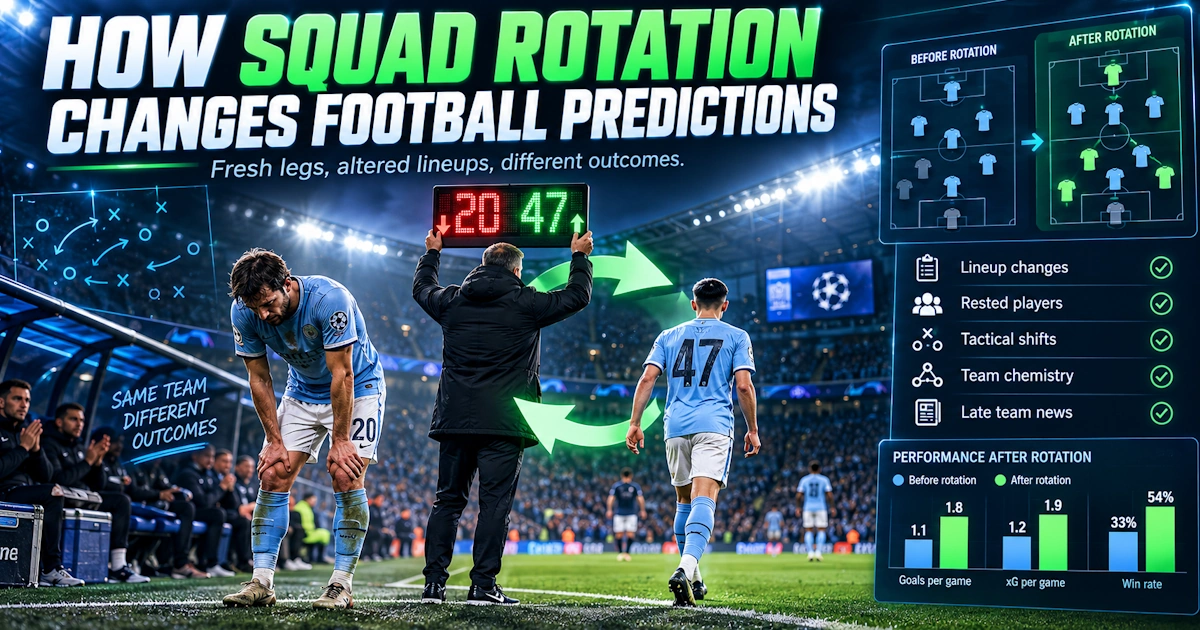
Squad rotation can completely change a football prediction. You may spend hours analysing a team’s recent xG, shots on target, home form and goal average.
Then the manager rests five starters and suddenly much of that data becomes less relevant. This happens frequently during:
Champions League weeks
Europa League schedules
Domestic cup matches
Holiday fixture periods
Matches before important finals or derbies
The biggest mistake is treating rotation as automatically negative. Sometimes it weakens a team badly.
Sometimes the substitutes are almost as strong as the regular starters. And sometimes rotation weakens the defence while leaving the attack almost untouched, making goal markets more attractive.
The useful question is therefore not how many players are being rested. It is which players are being replaced, and how much does that change the team?
What Does Squad Rotation Mean?
Squad rotation happens when a manager changes several players from the usual starting XI. Imagine a team normally starts its first-choice goalkeeper, two regular centre-backs, a main creative midfielder, two first-choice wingers, and a main striker.
Three days after a European match, the manager changes five players. That sounds significant.
But the effect depends entirely on who comes out. Replacing two full-backs and three midfielders with high-quality alternatives is very different from resting the core spine.
If you rest the goalkeeper, both centre-backs, the main playmaker, and the top scorer, the impact is massive. The number of changes matters less than the quality and role of those changes.
Rotation Can Affect Results
Research suggests that excessive rotation can affect team performance. A recent study examining 118 Chinese Super League matches played during congested schedules found that greater rotation was associated with a lower probability of winning.
The researchers found that passing and shooting performance helped explain part of that effect. In one of their rotation measures, each increase in rotation was associated with a 6.4% reduction in winning probability.
That does not mean every rotated team becomes 6.4% weaker, as the study involved one specific competition and season. But it supports a logical point.
Changing too many players can affect coordination, passing relationships and attacking efficiency. Football is not simply 11 individual players added together; relationships matter.
Team Chemistry Can Be More Important Than Individual Quality
Imagine a backup winger is almost as talented as the starter. On paper, the difference looks small.
But the regular winger may already understand when the full-back overlaps and where the striker wants crosses. They also know when the midfielder makes forward runs and how the team presses after losing possession.
The substitute may have less experience in those patterns. If several changes happen at once, the team can lose fluency even when the individual replacements are good players.
This is especially important for predictions involving:
Possession
Team goals
Shots
First-half performance
Rotated teams sometimes need time to find rhythm.
Rotation in Attack Can Reduce Goal Expectation
Suppose a team averages 2.0 goals and 1.9 xG at home. Those are excellent attacking numbers.
But tonight the manager rests the main striker, creative midfielder, and right winger. Those season averages were largely produced with those specific players on the pitch.
You should not automatically project the same 1.9 xG expectation onto the rotated lineup. The replacements might still be dangerous, but your forecast should be adjusted.
Look at:
Goals contributed by missing starters
Assists
Shot volume
xG contribution
Chance creation
Minutes played together
The more attacking responsibility that has been removed, the less reliable the historical scoring average becomes.
Practical Example: Rotated Attack
Imagine the regular front three have produced 28 league goals. The replacement front three have produced just 7.
The team normally averages 6 shots on target. With the backup attackers starting, it may still dominate possession.
But possession does not guarantee goals. Instead of automatically backing Team Over 2.5 Goals, you might prefer Team Over 1.5, or avoid the goal market altogether.
The lineup has changed the risk.
Defensive Rotation Can Have the Opposite Effect
Rotation can sometimes make an Over prediction stronger. Imagine the attack remains unchanged, but the manager rests the first-choice goalkeeper, best centre-back, defensive midfielder, and regular right-back.
The team still has enough attacking quality to score. But its defensive protection has weakened.
That can increase the appeal of:
Over 2.5
Opponent Team Over 0.5
Opponent Team Over 1.5
This is why you should never treat rotation as a simple negative for the entire match. You need to identify which area has been weakened.
Goalkeeper Rotation Deserves Special Attention
Goalkeepers are sometimes overlooked in lineup analysis. But changing the goalkeeper can affect more than shot stopping.
A backup goalkeeper may also be weaker at:
Crosses
Distribution
Communication
Defensive organisation
Sweeping behind a high line
Suppose the regular goalkeeper has played almost every match and the backup suddenly starts in a European or cup fixture. That does not guarantee goals.
But if the opponent already creates strong xG and plenty of shots on target, the change deserves attention. Goalkeeper rotation is particularly relevant when combined with changes in central defence.
Centre-Back Partnerships Matter
Defensive chemistry can be difficult to measure, but it matters. Two regular centre-backs develop habits together.
They understand who attacks the first ball, who covers behind, when to step forward, how to defend crosses, and how to organise the offside line. Replace both at once and communication can suffer.
Now imagine the new centre-backs are facing a team with fast forwards, strong counterattacks, and good set-piece delivery. The defensive rotation becomes highly relevant to goal predictions.
The Defensive Midfielder Can Be the Biggest Missing Player
Bettors often focus on strikers and centre-backs. But the holding midfielder can completely change a defensive structure.
A good defensive midfielder stops counterattacks, protects centre-backs, wins second balls, controls transitions, and helps the team maintain shape. If that player is rested, opponents may suddenly reach dangerous areas more easily.
This can increase xGA, shots conceded, and counterattacking opportunities. So when checking a rotated lineup, do not only count defenders.
Look at the midfield protection in front of them.
Full-Back Rotation Can Change Both Attack and Defence
Modern full-backs often influence both ends of the pitch. A first-choice full-back may provide width, overlapping runs, crosses, progressive passes, and defensive recovery pace.
Replacing both full-backs can therefore change several markets. The team may create less from wide areas.
At the same time, weaker replacements may allow more counterattacks. This can reduce the favourite’s attacking strength while increasing the underdog’s chance of scoring.
That is exactly the kind of situation where BTTS may become more attractive than Favourite Team Over 2.5.
Squad Depth Changes Everything
Rotation at Manchester City, Real Madrid or another elite club is not the same as rotation at a smaller team with limited resources. Imagine Team A replaces its striker with another international forward.
Team B replaces its striker with a 19-year-old academy player who has played 120 senior minutes. Both have made one change, but the quality difference is completely different.
When analysing rotation, ask how large the gap is between starter and replacement. This is far more important than simply counting substitutions.
Congested Schedules Make Rotation More Likely
Managers rotate because players cannot play every minute forever. A systematic review of professional football research found that fixture-congested periods generally increase match injury incidence, particularly when teams repeatedly have four days or fewer between matches.
Another study tracking Serie A players during congested schedules found that starters experienced substantially greater exposure, perceived exertion and running loads than non-starters. That explains why a manager may rest important players even in a meaningful game.
For predictions, check the previous workload before assuming the strongest XI will start.
Individual Minutes Are More Useful Than the Fixture List Alone
Suppose a team has played three matches in eight days. That looks congested.
But its main striker started only once, the left winger played 90 minutes in all three, and the centre-back played every minute. Who is more likely to be rested?
The answer is obvious. Check individual minutes over the previous 7, 14, and 21 days.
This can help anticipate rotation before lineups are announced. It is especially useful in competitions where bookmakers release odds long before team news.
Rotation Before a Bigger Match
Context matters. Suppose a team has a Europa League game on Thursday and a major domestic derby on Sunday.
The manager may decide that Sunday is more important. Alternatively, if they face a bottom team on Saturday and a Champions League knockout match on Wednesday, the league fixture may become the rotation game.
Always check what comes next. Teams do not manage squads one match at a time; managers plan across several fixtures.
Already-Qualified Teams Can Be Difficult to Predict
European competitions create another common rotation situation. Imagine a team has already secured qualification.
Its final league-phase match may still matter for ranking, but perhaps not enough to justify risking every starter. You could see a backup goalkeeper, young defenders, a rotated midfield, and a rested striker.
This makes old averages less useful. A team that normally scores 2.2 goals per match is not necessarily the same attacking unit tonight.
When qualification is already secured, expected lineups become even more important.
Young Players Can Increase Variance
Rotation often creates opportunities for young players. They may have excellent technical ability but less tactical experience.
That can make matches less predictable. A young winger may attack fearlessly and create more chances, while a young defender may also make positioning mistakes.
The result can be faster transitions, more turnovers, less tactical control, and higher variance. This does not automatically mean Over.
But a heavily rotated youthful lineup may produce a very different match from the team’s normal statistical profile.
Substitutes Can Still Have Major Impact
Rotation does not end when the starting XI is announced. The bench matters too.
UEFA reported that substitutes accounted for 16% of Champions League goals across the previous season, while in one recent 2026 matchweek that share rose to 23%. That shows why strong benches can protect a rotated team.
A favourite might begin with several backups but still introduce elite attackers after 60 minutes. For goal markets, consider the starting XI, bench strength, likely substitutions, and game state.
A rotated starting attack does not necessarily mean 90 minutes of reduced attacking quality.
Practical Example: Rotation Supports BTTS
Imagine a strong favourite usually keeps many clean sheets. For tonight’s match it rests its goalkeeper, one centre-back, and a defensive midfielder.
The main striker and both wingers still start. The opponent normally averages 1.3 away xG.
Now the setup becomes interesting. The favourite should still have enough quality to score, but the weakened defensive structure gives the underdog a better chance.
Possible scores include 2-1, 3-1, or 2-2. BTTS may have improved because of the rotation.
Practical Example: Rotation Supports Under
Now imagine another team rests its main striker, number 10, and two attacking wingers. Its defence remains unchanged.
The replacements are much less productive, and the opponent is also conservative. Possible scores include 0-0, 1-0, or 1-1.
Here, the same word—rotation—points in the opposite direction. Under 2.5 may become more attractive.
Again, position matters.
Practical Example: Rotation Does Not Matter Much
Suppose an elite club makes five changes. That sounds dramatic.
But the replacements include an experienced international goalkeeper, a €40 million centre-back, an international midfielder, a proven winger, and an international striker. The difference between the first and second XI may be relatively small.
The market might overreact to the headline of “five changes.” This is why player quality matters more than the raw number of rotated starters.
Passing Relationships Can Suffer
Squad rotation can affect build-up play even if overall talent remains high. The recent professional-football study mentioned earlier found passing performance played a measurable role in the negative relationship between rotation and match outcomes.
This makes sense. Football passing patterns depend on repeated combinations.
A midfielder needs to know whether a teammate comes short, runs behind, moves inside, or holds width. If several relationships change at once, possession can become slower and less precise.
This is worth considering when predicting whether a favourite will dominate strongly enough to cover large handicaps or team goal lines.
Shooting Output Can Change Too
The same rotation study also found shooting performance helped mediate the relationship between rotation and results. For bettors, this is particularly relevant.
A rotated team may still have 65% possession but create fewer dangerous shots. That can be misleading if you focus only on possession statistics.
For goal predictions, always prioritise xG, shots on target, and big chances over possession alone.
Confirmed Lineups Can Change the Value
Suppose you estimate Over 2.5 at 58%. Then the lineups appear.
Both teams have rotated their defences but kept their main attackers. You might raise your estimate.
Now imagine the opposite: both top scorers are rested. Your estimate should fall.
Bookmakers will also react to this information, so price matters. A selection that looked attractive at 1.95 may no longer offer value after the odds fall to 1.65.
Team news changes both probability and price. You need to consider both.
Do Not Automatically Wait for Lineups
Waiting for confirmed lineups gives you more information, but there is a trade-off. By the time lineups appear, the market may already have moved, and attractive odds may disappear.
If you understand a manager’s rotation patterns, you may sometimes predict likely changes in advance. Studying previous rotations, player minutes, upcoming matches, press conferences, and injury reports can help.
But if your prediction depends heavily on one uncertain player, waiting may still be safer.
Do Not Double-Count Rotation
Suppose a team has poor recent form because it has already been rotating heavily. Be careful not to count poor form, weak xG, and rotation as three completely independent negatives.
The weak numbers may already reflect the rotation. Try to understand what information is genuinely new.
If tonight’s lineup is even weaker than recent rotated teams, then another adjustment may be justified.
Squad Rotation Prediction Checklist
Before changing your prediction because of rotation, ask:
How many starters are missing and which positions are affected?
How important are those players and how good are the replacements?
Is the goalkeeper, both centre-backs, or defensive midfielder changing?
Are the main attackers starting?
How many minutes have regular starters played recently?
Is there a bigger match coming next, or is the team already qualified?
How strong is the bench?
Does the team’s recent data already include heavy rotation?
Does rotation increase or decrease expected goals?
Has the bookmaker price already adjusted?
Do not reduce a team’s rating simply because you see five changes. Understand the five changes first.
Frequently Asked Questions
Does squad rotation always weaken a football team? No. The effect depends on which players are rested and how good the replacements are. Elite teams can sometimes rotate heavily without losing much overall quality.
Does rotation usually mean fewer goals? Not necessarily. Rotating attackers can reduce goal potential, while rotating defenders or the goalkeeper can increase the opponent’s chances.
How many changes are considered heavy rotation? There is no exact number. Five changes can be significant, but three changes involving a goalkeeper, centre-back and main striker may matter more than five low-impact changes.
Should I wait for confirmed lineups before betting? If your prediction depends heavily on specific players, confirmed lineups can be very useful. However, odds may move quickly once team news becomes public.
What positions matter most when analysing rotation? Goalkeeper, centre-back, defensive midfield, creative midfield and striker are usually worth checking first, but the tactical importance of each player varies between teams.
Final Thoughts
Squad rotation should never be analysed by counting names alone. Five changes does not tell you enough.
You need to know who is leaving the lineup, who is replacing them and what part of the team is being affected. A rotated attack may reduce xG and make an Under market more attractive.
A rotated defence with the normal attackers still starting can do the opposite and strengthen BTTS or Over 2.5. The quality of the replacements also matters enormously.
Elite clubs can often rotate without a dramatic reduction in talent, while smaller teams may experience a large drop when two or three important starters are missing. So before changing a prediction because of team news, ask one simple question.
What does this rotation actually change on the pitch? If you can answer that clearly, squad rotation becomes useful information rather than another misleading football statistic.
Responsible betting: Lineup changes can improve your understanding of a match but cannot guarantee a result. Use team news alongside current statistics, compare your estimated probability with the available odds, keep stakes controlled and never bet money you cannot afford to lose.