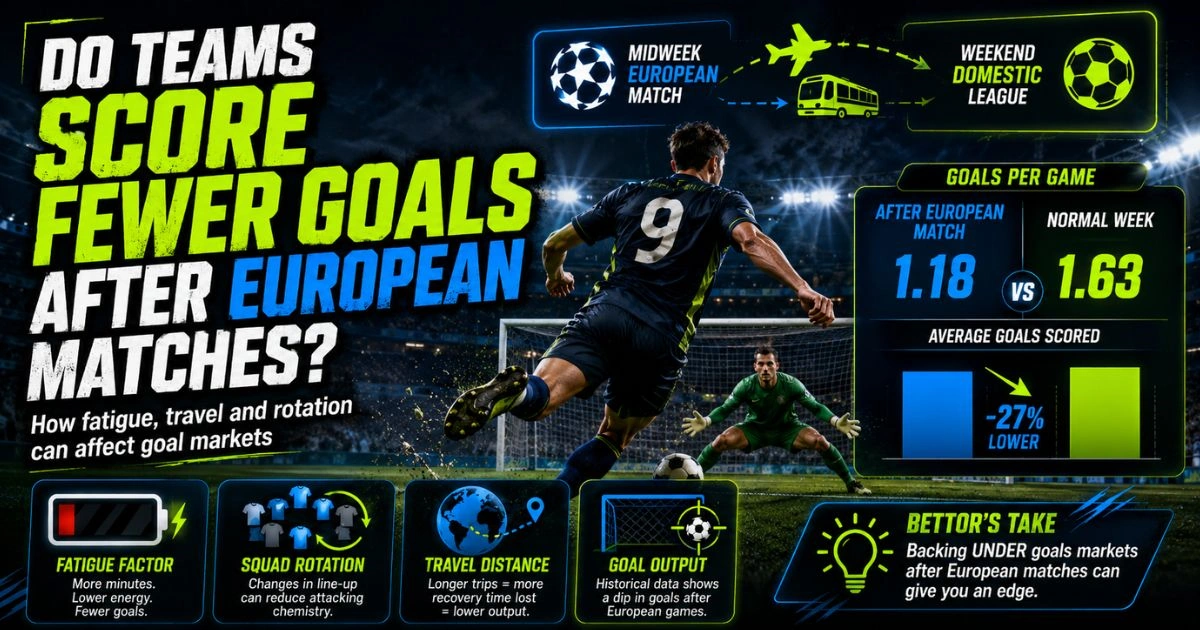
The idea of a “European hangover” appears almost every weekend. A club plays in the Champions League, Europa League or Conference League on Tuesday or Thursday, then returns to domestic action a few days later. The immediate assumption is that tired players will move more slowly, create fewer chances and score fewer goals.
It sounds logical, but football is rarely that tidy.
European matches can affect recovery, preparation and team selection. Long journeys may reduce sleep, while a physically demanding match can leave players sore for several days. Yet clubs involved in Europe usually have stronger squads, better medical teams and more attacking quality than the average domestic opponent.
The evidence does not show that teams automatically score fewer goals after European matches. The effect depends on recovery time, travel, rotation, squad depth, the intensity of the European fixture and the tactical demands of the next league match.
For the wider analytical framework, read our guide to football goal predictions, including form, venue-specific data, team news, tactics and match context.
What Does the Research Suggest?
Research has generally failed to find a universal decline in domestic performance after European fixtures.
A CIES Football Observatory study compared domestic results achieved within five days before or after UEFA matches with teams’ other league results. It found no clear short-term reduction in league performance for clubs competing in either the Champions League or Europa League.
Another study examined 16 seasons of Premier League and La Liga football. Clubs qualifying for the Europa League did not perform worse domestically than comparable teams that narrowly missed qualification. In fact, the European participants scored more league goals across the season, although this does not prove that playing in Europe caused the improvement—those clubs were generally strong enough to qualify in the first place.
The sensible conclusion is not that fatigue is imaginary. It is that “played in Europe” is too broad to function as a prediction by itself.
Short Recovery Can Still Matter
Players do not fully recover from a demanding match overnight.
A systematic review of 16 studies defined fixture congestion as consecutive matches separated by no more than 96 hours. It found no significant overall reduction in total distance covered, but some studies reported changes in lower-intensity movement and possible tactical performance. The researchers also noted that the available evidence was inconsistent and that tactical effects remained under-studied.
This helps explain why a tired team may not visibly stop running. Players can still cover similar distances while adjusting how they move, press and position themselves.
For goal predictions, the important effects may include:
- less coordinated pressing;
- slower defensive recovery;
- fewer forward runs from midfield;
- reduced intensity after taking the lead;
- greater reliance on individual moments;
- mistakes late in the match.
When fatigue begins to affect defensive recovery during the closing stages, our guide to predicting late goals after the 75th minute explains how pressure, substitutions, xG, counterattacking space and stoppage time should be assessed.
Fatigue can reduce attacking quality, but it can also weaken defending. That means European involvement may support either Under or Over markets depending on which effect is stronger.
Recovery Time Is More Important Than the Competition Name
A team playing on Tuesday and again on Sunday has a very different situation from one playing away on Thursday night and returning for a Sunday afternoon league match.
Check the number of recovery days rather than simply noting that the club played in Europe.
For a broader look at recovery gaps themselves, our guide to rest days and recovery explains how short turnarounds can affect attacking intensity, defensive organisation and goal expectations even outside European competition.
The risk becomes more meaningful when a team has:
- fewer than four full recovery days;
- travelled a long distance;
- played extra time;
- used most of its normal starting eleven;
- completed a high-intensity match;
- faced several congested weeks in succession.
An 11-season UEFA injury study involving 27 professional teams found that muscle-injury rates were 32% higher in league matches played with four or fewer recovery days than in matches following at least six days of recovery. Team results, however, showed little or no consistent decline.
That distinction matters. A congested schedule may increase physical risk without immediately producing fewer goals or worse results in every match.
Travel Can Be as Important as the Match
Not all European away trips create the same burden.
A short flight followed by a home league match is relatively manageable. A Thursday-night fixture several time zones or thousands of kilometres away may disrupt sleep, meal timing and preparation.
When assessing the next domestic game, check:
- where the European fixture was played;
- when the squad returned;
- whether the domestic match is home or away;
- the travel required for both fixtures;
- weather and playing conditions;
- whether the team had an extra day of recovery.
A Europa League trip followed by another long domestic journey is more concerning than a home Champions League game followed by a home league fixture.
The venue of the domestic match should also be reflected in the team data. Our guide to home and away form for goal bets explains how the relevant home and away scoring and defensive records should be compared.
Still, travel should adjust your prediction rather than decide it alone.
Rotation Changes the Calculation
Strong European clubs rarely use exactly the same eleven players in every match.
Rotation can protect tired starters, but it creates a new question: how good are the replacements?
A team may rest its leading striker, creative midfielder and attacking full-back. Its overall reputation remains impressive, but the starting attack may be far less productive.
Alternatively, fresh substitutes may play with more energy against a weaker domestic opponent. A reserve forward trying to earn a regular place may not approach the match like a tired player at all.
Before predicting goals, check:
- how many starters are expected to be rested;
- whether the main goalscorer starts;
- who provides creativity;
- whether the defensive partnership changes;
- how often the replacements have played together;
- the quality difference between the first and second choices.
When rotation affects the back line, our guide to how missing defenders affect football goal predictions explains how unfamiliar centre-back partnerships, reserve goalkeepers and replacement quality can change the expected total.
Rotation is not automatically negative. It becomes important when the replacements significantly alter the team’s attacking or defensive level.
The European Match Itself Matters
A comfortable 3–0 home victory is not physically or emotionally equivalent to a tense knockout match decided in stoppage time.
Consider:
- Was the match competitive until the final whistle?
- Did the team play with ten men?
- Was extra time required?
- Did it spend long periods defending?
- Was the result disappointing?
- Were important players injured?
- Did the manager make early substitutions?
A club that controlled possession and rested players after an hour may arrive relatively fresh. A team that chased the ball, protected a narrow lead and travelled home overnight may carry a more genuine fatigue risk.
The scoreline alone does not reveal the workload.
When European Football May Reduce Goal Output
Fewer goals may be more likely when the European club:
- has a short recovery period;
- rotates several attacking players;
- faces a compact domestic opponent;
- would accept a narrow victory;
- has another important European match approaching;
- regularly slows games after scoring;
- lacks squad depth.
Practical example: A Europa League club returns from a difficult Thursday away match and plays on Sunday. Its main striker is rested, while the opponent uses a deep defensive block and rarely concedes more than once.
The favourite may still win, but results such as 1–0 or 2–0 could be more realistic than a comfortable 3–1. Under 3.5 goals or the opponent’s team total Under may fit the scenario better than blindly backing Over 2.5.
When the evidence points towards reduced attacking output and a controlled match, our guide on how to predict Under 2.5 goals explains which attacking, defensive and tactical indicators should confirm a lower total.
When European Football May Increase Goal Potential
Congestion can also create more goals.
Tired teams may press less effectively, leave larger spaces between midfield and defence, or make positional errors late in the match. Rotated defenders and reserve goalkeepers can further reduce organisation.
Over markets may become more attractive when:
- several defenders played the full European match;
- the domestic opponent attacks aggressively;
- an unfamiliar back line starts;
- both teams score regularly;
- the European side must rotate because of injuries;
- fatigue is more likely to affect defending than attacking.
Practical example: A Champions League team plays an intense away match on Wednesday, then faces a fast counterattacking opponent on Saturday. The manager rotates both centre-backs but retains the main forwards.
The favourite may still create enough chances to score twice, while the weakened defence provides the opponent with a realistic goal. A 2–1 or 3–1 result becomes plausible, supporting Over 2.5 or BTTS – Yes.
Our guide on how to predict Over 2.5 goals explains how attacking output, defensive weakness, venue form, xG and shots on target should support this type of higher-scoring scenario.
When the key question is whether the opponent can also exploit the weakened defence, our BTTS vs Over 2.5 comparison explains how to choose between goals from both sides and a total that may be covered mainly by one team.
Check the Domestic Opponent
The team not involved in Europe is often treated as automatically fresher and better prepared. That can also be misleading.
It may have:
- several injuries;
- poor attacking form;
- limited squad quality;
- a defensive manager;
- a difficult midweek domestic cup match;
- little ability to exploit tired opponents.
Freshness only matters when the team has the tactical and technical quality to use it.
A rested bottom-table side averaging 0.7 away goals may still fail to trouble an elite defence. Conversely, an energetic pressing team with quick forwards may be perfectly designed to punish a European participant after a demanding trip.
A Practical Post-Europe Checklist
Before changing a goal prediction because one team played in Europe, check:
- How many recovery days were available?
- Was the European match home or away?
- How demanding was the travel?
- Did the likely starters play the full match?
- Was extra time involved?
- Which players are expected to be rotated?
- Are attackers or defenders more affected?
- How deep is the squad?
- Can the domestic opponent exploit fatigue?
- Does the team historically control or open matches after taking the lead?
- Have the bookmakers already adjusted the odds?
The strongest prediction is based on the specific workload and matchup, not on the European fixture alone.
Frequently Asked Questions
Do teams generally score fewer goals after European matches?
Not consistently. Research has found no universal domestic-performance decline. Individual circumstances such as recovery time, travel and rotation matter more.
Are Thursday-to-Sunday fixtures the biggest concern?
They can be because the recovery period is short, particularly after an away trip. However, squad depth and the intensity of the European game remain important.
Does fatigue favour Under 2.5 goals?
Sometimes, if attacking intensity and finishing quality decline. It can also favour Over if defensive organisation suffers.
Should I wait for confirmed line-ups?
Yes, especially when the prediction depends on expected rotation. Resting attackers and resting defenders can push the goal market in opposite directions.
Does extra time make a difference?
It can. An additional 30 minutes increases physical load and shortens effective recovery, particularly for players who complete the full match.
Final Thoughts
Teams do not automatically score fewer goals after playing in Europe.
Fixture congestion can influence recovery, injuries, tactics and selection, but elite clubs often compensate through squad depth and rotation. Research has generally found limited or inconsistent effects on overall match performance, even though short recovery periods can raise muscle-injury risk.
For goal predictions, avoid using “European hangover” as a shortcut.
Examine the travel, recovery period, minutes played, expected line-up and domestic opponent. Then decide whether fatigue is more likely to reduce attacking output or weaken defensive organisation.
That distinction is what determines whether the better angle is Under, Over, BTTS or no bet at all.
Explore our football betting resources for more guides covering goal markets, team analysis, match context and football statistics.
Responsible betting: Use scheduling information as part of a wider analysis, keep stakes within a fixed budget and never bet money you cannot afford to lose.