
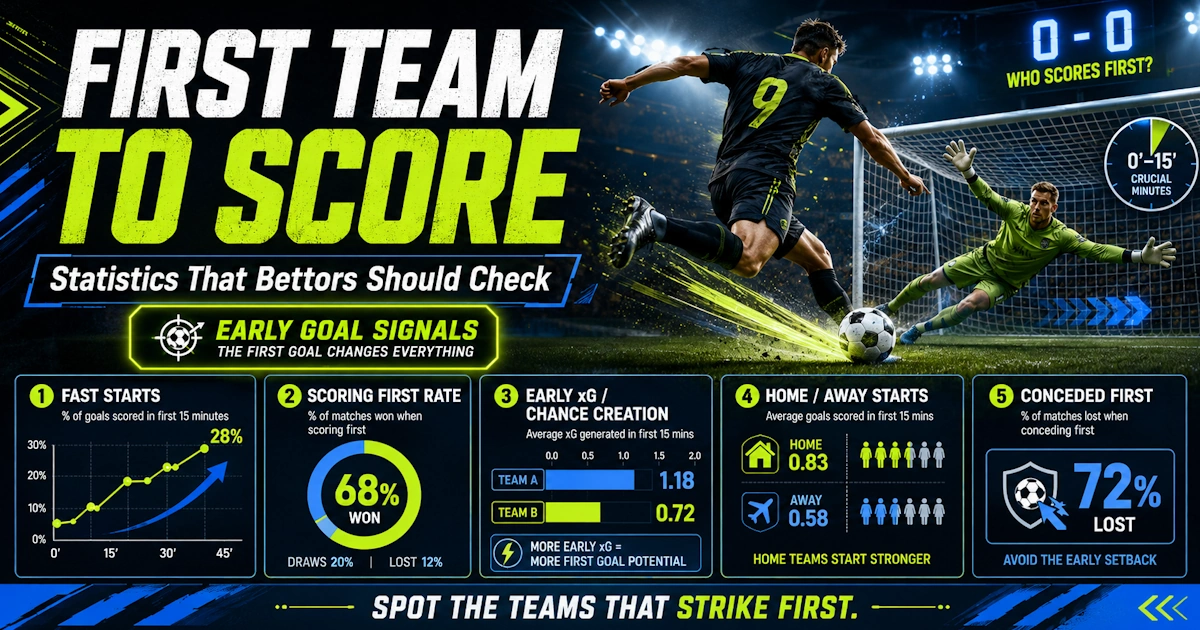
The first team to score market looks straightforward: which side will get the opening goal?
In reality, it is one of those betting markets where a few basic statistics can be far more useful than simply backing the stronger team.
A favourite may dominate possession but regularly start slowly. An underdog may lose most of its matches but still score first surprisingly often, especially at home. Some teams are aggressive from kick-off, while others take 20 or 30 minutes to build attacking rhythm.
That is why first-goal betting should focus on how teams start matches, not just how good they are overall.
The strongest selections usually come from combining opening-goal frequency, first-half attacking numbers, opponent vulnerability, home-away splits and tactical context.
For the broader framework behind football goal markets, read our guide to football goal predictions, including attacking form, defensive records, venue data, expected goals and match context.
Start With the Percentage of Matches Scored First
The most obvious statistic is how often a team scores the first goal.
Suppose a home side has opened the scoring in 14 of its previous 20 home matches. That is a 70% rate.
Now suppose the visitors have conceded first in 13 of their previous 20 away matches.
Those two trends support the same scenario.
That is much more useful than simply knowing that the home team has won 12 matches this season.
For every fixture, check:
Percentage of matches in which the team scored first
Percentage in which it conceded first
Home or away split
Recent 5–10 match trend
Strength of opponents faced
A team with a strong overall first-goal record may be much less convincing away from home, so venue-specific data matters.
If the timing of the goal is not important and the main question is simply whether a team will score, our team-to-score betting guide explains how scoring frequency, opponent conceding rates, xG and venue form should be analysed.
First-Half Scoring Rates Are Important
The first goal often arrives in the first half, so early scoring patterns deserve extra attention.
Check how often each side scores before half-time.
For example:
Home team
Scores in the first half in 65% of home matches
Averages 0.9 first-half goals
Has scored first in 7 of the last 10 at home
Away team
Concedes in the first half in 60% of away matches
Has trailed at half-time in 5 of the last 8
Allows many early shots
That combination gives a much clearer first-goal profile.
A team that scores regularly overall but usually does its damage after the 60th minute may be less suitable for first-team-to-score betting.
Our guide on how to predict Over 0.5 first-half goals explains how early scoring rates, 0–0 half-time percentages, first-half xG and chance creation can be used to judge whether a fixture is likely to produce an early goal.
Look at the Average Time of the First Goal
Timing data can reveal whether a team starts aggressively or slowly.
A side whose average first goal comes around the 24th minute may be more interesting than one whose average opening goal arrives around the 53rd minute.
Similarly, check when the opponent usually concedes first.
If a visiting side tends to concede between minutes 15 and 30, while the home team regularly starts strongly, the matchup becomes more attractive.
Useful timing ranges include:
1–15 minutes
16–30 minutes
31–45 minutes
46–60 minutes
61–75 minutes
76–90 minutes
These splits can also help with related markets such as goal before 30 minutes or first-half team totals.
For a broader look at when goals tend to arrive, our guide to goal timing in football explains how scoring patterns change across different periods of a match and how the opening goal can alter what happens next.
Expected Goals Can Reveal Who Is Creating Early Chances
Goals can be random in small samples. Expected goals can help show whether early scoring is supported by actual chance quality.
Imagine Team A scored first in four consecutive matches, but its first-half xG averaged only 0.35.
That run may not be sustainable.
Now compare Team B, which has scored first in only three of five matches but averaged 0.95 first-half xG and created several big chances.
Team B may actually have the stronger early attacking profile.
For first-team-to-score betting, look at:
First-half xG
xG in the opening 30 minutes
Big chances created early
Shots from central areas
Penalty-area touches
The more consistently a team creates dangerous early chances, the more reliable its first-goal numbers become.
Our expected goals guide explains how xG and xGA can help distinguish repeatable chance creation from opening-goal streaks produced by a small number of unusually efficient finishes.
Shots on Target Can Support the Prediction
Early pressure needs to produce something meaningful.
A team may dominate possession from kick-off but spend most of the opening 20 minutes passing sideways.
That is not the same as testing the goalkeeper.
Check first-half or early-match:
Shots on target
Total shots
Shots inside the box
Big chances
Corners
Dangerous attacks
A home side averaging four first-half shots with two on target has a stronger first-goal profile than one averaging five attempts but only 0.8 on target.
Recent match momentum also matters. If a team has started its last five games with immediate pressure, that can be relevant even if the full-season average is more moderate.
Home and Away Splits Can Change Everything
This market is particularly sensitive to venue.
Some teams are extremely aggressive at home but much more cautious away.
A club may score first in:
75% of home matches
Only 40% of away matches
The combined figure of 57.5% hides an important difference.
The same applies to conceding first.
A team may defend well at home but struggle badly in the opening stages away.
Before making a prediction, compare:
Home team
First-goal percentage at home
First-half goals at home
Home xG
Early shots
Away team
First-conceded percentage away
First-half goals conceded away
Away xGA
Early defensive errors
This is much more useful than relying on overall league tables.
Our guide to home and away form for goal bets explains why venue-specific attacking and defensive patterns should normally carry more weight than combined season averages.
Check Whether the Favourite Is a Slow Starter
One of the biggest traps is assuming the favourite will automatically score first.
Some strong teams dominate possession but need time to break opponents down.
They may win 3–1 but concede the opening goal.
This can happen because:
They push defenders high
They start slowly
The underdog counterattacks well
Their first-half intensity is low
They rotate players
They are vulnerable from set pieces
A favourite may still be the most likely team to score first, but short odds require strong evidence.
If a team is priced at 1.40 to score first, the implied probability is roughly 71%.
You need to believe its real chance is higher than that, not merely that it is the better team.
Consider the Underdog’s Counterattacking Threat
Underdogs are often underestimated in first-team-to-score markets.
They may have little possession yet still create the first dangerous chance.
This is especially relevant when the favourite:
Uses a high defensive line
Commits full-backs forward
Presses aggressively
Leaves space behind midfield
A quick counterattack can produce the opening goal even if the underdog later loses comfortably.
Imagine a favourite that wins most home games but has conceded first in four of its last eight. Its opponent has scored first in five of its last seven away matches and uses fast forwards.
The favourite may still win 3–1, but the underdog first-goal selection could be more realistic than the pre-match odds suggest.
Set Pieces Can Decide the Opening Goal
The first goal does not need to come from open play.
Corners, free kicks and penalties are important because set pieces can disrupt the expected flow of a match.
Check whether a team:
Wins many early corners
Has strong aerial players
Uses dangerous free-kick takers
Faces an opponent weak at defending set pieces
A defensive underdog may create almost nothing from open play but still have a realistic first-goal route through a corner.
Set-piece strength becomes particularly useful when comparing two teams with similar attacking numbers.
Team News Matters More Than Usual
First-goal predictions can be strongly affected by one or two key absences.
Check:
Starting striker
Main creator
Set-piece taker
First-choice goalkeeper
Central defenders
Defensive midfielder
If the favourite rests its leading striker and creative midfielder, its historical first-goal percentage may become less relevant.
Likewise, an opponent missing its first-choice goalkeeper and one centre-back may be much more vulnerable early.
Our guide to how missing defenders affect football goal predictions explains how goalkeeper changes, absent centre-backs and unfamiliar defensive partnerships can alter a team’s usual defensive profile.
Confirmed line-ups are therefore valuable when the market price is tight.
Practical Example: Strong Home First-Goal Selection
Imagine the home team has:
Scored first in 8 of its last 10 home matches
Scored in the first half in 7 of 10
Averaged 1.0 first-half xG
Produced 2.3 first-half shots on target
Kept its main attackers available
The visitors have:
Conceded first in 7 of 10 away matches
Trailed at half-time in 6
Allowed 1.1 first-half xGA
Kept only one clean sheet away
Several independent indicators support the home team scoring first.
That is much stronger than simply saying the home team is higher in the table.
Practical Example: Avoiding a Short-Priced Favourite
Now imagine the favourite has:
Scored first in only 5 of 10 home matches
Conceded first in 4
Averaged just 0.55 first-half xG
Played slowly in recent first halves
The underdog has:
Scored first in 6 of 10 away matches
Produced strong transition numbers
Scored from set pieces regularly
The favourite may still be expected to win, but a very short first-team-to-score price would be difficult to justify.
This is exactly why match-winner odds and first-goal odds should not be treated as the same thing.
Do Not Ignore the No Goal Option
Some bookmakers also offer No Goal in the first-team-to-score market.
This wins if the match finishes 0–0.
It is usually a long price, but it can matter in fixtures involving:
Two low-scoring teams
High clean-sheet rates
Low xG
Few shots on target
Defensive tactical approaches
If both teams fail to score frequently, backing either side to score first may be less attractive than the odds initially suggest.
When neither side has a convincing scoring route, our guide to identifying matches that could finish 0–0 explains how low xG, clean sheets, failure-to-score rates and defensive tactics can support a goalless scenario.
First Team to Score Checklist
Before placing a first-goal bet, check:
First-goal percentage
First-conceded percentage
Home and away splits
First-half scoring rates
Average first-goal timing
First-half xG
Early shots on target
Opponent’s early xGA
Set-piece threat
Counterattacking ability
Team news
Whether the odds offer enough value
The strongest selections usually have both statistical and tactical support.
Frequently Asked Questions
Is the favourite always the best first-team-to-score bet?
No. Some favourites start slowly or are vulnerable to counterattacks, so the underdog can score first even if it later loses.
Is first-half form important?
Yes. Early scoring and conceding rates are more relevant to this market than full-match totals alone.
Should I use xG?
Yes. First-half or early-match xG helps show whether recent opening goals are supported by genuine chance creation.
Are home teams more suitable?
Often, because many teams start more aggressively at home. However, the actual home first-goal percentage should be checked.
Is first team to score better than match winner?
It is simply a different market. A team can score first and still lose, so the analysis should focus on early-match behaviour rather than the final result.
Final Thoughts
First-team-to-score betting is about timing as much as team quality.
The most useful statistics are the ones that describe the opening phase of matches: first-goal rates, first-half scoring, early xG, shots on target and venue-specific trends.
Then add the tactical context. Does the favourite start aggressively? Can the underdog counterattack? Are set pieces a realistic threat? Are key attackers or defenders missing?
The best selection is not automatically the strongest team. It is the side with the clearest route to creating the first dangerous chances.
When the statistical pattern and the tactical matchup point in the same direction, first-team-to-score markets become much easier to analyse.
Explore our football betting resources for more guides covering goal markets, team statistics, tactical analysis and match selection.
Responsible betting: Even strong first-goal trends can fail because one moment can change the match. Keep stakes within a fixed budget and never bet money you cannot afford to lose.