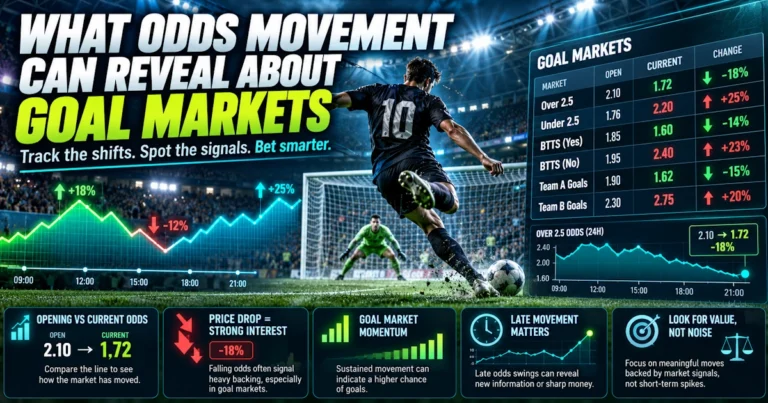

Over 0.5 first-half goals is one of the simplest football betting markets to understand. The selection wins when at least one goal is scored before half-time, including first-half stoppage time.
The final score does not matter. A match can finish 1–0, 1–1, 3–2 or 4–0—as long as one of those goals arrives during the first half, the bet wins.
That simplicity makes the market attractive, but it can also encourage rushed decisions. Many bettors see two attacking teams or a strong favourite and assume an early goal is almost guaranteed. In reality, some high-scoring sides start cautiously, while certain weaker teams defend compactly for the opening 30 or 40 minutes.
A good prediction therefore needs more than overall goal averages. You must examine when the teams score, how often they reach half-time at 0–0 and whether the likely match pattern supports early attacking pressure.
First-half markets are part of the wider approach to football goal predictions, which also includes full-time Over/Under and Both Teams to Score analysis.
Here are the most useful statistics and factors to check.
1. First-Half Over 0.5 Percentage
The most direct statistic is how often each team’s matches contain at least one first-half goal.
For example, if eight of a team’s previous ten matches had a goal before half-time, its Over 0.5 first-half rate is 80%.
A strong percentage from both teams is an encouraging starting point. However, the number should be divided into relevant samples:
- All competitive matches
- Recent five or ten matches
- Home matches for the home team
- Away matches for the visitors
- League matches rather than friendlies
Suppose the home side has recorded a first-half goal in nine of its last ten home fixtures, while the visitors have seen one in eight of ten away matches. That combination provides stronger evidence than an overall seasonal percentage that mixes different venues.
Percentages show a pattern, but they do not explain it. You still need to identify which team is likely to create the early goal.
2. Average First-Half Goals
The average number of first-half goals provides more detail than the basic Over 0.5 rate.
A team whose matches average 1.4 goals before half-time has generally produced more early action than one averaging 0.7.
The average can also reveal whether the market regularly succeeds with room to spare. A team may have first-half goals in 70% of its matches, but most of those games contain only one. Another team with the same percentage may regularly produce two or three goals before the interval.
Be careful with extreme results. One first half ending 4–1 can inflate a small sample. Check the individual scores as well as the average.
A steady sequence such as:
- 1–0 at half-time
- 1–1 at half-time
- 2–0 at half-time
- 0–1 at half-time
- 1–0 at half-time
is often more useful than a sample dominated by one unusual match.
3. The 0–0 Half-Time Rate
Instead of looking only for positive signals, check how frequently each team reaches the break without a goal.
The 0–0 half-time percentage is essentially the main risk to an Over 0.5 first-half selection.
A team with a 0–0 half-time rate of only 15% regularly produces early goals. A rate of 45% suggests that nearly half its matches remain goalless through the opening period.
This statistic becomes particularly useful when both teams have low 0–0 rates.
For example:
- Home team: 0–0 at half-time in 2 of 10 home matches
- Away team: 0–0 at half-time in 3 of 10 away matches
The combined pattern supports an early goal more strongly than a fixture in which both teams regularly stay level and goalless until the second half.
4. First-Half Goals Scored
Check how often each side scores before half-time, not merely whether its matches contain a goal.
A strong home favourite may have a high first-half scoring rate because it begins matches aggressively. A weaker visitor may also concede early but offer very little attacking threat of its own.
Useful questions include:
- Has the home team scored before half-time in recent home games?
- Does the away team score early on the road?
- How many first-half goals does each side average?
- Is one team capable of covering the selection alone?
A match does not need both sides to attack well. If the home team has scored in the first half of eight consecutive home matches, it may provide the main reason for the prediction.
That is very different from Both Teams to Score in Both Halves, where both teams must contribute before half-time and then each score again after the break.
5. First-Half Goals Conceded
Early defensive weakness can be just as important as attacking quality.
Some teams start slowly, struggle against high pressing or regularly concede before settling into the match. Others remain organised for long periods before becoming vulnerable late in the game.
Compare the home team’s first-half scoring rate with the away side’s first-half conceding rate.
Practical example: The home team has scored before half-time in 75% of its home matches. The visitors have conceded before half-time in 70% of their away matches. These are two independent statistics supporting the same match scenario.
The opposite combination also matters. If the visitors rarely concede early, the home team’s attacking percentage may be less convincing.
6. Time of the First Goal
The average timing of the first goal can show whether the teams tend to produce genuinely early action or depend on goals shortly before the interval.
Our guide to goal timing in football explains how scoring patterns differ across the opening minutes, the second half and the closing stages of a match.
A match regularly producing its first goal between the 10th and 25th minute may be more comfortable for this market than one where most first-half goals arrive after the 40th minute.
Both patterns can win, but later goals create more risk.
Look at the distribution rather than one exact average:
- Goals in minutes 1–15
- Goals in minutes 16–30
- Goals in minutes 31–45+
- No first-half goal
This can also help with live betting. If a team creates most of its pressure during the opening 20 minutes, waiting too long may remove the strongest part of the expected pattern.
When the question is which side is most likely to produce that opening goal, our first-team-to-score guide explains how first-goal percentages, early xG, venue splits and opponent vulnerability should be compared.
7. First-Half Shots and Shots on Target
Goals can sometimes hide poor performances. A team may score from its only first-half attempt, while another may remain goalless despite creating several good chances.
First-half shot statistics help measure attacking activity.
Look for teams that regularly:
- Produce several shots before half-time
- Test the goalkeeper early
- Enter the penalty area frequently
- Win corners and attacking free kicks
- Force defensive errors through pressing
Shots on target are normally more useful than total attempts. Ten speculative shots from long range may be less dangerous than three clear opportunities inside the box.
When both teams create and allow several first-half shots on target, the chance of at least one goal naturally improves.
8. First-Half Expected Goals
First-half expected goals, where available, estimate the quality of chances created before the interval.
A team may have failed to score in two recent first halves but produced 0.9 and 1.1 first-half xG. That suggests the attack still created enough chances and may have been affected by poor finishing.
The reverse can also happen. A team may have scored early in three consecutive matches while creating very little. Such efficiency may not continue.
First-half xG is most useful when combined with actual scoring data:
- High scoring rate and strong xG: convincing
- Low scoring rate but strong xG: possible improvement
- High scoring rate but weak xG: potential overperformance
- Low scoring rate and weak xG: poor candidate
Not every competition provides reliable first-half xG figures. When unavailable, use shots on target, chance quality and match reports as alternatives.
For a broader explanation of how xG and xGA measure chance quality rather than guaranteed goals, read our expected goals guide.
9. Home and Away Differences
Overall statistics can hide major venue-related differences.
Some teams begin home games with energy, press high and try to score before the opponent settles. The same side may start slowly away and prioritise defensive organisation.
Use:
- Home first-half scoring data for the home team
- Away first-half scoring data for the visitors
- Home first-half goals conceded
- Away first-half goals conceded
- Venue-specific 0–0 half-time percentages
Practical example: A team may have a 65% Over 0.5 first-half rate across the season but an 85% rate at home. If the next fixture is at its own stadium, the home figure is more relevant.
The same principle applies to the visiting team. A strong overall attack may become far less productive away from home.
Our guide to home and away form for goal bets explains how the home team’s venue-specific attack should be compared directly with the visitor’s away scoring and defensive profile.
10. The Likely Match Pattern
Statistics should help you picture how the first half may develop.
Ask whether:
- The favourite is likely to attack immediately
- The underdog will defend very deep
- Both teams need a win
- A draw would be acceptable
- The match is a first or second leg
- One side is protecting an aggregate lead
- The teams normally press or counterattack
A dominant favourite against a weak defence may create an early goal even if the visitors contribute nothing. Two balanced attacking sides may provide opportunities at both ends.
However, a knockout first leg between cautious teams can stay controlled despite strong league scoring statistics.
This is particularly relevant in the final qualifying round. Our Champions League play-off first-leg guide explains how financial pressure, tactical caution and the quality difference can affect early and full-match goal markets.
Return fixtures require a different approach because the aggregate score can force one team to attack early or allow the other to protect its advantage. Read more about second-leg goal patterns and how they affect match tempo.
These considerations are also important when analysing Champions League qualifier goal predictions, where clubs may differ significantly in match fitness, quality and European experience.
Match context matters because teams do not approach every fixture in the same way.
Team News and Starting Line-Ups
Before placing the bet, check whether the players responsible for creating and finishing chances are available.
The absence of a leading striker or creative midfielder can reduce early attacking quality. Defensive injuries may have the opposite effect.
Our guide to how missing defenders affect football goal predictions explains why reserve goalkeepers and unfamiliar defensive partnerships may increase scoring potential, while tactical adjustments can sometimes make the match more cautious.
Also consider rotation. A heavy favourite may rest several attackers, particularly during a busy schedule or after securing a comfortable first-leg advantage.
Confirmed line-ups can therefore change a prediction that looked strong earlier in the day.
A Practical Analysis Example
Imagine the home team has the following record:
- Over 0.5 first-half goals in 8 of 10 home matches
- Scored before half-time in 7 of 10
- Average of 1.2 first-half goals
- Only two 0–0 half-time results
The visitors have:
- Over 0.5 first-half goals in 7 of 10 away matches
- Conceded before half-time in 6 of 10
- A 30% 0–0 half-time rate
- An average of four first-half shots allowed on target
The home team is expected to start strongly and has its main attackers available.
No single figure guarantees a goal, but the combination creates a clear argument: the home side scores early regularly, while the visitors frequently allow first-half chances and goals.
That is a much stronger prediction than simply noticing that the teams’ last match finished 3–2.
Previous meetings can provide supporting evidence, but our guide to using H2H statistics for goal predictions explains why one result or a small sample should not drive the selection.
Quick Checklist
Before predicting Over 0.5 first-half goals, check:
- First-half Over 0.5 percentages
- Average first-half goals
- 0–0 half-time rates
- First-half goals scored and conceded
- Home and away splits
- Timing of the first goal
- First-half shots and xG
- Likely tactics and match importance
- Injuries and confirmed line-ups
- Whether the odds reflect the actual probability
The best selections usually have several statistics supporting the same early-goal scenario.
Frequently Asked Questions
What does Over 0.5 first-half goals mean?
It means at least one goal must be scored before half-time, including first-half stoppage time.
Does a goal in the second half count?
No. The selection is settled only on goals scored during the first half.
Is a strong favourite enough for this prediction?
Not always. Some favourites start slowly or face opponents that defend deep. Check first-half scoring data rather than relying only on overall team quality.
How many matches should I analyse?
Review the latest five to ten relevant matches and compare them with the broader home or away record. A very small sample can be misleading.
Is Over 0.5 first-half safer than Over 2.5 full-time?
It requires fewer goals, but they must arrive within a shorter period. Neither market is automatically safe, and the available odds should always be considered.
For the full-time market, our guide on how to predict Over 2.5 goals explains the attacking, defensive and chance-creation statistics that should be compared.
Final Thoughts
Predicting Over 0.5 first-half goals is mainly about timing. Overall attacking strength matters, but it is more important to know whether the teams create, score and concede chances before the interval.
First-half goal percentages, 0–0 rates, venue splits, shots on target and expected goals can reveal matches with a genuine early-goal pattern. Team news, tactics and match importance then provide the context needed to interpret those numbers properly.
No statistic can guarantee a goal before half-time. Use several independent indicators, compare the estimated probability with the odds and avoid treating a low-priced selection as risk-free.
Explore our football betting resources for more guides covering goal markets, match statistics and prediction strategies.
Responsible betting: Set a fixed budget, avoid chasing losses and never stake money you cannot afford to lose.
How to Predict Over 0.5 First-Half Goals: Betting Guide
August 1, 2026
7:46 am
https://nicefixedmatches.com/how-to-predict-over-0-5-first-half-goals-betting-guide/
Over 0.5 first-half goals is one of the simplest football betting markets to understand. The selection wins when at least one goal is scored before half-time, including first-half stoppage time.
The final score does not matter. A match can finish 1–0, 1–1, 3–2 or 4–0—as long as one of those goals arrives during the first half, the bet wins.
That simplicity makes the market attractive, but it can also encourage rushed decisions. Many bettors see two attacking teams or a strong favourite and assume an early goal is almost guaranteed. In reality, some high-scoring sides start cautiously, while certain weaker teams defend compactly for the opening 30 or 40 minutes.
A good prediction therefore needs more than overall goal averages. You must examine when the teams score, how often they reach half-time at 0–0 and whether the likely match pattern supports early attacking pressure.
First-half markets are part of the wider approach to football goal predictions, which also includes full-time Over/Under and Both Teams to Score analysis.
Here are the most useful statistics and factors to check.
1. First-Half Over 0.5 Percentage
The most direct statistic is how often each team’s matches contain at least one first-half goal.
For example, if eight of a team’s previous ten matches had a goal before half-time, its Over 0.5 first-half rate is 80%.
A strong percentage from both teams is an encouraging starting point. However, the number should be divided into relevant samples:
- All competitive matches
- Recent five or ten matches
- Home matches for the home team
- Away matches for the visitors
- League matches rather than friendlies
Suppose the home side has recorded a first-half goal in nine of its last ten home fixtures, while the visitors have seen one in eight of ten away matches. That combination provides stronger evidence than an overall seasonal percentage that mixes different venues.
Percentages show a pattern, but they do not explain it. You still need to identify which team is likely to create the early goal.
2. Average First-Half Goals
The average number of first-half goals provides more detail than the basic Over 0.5 rate.
A team whose matches average 1.4 goals before half-time has generally produced more early action than one averaging 0.7.
The average can also reveal whether the market regularly succeeds with room to spare. A team may have first-half goals in 70% of its matches, but most of those games contain only one. Another team with the same percentage may regularly produce two or three goals before the interval.
Be careful with extreme results. One first half ending 4–1 can inflate a small sample. Check the individual scores as well as the average.
A steady sequence such as:
- 1–0 at half-time
- 1–1 at half-time
- 2–0 at half-time
- 0–1 at half-time
- 1–0 at half-time
is often more useful than a sample dominated by one unusual match.
3. The 0–0 Half-Time Rate
Instead of looking only for positive signals, check how frequently each team reaches the break without a goal.
The 0–0 half-time percentage is essentially the main risk to an Over 0.5 first-half selection.
A team with a 0–0 half-time rate of only 15% regularly produces early goals. A rate of 45% suggests that nearly half its matches remain goalless through the opening period.
This statistic becomes particularly useful when both teams have low 0–0 rates.
For example:
- Home team: 0–0 at half-time in 2 of 10 home matches
- Away team: 0–0 at half-time in 3 of 10 away matches
The combined pattern supports an early goal more strongly than a fixture in which both teams regularly stay level and goalless until the second half.
4. First-Half Goals Scored
Check how often each side scores before half-time, not merely whether its matches contain a goal.
A strong home favourite may have a high first-half scoring rate because it begins matches aggressively. A weaker visitor may also concede early but offer very little attacking threat of its own.
Useful questions include:
- Has the home team scored before half-time in recent home games?
- Does the away team score early on the road?
- How many first-half goals does each side average?
- Is one team capable of covering the selection alone?
A match does not need both sides to attack well. If the home team has scored in the first half of eight consecutive home matches, it may provide the main reason for the prediction.
That is very different from Both Teams to Score in Both Halves, where both teams must contribute before half-time and then each score again after the break.
5. First-Half Goals Conceded
Early defensive weakness can be just as important as attacking quality.
Some teams start slowly, struggle against high pressing or regularly concede before settling into the match. Others remain organised for long periods before becoming vulnerable late in the game.
Compare the home team’s first-half scoring rate with the away side’s first-half conceding rate.
Practical example: The home team has scored before half-time in 75% of its home matches. The visitors have conceded before half-time in 70% of their away matches. These are two independent statistics supporting the same match scenario.
The opposite combination also matters. If the visitors rarely concede early, the home team’s attacking percentage may be less convincing.
6. Time of the First Goal
The average timing of the first goal can show whether the teams tend to produce genuinely early action or depend on goals shortly before the interval.
Our guide to goal timing in football explains how scoring patterns differ across the opening minutes, the second half and the closing stages of a match.
A match regularly producing its first goal between the 10th and 25th minute may be more comfortable for this market than one where most first-half goals arrive after the 40th minute.
Both patterns can win, but later goals create more risk.
Look at the distribution rather than one exact average:
- Goals in minutes 1–15
- Goals in minutes 16–30
- Goals in minutes 31–45+
- No first-half goal
This can also help with live betting. If a team creates most of its pressure during the opening 20 minutes, waiting too long may remove the strongest part of the expected pattern.
When the question is which side is most likely to produce that opening goal, our first-team-to-score guide explains how first-goal percentages, early xG, venue splits and opponent vulnerability should be compared.
7. First-Half Shots and Shots on Target
Goals can sometimes hide poor performances. A team may score from its only first-half attempt, while another may remain goalless despite creating several good chances.
First-half shot statistics help measure attacking activity.
Look for teams that regularly:
- Produce several shots before half-time
- Test the goalkeeper early
- Enter the penalty area frequently
- Win corners and attacking free kicks
- Force defensive errors through pressing
Shots on target are normally more useful than total attempts. Ten speculative shots from long range may be less dangerous than three clear opportunities inside the box.
When both teams create and allow several first-half shots on target, the chance of at least one goal naturally improves.
8. First-Half Expected Goals
First-half expected goals, where available, estimate the quality of chances created before the interval.
A team may have failed to score in two recent first halves but produced 0.9 and 1.1 first-half xG. That suggests the attack still created enough chances and may have been affected by poor finishing.
The reverse can also happen. A team may have scored early in three consecutive matches while creating very little. Such efficiency may not continue.
First-half xG is most useful when combined with actual scoring data:
- High scoring rate and strong xG: convincing
- Low scoring rate but strong xG: possible improvement
- High scoring rate but weak xG: potential overperformance
- Low scoring rate and weak xG: poor candidate
Not every competition provides reliable first-half xG figures. When unavailable, use shots on target, chance quality and match reports as alternatives.
For a broader explanation of how xG and xGA measure chance quality rather than guaranteed goals, read our expected goals guide.
9. Home and Away Differences
Overall statistics can hide major venue-related differences.
Some teams begin home games with energy, press high and try to score before the opponent settles. The same side may start slowly away and prioritise defensive organisation.
Use:
- Home first-half scoring data for the home team
- Away first-half scoring data for the visitors
- Home first-half goals conceded
- Away first-half goals conceded
- Venue-specific 0–0 half-time percentages
Practical example: A team may have a 65% Over 0.5 first-half rate across the season but an 85% rate at home. If the next fixture is at its own stadium, the home figure is more relevant.
The same principle applies to the visiting team. A strong overall attack may become far less productive away from home.
Our guide to home and away form for goal bets explains how the home team’s venue-specific attack should be compared directly with the visitor’s away scoring and defensive profile.
10. The Likely Match Pattern
Statistics should help you picture how the first half may develop.
Ask whether:
- The favourite is likely to attack immediately
- The underdog will defend very deep
- Both teams need a win
- A draw would be acceptable
- The match is a first or second leg
- One side is protecting an aggregate lead
- The teams normally press or counterattack
A dominant favourite against a weak defence may create an early goal even if the visitors contribute nothing. Two balanced attacking sides may provide opportunities at both ends.
However, a knockout first leg between cautious teams can stay controlled despite strong league scoring statistics.
This is particularly relevant in the final qualifying round. Our Champions League play-off first-leg guide explains how financial pressure, tactical caution and the quality difference can affect early and full-match goal markets.
Return fixtures require a different approach because the aggregate score can force one team to attack early or allow the other to protect its advantage. Read more about second-leg goal patterns and how they affect match tempo.
These considerations are also important when analysing Champions League qualifier goal predictions, where clubs may differ significantly in match fitness, quality and European experience.
Match context matters because teams do not approach every fixture in the same way.
Team News and Starting Line-Ups
Before placing the bet, check whether the players responsible for creating and finishing chances are available.
The absence of a leading striker or creative midfielder can reduce early attacking quality. Defensive injuries may have the opposite effect.
Our guide to how missing defenders affect football goal predictions explains why reserve goalkeepers and unfamiliar defensive partnerships may increase scoring potential, while tactical adjustments can sometimes make the match more cautious.
Also consider rotation. A heavy favourite may rest several attackers, particularly during a busy schedule or after securing a comfortable first-leg advantage.
Confirmed line-ups can therefore change a prediction that looked strong earlier in the day.
A Practical Analysis Example
Imagine the home team has the following record:
- Over 0.5 first-half goals in 8 of 10 home matches
- Scored before half-time in 7 of 10
- Average of 1.2 first-half goals
- Only two 0–0 half-time results
The visitors have:
- Over 0.5 first-half goals in 7 of 10 away matches
- Conceded before half-time in 6 of 10
- A 30% 0–0 half-time rate
- An average of four first-half shots allowed on target
The home team is expected to start strongly and has its main attackers available.
No single figure guarantees a goal, but the combination creates a clear argument: the home side scores early regularly, while the visitors frequently allow first-half chances and goals.
That is a much stronger prediction than simply noticing that the teams’ last match finished 3–2.
Previous meetings can provide supporting evidence, but our guide to using H2H statistics for goal predictions explains why one result or a small sample should not drive the selection.
Quick Checklist
Before predicting Over 0.5 first-half goals, check:
- First-half Over 0.5 percentages
- Average first-half goals
- 0–0 half-time rates
- First-half goals scored and conceded
- Home and away splits
- Timing of the first goal
- First-half shots and xG
- Likely tactics and match importance
- Injuries and confirmed line-ups
- Whether the odds reflect the actual probability
The best selections usually have several statistics supporting the same early-goal scenario.
Frequently Asked Questions
What does Over 0.5 first-half goals mean?
It means at least one goal must be scored before half-time, including first-half stoppage time.
Does a goal in the second half count?
No. The selection is settled only on goals scored during the first half.
Is a strong favourite enough for this prediction?
Not always. Some favourites start slowly or face opponents that defend deep. Check first-half scoring data rather than relying only on overall team quality.
How many matches should I analyse?
Review the latest five to ten relevant matches and compare them with the broader home or away record. A very small sample can be misleading.
Is Over 0.5 first-half safer than Over 2.5 full-time?
It requires fewer goals, but they must arrive within a shorter period. Neither market is automatically safe, and the available odds should always be considered.
For the full-time market, our guide on how to predict Over 2.5 goals explains the attacking, defensive and chance-creation statistics that should be compared.
Final Thoughts
Predicting Over 0.5 first-half goals is mainly about timing. Overall attacking strength matters, but it is more important to know whether the teams create, score and concede chances before the interval.
First-half goal percentages, 0–0 rates, venue splits, shots on target and expected goals can reveal matches with a genuine early-goal pattern. Team news, tactics and match importance then provide the context needed to interpret those numbers properly.
No statistic can guarantee a goal before half-time. Use several independent indicators, compare the estimated probability with the odds and avoid treating a low-priced selection as risk-free.
Explore our football betting resources for more guides covering goal markets, match statistics and prediction strategies.
Responsible betting: Set a fixed budget, avoid chasing losses and never stake money you cannot afford to lose.