
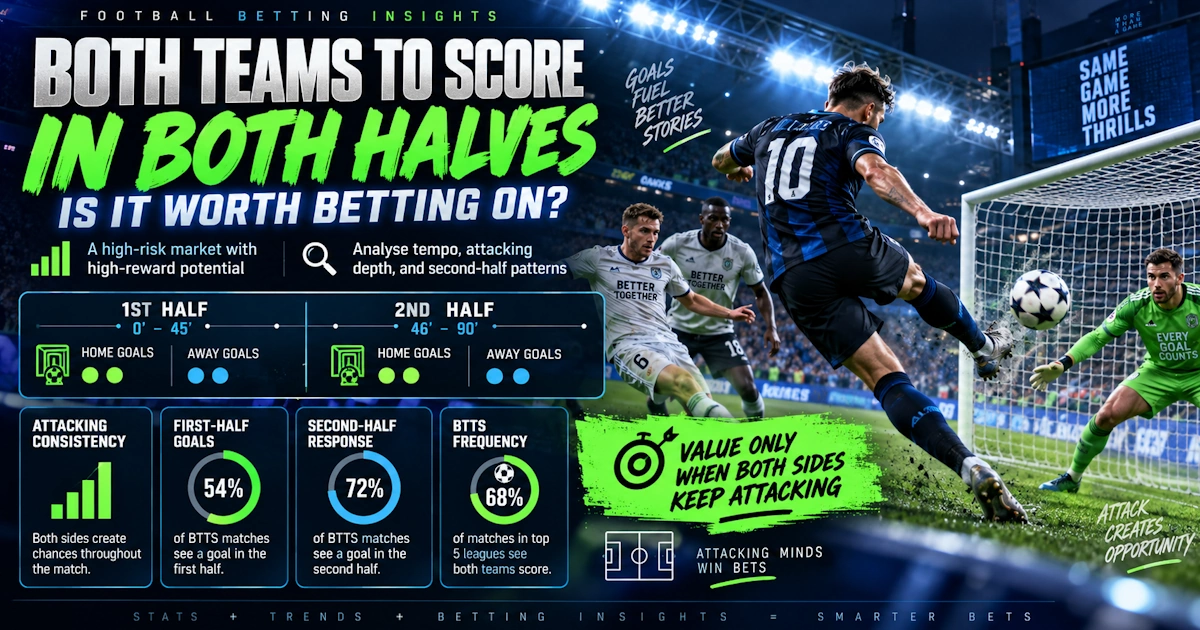
Both Teams to Score in Both Halves is one of those football markets that immediately catches the eye because the odds can be much higher than standard BTTS.
The requirement sounds simple: both teams must score in the first half and both teams must score in the second half.
In practice, that is a demanding prediction.
A normal BTTS bet can win with a 1-1 draw. BTTS in both halves needs at least four goals, and those goals must be distributed correctly across the match. A 4-1 result can contain five goals and still lose. Even a 3-2 thriller can fail if one team scores all of its goals in the same half.
That is why this market should not be treated as simply a more adventurous version of BTTS. It requires a very specific match pattern.
For the broader distinction between both teams contributing and one side producing most of the total, our BTTS vs Over 2.5 comparison explains why two goal markets can react very differently to the same final score.
What Does BTTS in Both Halves Mean?
For the bet to win, each team must score at least once before half-time and at least once after half-time.
A result such as 2-2 can win if the scoring is distributed like this:
- First half: 1-1
- Second half: 1-1
A 4-2 result could also win if both teams contribute in each period.
However, consider a match that finishes 3-2:
- First half: 2-0
- Second half: 1-2
There are five goals, but the bet loses because the away team failed to score in the first half.
This is the first thing bettors need to understand: total goals alone are not enough. Timing matters just as much.
Why the Market Is Difficult to Win
The minimum requirement is four goals, but even four goals do not guarantee success.
A 3-1 result can never win BTTS in both halves because one team has scored only once and therefore cannot have scored in both periods.
Even many 2-2 results lose if the goals are unevenly distributed.
Compare these two 2-2 matches:
Match A
- Half-time: 1-1
- Second half: 1-1
- BTTS both halves: Win
Match B
- Half-time: 0-1
- Second half: 2-1
- BTTS both halves: Lose
The final score is identical. The betting result is completely different.
That makes this market significantly more difficult than Over 3.5 or regular BTTS.
First-Half Scoring Is Usually the Biggest Obstacle
Many strong attacking teams score consistently over 90 minutes but are much less reliable during the first 45.
A club may score in 85% of full matches while scoring before half-time in only 55%.
That difference becomes crucial.
For BTTS in both halves, you need four separate scoring events: the home team scores in the first half, the away team scores in the first half, the home team scores in the second half and the away team scores in the second half.
If either side is a slow starter, the entire bet becomes difficult before the second half even begins.
This is why first-half statistics deserve more attention than overall BTTS percentages.
Our guide on how to predict Over 0.5 first-half goals explains how early scoring rates, 0-0 half-time percentages, first-half shots and first-half xG can be used to judge whether the opening period has a genuine scoring profile.
Use Half-by-Half Scoring Rates
Suppose two fictional teams have these numbers.
The home side scores:
- In 70% of first halves
- In 80% of second halves
The visitors score:
- In 65% of first halves
- In 75% of second halves
Those are already strong percentages.
If we used a very simplified independence calculation, the probability of all four events happening would be: 0.70 × 0.80 × 0.65 × 0.75 = approximately 27%.
That corresponds to fair odds of roughly 3.70 before accounting for bookmaker margin.
This is only an illustrative calculation because football events are not truly independent. A first-half goal changes tactics, and the score affects second-half risk.
Still, it demonstrates why this market naturally carries much higher odds than standard BTTS.
Even teams with excellent scoring rates do not necessarily make BTTS in both halves highly probable.
Half-specific data should also be interpreted alongside the way scoring changes during a match. Our guide to goal timing in football explains how early goals, second-half patterns, fatigue and game state can change the likelihood of further scoring.
Regular BTTS Is Not Enough
One of the biggest mistakes is starting with teams that have high full-match BTTS percentages.
Suppose both teams have recorded BTTS in eight of their last ten matches.
That sounds perfect.
But then you discover that only three of those ten matches had both teams scoring before half-time.
The standard BTTS statistic tells you both attacks are capable of scoring.
It does not tell you whether they score early enough or often enough in both periods.
For this market, check:
- First-half BTTS rate
- Second-half BTTS rate
- First-half scoring frequency for both teams
- Second-half scoring frequency
- Goals by 15-minute intervals
- Half-time score patterns
These numbers are much more relevant than the overall BTTS percentage.
Over 3.5 Goals Is Necessary, but Not Sufficient
BTTS in both halves requires at least four goals.
Therefore, matches with strong Over 3.5 profiles should usually be the starting point.
Imagine two teams whose matches regularly produce:
- 2-2
- 3-2
- 2-3
- 3-3
That is more promising than two teams whose typical BTTS result is 1-1.
But you still need to know how the goals are distributed.
A team that often wins 4-0 may have an excellent Over 3.5 record but be terrible for this market because the opponent rarely scores.
The ideal match is not simply high-scoring. It is high-scoring and balanced enough for both sides to contribute throughout the game.
Look for Teams That Attack Even When Ahead
Game state matters enormously.
Some teams take a 2-1 lead and continue attacking aggressively. Others become cautious and protect the advantage.
BTTS in both halves works better when both teams continue looking for goals regardless of the score.
Useful characteristics include:
- High pressing
- Aggressive full-backs
- Weak defensive transitions
- Strong attacking benches
- A habit of creating chances late in matches
A team that becomes conservative after scoring may ruin an otherwise excellent statistical setup.
For example, if the home side leads 2-1 at half-time and spends the entire second half defending, the match may finish 2-1 despite an open first period.
Defensive Weakness Is Just as Important as Attacking Strength
You need two reliable attacks, but you also need two vulnerable enough defences.
A team keeping frequent clean sheets is dangerous for this market even if it scores heavily itself.
Suppose the home side averages 2.4 goals but keeps a clean sheet in 50% of its home matches.
It may produce plenty of 3-0 and 4-0 victories.
Those are excellent for home team totals and Over 2.5, but useless for BTTS in both halves.
When one team may be capable of producing most of the scoring alone, our team total goals guide explains how to choose between Team Over 0.5, 1.5 and 2.5 rather than depending on the opponent to contribute.
Ideally, both teams should:
- Score regularly
- Concede regularly
- Allow chances in both halves
- Continue attacking when the match opens
That combination is much rarer than simply finding two strong attacks.
Our clean-sheet statistics and goal markets guide explains how clean-sheet percentages should be checked against xGA, shots allowed, goalkeeper performance and opponent quality before trusting the defensive record.
Expected Goals Can Help
Expected goals can show whether repeated high-scoring matches are supported by chance creation.
Imagine Team A has recorded three consecutive 3-2 results.
That looks perfect.
But its average combined match xG has been only 2.2.
The recent scores may have depended on unusually efficient finishing.
Now imagine Team B’s matches average around 3.8 combined xG, with good chances created at both ends.
The second profile is more convincing.
For BTTS in both halves, useful xG indicators include:
- First-half xG
- Second-half xG
- Opponent xGA by half
- Big chances
- Shots inside the penalty area
If most of a team’s xG consistently arrives after the 60th minute, its full-match attacking numbers may exaggerate its suitability for this particular bet.
Our expected goals guide explains how xG and xGA can distinguish sustainable chance creation from scorelines produced by unusually efficient finishing.
Practical Example: A Strong Candidate
Imagine two attacking teams meet.
The home side has:
- Scored in 8 of its last 10 first halves
- Scored in 9 of its last 10 second halves
- Conceded in both halves in 5 of 10
- Recorded Over 3.5 in 6 of 10
The visitors have:
- Scored first-half goals in 7 of 10
- Scored second-half goals in 8 of 10
- Kept only one clean sheet
- Recorded BTTS in 8 of 10
Both teams use high defensive lines and have strong attacking substitutes.
A score such as 2-2, 3-2 or 3-3 is realistic, and there are genuine routes to goals in both periods.
This is the type of match where BTTS in both halves can at least be considered.
Practical Example: A Match to Avoid
Now consider two sides with excellent standard BTTS records.
Both have BTTS in 7 of their last 10 matches.
However:
- Home team scored in only 4 of 10 first halves
- Away team scored in only 3 of 10 first halves
- Most goals arrive after the 60th minute
- Typical results are 1-1 and 2-1
These teams may still be suitable for regular BTTS.
They are poor candidates for BTTS in both halves.
The market requires much more than both teams eventually finding the net.
Compare the Odds With the Probability
Because the bet is difficult, bookmakers often offer attractive-looking prices.
That can tempt bettors into choosing the market purely because the payout is larger.
Suppose the odds are 4.50.
Those odds imply a probability of about 22.2%.
If your analysis suggests the true probability is closer to 15%, 4.50 is not good value despite looking generous.
If your estimate is around 27%, the price becomes more interesting.
This is why betting frequency matters.
BTTS in both halves should generally be a selective market rather than something used for several matches every weekend.
A Useful Selection Checklist
Before considering BTTS in both halves, check:
- Both teams’ first-half scoring rates
- Both teams’ second-half scoring rates
- First-half BTTS frequency
- Over 3.5 percentage
- Overall BTTS rate
- Clean-sheet percentages
- xG by half
- Shots on target
- Whether both sides concede late
- Tactical willingness to keep attacking
- Starting attackers and defensive absences
- Whether the odds compensate for the difficulty
If only the full-match BTTS numbers look strong, that is usually not enough.
Frequently Asked Questions
What is the minimum number of goals needed?
At least four goals are required because both teams must score in each half.
Does a 2-2 result always win?
No. Both teams must score in both halves. A 0-1 half-time score followed by a 2-1 second half still loses the bet.
Is BTTS in both halves better than Over 3.5?
They are different markets. Over 3.5 only needs four total goals, while BTTS in both halves also requires the goals to be distributed between both teams and both periods.
Which statistics matter most?
First-half and second-half scoring rates, first-half BTTS, Over 3.5 frequency, xG by half and defensive records are particularly useful.
Is this market suitable for accumulators?
It is generally high variance. Combining several such selections can make the probability of success extremely low.
Final Thoughts
Both Teams to Score in Both Halves can offer appealing odds, but the higher price exists for a reason.
You are not simply predicting a high-scoring match. You need both teams to contribute before half-time and then do it again after the break.
That makes ordinary BTTS statistics insufficient.
Look for teams that score early and late, concede regularly, produce strong chance quality and continue attacking regardless of game state. Over 3.5 trends can help identify candidates, but they should be supported by half-specific data.
Most matches will not meet those conditions.
That is why BTTS in both halves is better treated as a specialist, selective market rather than a routine alternative to standard BTTS.
When the statistical profile is unusually strong and the odds properly compensate for the risk, it can be worth considering. Otherwise, regular BTTS or Over 2.5 will often provide a much simpler route to the same general expectation of goals.
Explore our football betting resources for more guides covering goal markets, team statistics, tactical analysis and match selection strategies.
Responsible betting: High-odds markets can encourage excessive risk. Use a fixed staking plan, avoid chasing bigger payouts and never bet money you cannot afford to lose.