
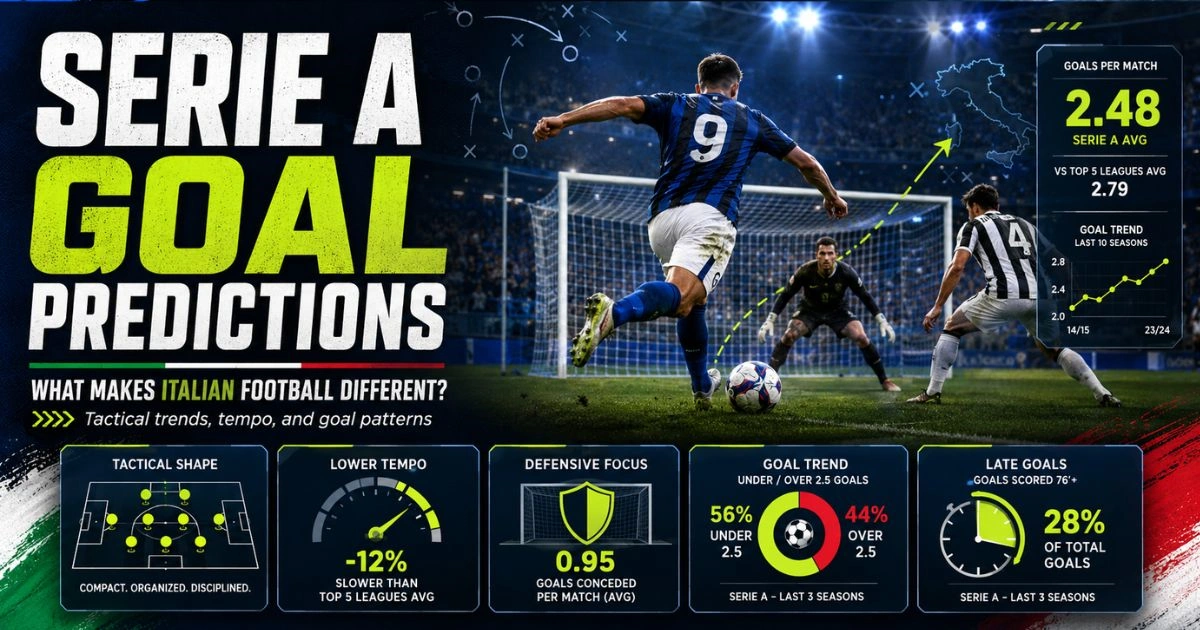
Serie A is still commonly described as a defensive league. That reputation is not completely undeserved, but it is far too simple for modern Italian football.
Some teams protect space, manage narrow leads and make matches difficult to open. Others press aggressively, attack through wing-backs and create chances from quick transitions. A fixture between two cautious sides may be ideal for Under 2.5 goals, while another Serie A match can become one of the most open games on the weekend.
That variety is what makes Serie A goal predictions interesting—and occasionally frustrating.
The 2025/26 season produced 922 goals across 380 matches, an average of 2.43 per game. There were also 99 draws, or roughly 26% of all fixtures. A season summary recorded Over 2.5 goals in 46% of matches and Both Teams to Score in 45%, so neither goals nor low totals could be backed blindly.
For comparison with other competitions, our guide to European leagues with the most Over 2.5 goals shows how Serie A’s scoring rate compares with the Bundesliga, Premier League, Eredivisie and other major leagues.
The lesson is simple: do not bet on a Serie A stereotype. Analyse the individual teams and the tactical matchup.
For a broader framework, read our complete guide to football goal predictions, including Over/Under, BTTS, venue form, expected goals and match context.
Serie A Is Not One Type of Football
Italian coaches are traditionally associated with tactical preparation, but that does not mean every team plays defensively.
Within the same league, you may find:
A possession team building patiently from the back
A side defending in a compact low block
An aggressive pressing team
A direct team using physical forwards
A transition-based side attacking open space
A formation built around attacking wing-backs
Official Serie A analysis from the 2025/26 season noted that teams reached dangerous positions in very different ways. Some controlled possession, while others created high-quality chances through transitions despite having far less of the ball.
This matters because two teams can have similar goal averages for completely different reasons.
One may produce Over 2.5 results through attacking quality. Another may reach the same total because its defensive structure regularly breaks down.
Understanding the reason behind the numbers helps determine whether the pattern can continue against the next opponent.
Do Not Automatically Back Under 2.5
Serie A’s 2.43-goal average and 54% Under 2.5 rate in 2025/26 show that lower totals were slightly more common. However, that does not make Under 2.5 the default selection for every Italian match.
The league still contained major attacking differences. Champions Inter scored 89 goals, while Como finished with 65. At the other end, several teams struggled to reach one goal per match.
Before selecting Under 2.5, check whether one team can score three goals without help.
A disciplined visitor may offer little attacking threat, but if it faces one of the league’s strongest home attacks, results such as 3–0 or 4–0 remain possible.
Our BTTS vs Over 2.5 comparison explains why a one-sided score such as 3–0 can support the total-goals market even when the weaker team has little chance of scoring.
In that situation, BTTS – No may fit the expected pattern better than Under 2.5.
When the individual matchup genuinely points towards a low total, our guide on how to predict Under 2.5 goals explains how attacking output, clean sheets, xG, shots on target and tactical control should support the selection.
Tactical Control Matters More Than Possession
Possession percentages can be misleading in Serie A.
A team may hold the ball for long periods without creating much because the opponent is comfortable defending around its own penalty area. Another may have only 40% possession but generate the better chances through quick counterattacks.
When analysing goal markets, examine:
Expected goals
Shots on target
Chances created inside the box
Counterattacking threat
Possession in dangerous areas
How easily the team progresses through midfield
A 65% possession figure does not automatically support goals. It may describe slow circulation in front of an organised defence.
Likewise, a low-possession side should not automatically be treated as harmless. Serie A’s official xG analysis highlighted examples of teams creating dangerous opportunities through transitions despite ranking near the bottom for possession.
Our expected goals guide explains how xG and xGA can help distinguish genuine chance creation from harmless possession and misleading final scorelines.
Wing-Backs Can Change the Goal Pattern
Wide defenders play an unusually important attacking role for many Italian teams.
Some Serie A formations appear defensive on paper because they contain three centre-backs and two wing-backs. In possession, however, the wing-backs may operate almost like wingers.
They can:
Create overloads near the touchline
Deliver crosses
Make late runs into the penalty area
Force opposing full-backs deeper
Leave counterattacking space behind them
Lega Serie A described the flanks as some of the most interesting tactical spaces of the 2025/26 season. Several defenders recorded significant numbers of opposition-box touches, chances created, goals and assists.
When two teams use adventurous wing-backs, the match can become much more open than the formations initially suggest.
When one side pins the opponent’s wing-backs deep, the opposite can happen: the match becomes narrow, controlled and short of attacking width.
Set Pieces Deserve Extra Attention
Italian teams are often highly organised at corners, free kicks and wide deliveries.
Set pieces can support Over or BTTS predictions when one side:
Has dominant aerial players
Creates many corners
Uses specialist deliveries
Faces an opponent that struggles to defend crosses
Includes centre-backs with a consistent scoring threat
Several Serie A defenders scored regularly in 2025/26, with headers and set-piece combinations contributing significantly. The league’s official review also highlighted renewed use of structured long throws as attacking weapons.
This is particularly important in otherwise tight matches.
A fixture may produce little from open play, yet one corner can open the scoring. Once the first goal arrives, the trailing team may have to abandon its cautious plan, creating a completely different game.
The First Goal Can Be More Important Than the Pre-Match Average
Many Serie A teams are good at managing game state.
A team taking a 1–0 lead may reduce its pressing, protect central areas and invite the opponent to attack from less dangerous wide positions. This can make a promising Over match settle into a controlled result.
Other sides continue attacking after scoring and become especially dangerous when the opponent leaves more space.
Before betting, check how the teams perform:
When scoring first
When conceding first
While protecting a narrow lead
During the final 30 minutes
Against deep defensive blocks
Live goal betting in Serie A should account for these tactical changes.
A 0–0 after 60 minutes may still offer a late-goal opportunity if one team needs to win and is creating pressure. A 1–0 match may become less attractive for further goals if the leading side is controlling possession and allowing almost nothing.
For live situations like this, our guide to predicting late goals after the 75th minute explains how urgency, recent pressure, substitutions, xG and counterattacking space should be assessed.
Goals May Be Spread Across the Team
Serie A goal production is not always centred on one prolific striker.
The 2025/26 leading scorer finished with 17 goals—the lowest winning total since the competition returned to 20 teams. At the same time, Inter scored 89 league goals, showing that a highly productive attack can distribute its scoring across several players.
This is useful when reviewing injuries.
The absence of one forward may not significantly weaken a team whose wing-backs, midfielders and second striker all contribute. For another club, losing its main scorer could remove a large percentage of its expected goals.
Check:
Percentage of team goals scored by the leading striker
Goals from midfield and defence
Set-piece contributions
Replacement quality
Whether the system creates chances for several positions
Defensive team news should be assessed in the same way. Our guide to how missing defenders affect football goal predictions explains how goalkeeper absences, centre-back changes and replacement quality can alter both defensive organisation and the expected goal total.
Do not judge an attack only by the top scorer’s total.
Home and Away Form Must Be Separated
Venue-specific numbers are essential in Serie A.
Some teams are much more ambitious at home but become cautious away. Others are designed for counterattacking football and may create better chances when playing on the road.
For the home team, analyse:
Home goals scored and conceded
Home Over 2.5 percentage
Home clean sheets
Home xG and xGA
For the visitor, use the equivalent away figures.
Suppose a team averages 1.5 goals overall but scores 2.1 at home and only 0.9 away. The broad average hides the statistic that matters most for the upcoming fixture.
The interaction is more important than either team’s figure alone. A strong home attack may still struggle against the league’s best away defence.
Our guide to home and away form for goal bets explains how the home side’s venue-specific attack and defence should be compared directly with the visitor’s away profile.
Practical Example: An Over 2.5 Match
Imagine a home side that:
Scores 2.0 goals per home match
Uses attacking wing-backs
Produces strong home xG
Regularly concedes during transitions
The visitors:
Score consistently away
Struggle to defend crosses
Have a low clean-sheet rate
Use quick forwards against high defensive lines
The likely scorelines include 2–1, 2–2 and 3–1.
Here, Over 2.5 has several independent routes: home attacking quality, away counterattacking threat and weaknesses on both sides.
Practical Example: An Under 2.5 Match
Now consider two teams that:
Average close to one goal scored per match
Allow few shots inside the box
Have high clean-sheet percentages
Play cautiously when the score is level
Depend heavily on set pieces
Would both accept a draw
Likely results may include 0–0, 1–0 and 1–1.
Under 2.5 has a clear tactical and statistical foundation. The selection is not based merely on the match being played in Italy.
Quick Serie A Goal Checklist
Before making a prediction, check:
Relevant home and away averages
Over 2.5 and BTTS percentages
xG and chance quality
Tactical formations in and out of possession
Wing-back involvement
Set-piece strengths and weaknesses
Performance after scoring first
Attacking distribution across the squad
Defensive and goalkeeper absences
Whether the available price reflects the matchup
Frequently Asked Questions
Is Serie A still a defensive league?
It can be tactically controlled, but teams use very different styles. Some fixtures are excellent Under candidates, while others contain aggressive pressing, attacking wing-backs and strong transition play.
Is Under 2.5 the best Serie A market?
Not automatically. The 2025/26 season leaned slightly towards Under, but individual team profiles matter much more than the league average.
Are three-centre-back formations defensive?
Not necessarily. The wing-backs may play extremely high, making the formation highly attacking in possession.
Are set-piece statistics important?
Yes. Corners, free kicks, long throws and aerial defenders can provide goals even when open-play chance creation is limited.
Should possession be used for goal predictions?
Only with context. High possession can be harmless, while a low-possession team may create excellent counterattacking chances.
Final Thoughts
What makes Serie A different is not simply defensive football. It is the level of tactical variation and the ability of teams to alter matches according to the score.
Goal predictions should account for formations, wing-back roles, set pieces, game-state management and the contrast between possession and chance quality. Current home and away data should then be used to identify whether those tactical characteristics are producing goals.
Avoid beginning with the assumption that Italian matches are automatically low-scoring. Begin with the teams, picture how their styles interact and then choose the market that best matches that expected pattern.
Explore our football betting resources for more guides covering goal markets, football statistics and prediction strategies.
Responsible betting: Use statistics as analytical tools rather than guarantees, keep stakes within a fixed budget and never bet money you cannot afford to lose.