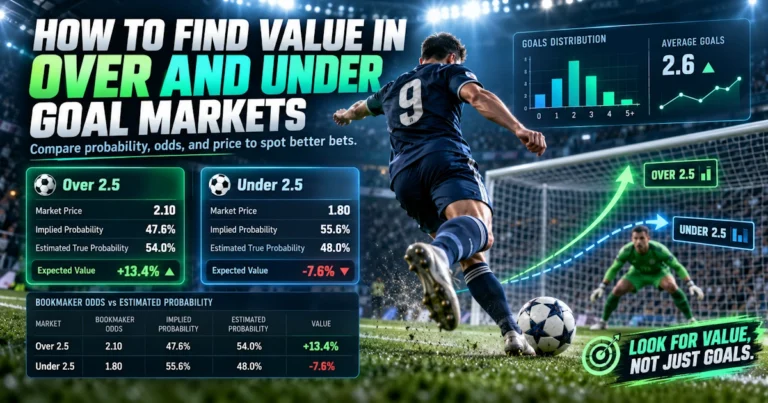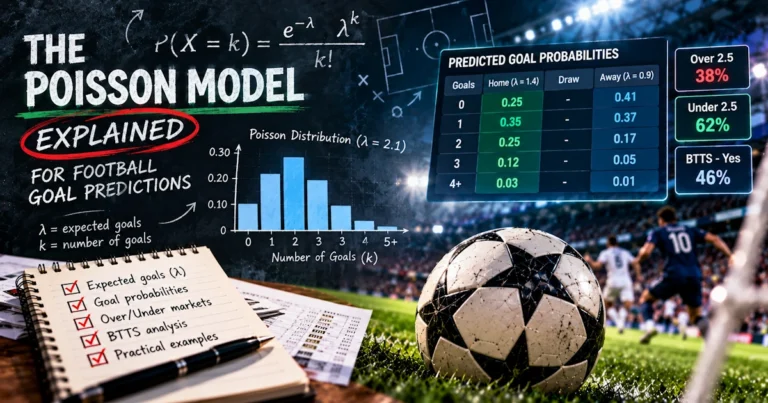
Football odds tell you more than how much a winning bet would return.
They also tell you what probability the market is roughly assigning to an outcome.
If Over 2.5 Goals is priced at 2.00, the basic implied probability is 50%. If the same selection is offered at 1.50, the implied probability rises to 66.7%.
Understanding this relationship is one of the most useful skills in football analysis because it allows you to stop thinking only in terms of:
“Do I think this will happen?”
and start thinking:
“Do I think this will happen more often than the odds suggest?”
That distinction is fundamental.
A prediction can be correct in principle but still be a poor bet if the price is too short.
The Basic Formula for Decimal Odds
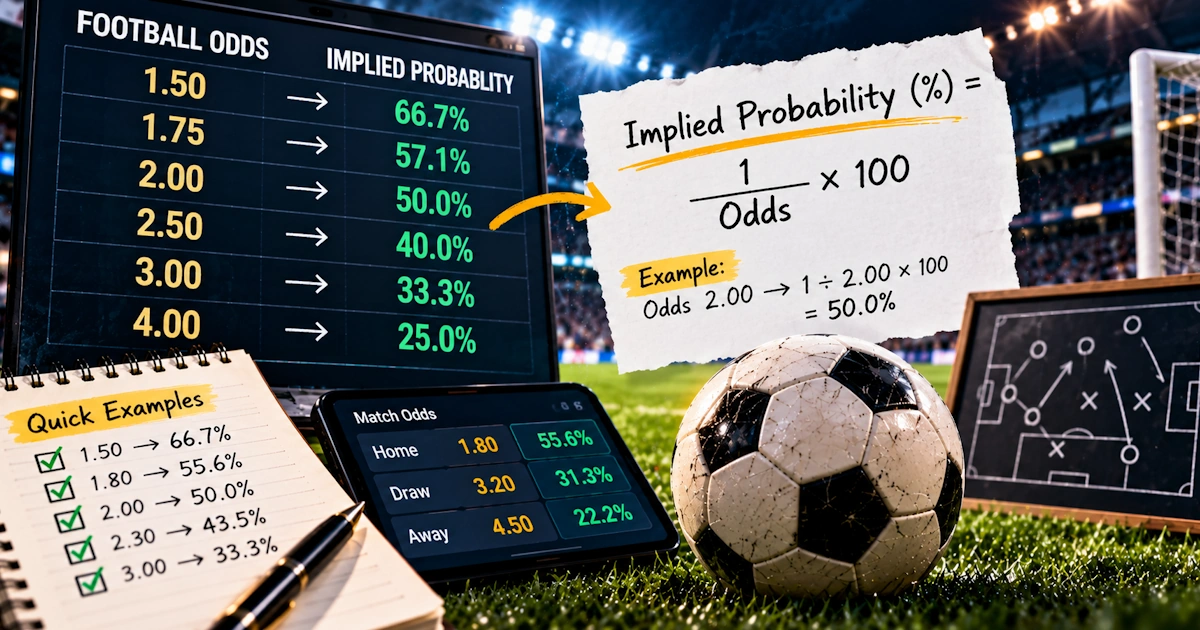
For decimal odds, the calculation is simple:
Implied Probability = 1 ÷ Decimal Odds × 100
For example:
Odds of 2.00
1 ÷ 2.00 × 100 = 50%
Odds of 1.80
1 ÷ 1.80 × 100 = 55.6%
Odds of 2.50
1 ÷ 2.50 × 100 = 40%
That is the basic conversion.
Once you understand it, football odds become much easier to compare.
Quick Implied Probability Table
Here are some common football prices:
- 1.20 = 83.3%
- 1.25 = 80.0%
- 1.30 = 76.9%
- 1.40 = 71.4%
- 1.50 = 66.7%
- 1.60 = 62.5%
- 1.70 = 58.8%
- 1.80 = 55.6%
- 1.90 = 52.6%
- 2.00 = 50.0%
- 2.20 = 45.5%
- 2.50 = 40.0%
- 3.00 = 33.3%
This table is useful because it immediately shows how much confidence is already built into the price.
A selection at 1.40 is not simply “safe”.
The market is roughly asking whether that outcome happens more than 71% of the time.
Why Probability Is More Useful Than Odds Alone
Imagine two selections.
Selection A
Over 2.5 Goals at 1.50
Selection B
BTTS – Yes at 2.00
Selection A looks safer.
But the implied probabilities are:
- 1.50 → 66.7%
- 2.00 → 50%
Now suppose your own analysis estimates:
- Over 2.5: 62%
- BTTS: 57%
Selection A may actually be overpriced because your estimate is lower than the market’s.
Selection B may offer more potential value because your estimate is higher.
This is why the shortest odds are not automatically the best bet.
Implied Probability Is Not the Same as True Probability
This point is extremely important.
Odds do not tell you the exact true probability of an event.
They reflect:
- Bookmaker pricing
- Market expectations
- Betting activity
- Margin
- Available information
If a bookmaker offers 1.80, the raw implied probability is 55.6%.
That does not mean the event has exactly a 55.6% chance of happening.
The bookmaker’s margin is built into the market.
So implied probability should be treated as the price you need to beat, not as a perfect prediction.
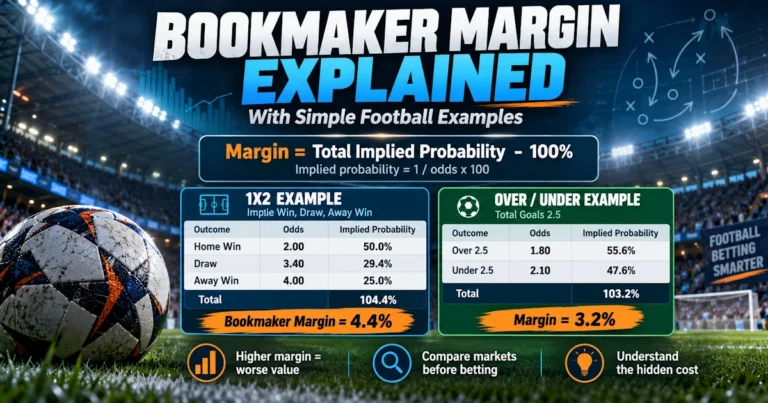
Understanding the Bookmaker Margin
Consider a simple two-way goal market:
Over 2.5: 1.91
Under 2.5: 1.91
Convert both:
1 ÷ 1.91 = 52.36%
So:
Over = 52.36%
Under = 52.36%
Total:
104.72%
But the real probabilities cannot add up to 104.72%.
They must total 100%.
The extra 4.72 percentage points represent the bookmaker’s theoretical margin, often called the overround.
That is why you should not assume raw implied probabilities are fair probabilities.
Example With Over and Under Goals
Suppose:
Over 2.5 = 1.80
Under 2.5 = 2.05
Raw implied probabilities:
Over:
1 ÷ 1.80 = 55.56%
Under:
1 ÷ 2.05 = 48.78%
Combined:
55.56 + 48.78 = 104.34%
Again, the total exceeds 100%.
To estimate the market’s margin-free probabilities, divide each raw probability by the total.
For Over:
55.56 ÷ 104.34 ≈ 53.25%
For Under:
48.78 ÷ 104.34 ≈ 46.75%
That is closer to the market’s underlying view.
The bookmaker price says 55.6%.
After removing the margin, the estimated fair probability is nearer 53.3%.
Three-Way Football Markets Have Margin Too
The same principle applies to 1X2 markets.
Suppose:
- Home: 2.20
- Draw: 3.40
- Away: 3.30
Convert them:
Home:
1 ÷ 2.20 = 45.45%
Draw:
1 ÷ 3.40 = 29.41%
Away:
1 ÷ 3.30 = 30.30%
Total:
45.45 + 29.41 + 30.30 = 105.16%
The theoretical overround is approximately:
5.16%
That margin is one reason you need more than simply identifying the most likely result.
The price still has to be good enough.
Turning Your Own Probability Into Fair Odds
You can reverse the calculation.
If you estimate the probability yourself:
Fair Odds = 1 ÷ Probability
Use the probability as a decimal.
Suppose you estimate BTTS – Yes at:
60%
Convert 60% to 0.60.
1 ÷ 0.60 = 1.67
Your fair price is approximately 1.67.
If the bookmaker offers:
1.90
you may have identified potential value.
If the bookmaker offers:
1.50
the price is shorter than your estimate suggests it should be.
Practical Example: Over 2.5 Goals
Imagine your analysis shows:
- Strong combined xG
- Both teams average five shots on target
- Weak clean-sheet records
- Few defensive absences
You estimate Over 2.5 at:
58%
Fair odds:
1 ÷ 0.58 = 1.72
Now compare bookmaker prices.
Bookmaker price: 1.95
Raw implied probability:
1 ÷ 1.95 = 51.3%
Your estimate: 58%.
That difference is potentially interesting.
Bookmaker price: 1.60
Implied probability:
62.5%
Your estimate: 58%.
Now the price is asking for more confidence than your analysis provides.
Same match.
Same prediction.
Different betting decision.
Practical Example: BTTS
Suppose you estimate BTTS – Yes at 56%.
Fair odds:
1 ÷ 0.56 = 1.79
If the market offers 2.00, its raw implied probability is 50%.
Your estimate is six percentage points higher.
That could indicate value.
Now imagine the price falls to 1.65.
Implied probability:
60.6%
Your original prediction has not necessarily changed.
But the value may have disappeared.
This is why odds movement matters.
The Difference Between Probability and Confidence
A common mistake is saying:
“I am very confident in this bet.”
Confidence is subjective.
Probability forces you to be more precise.
Instead of saying:
“This looks strong.”
Try:
“I estimate this at around 60%.”
Now you can compare your opinion directly with the price.
If the bookmaker also implies around 60%, there may be no advantage.
If the bookmaker implies only 50%, your analysis may be identifying something useful.
Thinking probabilistically makes betting decisions much clearer.
Why Short Odds Can Be Dangerous
A selection at 1.25 feels extremely safe.
But its implied probability is:
1 ÷ 1.25 = 80%
That still means a 20% failure rate before adjusting for margin.
In simple terms, an event with a true 80% probability would fail roughly once in every five attempts over a large enough sample.
That is why a coupon filled with short-priced selections is not automatically low-risk.
Each leg still has a meaningful chance of losing.
Accumulators Make Implied Probability More Important
Suppose three independent selections are all priced at 1.50.
Combined odds:
1.50 × 1.50 × 1.50 = 3.375
The implied probability of the accumulator is approximately:
1 ÷ 3.375 = 29.6%
Each individual selection may look safe at 1.50.
Together, the probability of all three landing is much lower.
Now add a fourth 1.50 selection:
Combined odds:
5.06
Implied probability:
approximately 19.8%
One more “safe” selection has reduced the chance of the whole accumulator winning considerably.
Probability Helps With Goal Market Selection
Suppose your predictive model estimates:
- Over 1.5 Goals: 78%
- Over 2.5 Goals: 56%
- BTTS – Yes: 54%
Available odds:
- Over 1.5: 1.25
- Over 2.5: 1.95
- BTTS: 2.05
Compare implied probabilities.
Over 1.5 at 1.25:
80%
Your estimate: 78%.
Not attractive.
Over 2.5 at 1.95:
51.3%
Your estimate: 56%.
More interesting.
BTTS at 2.05:
48.8%
Your estimate: 54%.
Also potentially interesting.
The market with the highest expected success rate is not necessarily the one with the best value.
Do Not Pretend Your Probability Estimates Are Perfect
This is another important point.
Estimating a match at exactly 57.3% can create false precision.
Football contains uncertainty.
Your estimate might really be somewhere around:
54–60%
rather than exactly 57.3%.
That is fine.
Probability is useful because it encourages structured thinking, not because it produces certainty.
The bigger the difference between your estimate and the market’s, the more interesting the potential opportunity becomes.
Tiny differences may simply be estimation noise.
Keep Records of Your Estimated Probabilities
If you regularly make football predictions, record:
- Market
- Odds taken
- Implied probability
- Your estimated probability
- Closing odds
- Result
After 100 or 200 selections, you can begin checking whether your probability estimates were realistic.
For example, if you label many selections as 70% chances but only 52% win over a large sample, your estimates are probably too optimistic.
This is called calibration.
A well-calibrated prediction process should produce results reasonably close to the probabilities it assigns over large samples.
Common Mistakes
One common mistake is confusing high probability with good value.
Another is ignoring bookmaker margin.
Bettors also frequently compare odds without converting them to probabilities, making small price differences harder to understand.
And perhaps the biggest mistake is treating probability as certainty.
A 70% selection can still lose.
In fact, if the estimate is accurate, it should lose approximately 30% of the time.
That is normal.
Implied Probability Checklist
Before placing a football prediction, ask:
- What probability do the odds imply?
- Have I considered bookmaker margin?
- What probability does my own analysis suggest?
- What are the fair odds based on that estimate?
- Is the bookmaker offering a better price?
- Has the price moved significantly?
- Is the difference large enough to matter?
- Am I estimating probability realistically?
- Would I still like the bet at the current odds?
That last question matters because a good prediction can become a bad price.
Frequently Asked Questions
How do I convert decimal odds into probability?
Use: 1 ÷ odds × 100. For example, odds of 2.00 imply 50%.
What probability does 1.50 represent?
Approximately 66.7%.
What probability does 1.80 represent?
Approximately 55.6%.
What are fair odds?
Fair odds are the price corresponding to your estimated true probability without bookmaker margin. If you estimate an event at 60%, fair odds are approximately 1.67.
Why do bookmaker probabilities add up to more than 100%?
Because the bookmaker builds a margin into the prices. The amount above 100% is commonly called the overround.
Final Thoughts
Converting football odds into implied probability is simple mathematics, but it changes the way you look at predictions.
Instead of asking only:
“Will this happen?”
you begin asking:
“How often should this happen, and is the price high enough?”
That is much more useful.
Odds of 1.50 imply roughly 66.7%. Odds of 2.00 imply 50%. Odds of 2.50 imply 40%.
From there, you can compare the market’s expectation with your own estimate based on xG, shots, team news, tactical matchup and statistical models.
The goal is not to find selections that look likely.
It is to find situations where your estimated probability is meaningfully higher than the probability implied by the available price.
That difference is where the idea of value begins.
Responsible betting: Implied probability helps measure price, but it cannot guarantee outcomes. Use realistic estimates, keep stakes within a fixed budget and never bet money you cannot afford to lose.