Finding a match that looks good for goals is not the same as finding value.
That distinction is one of the most important ideas in football betting.
You may correctly believe a match is likely to produce Over 2.5 Goals. But if the bookmaker has already priced Over 2.5 at 1.45, the market may be offering very little reward for the risk.
Likewise, an Under 2.5 selection can look uncomfortable at 2.20, but if your analysis suggests it should be closer to 1.85, the bigger price may represent better value.
So the real question is not: Will this match go Over or Under?
It is: Is the available price higher than the probability suggested by my analysis?
That is what value means.
Start With Implied Probability
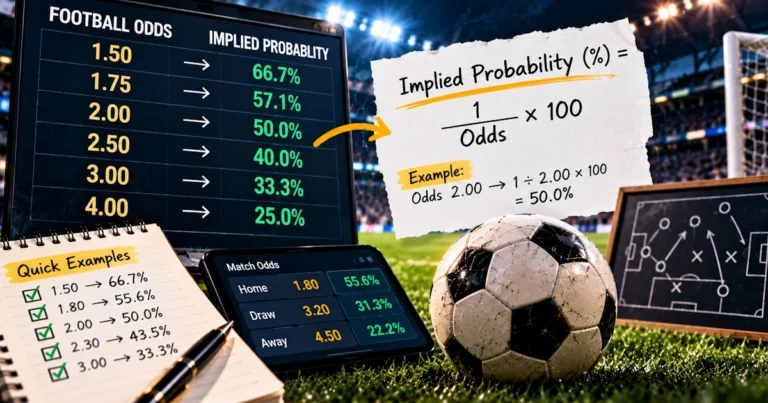
Decimal odds can be converted into implied probability with a simple formula:
1 ÷ Odds × 100
For example:
- 1.50 = 66.7%
- 1.80 = 55.6%
- 2.00 = 50%
- 2.20 = 45.5%
- 2.50 = 40%
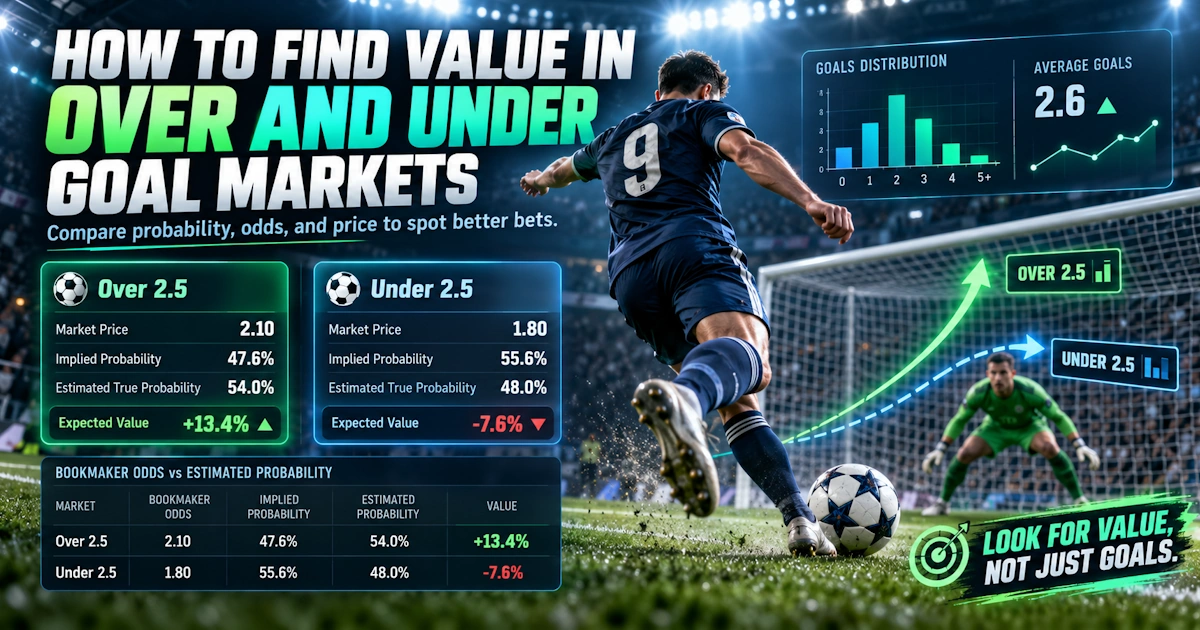
Suppose Over 2.5 is available at 1.80.
The raw implied probability is about: 55.6%
If your analysis suggests the true probability is closer to 63%, the price may be attractive.
If you estimate the chance at only 50%, then 1.80 is not good enough.
This simple comparison is the foundation of value betting.
Value Does Not Mean High Odds
A common mistake is thinking value means backing outsiders or big prices.
It does not.
A selection at 1.50 can offer value.
A selection at 3.00 can be terrible value.
It depends entirely on probability.
Imagine Over 1.5 Goals is priced at 1.40.
Implied probability: 1 ÷ 1.40 = 71.4%
If your estimate is 80%, the price may still be good despite being short.
Now imagine Over 3.5 is available at 2.80.
Implied probability: 35.7%
If you think the true probability is only 25%, the price is not attractive even though the odds look much bigger.
Value is about the relationship between price and probability, not the size of the odds.
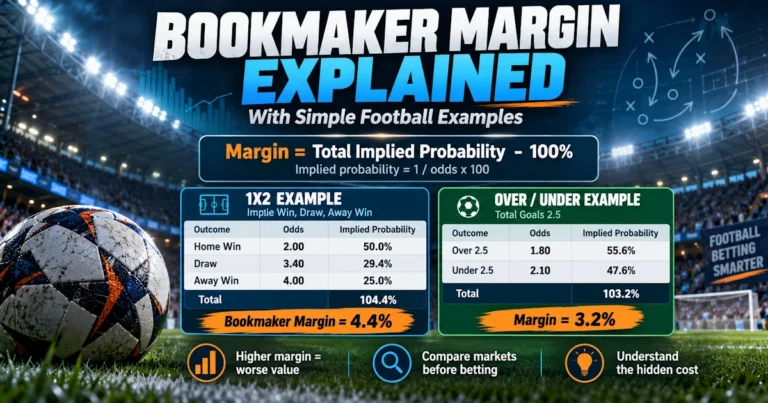
Understand Bookmaker Margin
Bookmakers build margin into goal markets.
Suppose:
- Over 2.5: 1.85
- Under 2.5: 2.00
Implied probabilities:
Over: 1 ÷ 1.85 = 54.1%
Under: 1 ÷ 2.00 = 50%
Combined: 104.1%
That extra 4.1% is the bookmaker’s overround.
So the raw implied probability of Over 2.5 is not exactly the market’s fair estimate.
To estimate margin-free probabilities, divide each side by the total.
Over: 54.1 ÷ 104.1 ≈ 52.0%
Under: 50 ÷ 104.1 ≈ 48.0%
That gives a better idea of how the market actually views the match.
Build Your Own Goal Expectation
To find value, you need your own estimate of the match.
That estimate does not need to be perfect.
It just needs to be more thoughtful than blindly following the bookmaker.
Useful inputs include:
- Goals scored and conceded
- xG and xGA
- Shots on target
- Big chances
- Home and away splits
- Clean-sheet rates
- Failure-to-score rates
- Goal conversion
- Tactical style
- Team news
- Match motivation
The strongest value usually appears when several indicators point in one direction while the market price still looks relatively generous.
Expected Goals Are Extremely Useful
xG helps separate real attacking quality from misleading scorelines.
Suppose Team A has scored 10 goals in its last four matches.
That sounds excellent.
But its total xG over those matches is only 5.8.
The team may be finishing at an unusually high rate.
Now imagine Team B has scored only six goals but produced 8.5 xG.
Its results look weaker, but the chance creation may be more sustainable.
For Over markets, this matters a lot.
High recent scores are less convincing when xG remains moderate.
For Under markets, an apparently low-scoring team may actually be creating enough chances for its results to improve.
Shots on Target Help Confirm the Profile
Goal totals become more reliable when shot data supports them.
Suppose a match involves two teams averaging:
- 5.2 shots on target
- 4.8 shots on target
Both also allow plenty of accurate shots.
That is a stronger Over profile than a match where both teams average only two or three shots on target.
Now imagine a supposedly high-scoring team regularly takes 16 shots but only gets 2.5 on target.
The attack may be much less dangerous than the raw shot count suggests.
Shots on target are particularly useful when deciding whether the bookmaker’s Over price is too short or still has room.
Home and Away Splits Matter
Overall season averages can hide major venue differences.
Suppose a team averages: 1.8 goals per match overall
But:
- 2.2 at home
- 1.3 away
If the upcoming match is away, using the overall average may overstate the attacking threat.
The same applies to defence.
A team might concede:
- 0.8 at home
- 1.7 away
For Over/Under analysis, compare: home team at home with away team away
This produces a much more relevant picture.
Practical Example: Finding Value in Over 2.5
Imagine the home team has:
- 1.9 home xG
- 5.7 shots on target
- 1.8 home goals
- Few clean sheets
The visitors have:
- 1.5 away xG
- 4.5 shots on target
- 1.4 away goals
- Concede regularly
You estimate the probability of Over 2.5 at: 60%
Fair odds would be: 1 ÷ 0.60 = 1.67
The bookmaker offers: 1.95
The raw implied probability is: 51.3%
Your estimate is significantly higher.
That is a potential value situation.
The bet can still lose.
But the price appears favourable relative to your probability estimate.
Practical Example: Over Looks Good but Has No Value
Now imagine another match.
You estimate Over 2.5 at: 62%
That sounds strong.
But the bookmaker offers: 1.50
Implied probability: 66.7%
The market is actually more confident than you are.
The match may still finish 3-2.
Your football prediction may be correct.
But based on your own numbers, the price was too short.
This is the key difference between predicting goals and finding value.
Finding Value in Under Markets
Value betting is not only about Overs.
Under markets can become attractive when the public or market overreacts to recent high-scoring results.
Suppose both teams recently produced several Over 2.5 matches.
The market prices: Under 2.5 at 2.20
Implied probability: 45.5%
But deeper analysis shows:
- Combined xG is modest
- Recent conversion is unusually high
- Few big chances are created
- One main striker is unavailable
- Both teams are tactically cautious
You estimate Under 2.5 at: 52%
Fair odds: 1 ÷ 0.52 = 1.92
If 2.20 is available, the price may be attractive.
The headline results suggest Over.
The underlying process suggests the market may be overpricing those recent goals.
Recent Results Can Create False Value Signals
Suppose a team has:
- 4-2
- 3-2
- 4-1
- 3-3
in its last four matches.
The market may shorten Over 2.5 heavily.
But what caused those scores?
Perhaps:
- Two matches had red cards
- Three penalties were scored
- Goalkeepers made errors
- Conversion rates were extreme
If xG and shot quality do not support the results, the Under side may now offer better value.
The opposite can happen after several 0-0 and 1-0 matches.
If xG is high and chances are being missed, the Over price may become attractive.
Fair Odds Are More Useful Than Saying “Good Bet”
Instead of writing: Over 2.5 looks good
try to estimate: Over 2.5 = 58%
Fair odds: 1 ÷ 0.58 = 1.72
Now compare the market.
If the price is 1.95, interesting. If it is 1.60, less attractive.
This forces your analysis to become more disciplined.
You are no longer asking whether you like the selection.
You are asking whether the price is high enough.
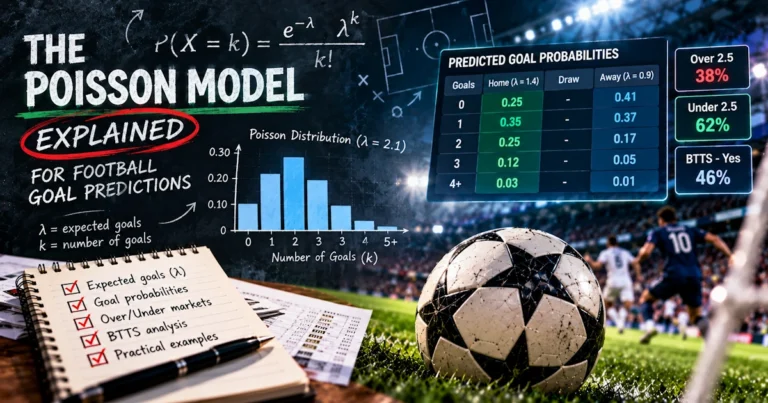
Poisson Models Can Help
A basic Poisson model can estimate goal probabilities from expected scoring rates.
Suppose you estimate: Home expected goals: 1.7 Away expected goals: 1.2
Combined expected goals: 2.9
A Poisson model can estimate the probability of:
- Over 1.5
- Over 2.5
- Under 2.5
- BTTS
- Correct scores
The model is not perfect, but it gives you a structured probability estimate.
You can then compare that with bookmaker prices.
The value comes from the difference.
Team News Can Create Temporary Value
Sometimes value appears because the market has not fully adjusted to new information.
For example:
- Starting goalkeeper ruled out
- Two centre-backs unavailable
- Main striker returns
- Team rotates several attackers
- Defensive midfielder suspended
Suppose Over 2.5 is still available at 2.00 shortly after news breaks that both starting centre-backs are unavailable.
If your adjusted probability rises from 50% to 58%, the current price may become valuable.
Of course, the market can react quickly.
That is why timing sometimes matters.
Odds Movement Can Remove Value
Imagine you like Over 2.5 at: 2.05
Your fair price is: 1.80
Good.
Then the odds shorten to: 1.70
The prediction may still be strong.
But now the market price is below your fair odds.
The value has disappeared.
Do not chase the bet simply because you liked it earlier.
Value is attached to a specific price, not permanently to a selection.
Small Differences May Not Be Enough
Suppose your estimate is: Over 2.5 = 55%
The bookmaker’s margin-adjusted probability is: 54%
That 1% difference is tiny.
Your model could easily be wrong by more than that.
Now suppose: Your estimate = 62% Market = 52%
That difference deserves much more attention.
Football probabilities are uncertain.
Do not pretend your model is precise enough to exploit every tiny disagreement.
Look for meaningful gaps.
Track Whether Your Value Estimates Are Actually Good
You should test your method.
Record:
- Market
- Odds taken
- Implied probability
- Your estimated probability
- Closing odds
- Result
After a large sample, ask:
- Do your 60% selections win around 60%?
- Are you consistently getting better odds than closing prices?
- Which markets perform best?
- Are your estimates too optimistic?
This is how a value-based approach improves over time.
Without record-keeping, it is easy to confuse lucky winning runs with genuine pricing skill.
Over and Under Value Checklist
Before making a goal-market selection, ask:
- What probability does the bookmaker price imply?
- What is the bookmaker margin?
- What is the margin-free market probability?
- What probability does my analysis suggest?
- Are goals supported by xG?
- Are shots on target strong or weak?
- Do home-away splits support the selection?
- Are recent results distorted by conversion, penalties or red cards?
- Has team news changed the goal expectation?
- Has the price already moved?
- Is the difference between my estimate and the market large enough?
If you cannot explain why the bookmaker price is wrong, you may not have value.
Frequently Asked Questions
What does value mean in goal betting?
Value means you believe the true probability of an outcome is higher than the probability implied by the bookmaker’s price.
Can a short-priced Over bet still have value?
Yes. If the true probability is sufficiently higher than the implied probability, even short odds can represent value.
Are high odds automatically value?
No. A high price is only attractive if the outcome is more likely than the odds suggest.
Is xG useful for finding value?
Yes. xG can reveal when recent scoring results are supported by chance quality or when finishing has been unusually efficient or poor.
Can an Under bet be valuable even after several high-scoring matches?
Absolutely. If recent goals were driven by unusual finishing, penalties or red cards and the underlying numbers remain low, the market may overreact.
Final Thoughts
Finding value in Over and Under markets is not about predicting the final score perfectly.
It is about estimating probability better than the price suggests.
Start with the bookmaker’s implied probability. Remove the margin if possible. Then build your own estimate using xG, shots on target, home-away splits, team news, tactical style and recent performance.
If your estimate is meaningfully higher than the market’s probability, you may have found value.
If the market price already reflects—or exceeds—your confidence, the correct decision may be to skip the bet.
That is the hardest part.
A match can look perfect for Over 2.5 and still offer no value at 1.45.
Another can look only moderately attractive but become interesting at 2.10.
The best goal-market analysis therefore asks two separate questions: What do I think will happen? and: Is the bookmaker paying enough for me to be right?
That second question is where value begins.
Responsible betting: Value estimates are still uncertain and losing runs are inevitable. Keep records, use controlled stakes and never bet money you cannot afford to lose.