Football odds are not simply predictions of what will happen.
They are also prices designed to give the bookmaker an advantage.
That advantage is usually called the bookmaker margin, overround or sometimes the vig.
Understanding it matters because a market can look perfectly balanced while still being mathematically unfavourable to the bettor.
For example, imagine a genuine 50-50 football market. Fair odds would be:
2.00 vs 2.00
But a bookmaker might offer:
1.90 vs 1.90
The event is still effectively 50-50, but you are being paid less than the fair price whichever side you choose.
That difference is the bookmaker’s margin.
Once you learn how to calculate it, football odds become much easier to evaluate.
Start With Implied Probability
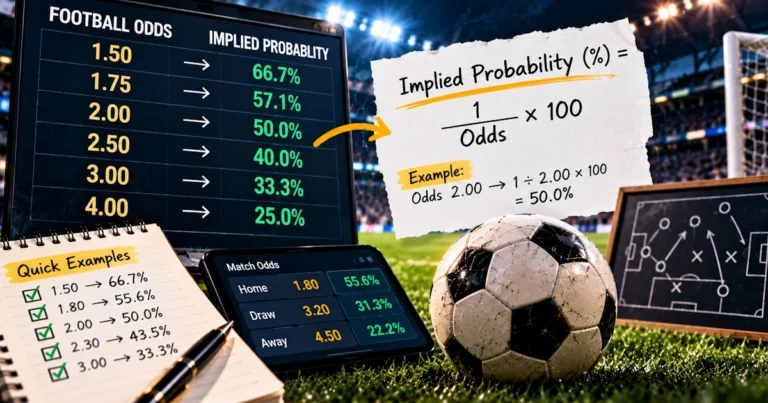
To understand margin, first convert decimal odds into implied probability.
The basic formula is:
Implied Probability = 1 ÷ Odds × 100
For example:
Odds of 2.00 1 ÷ 2.00 × 100 = 50%
Odds of 1.80 1 ÷ 1.80 × 100 = 55.6%
Odds of 2.50 1 ÷ 2.50 × 100 = 40%
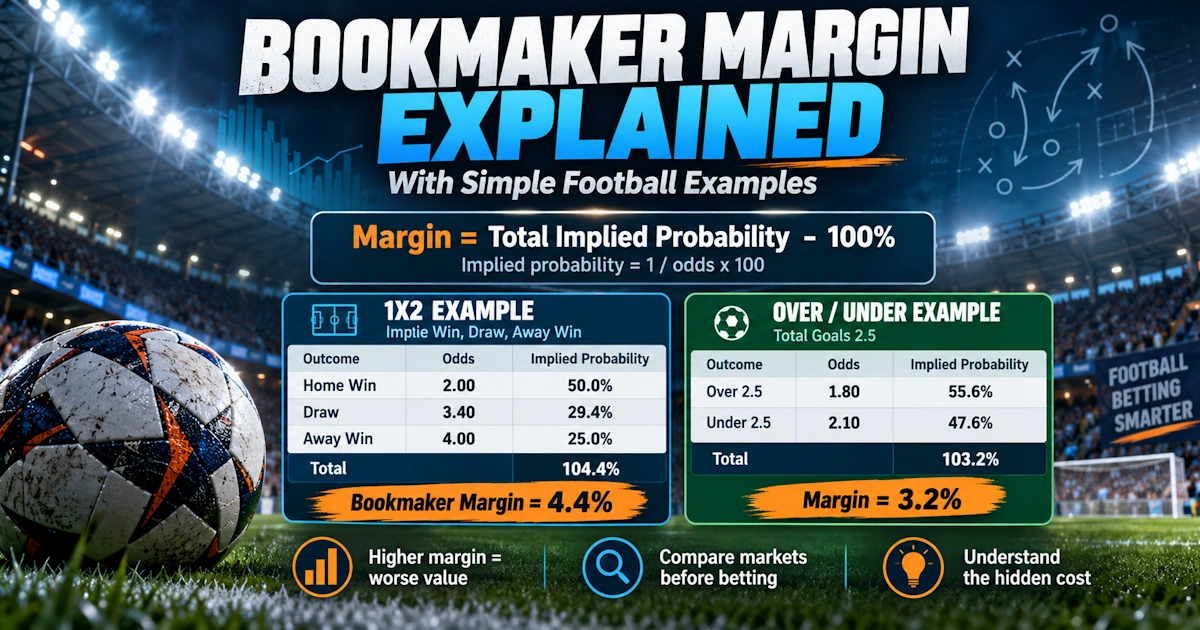
In a perfectly fair market, all possible outcomes should add up to exactly:
100%
Bookmaker markets usually add up to more.
That extra percentage is where the margin appears.
A Simple Two-Way Football Example
Consider an Over/Under market.
The bookmaker offers:
Over 2.5 Goals: 1.90
Under 2.5 Goals: 1.90
Convert each price.
Over: 1 ÷ 1.90 = 52.63%
Under: 1 ÷ 1.90 = 52.63%
Add them together: 52.63 + 52.63 = 105.26%
The market adds up to 105.26%, not 100%.
The overround is therefore: 105.26% – 100% = 5.26%
That is the basic bookmaker margin in the market.
Why Probabilities Above 100% Matter
Both Over and Under cannot each have a true probability of 52.63%.
Only one side can win.
The actual probabilities must collectively equal 100%.
The bookmaker has effectively compressed the odds on both outcomes.
If the event were truly 50-50, fair odds would be:
2.00 / 2.00
Instead, the bettor receives:
1.90 / 1.90
That difference may look small on one bet.
Across hundreds of bets, it becomes important.
How to Remove the Bookmaker Margin
You can estimate the market’s margin-free probabilities by normalising the raw implied probabilities.
Using the previous example:
Over raw probability: 52.63% Under raw probability: 52.63% Total: 105.26%
Now divide each probability by the total.
Over: 52.63 ÷ 105.26 = 50%
Under: 52.63 ÷ 105.26 = 50%
So the market’s approximate fair view is:
Over 50%
Under 50%
The bookmaker simply priced both sides shorter than fair odds.
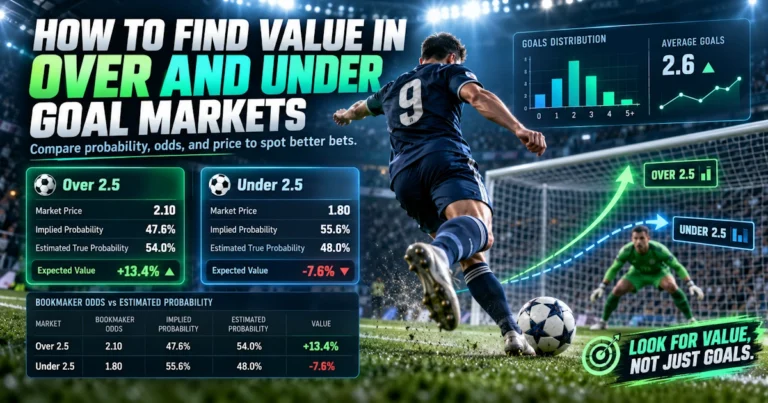
A More Realistic Over 2.5 Example
Suppose the market is:
Over 2.5: 1.75
Under 2.5: 2.10
Convert them.
Over: 1 ÷ 1.75 = 57.14%
Under: 1 ÷ 2.10 = 47.62%
Total: 57.14 + 47.62 = 104.76%
The overround is: 4.76%
Now remove the margin.
Over: 57.14 ÷ 104.76 ≈ 54.54%
Under: 47.62 ÷ 104.76 ≈ 45.46%
This tells us something useful.
At first glance, Over 2.5 at 1.75 implies 57.14%.
After adjusting for the bookmaker margin, the market’s underlying estimate is closer to 54.5%.
That distinction matters when comparing the bookmaker’s view with your own model.
Converting Fair Probability Back Into Odds
Once you have the fair probability, you can calculate fair odds.
Use:
Fair Odds = 1 ÷ Probability
Convert the percentage into decimal form first.
For Over 2.5 at 54.54%: 1 ÷ 0.5454 ≈ 1.83
So although the bookmaker offers 1.75, the approximate margin-free price is closer to: 1.83
For Under: 1 ÷ 0.4546 ≈ 2.20
The bookmaker offers 2.10.
Again, both prices are shorter than their approximate fair equivalents.
Bookmaker Margin in a 1X2 Market
Three-way football markets are slightly more interesting because there are three possible outcomes:
- Home win
- Draw
- Away win
Suppose the odds are:
Home: 1.80
Draw: 3.80
Away: 4.80
Convert them.
Home: 1 ÷ 1.80 = 55.56%
Draw: 1 ÷ 3.80 = 26.32%
Away: 1 ÷ 4.80 = 20.83%
Total: 55.56 + 26.32 + 20.83 = 102.71%
The overround is approximately: 2.71%
Now imagine another bookmaker offers:
1.72 / 3.60 / 4.50
The implied probabilities are:
- Home: 58.14%
- Draw: 27.78%
- Away: 22.22%
Total: 108.14%
That is a much larger margin.
The favourite may be identical.
The match may be identical.
But the second market is much less favourable to the bettor.
Why Comparing Bookmakers Matters
Suppose you want Over 2.5 Goals.
Bookmaker A offers: 1.78 Bookmaker B offers: 1.88 Bookmaker C offers: 1.95
If you have already decided the bet has value, the highest price is obviously preferable.
But the difference becomes clearer in probability terms.
1.78 implies: 56.18% 1.88 implies: 53.19% 1.95 implies: 51.28%
You are being asked to accept very different prices for exactly the same outcome.
Repeatedly accepting inferior odds can make a major difference over a large sample.
Margin Does Not Mean the Bookmaker Wins Every Bet
A bookmaker margin is a long-term mathematical advantage.
It does not mean the bookmaker profits on every match.
A bettor can win one bet. A bettor can have a profitable month.
A bookmaker can even lose heavily on an individual fixture.
The advantage appears over large numbers of bets when customers consistently accept prices that are below fair value.
That is why understanding price is so important.
Football prediction is not only about identifying what is most likely to happen.
It is about whether the available odds compensate you sufficiently for the risk.
Practical Example: A Correct Prediction Can Still Be a Bad Bet
Suppose you believe a favourite will win.
Your estimated probability: 70%
Fair odds: 1 ÷ 0.70 = 1.43
The bookmaker offers: 1.30
The implied probability is: 1 ÷ 1.30 = 76.9%
The team may still win 3-0.
Your football prediction was correct.
But based on your own estimate, 1.30 was too short.
The outcome of one match does not tell you whether the price was good.
This is one of the most important distinctions in betting analysis.
Practical Example: Finding Potential Value
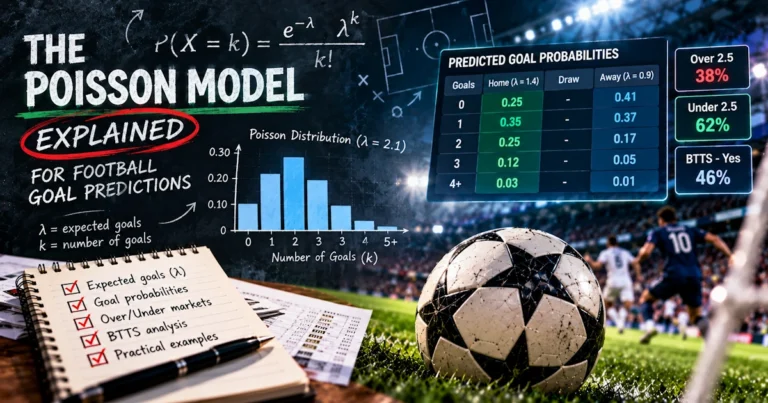
Suppose your statistical model gives BTTS – Yes:
58% probability
Fair odds: 1 ÷ 0.58 ≈ 1.72
The bookmaker offers: 1.95
The raw implied probability of 1.95 is: 51.28%
Your estimated probability is significantly higher.
That may represent potential value.
Of course, your 58% estimate could be wrong.
But at least you are now comparing probability with price rather than simply saying: “Both teams usually score.”
Margin Becomes Important in Accumulators
Bookmaker margin can become especially noticeable when multiple selections are combined.
Imagine three selections with true fair odds of:
- 1.50
- 1.60
- 1.70
Fair combined odds: 1.50 × 1.60 × 1.70 = 4.08
Now suppose the bookmaker’s available prices are:
- 1.44
- 1.54
- 1.62
Combined bookmaker odds: 1.44 × 1.54 × 1.62 ≈ 3.59
The difference between 4.08 and 3.59 is substantial.
Each individual price looked only slightly shorter.
Once combined, the effect becomes much more visible.
This is one reason long accumulators can be expensive from a pricing perspective as well as difficult to win.
Short Odds Do Not Mean Small Margin
A selection priced at 1.25 may look safe.
But the important question is not whether the odds are short.
It is whether they are fair.
Suppose you estimate a team’s true probability at 75%.
Fair odds: 1 ÷ 0.75 = 1.33
If the bookmaker offers only 1.25, the selection may be poor value despite being highly likely to win.
Short odds can sometimes create false comfort because bettors focus on probability and ignore price.
A high-probability event can still be overpriced.
Different Markets Can Have Different Margins
Not every football market is priced equally efficiently.
Major 1X2, Asian handicap and goal-total markets often have heavy competition between bookmakers and large trading volumes.
More specialised markets can sometimes have wider pricing gaps.
Examples include:
- Correct Score
- Player props
- Exact goal totals
- Smaller leagues
- Niche combinations
This does not mean these markets should always be avoided.
It means price comparison becomes even more important.
The less competitive the market, the more carefully you should inspect the odds.
Correct Score Shows the Problem Clearly
Imagine a bookmaker offers dozens of possible correct scores.
The individual odds may look huge:
- 1-0 at 7.00
- 1-1 at 6.50
- 2-1 at 8.50
- 2-0 at 9.00
Large odds can create the impression that the prices are generous.
But you would need to convert every possible scoreline into implied probabilities and add them together to see the total overround.
The headline odds alone tell you very little about the margin.
High odds do not necessarily mean good value.
Margin and Closing Odds
The closing market near kick-off is often more efficient because more information and betting activity have entered the market.
Suppose you take: Over 2.5 at 2.00
It later closes at: 1.80
The market has moved strongly towards your side.
You received a much better price than later bettors.
Tracking whether you regularly beat the closing price can therefore be useful when reviewing your predictions.
It does not prove every bet was good.
But across a meaningful sample, consistently getting better prices can be a positive sign.
Why Margin Matters More Over Hundreds of Bets
One slightly poor price will not destroy your results.
The problem is repetition.
Imagine two bettors make the same 200 selections.
Bettor A consistently obtains an average price of: 1.90
Bettor B gets: 1.80
Assume, for illustration, both win exactly 110 bets and lose 90.
Bettor A
Profit from winners: 110 × 0.90 = 99 units Losses: 90 units Result: +9 units
Bettor B
Profit from winners: 110 × 0.80 = 88 units Losses: 90 units Result: -2 units
Same predictions. Same number of winners. Completely different result.
The price was the difference.
A Simple Bookmaker Margin Checklist
Before making a football selection, ask:
- What probability do the odds imply?
- What is the total overround?
- What would the margin-free probability be?
- What are the approximate fair odds?
- How does that compare with my own estimate?
- Is another bookmaker offering a better price?
- Has the price moved?
- Am I accepting short odds simply because the selection feels safe?
- Would the bet still make sense at the current price?
Good football analysis should eventually lead to a pricing decision.
Frequently Asked Questions
What is bookmaker margin?
It is the built-in pricing advantage created when the implied probabilities of all outcomes add up to more than 100%.
What is an overround?
Overround is another name for the amount by which the combined implied probabilities exceed 100%.
How do I calculate bookmaker margin?
Convert every outcome into implied probability, add them together and subtract 100%.
Does a lower bookmaker margin mean better odds?
Generally, a lower-margin market provides more competitive pricing, although you should still compare the specific selection you want.
Can I remove the bookmaker margin from odds?
You can estimate margin-free probabilities by dividing each raw implied probability by the total implied probability of all outcomes.
Final Thoughts
Bookmaker margin is one of the simplest concepts in football betting, but it explains something extremely important:
Why predicting the right outcome is not enough.
A bookmaker does not normally offer the mathematical fair price on every outcome. The prices are shortened so that the combined implied probabilities exceed 100%.
That difference is the margin.
Once you understand it, odds become easier to evaluate.
You can convert prices into probabilities, calculate the overround, estimate fair odds and compare the market’s view with your own football analysis.
Most importantly, you begin to recognise that two questions must always be separated:
What do I think will happen?
and:
Is the available price good enough to bet on it?
The first question is about prediction.
The second is about value.
Long-term football analysis needs both.
Responsible betting: Understanding bookmaker margin does not remove risk or guarantee profit. Compare prices carefully, keep stakes within a fixed budget and never bet money you cannot afford to lose.