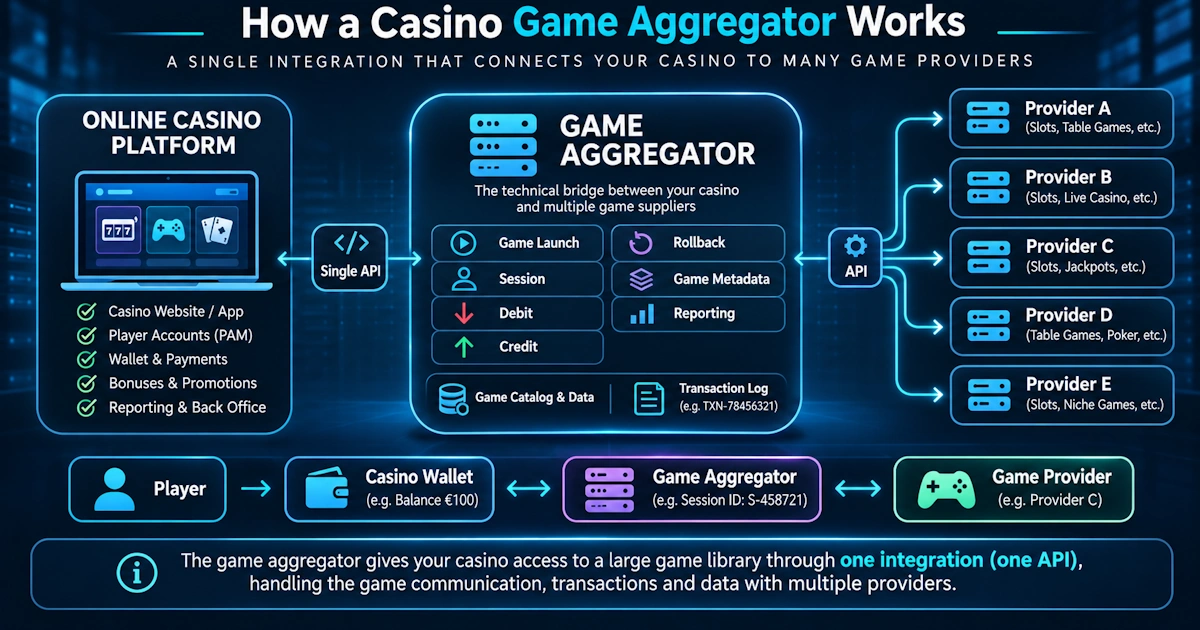
A casino game aggregator is a B2B technology layer that connects an online casino operator with games from multiple game providers through one main integration.
Instead of building and maintaining a separate technical connection with every slot studio, live casino supplier or other game provider, the operator can integrate with an aggregator and access many suppliers through that connection.
A simplified architecture looks like this:Casino Platform → Game Aggregator → Multiple Game Providers
The aggregator can handle much more than displaying a catalogue of games. Depending on the product, it may manage game-launch requests, player sessions, wallet transactions, game metadata, technical normalization, reporting and other integration functions.
However, an aggregator is not automatically a complete casino platform, PAM or Remote Game Server.
Its main role is to make game distribution and integration easier at scale.
Industry reporting increasingly describes aggregators as infrastructure connecting operators with game suppliers, often through a single API, while newer aggregation products may also add compliance, analytics and promotional tooling.
What Does a Casino Game Aggregator Do?
Imagine an online casino wants games from 30 different studios.
Without an aggregator, the operator might need to build: Integration 1 → Provider A Integration 2 → Provider B Integration 3 → Provider C and continue the same process for every other supplier.
Each integration can have its own:
API structure
authentication method
wallet communication
game-launch process
error codes
reporting format
game metadata
technical documentation
This can become difficult to manage as the number of suppliers grows.
An aggregator creates another layer:Casino Platform → Aggregator → Providers A, B, C, D…
The casino develops one principal integration with the aggregator. The aggregator then manages many of the provider-side integrations.
This is why the phrase single API integration appears frequently in the game-aggregation market. Recent B2B implementations continue to describe aggregators as giving operators access to many providers through one API connection.
Why Do Online Casinos Use Game Aggregators?
The main reason is integration efficiency.
A casino with several hundred or several thousand games does not necessarily have direct technical integrations with every studio represented in its lobby.
Using an aggregator can reduce the number of integrations the operator’s own development team needs to maintain.
This can make it easier to:
add new providers
launch additional games
enter new markets
manage game metadata
standardise transaction flows
monitor supplier connectivity
The aggregator effectively sits between two worlds:operator technology and:game-provider technology
Its job is to make those systems communicate more consistently.
How Does a Casino Game Aggregator Work?
The exact architecture varies, but a typical game flow may look like this:
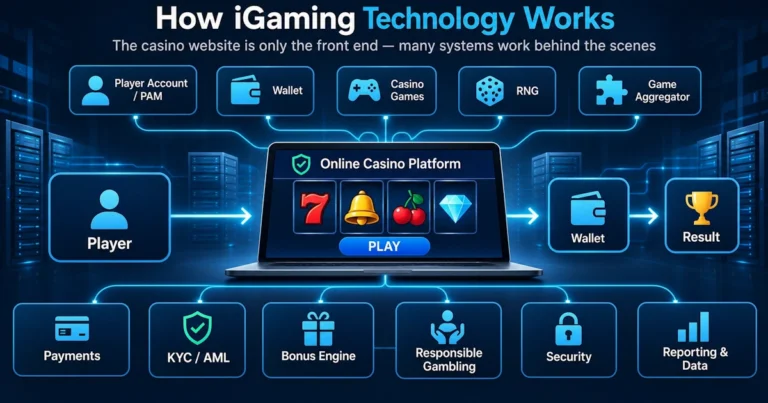
Player ↓ Casino Website / App ↓ Casino Platform ↓ Game Aggregator ↓ Game Provider / RGS
When the player launches a game, the casino platform sends information to the aggregator. The aggregator identifies the relevant game provider and forwards the request through the required provider integration.
The game then opens for the player. When wagers and results occur, information can flow back through the same chain.
For example:Game Provider → Aggregator → Casino Wallet / Platform
The operator still owns the customer relationship. The aggregator provides the technology linking that operator environment to multiple game suppliers.
What Happens When a Player Launches a Game?
Consider a player selecting a slot from the casino lobby. A simplified launch process might work like this.
Step 1: Player Selects the Game The casino knows which internal game ID the player selected.
Step 2: Casino Sends a Launch Request The platform sends the aggregator information such as:
Player reference
Game reference
Currency
Language
Session information
The exact fields vary by API.
Step 3: Aggregator Identifies the Provider The aggregator maps its game reference to the correct supplier.
Step 4: Provider Creates the Game Session The relevant game-provider system or RGS creates the session.
Step 5: Launch Information Returns The required launch information is passed back: Provider → Aggregator → Casino
Step 6: Game Opens The player sees the game.
The process may involve several systems, but to the player it can feel like one click.
What Is Game ID Mapping?
One practical problem in aggregation is that different systems can use different identifiers for the same game.
For example: Provider Game ID: SLOT_45821 Aggregator Game ID: AGG_128734 Casino Internal ID: GAME_9034
The integration needs to know that all three refer to the same game. This process is often handled through mapping.
Game mapping can also involve metadata such as:
game name
provider
game category
supported currency
language
mobile compatibility
demo availability
jurisdiction availability
Without reliable metadata and mapping, even a technically integrated game catalogue becomes difficult to operate.
What Is a Single API Game Integration?
A single API integration means the operator integrates with one aggregator interface instead of separately implementing each provider’s technical interface.
It does not mean every game provider uses identical technology behind the aggregator. Provider A might use one protocol. Provider B might use another. Provider C might have different transaction rules.
The aggregator translates or normalizes those differences into the interface presented to the casino.
In simplified form: Provider A API ↘ Provider B API → Aggregator API → Casino Platform Provider C API ↗
This normalization is one of the main technical values of aggregation.
Industry analysis published in 2026 describes exactly this role: providers can have different technical mechanics, while the aggregator helps translate those differences into a simpler integration model for operators.
Does One API Mean One Contract?
Not necessarily. This is an important B2B distinction.
Technical integration and commercial contracting are separate issues.
An aggregator may have commercial agreements with providers and make their content available under one commercial arrangement. Another aggregation model may allow the operator to negotiate directly with selected studios while still using the aggregator’s technical infrastructure.
Industry reporting in 2026 noted the growth of Platform-as-a-Service-style aggregation models where operators can negotiate direct provider agreements while continuing to rely on aggregator infrastructure for technical and regulatory operations.
So:One API ≠ automatically one commercial contract The answer depends on the aggregator’s business model.
How Does the Aggregator Connect to the Casino Wallet?
Real-money casino games need access to player balances. The game provider usually should not independently invent a player’s casino wallet balance. Instead, transactions are coordinated with the operator’s wallet.
Suppose the player has: €100 cash balance and places: €2 wager
A simplified flow could be:Game → Aggregator → Casino Wallet
Request: Debit €2
The wallet checks the account. If accepted: €100 → €98
The casino sends confirmation back:Wallet → Aggregator → Game
If the game then pays: €10
another message can be sent:Game → Aggregator → Wallet
Request: Credit €10
The resulting balance becomes: €108
The aggregator is facilitating communication. The casino wallet remains responsible for the player’s operator-side balance.
What Are Debit and Credit Calls?
These terms appear frequently in casino game integrations.
Debit A debit removes the wager from the player balance. Example: Balance €50 Debit €1 New balance €49
Credit A credit adds winnings. Example: Balance €49 Credit €5 New balance €54
The API needs enough information to correctly connect each debit and credit with:
player
game
gaming round
transaction
This is why unique transaction identifiers are important.
What Is a Game Round ID?
A game round ID identifies a particular game round or related sequence of transactions.
Suppose the player places: €2 wager and wins: €8
The system needs to understand that: Debit €2 and: Credit €8 belong to the same game round.
An identifier could conceptually look like: Round ID: 83920471
It allows the operator, aggregator and game provider to trace what happened.
Round-level records can become important when investigating:
player disputes
failed transactions
interrupted games
incorrect balances
reconciliation issues
What Happens If a Game Transaction Fails?
Distributed systems do not always work perfectly. A connection could fail after the game provider sends a wager request but before the casino confirms it.
The systems therefore need clear transaction handling.
Imagine: Game requests Debit €5 The casino wallet processes the debit. Then the connection fails before the game receives confirmation.
Without proper controls, the game could retry the request and debit the player twice.
This is why integrations need mechanisms such as:
unique transaction IDs
duplicate protection
transaction status checks
retry logic
rollback handling
reconciliation
The exact design differs between suppliers. The goal is always the same: one legitimate transaction should produce one correct financial result.
What Is a Rollback?
A rollback is a mechanism for reversing or correcting a transaction when the related game action cannot be completed as intended.
For example: €5 wager debited but: game round fails before acceptance
The integration may need to return: €5 to the player’s balance.
Different systems use different terminology and transaction logic. A rollback should not be confused with simply deleting transaction history. Financial systems generally need traceable records showing both the original event and its correction.
Why Is Idempotency Important?
Idempotency is a technical concept that helps prevent the same request from being processed multiple times.
Suppose the aggregator sends: Credit €100
The casino processes it successfully, but the response is lost because of a network issue. The aggregator retries the same request.
Without duplicate protection, the player could receive: €100 + €100 instead of: €100
An idempotent implementation recognizes that the second request refers to the same transaction and avoids processing the financial action twice.
This type of transaction integrity is especially important where real-money systems are connected through multiple APIs.
What Is Game Catalogue Management?
Aggregation is not only about wagers. The operator also needs information about the games it can offer.
An aggregator can maintain game catalogue data such as:
Game Name
Provider
Game Type
Game ID
Languages
Currencies
Devices
Jurisdictions
Release Status
The operator can then use that information to decide which games appear in its casino lobby.
Some aggregators also offer management tools allowing operators to activate, deactivate or organize content across brands.
Does an Aggregator Decide Which Games Appear in the Casino?
Usually the operator retains significant control over its own catalogue, but the available tools vary.
The aggregator determines which content is technically available through its integrations. The casino can then configure which of those games it wants to offer, subject to:
commercial agreements
market restrictions
certification
supplier conditions
platform configuration
A game being technically present inside an aggregator does not automatically mean every operator can legally launch it in every country.
Casino Game Aggregator vs Game Provider
A game provider develops or supplies games. Examples of provider-side content might include:
slots
roulette
blackjack
crash games
live casino
A game aggregator distributes access to games from multiple providers. So:Game Provider → Creates / operates game content Aggregator → Connects many providers with operators
Some companies perform both roles. A business may develop its own games while also distributing games from third parties. This is why the real functionality matters more than the company label.
Casino Game Aggregator vs RGS
RGS usually means Remote Game Server or Remote Gaming Server. An RGS operates game-side infrastructure.
It can support functions such as:
game logic
game sessions
outcomes
RNG interaction
payouts
The aggregator performs a different role. It connects operators with one or many provider/RGS environments.
A simplified structure is:Casino Platform ↓ Aggregator ↓ Provider RGS ↓ Game
One aggregator can therefore communicate with many separate RGS environments.
Casino Game Aggregator vs PAM
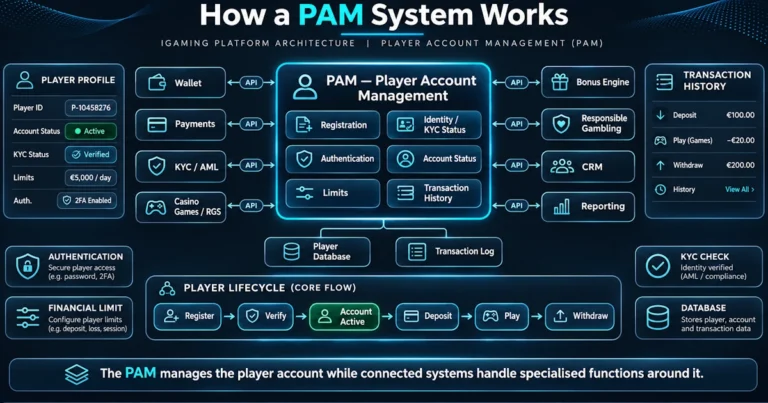
A PAM manages the player account. A game aggregator manages game integration.
PAM Focuses on: Who is the player? What is the account status? Which limits apply?
Aggregator Focuses on: Which game is being launched? Which provider owns it? How should game transactions move between provider and operator?
The systems may communicate indirectly through the casino platform. They should not be treated as the same technology.
Casino Game Aggregator vs Online Casino Platform
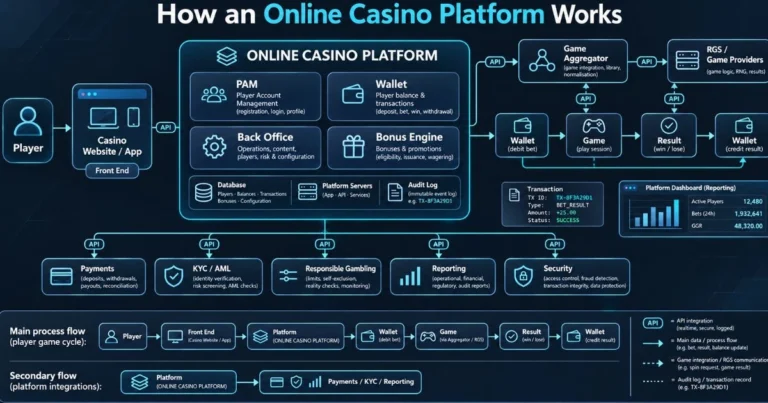
A full online casino platform can manage:
players
wallets
payments
bonuses
KYC
reporting
games
The game aggregator is usually one component or connected service within that wider architecture.
For example:Player → Casino Platform → PAM / Wallet and:Casino Platform → Game Aggregator → Providers
Some B2B suppliers offer both a casino platform and a game aggregator. That commercial packaging can make the terminology confusing. But architecturally, the concepts remain different.
How Do Aggregators Add New Game Providers?
When an aggregator adds a new provider, the two companies need to connect their technical systems.
This can involve:
agreeing API specifications
building game-launch integration
implementing wallet transactions
mapping game metadata
handling currencies and languages
testing game rounds
testing failed transactions
configuring environments
completing applicable certification or regulatory work
moving to production
Once the provider is successfully integrated into the aggregator, connected operators may be able to access that content without building an entirely new provider integration of their own. That is one of the main scalability advantages of aggregation.
Does an Aggregator Test the Games?
An aggregator can perform technical checks before making a provider’s games available through its system.
But aggregator integration testing should not be confused with independent regulatory game certification. These are different activities.
The aggregator may test:
launch flow
wallet transactions
metadata
session handling
error handling
A regulated market may separately require the game, gaming software or wider system to meet specific technical requirements or independent testing standards.GLI‘s standards library currently lists GLI-19 Interactive Gaming Systems v4.0 as its current interactive-gaming standard. GLI also makes clear that individual jurisdictions set their own requirements, even where GLI standards are used as a reference point.
Does an Aggregator Handle Game Certification?
It can help manage certification information or distribution controls, but responsibility varies.
For example, the aggregator may maintain information about:
certified game versions
approved markets
supplier licences
available RTP configurations
But using an aggregator does not eliminate the need to confirm that the relevant game and supplier are permitted in the operator’s target jurisdiction. The operator, supplier and aggregator may each have different compliance responsibilities.
A single API does not create a single worldwide approval.
What Is Market Filtering?
Game availability can differ by country or licence.
An aggregator may therefore use market rules to determine which games are made available to a particular operator or brand.
For example: Provider A Game 1 → Market X approved Provider A Game 2 → Market X unavailable Provider B Game 3 → Market X approved
The platform should not simply assume that every integrated game is suitable everywhere.
Market filtering can involve:
game certification
game type
provider authorization
jurisdiction restrictions
configuration requirements
For multi-market operators, this can become a major operational feature.
Can Aggregators Handle Different RTP Versions?
Some casino games can exist in several approved mathematical configurations. For example, one game might have different theoretical RTP variants.
Where multiple versions exist, the correct configuration needs to be distributed and identified accurately. An aggregator may help manage configuration information between the provider and operator.
However, the aggregator does not have unlimited freedom to create its own RTP settings. The available configurations come from the game’s approved mathematics and applicable regulatory framework.
What Other Features Can Game Aggregators Offer?
Modern aggregation products can go beyond basic game distribution.
Depending on the supplier, additional capabilities may include:
game analytics
reporting
tournaments
jackpots
promotional tools
recommendation systems
game lobby management
provider management
market filtering
These features are not universal.
Industry research published in 2026 noted that aggregation has expanded beyond basic connectivity into areas such as compliance support, API security, promotional tooling and data services. The important distinction is that these are additional capabilities. They should not be assumed to exist in every aggregator.
Why Reporting Matters
The operator may need to understand activity by:
game
provider
brand
country
currency
The aggregator can be an important source of game-level transaction data.
For example:Provider A Wagers: €500,000 Payouts: €470,000
Provider B Wagers: €300,000 Payouts: €285,000
This type of reporting can support:
reconciliation
commercial settlement
game-performance analysis
provider management
However, operator reporting should still be reconciled with the operator’s own wallet and financial records. The aggregator should not automatically become the only source of financial truth.
How Does Reconciliation Work With an Aggregator?
Consider three systems: Game Provider Aggregator Casino Wallet
All three may have transaction records. At the end of a reporting period: Provider record: €1,000,000 wagers Aggregator record: €1,000,000 wagers Casino record: €1,000,000 wagers
The figures match.
Now imagine: Provider: €1,000,000 Aggregator: €999,950 Casino: €999,950
The €50 difference needs investigation.
Reliable transaction identifiers allow teams to locate the affected rounds rather than searching through millions of transactions manually. Reconciliation is therefore a core operational requirement in aggregation.
Why Availability Matters
An aggregator can become an important dependency.
If the aggregator is unavailable:Casino → Aggregator ✕ → Game Providers
many or all aggregated games may become unavailable even if the individual provider systems are still operating. This creates what B2B architecture teams may call a concentration point.
Operators therefore need to evaluate areas such as:
uptime
redundancy
failover
incident management
monitoring
technical support
A very large game catalogue has limited value if the aggregation layer is unreliable.
Why Performance Matters
Game launches and wallet transactions should happen quickly.
If the integration adds too much latency, players can experience:
slow game launches
delayed balance updates
transaction timeouts
The aggregator therefore needs infrastructure capable of handling high transaction volumes with consistent performance.
This becomes especially important when one aggregator connects:many operators with:many providers and processes large numbers of game transactions simultaneously.
Why Security Matters
The aggregator sits between financially sensitive systems. It may process information connected with:
player sessions
wagers
winnings
account identifiers
game transactions
That makes API security important. Controls can include:
encrypted connections
authentication
authorization
signed requests
secure credential management
access controls
logging
monitoring
Industry analysis in 2026 highlighted API security as an increasingly important part of modern aggregation rather than treating the aggregator only as a content pipe.
Is a Casino Game Aggregator Regulated?
There is no universal licence called a casino game aggregator licence that applies everywhere. Regulatory treatment depends on what the business actually does and where it operates.
In Great Britain, gambling software is broadly defined as software designed for use in connection with remote gambling. The Gambling Commission says core gambling software generally includes systems that accept or record gambling transactions, determine results, or calculate and allocate winnings. Suppliers involved in manufacturing, supplying, installing or adapting relevant software can require a gambling software licence.
If a supplier goes further and actually hosts casino gaming facilities accessed by customers through other operators’ platforms, a remote casino game host operating licence can also become relevant in Great Britain.
The exact analysis depends on the aggregator’s role.
How Are Aggregators Treated in Malta?
Malta similarly regulates certain B2B gaming technology through its Critical Gaming Supply framework.
The Malta Gaming Authority states that a B2B Critical Gaming Supply licence can apply to businesses supplying and managing material elements of games or software that generates, captures, controls or processes essential regulatory records.
This does not mean every company using the marketing term “aggregator” automatically falls into exactly the same licensing category.
The actual services and technical responsibilities matter. That is a recurring theme in iGaming regulation: regulators care more about what the system does than what the vendor calls it.
Does Using an Aggregator Remove the Operator’s Compliance Responsibilities?
No. An operator cannot simply say: “The aggregator provides the games, so compliance belongs entirely to them.”
Responsibilities depend on the jurisdiction and contractual model. The operator still needs to ensure that the games it makes available to customers comply with the requirements applying to its gambling service.
For the British market, licensed remote operators must use gambling software supplied through the applicable licensed supply chain and ensure relevant gambling software meets the Commission’s technical requirements.
An aggregator can simplify operational compliance. It does not remove the operator’s regulatory obligations.
Direct Integration vs Game Aggregator
An operator may choose between:Direct provider integration and:Aggregator integration
Neither model is automatically superior.
Direct Integration
The operator connects directly to the game provider. Possible advantages include:
direct technical relationship
direct control
fewer technical intermediaries
But each provider requires its own integration and ongoing maintenance.
Aggregator Integration
The operator connects to many providers through one layer. Possible advantages include:
faster content expansion
fewer integrations
normalized APIs
centralized game management
But the operator becomes more dependent on the aggregator’s technology and commercial model.
Large operators can also use a hybrid approach. They may integrate directly with strategic providers while using an aggregator for the rest of the catalogue.
Does an Aggregator Reduce Time to Market?
Potentially, yes. Once an operator has integrated the aggregator, adding another already-supported provider may require much less development work than building a fresh direct API integration.
That does not mean every game can be launched immediately. Additional steps can still involve:
contracts
market approvals
game certification
provider configuration
testing
commercial setup
Aggregation reduces one major technical barrier. It does not make every other launch requirement disappear.
What Should Operators Evaluate in a Casino Game Aggregator?
B2B buyers should look beyond the advertised number of games. A serious evaluation should consider:
Provider coverage Are the suppliers needed for the target markets actually available?
Jurisdiction coverage Can the aggregator support the operator’s regulated markets?
API quality Is the integration well documented, stable and consistent?
Wallet model How are debit, credit, rollback and duplicate transactions handled?
Game launch architecture How are sessions created and authenticated?
Metadata Is game information accurate and easy to manage?
Reporting and reconciliation Can transaction records be traced across systems?
Security How are API credentials and financial messages protected?
Availability What happens if the aggregator fails?
Support How are production incidents escalated?
Commercial model Who contracts with the game providers?
Compliance responsibilities Who manages certifications, market approvals and provider eligibility?
A huge game catalogue can be impressive. For an operator, transaction integrity and reliability are more important than the biggest game count on a sales slide.
Common Casino Game Aggregator Misconceptions
“An aggregator develops all the games it offers.” No. Its core role is usually to distribute and integrate games from multiple providers, although some companies also develop games.
“A game aggregator is a full casino platform.” Not necessarily. A complete platform normally covers wider areas such as PAM, wallet, payments and account management.
“One API means one provider.” No. That is the main point of aggregation: one operator-side integration can connect to many provider integrations.
“One API means every game is approved in every country.” No. Market availability, licensing and certification still matter.
“The aggregator owns the player’s balance.” Usually the operator’s wallet remains the authoritative balance system, although exact architectures differ.
“Using an aggregator removes the need for compliance work.” No. The aggregator can support compliance and distribution, but the operator still has regulatory responsibilities.
Why Game Aggregation Matters in Modern iGaming
The number of game studios and titles available to online casinos has grown far beyond what would be practical for many operators to integrate independently.
Recent industry data illustrates the scale of the content ecosystem. Aggregators have developed partly because operators need a manageable way to connect large and constantly changing supplier catalogues.
The aggregator therefore solves an infrastructure problem: How can one casino platform communicate efficiently with many independent game systems?
Its answer is: one integration layer that normalizes and distributes those connections.
That role can become even more important as operators expand into more brands, providers and jurisdictions.
Final Thoughts
So, what is a casino game aggregator?
It is a B2B technology layer that connects online casino operators with games from multiple suppliers.
Instead of: Casino → Provider A Casino → Provider B Casino → Provider C
the architecture becomes:Casino → Aggregator → Providers A, B and C
The aggregator can standardise technical differences between providers and help manage:
Game Launches
Player Sessions
Wallet Transactions
Game Metadata
Reporting
Provider Connectivity
Modern aggregators may also include analytics, compliance support, promotional tools and other services, but those features vary between suppliers.
The most important architectural distinction is: The casino platform manages the wider operation. The PAM manages the player account. The wallet manages the player’s money. The RGS runs game-side functionality. The game aggregator connects the operator with multiple game providers.
For B2B operators, that makes aggregation primarily a question of scale and integration efficiency.
A strong aggregator is not simply the one claiming the largest game library. It is the one that can reliably connect providers and operators while maintaining accurate transactions, stable APIs, clear reporting, appropriate market controls and dependable technical operations.
Frequently Asked Questions
What is a casino game aggregator? A casino game aggregator is B2B technology that connects an online casino with games from multiple game providers, usually through one main API integration.
What is a single API casino integration? It means the operator integrates with the aggregator’s technical interface instead of separately implementing an API for every individual game provider. The aggregator manages the provider-side connections.
Is a game aggregator the same as an online casino platform? No. A casino platform manages the wider operation, including player accounts and other services. A game aggregator primarily connects the operator with game suppliers.
Is a game aggregator the same as an RGS? No. An RGS operates game-side infrastructure. An aggregator can connect the operator to multiple providers and their RGS environments.
Does a casino game aggregator handle player balances? It can transport wallet transaction requests between games and the operator, but the operator-side wallet commonly remains the authoritative system for player balances. Architectures can differ.
Do casino game aggregators need licences? Potentially. Requirements depend on the jurisdiction and exactly what the aggregator supplies or operates. Relevant gambling-software, B2B critical-supply or game-host permissions can apply depending on the business model.