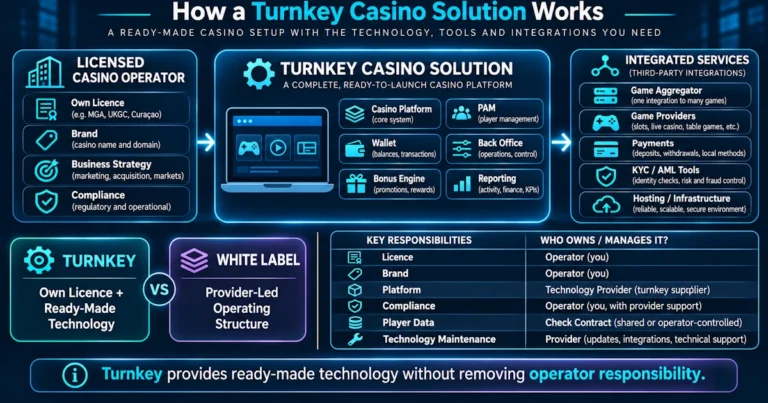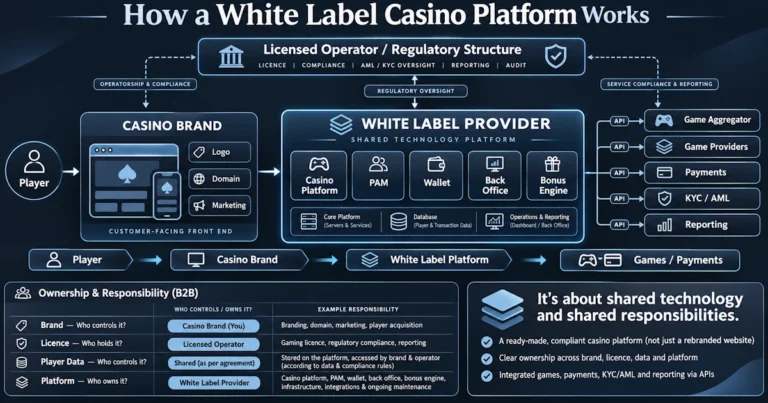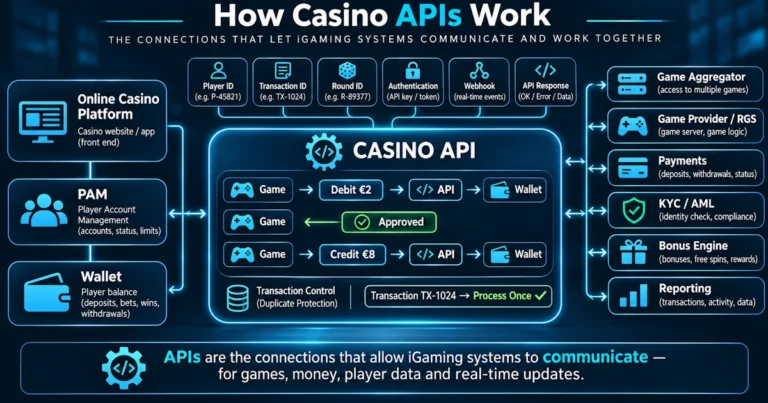
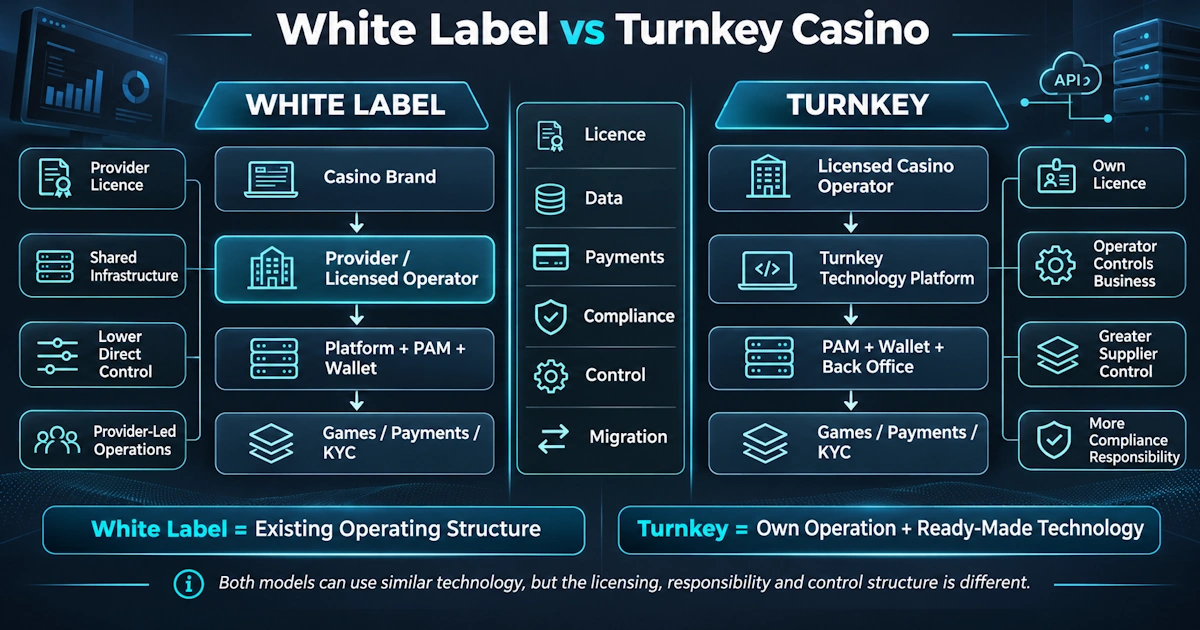
The main difference between a white label vs turnkey casino is usually the level of regulatory and operational control held by the casino business.
In a typical white-label model, a brand launches using an existing licensed operator’s technology and regulatory structure. The provider or licensed operator controls much of the core infrastructure, while the partner focuses mainly on branding, marketing and customer acquisition.
In a typical turnkey model, the technology is still supplied by a third party, but the casino operator normally holds its own gambling licence and operates the business in its own regulatory name.
A simple way to think about the two models is:White Label = Use an Existing Operating Structure Turnkey = Use Existing Technology for Your Own Operating Structure
However, these are commercial industry terms rather than universal legal definitions. Vendor packages differ, and gambling rules vary by jurisdiction.
The correct choice therefore depends less on the label and more on who holds the licence, who contracts with players, who controls the data, who manages payments and who carries regulatory responsibility.
White Label vs Turnkey Casino at a Glance
| Area | White Label | Turnkey |
| Gambling licence | Usually provider/licensed operator in the classic model | Usually operator’s own licence |
| Casino technology | Provider | Provider |
| Brand | Typically partner/operator brand | Operator brand |
| Player relationship | Often controlled legally by licensed provider | Usually direct operator relationship |
| Compliance responsibility | Licence holder remains responsible | Operator normally carries direct responsibility |
| Payments | Often provider-led | More commonly operator-controlled |
| Player data control | Can be more restricted; contract matters | Usually greater operator control; contract still matters |
| Technical customisation | Usually more limited | Usually more flexible |
| Initial operating complexity | Lower | Higher |
| Regulatory independence | Lower | Higher |
| Provider dependency | High | Still significant, but usually lower |
| Migration control | Can be more difficult | Typically stronger, depending on contract |
| Best suited to | Businesses prioritising an existing operating structure | Licensed operators seeking more control |
This table describes common B2B usage, not a universal regulatory rule.
What Is the Core Difference?
The most important difference is usually:Who is the regulated casino operator?
In a white-label arrangement recognised by the UK Gambling Commission, the licensed operator provides the gambling facilities while another organisation supplies the brand. The licence holder remains responsible for gambling activity on the white-labelled website.
In common turnkey industry usage, the customer uses a ready-made platform but holds its own gambling licence and operates the casino directly. Current turnkey suppliers describe this model as technology deployed under the operator’s licence rather than the technology provider’s operating licence.
That one difference affects almost everything else:
Compliance
Payments
Player relationships
Data
Commercial control
Expansion
Exit strategy
What Is a White Label Casino?
A white-label casino typically allows a company to launch a branded gambling website using another licensed operator’s existing technology and operational infrastructure.
A simplified structure is:Player ↓ Casino Brand ↓ Licensed White Label Operator ↓ Platform / PAM / Wallet ↓ Games / Payments / KYC / Reporting
The brand can look independent to the player. But legally and operationally, the underlying licensed operator can remain the entity providing the gambling service.
The UK government describes white labelling as a commercial arrangement where a licence holder offers remote gambling under a brand supplied by a third party that does not itself hold the gambling operating licence.
That makes white label fundamentally different from simply buying casino software.
What Is a Turnkey Casino?
A turnkey casino solution generally provides a ready-made technology stack for an operator that runs the gambling business under its own regulatory structure.
A simplified architecture is:Licensed Operator ↓ Turnkey Platform ↓ PAM / Wallet / Back Office ↓ Games / Payments / KYC / Reporting
The supplier maintains much of the technology. The operator remains responsible for the gambling business.
This distinction is also consistent with the separation regulators make between technology supply and consumer-facing gambling operation. In Great Britain, for example, a remote gambling software licence permits the manufacture, supply, installation or adaptation of gambling software, while a separate remote casino operating licence is required to offer casino games directly to customers.
Is White Label or Turnkey a Legal Licence Category?
Not necessarily. This point is important.
The UK government explicitly notes that white label is not a statutory term. It describes a commercial arrangement rather than a separate category of gambling licence.
“Turnkey” is even more clearly a B2B commercial term.
Regulators generally care about:
Who provides the gambling service?
Who holds the licence?
Who supplies regulated software?
Who controls player funds and accounts?
rather than whether a vendor brochure calls the product:Turnkey or:White Label
That is why the contract and regulatory structure matter more than the product name.
Licence Ownership: The Biggest Difference
Licence structure is usually the first comparison a B2B buyer should make.
White Label Under a classic white-label structure, the casino brand may operate through another company’s gambling licence. In Great Britain, the Gambling Commission says the operator holds the licence and remains responsible for activity on white-labelled domains. A white-label marketing partner cannot itself offer gambling facilities unless it holds the relevant licence.
Turnkey A turnkey customer normally obtains and maintains its own gambling licence. The technology supplier provides the software environment. The casino operator manages its direct regulatory relationship.
This is why turnkey generally requires more preparation before launch. The operator needs more than software. It needs an authorised gambling business.
Does Turnkey Give the Operator More Control?
Usually, yes.
The operator generally has greater influence over:
licence strategy
payment relationships
compliance policies
customer operations
supplier relationships
market expansion
data strategy
But greater control does not mean ownership of the platform software. The technology can still belong to the turnkey provider.
The operator is buying or licensing access to a technology stack, not necessarily acquiring its source code or intellectual property. The exact rights need to be defined in the agreement.
Technology: Are the Platforms Actually Different?
Not necessarily. The same technology company could theoretically use the same underlying online casino platform architecture for both models.
For example, both could contain:
Wallet
Back Office
Bonus Engine
Game Aggregator
Payment Integrations
The major difference may be how the business is structured around that technology.
White label might look like: Provider Licence + Provider Platform + Partner Brand
Turnkey might look like: Operator Licence + Provider Platform + Operator Brand
So the technology stack can be similar while the business relationship is very different.
White Label vs Turnkey: Who Contracts With the Player?
This is a major legal distinction.
In a Great Britain white-label arrangement, the licensed operator is the entity providing the gambling facilities and contracting with customers.
In a conventional own-licence turnkey model, the licensed casino operator usually has the direct player relationship.
That affects:
terms and conditions
player complaints
account management
customer funds
regulatory reporting
responsible gambling obligations
For a B2B buyer, this question is much more important than who designed the website.
Who Handles Compliance?
White Label The licence holder retains regulatory responsibility. It may delegate operational tasks to partners or third-party service providers, but it cannot simply transfer its own compliance obligations. The UK Gambling Commission specifically states that responsibility for compliance on white-labelled gambling websites remains with the licence holder.
Turnkey The operator normally holds the licence and therefore carries the direct operating responsibility. The technology supplier can provide:
AML systems
responsible gambling controls
regulatory reporting
but those tools support the operator rather than replacing its regulatory duties.
The distinction is:White Label → compliance responsibility sits with the underlying licenseeTurnkey → compliance responsibility generally sits directly with the operator
Which Model Requires More Compliance Resources?
Usually turnkey.
An independent licensed operator may need its own:
compliance function
AML procedures
responsible gambling procedures
regulatory reporting
licence management
internal controls
A white-label partner can operate within more of the provider’s existing compliance environment. That can reduce operational burden for the partner. But it also reduces independence. The provider may impose stricter operational rules because the provider’s own licence is at risk.
How Do Payments Differ?
Payment structure can vary substantially.
White Label Payments The provider may already have established:
payment-provider agreements
merchant relationships
cashier systems
settlement processes
The brand operates inside that infrastructure.
Turnkey Payments The operator may use the platform’s pre-built payment integrations while establishing more of its own commercial relationships with payment companies. This creates greater control but can require more work.
A useful distinction is:Payment integration tells you the software can connect to the PSP.Payment agreement tells you whether the PSP has agreed to process transactions for your casino business.
Those are not the same thing.
Who Controls Player Funds?
This should always be clarified in the contract.
In a provider-led white-label structure, the licensed operator may have greater control over:
player wallets
payment settlement
because it is the regulated gambling operator.
In a turnkey model, the licensed operator typically has a more direct relationship with player funds and payment partners.
But arrangements vary. Never assume control simply because a product is called turnkey.
Who Controls the Player Database?
This is another major commercial issue.
White-label partners can have more limited rights over player data because the licensed operator may control the customer relationship.
A good example comes from Denmark. The Danish Gambling Authority states that a white-label buyer should not own the registered player database during the white-label relationship and should not generally control player accounts or operational activities.
That is a specific Danish framework, not a universal rule. But it illustrates why data control needs careful analysis.
With turnkey, an own-licence operator normally expects much stronger access to its player information.
Even then, contracts should clarify:
Who is the data controller?
Where is data hosted?
Can data be exported?
In what format?
What happens when the platform agreement ends?
Does Turnkey Mean the Operator Owns the Player Data?
Not automatically in every legal sense.
Statements such as:“You own the player data” can oversimplify privacy law.
Data-control rights depend on:
regulatory role
privacy law
contractual responsibilities
processing structure
Commercially, a turnkey operator generally has stronger control and portability expectations because it owns the regulated customer relationship. But the exact rights still need to be documented.
Which Model Offers More Customisation?
Turnkey usually offers more.
White-label platforms often operate as shared standardized environments. The provider may allow customisation of:
logo
colours
banners
game selection
selected promotions
But deeper backend changes can be restricted.
Turnkey arrangements may allow greater control over:
front end
APIs
payment integrations
CRM
game suppliers
data tools
account workflows
The amount of freedom still depends on the provider. Turnkey should not automatically be confused with custom software.
Which Model Is Faster to Launch?
White label can have a lower implementation burden because more of the operating structure already exists. The partner may not need to establish every component independently.
Turnkey removes much of the software-development work but usually does not remove the operator’s need to establish its own licensing and operating framework.
This means the technology itself can be deployed quickly while the total business launch still depends on:
licence process
banking
payment agreements
compliance setup
regulatory approvals
Commercial suppliers currently make the same distinction when describing turnkey deployment: technology setup and operator licensing are separate workstreams. For this reason, exact “launch in X days” claims should be treated cautiously unless the scope is clearly defined.
Which Model Has the Lower Initial Cost?
White label often requires less initial infrastructure and regulatory investment from the brand partner. The provider has already built much of the system and may already maintain the relevant operating structure.
Turnkey generally requires the operator to invest in:
licence application
corporate structure
compliance
banking
payment relationships
platform implementation
However, there is no reliable universal price difference. Suppliers use different combinations of:
setup fees
monthly fees
minimum fees
revenue share
third-party charges
A proper comparison needs the full commercial model.
Which Model Has Higher Ongoing Costs?
There is also no universal rule.
White-label providers may charge more through revenue-sharing arrangements because their service can include more than technology. The commercial package may include:
licensed operating structure
platform
payments
compliance infrastructure
support
Turnkey fees can focus more heavily on technology because the operator carries additional operating costs itself. But this does not mean turnkey is always cheaper.
The operator must also pay for areas such as:
compliance staff
regulatory costs
payments
KYC
legal advice
reporting
internal operations
The right comparison is:Total Cost of Operating the Casino rather than:Platform Fee Only
Revenue Share vs Platform Fees
A white-label contract may use a revenue share because the provider contributes substantial operating infrastructure.
A turnkey contract can use:
platform licence fee
minimum monthly fee
revenue share
combinations of these models
Do not assume:White Label = Revenue Share and:Turnkey = Fixed Fee
That distinction is common in some offers but not universal. The contract should define exactly how charges are calculated.
Which Model Gives Better Long-Term Margins?
Potentially turnkey, especially at scale, but not automatically.
A growing operator may prefer greater control over:
payment costs
game-provider commercial terms
infrastructure
marketing data
This can create opportunities to optimise margins.
However, those savings must be compared with the additional costs of maintaining an independent regulated operation. A smaller casino may find that paying a provider for a broader service is economically sensible. A larger operator may decide that paying for its own infrastructure and compliance gives it better long-term economics.
There is no single break-even point for the entire industry.
Which Model Offers More Regulatory Independence?
Turnkey generally offers more.
If the operator holds its own licence, another platform customer’s behaviour does not directly determine its licensing status. The operator still depends on technology suppliers, but its regulatory identity is separate.
In a white-label model, several brands can depend on the same licensed operator. That creates concentration risk. If the licence holder faces enforcement action or loses its licence, several partner brands could be affected.
The British framework makes this dependency clear because responsibility for all white-labelled sites sits with the underlying licensee.
Which Model Makes Entering New Markets Easier?
It depends on the market.
A white-label provider may already have permission to operate in certain jurisdictions. That can make entry simpler where the legal framework permits the structure. But the brand is limited by the provider’s regulatory coverage.
Turnkey allows an operator to build its own licensing strategy. For example: Market A → Licence A Market B → Licence B Market C → Licence C
This takes more work. But the operator is less dependent on whether the white-label provider decides to support the market.
Can a White Label Enter Every Market Supported by the Platform?
No. Technology availability and legal market access are different questions.
A platform may technically support:
Currency
Language
Payment Method
but that does not mean the white-label operating structure is legally permitted in that country. The same applies to turnkey. A platform can support a jurisdiction technically while the operator still needs the correct licence.
Malta: Why B2B and B2C Licensing Matters
Malta provides a useful example of the distinction between technology supply and gambling operation.
The Malta Gaming Authority has separate categories for:Gaming Service Licence — B2C and:Critical Gaming Supply Licence — B2B
The B2C licence covers offering a gambling service, while B2B critical gaming supply can cover material elements of games and certain software handling essential regulatory records.
This shows why having a licensed platform provider does not automatically mean that a separate business is authorised to operate directly with players. The operator and technology supplier can have different regulatory roles.
Which Model Offers Better Supplier Control?
Turnkey generally provides more potential control.
An independent operator may be able to negotiate directly with:
game providers
aggregators
PSPs
KYC suppliers
CRM providers
A white-label business may be restricted to suppliers already approved or integrated by the provider. That restriction can actually simplify operations. But it can also become limiting when the brand wants a service outside the existing ecosystem.
What About Game Providers?
Both models can use game aggregators. For example:White Label → Provider Platform → Aggregator → Games and:Turnkey → Operator Platform → Aggregator → Games
The difference is not necessarily the game technology. The difference is more about:
Who selects suppliers?
Who signs contracts?
Who controls commercial negotiations?
Turnkey may give the operator more opportunities for direct supplier relationships.
Which Model Gives Better Payment Control?
Turnkey typically offers more potential independence.
The operator may be able to maintain its own PSP relationships and negotiate:
processing rates
reserves
settlement terms
supported methods
A white-label partner may use the payment ecosystem chosen by the provider. This reduces setup complexity. But payment dependency can become an important limitation as a business grows.
Who Handles Customer Support?
Either model can use:
in-house support
provider support
outsourced support
There is no fixed rule.
White-label packages are more likely to bundle wider operational services. Turnkey packages can focus more heavily on software while the operator builds its own operational team.
The contract should clearly identify:
Who speaks to the player?
Who handles account complaints?
Who investigates withdrawals?
Who escalates compliance issues?
What Is the Difference in Vendor Lock-In?
White label can create stronger dependency because the provider may control several layers at once:
Licence
Platform
Payments
Player Database
Game Relationships
If the partnership ends, the brand may need to replace many of these components simultaneously.
Turnkey also creates vendor dependency because the core platform is still supplied by another company. But an operator with its own licence, payment relationships and customer contracts may have a stronger position when changing technology.
Which Model Is Easier to Migrate From?
Turnkey is often structurally easier, but only if migration rights were planned correctly. Even an own-licence operator can become heavily locked into a platform.
Before signing either type of contract, check:
Can player data be exported?
Can complete transaction history be exported?
Can active balances migrate?
What happens to bonus balances?
Which supplier contracts remain valid?
Who assists with migration?
What format will data be supplied in?
Exit planning should happen before launch.
Who Owns the Domain?
The brand should ideally know this immediately. Do not assume the platform provider controls it. Do not assume the brand controls it either.
The agreement should explicitly define ownership and administrative control of:
domain
trademarks
social accounts
design assets
content
Domain ownership becomes especially important if the commercial relationship ends.
White Label vs Turnkey: Compliance Risk
Both models have compliance risk. The location of that risk differs.
White Label A partner depends on the licensed operator maintaining a compliant business. Problems involving other brands or the provider itself can affect the wider operation.
Turnkey The operator carries more direct responsibility. A platform supplier may provide good tools, but the operator can still fail through poor:
KYC procedures
AML controls
player protection
reporting
staff processes
Turnkey transfers more control to the operator. It also transfers more accountability.
White Label vs Turnkey: Operational Risk
White label concentrates more activity inside the provider. That can reduce the number of systems the partner has to manage.
Turnkey spreads more responsibility across the operator’s organisation and suppliers.
Therefore:White Label Risk → dependency on providerTurnkey Risk → greater internal operational responsibility
Neither model removes risk. It changes where the risk sits.
White Label vs Turnkey: Business Continuity
Consider what happens if the platform provider experiences a major outage.
Both models could be affected because both may use the provider’s software. But a white-label brand could also depend on that same provider for:
licence
payments
compliance
player relationship
Turnkey may allow the operator to retain more of the surrounding business structure even while replacing the technology. This is one reason operational independence becomes increasingly important as a casino grows.
Is White Label Better for New Operators?
Sometimes, but not automatically.
A business with limited technical and operational infrastructure may value:
existing technology
existing supplier network
reduced launch complexity
White label can provide that.
But before choosing it, the business needs to confirm that the structure is permitted in its target market. The ability to launch quickly has little value if the model cannot legally support the intended jurisdiction.
Is Turnkey Better for Serious Long-Term Operators?
Often it is a more natural fit for businesses that want:
their own licence
direct regulatory relationship
stronger data control
greater supplier freedom
multi-market expansion
But turnkey demands more resources.
An inexperienced business that obtains a licence but lacks the people required to operate responsibly has not solved the hard part simply by purchasing good software. Technology and operating competence are different things.
When White Label May Make More Sense
White label may deserve consideration when:
the jurisdiction permits the model
an existing licensed operator provides the required market access
the business wants to minimise technical and operating complexity
extensive customisation is not essential
provider dependency is commercially acceptable
The specific provider and contract matter greatly.
When Turnkey May Make More Sense
Turnkey may be more suitable when:
the operator already has or intends to obtain its own licence
long-term independence matters
player-data portability is important
custom integrations are needed
direct payment relationships are valuable
the business expects multi-market growth
This usually requires a stronger internal operating organisation.
White Label vs Turnkey vs In-House
There is also a third option.
White Label Use Provider Operating Structure + Provider Technology
Turnkey Use Own Operating Structure + Provider Technology
In-House Use Own Operating Structure + Own Technology
Control generally increases as the business moves from:White Label → Turnkey → In-House
But so do:
cost
technical responsibility
staff requirements
operational complexity
The correct goal is not maximum control. It is the level of control the business can manage effectively.
Does Turnkey Eliminate Vendor Dependency?
No. Even a turnkey operator can depend heavily on its platform supplier.
The provider may still control:
software releases
wallet architecture
core APIs
back-office features
platform uptime
Turnkey should therefore be understood as:greater operational independence not:total technological independence
The contract remains crucial.
Can You Start White Label and Move to Turnkey Later?
Potentially, yes.
A business might use one operating model initially and later migrate toward a more independent setup. But migration can require:
new gambling licence
new player terms
database migration
balance migration
new payments
supplier agreements
compliance approval
technical integration
This is why a planned future migration should influence the original white-label contract. If data portability is poor, the future transition can become expensive.
How Should You Compare Commercial Offers?
Do not compare only the headline price. Create the same financial model for both options.
Include:
Setup
Platform Fees
Revenue Share
Licence Costs
Compliance Staff
Payment Fees
Game Fees
KYC
Customer Support
Hosting
Legal Costs
Reporting
Migration Costs
Then model the total at different business sizes. For example:
Low Revenue
Medium Revenue
High Revenue
This shows whether a low initial cost becomes expensive as the business scales.
The Most Important Contract Questions
Before choosing either model, resolve these questions:
Who holds the gambling licence?
Who legally contracts with players?
Who controls player funds?
Who owns or controls the domain?
Who controls access to player data?
Who contracts with payment providers?
Who contracts with game providers?
Who handles KYC and AML?
Who carries regulatory responsibility?
What happens if the agreement ends?
Can the player database be migrated?
What happens if the provider loses its licence?
If any of these answers are unclear, the business model is unclear.
A Simple Control Comparison
A useful commercial exercise is to map each major asset.
Typical White Label Structure
Licence — Provider / Licensed Operator Platform — Provider Brand — Partner Compliance — Licence Holder Payments — Often Provider-Led Player Data — Contract / Regulatory Structure Games — Provider Ecosystem
Typical Turnkey Structure
Licence — Operator Platform — Technology Provider Brand — Operator Compliance — Operator Payments — More Operator Control Player Data — Usually Greater Operator Control Games — Platform + Operator Supplier Strategy
Again, these are typical commercial models rather than universal legal definitions.
Common White Label vs Turnkey Misconceptions
“Turnkey means I own the platform.” Not necessarily. The operator may control the business while licensing the platform technology from another company.
“White label means an unlicensed casino.” No. In a legitimate white-label structure, the gambling service can be provided by a properly licensed operator. In Great Britain, for example, the licence holder remains responsible for the white-labelled site.
“Turnkey is always more expensive.” Not necessarily. It usually creates more independent operating costs, but total economics depend on fees, revenue share, licensing, compliance and scale.
“White label is always faster.” It can reduce launch complexity, but timing depends on the provider, target market, commercial setup and approvals.
“Turnkey gives complete independence.” No. The operator can still depend heavily on the technology provider.
“The model name tells me who owns the data.” No. Check the contract and regulatory structure.
Which Model Is Better?
Neither model is universally better. The decision depends on what the business is trying to build.
White label prioritises:
existing infrastructure
lower operational setup burden
provider-led structure
Turnkey prioritises:
regulatory independence
greater control
long-term flexibility
The more useful question is therefore not:“Which model is better?” It is:“How much control and regulatory responsibility does this business want and have the resources to manage?”
Final Thoughts
The key difference in white label vs turnkey casino is not the website design or the number of games. It is the operating structure behind the casino.
A simplified comparison is:
White Label Brand → Existing Licensed Operator → Provider Platform
versus:
Turnkey Licensed Operator → Third-Party Platform → Integrated Services
White label can reduce the amount of infrastructure a brand needs to establish independently. Turnkey gives the operator more direct control over its licence, customers, supplier strategy and long-term business.
But greater control comes with greater responsibility.
A turnkey operator must be capable of managing a regulated gambling business. A white-label partner must be comfortable depending on another licensed operator and its commercial ecosystem.
For B2B buyers, the strongest decision therefore comes from answering five questions:
Who holds the licence?
Who contracts with the player?
Who controls the money?
Who controls the data?
What happens when the partnership ends?
Once those answers are clear, the difference between white label and turnkey becomes much easier to understand.
Frequently Asked Questions
What is the main difference between a white label and turnkey casino? In common B2B usage, a white-label brand operates within another licensed operator’s existing regulatory and technology environment, while a turnkey casino uses ready-made technology but normally operates under its own gambling licence.
Does a turnkey casino need its own licence? Usually yes under the common turnkey model. The technology provider supplies the platform, while the casino operator obtains and maintains the relevant B2C gambling authorisation for its target market.
Is a white label casino legally licensed? A legitimate white-label site can operate under a licensed gambling operator. In Great Britain, the Gambling Commission states that the licensed operator, rather than the white-label brand itself, provides the gambling facilities and remains responsible for compliance.
Which is cheaper: white label or turnkey casino? There is no universal answer. White label can reduce initial operating and licensing setup, while turnkey can provide greater commercial control. Total costs should include platform fees, revenue share, compliance, licensing, payments, games and staff.
Who owns player data in a white label casino? There is no universal rule. Rights depend on the jurisdiction, regulatory structure, privacy obligations and commercial agreement. Data access and migration rights should be confirmed before signing.
Which is better for long-term expansion? Turnkey can provide more independence for an operator planning direct licensing, multi-market expansion and greater supplier control. White label can still be suitable where the regulatory structure permits it and provider dependency fits the business model.