A casino bonus engine is the software used to create, calculate, track and enforce promotional rewards inside an online casino platform.
It can manage offers such as deposit bonuses, free spins, cashback, reload bonuses and other promotional rewards.
The bonus engine does much more than add money to a player’s account. It may need to determine:
Who is eligible?
What action qualifies?
How large should the reward be?
Which games count?
How much wagering is required?
When does the bonus expire?
When do bonus winnings become withdrawable?
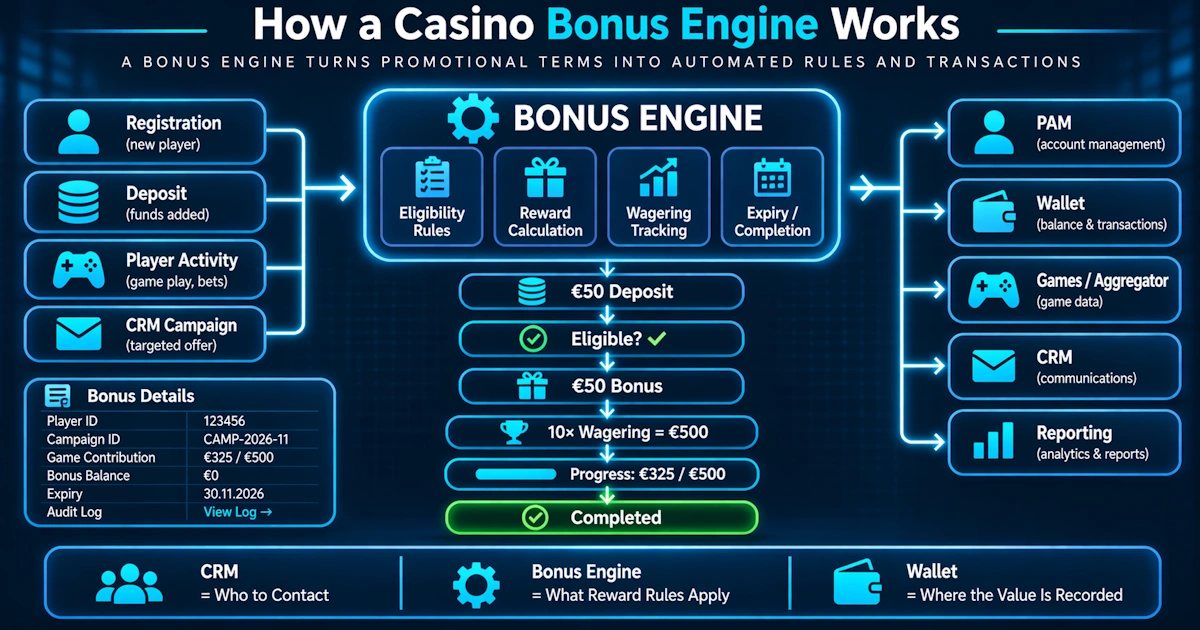
To answer those questions, the bonus engine usually connects with systems such as the PAM, wallet, game platform, payment system and CRM.
For B2B operators, a strong bonus engine therefore acts as a rules and reward-processing layer between promotional strategy and real-money casino activity.
What Is a Casino Bonus Engine?
A casino bonus engine is a software component that translates promotional rules into automated account actions.
Suppose an operator creates this offer:100% Deposit Bonus up to €100
The player deposits: €60
The bonus engine needs to calculate:
Eligible Deposit: €60
Bonus Percentage: 100%
Bonus Award: €60
It may then create or request a bonus balance and begin tracking whatever conditions apply.
A simplified process looks like:Player Action ↓ Bonus Engine Checks Eligibility ↓ Reward Calculated ↓ Bonus Added ↓ Player Activity Tracked ↓ Requirements Completed or Expired ↓ Bonus Settled
The exact architecture varies by platform. Some casino platforms include bonusing directly inside the PAM. Others use a separate modular bonus engine connected through APIs.
Why Do Online Casinos Need a Bonus Engine?
Without automated bonus technology, casino staff would need to manually calculate and monitor promotions for individual players. That does not scale.
Imagine 50,000 players participating in a welcome campaign. The operator may need to track:
qualifying deposits
bonus values
eligible games
wagering progress
expiration
completed offers
cancelled offers
A bonus engine automates those rules. It also helps the operator apply the same configured conditions consistently across eligible accounts.
Where Does the Bonus Engine Sit in the iGaming Stack?
A simplified architecture can look like:
Player ↓ Casino Front End ↓ PAM ↔ BONUS ENGINE ↙ ↓ ↘ Wallet — Games — Payments ↓ CRM / Reporting
The bonus engine usually does not operate in isolation. It needs information from other systems before it can decide what should happen.
For example:Payment System may say:Deposit Completed: €100
The bonus engine checks:Does this player qualify?
Then the wallet may be instructed:Credit €100 Bonus Funds
During gameplay, game or wallet events may tell the bonus engine:Player Wagered €10 on Eligible Game
The bonus engine updates:Wagering Progress +€10
What Is the Difference Between a Bonus Engine and PAM?
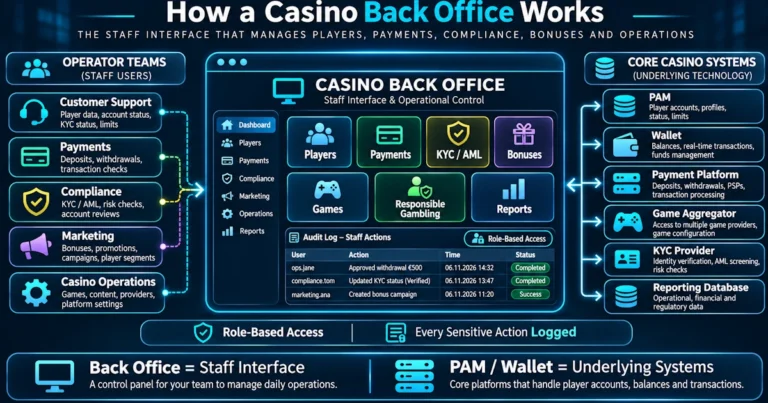
PAM stands for Player Account Management. The PAM manages the player account. The bonus engine manages promotional rules.
A simplified distinction is:
PAM Knows:
Player ID
Account Status
Jurisdiction
Registration Date
Bonus Engine Knows:
Campaign Eligibility
Bonus Amount
Promotion Status
Wagering Progress
Expiry
The bonus engine can use PAM information when applying its rules.
For example:Player registered today and:Country = Market A and:Account verified could form part of a campaign’s eligibility criteria.
Bonus Engine vs Wallet
These systems also have different roles.
Wallet Manages financial balances and transactions.
Bonus Engine Determines promotional entitlement and bonus rules.
Suppose a player qualifies for: €50 bonus
The bonus engine decides:Player should receive €50
The wallet then records:Bonus Balance +€50
During play, the wallet processes actual wagers and winnings. The bonus engine may monitor those events to determine whether promotional conditions are being completed.
The two systems therefore need very accurate communication.
What Is a Bonus Wallet?
Some platforms separate promotional funds from normal cash.
For example: Cash Balance: €100 Bonus Balance: €50
The player may therefore see: Total Displayed Funds: €150 but the two balances are not necessarily treated the same way.
Cash can normally be withdrawable subject to account and payment conditions. Bonus funds may remain restricted until the relevant promotional terms are satisfied.
The system needs clear rules governing:
which balance is used first
how winnings are allocated
what happens when the bonus completes
what happens if the bonus is cancelled
The exact behaviour varies by platform and campaign.
How Does a Deposit Bonus Work Technically?
Consider this fictional campaign: 100% Bonus up to €100 Minimum Deposit: €20 Wagering: 10× Bonus
A player deposits: €80
Step 1: Payment Event The payment system confirms:Deposit €80 — Completed
Step 2: Eligibility Check The bonus engine checks: New Player: Yes Correct Market: Yes Minimum Deposit Met: Yes Offer Already Used: No
Step 3: Bonus Calculation 100% of €80 is: €80 The maximum is €100, so the full €80 qualifies.
Step 4: Reward The system credits: Bonus Balance: €80
Step 5: Wagering Target If the wagering requirement is: 10× Bonus the target becomes: €80 × 10 = €800
Step 6: Player Activity Eligible wagers are reported to the bonus engine. For example: €25 qualifying wagering Progress becomes: €25 / €800
Step 7: Completion Once: €800 / €800 is reached under the campaign rules, the engine triggers the configured completion process.
The precise handling of remaining bonus funds or winnings depends on the promotional terms and platform design.
What Is a Rules Engine?
At the heart of many bonus systems is a rules engine. A rules engine evaluates conditions and decides whether an action should happen.
For example:IF Player Country = UK AND Account Status = Active AND First Deposit = Yes AND Deposit ≥ £20 THEN Award Welcome Bonus
This allows operators to create campaigns without manually evaluating every account.
Rules can potentially consider many attributes, depending on the platform. Examples include:
registration date
market
deposit amount
game activity
campaign history
account status
The more complex the rules become, the more important clear configuration and testing become.
What Is Bonus Eligibility?
Eligibility determines who can receive a promotion.
A campaign may be open to:All eligible new players or a narrower audience.
For example:
New Accounts
Market: Germany
Registration after 01.11.2026
Minimum Deposit: €25
The engine evaluates the player against those conditions. If one condition fails, the bonus may not be awarded.
Eligibility rules help operators prevent promotions from being applied outside their intended audience.
What Is a Trigger?
A trigger is the event that causes the bonus engine to evaluate or start a promotion.
Examples can include:
Player Registers
Player Makes First Deposit
Player Deposits €100
Player Completes Specific Activity
Operator Assigns Promotion
A trigger does not necessarily guarantee the reward. It may only start the eligibility check.
For example:Deposit Completed triggers the engine. The engine then checks whether all campaign conditions are satisfied.
What Is a Bonus Campaign?
A bonus campaign is a configured promotional programme inside the engine.
A campaign can contain fields such as:
Campaign Name
Start Date
End Date
Eligibility
Trigger
Reward Type
Maximum Reward
Eligible Games
Wagering Rules
Expiry
Markets
The exact configuration depends on the software. The important point is that a promotion should exist as a structured set of rules rather than informal instructions understood only by staff.
What Types of Rewards Can a Bonus Engine Manage?
Capabilities differ, but systems can support promotional formats such as:
Deposit Bonuses Example: 100% up to €100
Free Spins Example: 50 Free Spins
Reload Bonuses A reward linked to a later deposit rather than the initial registration deposit.
Cashback A reward calculated from defined activity over a period.
No-Deposit Rewards Bonus funds or promotional spins provided without a qualifying deposit, where legally and commercially permitted.
Loyalty or Reward Credits Promotional value linked to a wider reward system.
Not every engine supports every format. The actual reward mechanics should be reviewed during B2B platform selection.
How Do Free Spins Work in a Bonus Engine?
Free spins create another integration challenge because the reward may need to exist inside a particular game provider’s system.
Suppose the promotion is:20 Free Spins on Slot A
The bonus engine needs to know:
Player
Game
Number of Spins
Spin Value
Expiry
It may then call an aggregator or game-provider API.
For example:Bonus Engine → Game Aggregator → Provider
Request: Issue 20 Free Spins
The provider records the free-spin entitlement. The resulting winnings then need to be reported back according to the configured promotional rules.
This is why bonus systems often require integration not only with PAM and wallet, but also with game infrastructure.
What Are Wagering Requirements?
A wagering requirement defines how much qualifying play must occur before certain promotional funds or winnings become withdrawable.
Example: Bonus: €50 Wagering Requirement: 10× Bonus
Required wagering: €50 × 10 = €500
The bonus engine tracks qualifying wagers until the target is reached. Different jurisdictions can regulate these rules.
In Great Britain, the current UK Gambling Commission Social Responsibility Code 5.1.1 prohibits wagering requirements above 10 times the bonus funds. This requirement has applied since 19 January 2026.
That is a British regulatory requirement and should not be treated as a universal global limit.
Why Does the Bonus Engine Need Jurisdiction Rules?
A promotion that is valid in one market may not be permitted in another.
The system may therefore need to consider: Market A → Rules A Market B → Rules B
For example, Great Britain currently prohibits an incentive from mixing more than one gambling product category, such as casino and sports betting, within the same incentive.
This creates an important B2B requirement: Bonus configuration needs regulatory context.
The software may technically allow a campaign. That does not mean the operator is legally allowed to launch it in every market.
What Is Game Contribution?
Not every game necessarily needs to contribute equally toward a promotional wagering target.
A fictional promotion might be configured so that: Slot wagering = 100% contribution Other eligible games = Different Contribution
If a player wagers: €10 on a game contributing 50%, only: €5 would count toward the promotional target.
The bonus engine therefore needs information about:
game ID
game category
configured contribution
The exact contribution structure is determined by the campaign and must comply with relevant terms and rules.
Why Does the Engine Need Game IDs?
A promotion might apply only to certain games.
For example:Bonus valid on Slots A, B and C
The bonus engine therefore needs reliable game identifiers. Those IDs may come from:
casino platform
game aggregator
provider
If different systems use different IDs, mapping is required. Incorrect mapping could cause: eligible game not counted or: excluded game counted accidentally
This is one reason bonus systems depend on accurate game metadata.
What Is Bonus Progress Tracking?
Players and operators often need to know how far a promotion has progressed.
For example: Wagering Target: €500 Completed: €325 Remaining: €175
The engine updates this figure as qualifying activity occurs.
The Malta Gaming Authority‘s commercial communications guidance has stated that players enrolled in promotional schemes should be able to view their progress towards meeting applicable promotional requirements, illustrating the importance of clear progress information in regulated bonus design.
Progress tracking therefore serves both: system functionality and: player transparency
Why Does Real-Time Processing Matter?
Bonus activity can change after every wager.
Suppose the player needs: €10 more wagering to complete the bonus.
They then place: €10 qualifying wager
The bonus engine should receive that event and update the campaign accurately.
If the system is delayed, the player might continue seeing: €10 remaining even though the requirement has already been completed.
Real-time or near-real-time event handling can therefore improve both accuracy and player experience.
What Happens When a Bonus Is Completed?
Completion rules vary by promotion.
A completed campaign may trigger actions such as:
Convert eligible promotional value
Change balance status
Mark promotion Completed
Unlock configured funds
The precise transaction logic depends on:
wallet architecture
campaign rules
jurisdiction
Whatever the model, completion should be deterministic and auditable. The operator should be able to explain: why the campaign completed and: how the resulting balance was calculated.
What Happens When a Bonus Expires?
Promotions can also have expiration conditions.
For example:Bonus expires 7 days after activation
The engine tracks: Activation Time and: Expiry Time
If the requirements are not completed before expiration, the engine applies the configured expiry process.
Depending on the promotion, that could affect:
remaining bonus balance
promotional entitlement
unused free spins
The exact consequences should be defined clearly in the terms.
Can a Player Cancel a Bonus?
Some platforms support bonus cancellation. This can become technically complicated because the system may need to determine: How much cash remains? How much bonus remains? Were winnings generated from bonus funds? What should be removed?
The cancellation logic should be predetermined. A poor implementation can create balance disputes.
For B2B buyers, cancellation behaviour should therefore be tested rather than assumed.
How Does a Bonus Engine Know Which Balance Was Used?
This depends on wallet architecture.
A system may apply rules such as: Cash First or: Bonus First or a more complex model.
For example: Cash Balance: €100 Bonus Balance: €50
Player wagers: €10
The wallet needs to determine which balance funds the transaction. The bonus engine may need that information to calculate promotional progress and winnings correctly.
Balance-order logic should therefore be clearly defined between: wallet and: bonus engine
Why Are Wallet and Bonus Reconciliation Important?
Suppose the bonus engine says: Bonus Balance: €40 but the wallet says: Bonus Balance: €35
Which one is correct? The architecture should have a clearly defined source of truth.
For example: Bonus Engine → promotion status Wallet → financial balance
The exact design can differ. What matters is that both systems can be reconciled and inconsistencies can be investigated using transaction IDs and logs.
How Does the Bonus Engine Connect to Casino Games?
The system needs to understand game activity.
A simplified flow might be:Game Provider ↓ Game Aggregator ↓ Casino Wallet ↓ Bonus Engine
For every relevant wager, the engine may receive information such as: Player ID Game ID Wager Amount Round ID
It then evaluates: Is this game eligible? What contribution applies? Does the wager count?
This allows promotional progress to update automatically.
How Does the Bonus Engine Connect to Payments?
Deposit-based bonuses require payment information.
For example:Deposit Requested: €100 is not enough.
The bonus engine normally needs a qualifying event such as:Deposit Completed: €100
If the payment is later reversed, the platform may also need rules determining the effect on the promotion. Payment state matters.
The engine should not award a deposit bonus simply because a player clicked the Deposit button.
Bonus Engine vs CRM
These systems are frequently confused because both can be involved in promotions.
CRM Primarily handles:
audience segmentation
communications
campaign messaging
customer journeys
Bonus Engine Primarily handles:
eligibility rules
reward calculation
bonus accounting logic
wagering progress
expiry
settlement
A simple flow could be: CRM identifies audience ↓ CRM sends offer ↓ Player qualifies ↓ Bonus Engine applies reward
The two systems can work together. They do not perform exactly the same role.
Bonus Engine vs Marketing Automation
Marketing automation focuses on communication. For example:Send email when player becomes eligible
The bonus engine focuses on the actual promotional entitlement. For example:Award €20 bonus after qualifying deposit
A marketing system can tell the player:You have received €20 but it should not be the authoritative system deciding whether €20 actually exists in the player’s gambling wallet unless the platform is specifically designed that way.
Bonus Engine vs Gamification
Gamification can include:
missions
levels
achievements
tournaments
leaderboards
A bonus engine can sometimes support or connect to these features. But they are not automatically the same system.
For example: Mission: Play 20 qualifying rounds may trigger: Reward: 10 Free Spins
The gamification layer tracks the mission. The bonus engine can issue the reward. Some commercial platforms combine both functions.
What Is an Event-Driven Bonus Engine?
Modern systems can react to real-time events. Examples include: PlayerRegistered DepositCompleted WagerSettled BonusCompleted
The bonus engine subscribes to relevant events and evaluates campaign rules.
For example: DepositCompleted ↓ Check: First Deposit? Amount ≥ €50? Eligible Market? ↓ Award: €50 Bonus
Event-driven architecture can make bonus systems more flexible because they do not need to constantly scan every player account to see whether something changed.
How Do APIs Fit Into Bonus Systems?
APIs allow the bonus engine to communicate with other systems.
Possible requests include: Create Bonus Get Promotion Status Cancel Bonus Issue Free Spins Retrieve Progress
External systems may also call the engine. For example:CRM → Bonus API Request: Assign Campaign 789 to Player 123
The bonus engine then applies its rules. Strong API design becomes especially important when promotions involve real-money balances.
Why Are Idempotent Bonus Actions Important?
Imagine an API says: Award €50 bonus
The system processes it successfully. The response is lost.
The sending system retries: Award €50 bonus
Without duplicate protection, the player could receive: €100 instead of: €50
Bonus creation therefore needs transaction IDs or other duplicate-control mechanisms where repeated requests could affect value.
The same principle applies to:
free-spin allocation
cashback
bonus conversion
Real-money promotional systems need transaction integrity just like casino wallets.
Can Bonus Engines Prevent Bonus Abuse?
They can support controls that help identify or limit promotional misuse.
Examples can include rules concerning:
duplicate offer use
multiple accounts
repeated qualifying actions
excluded payment methods
account eligibility
A fraud or risk system may also provide information to the bonus engine.
However:automated rule triggered does not automatically mean:fraud proved
Operators still need fair procedures and clear contractual terms.
What Is Bonus Abuse?
The term generally refers to attempts to obtain promotional benefits outside the intended rules.
Examples could include:
creating multiple accounts
attempting to claim a one-time bonus repeatedly
exploiting technical errors
Operators need to distinguish intentional abuse from:
genuine customer mistakes
platform errors
unclear terms
This makes auditability especially important.
Why Are Clear Bonus Terms Important?
The software and the customer-facing terms should describe the same promotion.
If the terms say: 10× wagering while the engine is configured to: 20× wagering there is a serious problem.
The UK Gambling Commission requires bonus and incentive terms to be clear, transparent, fair and readily accessible.
The technical configuration should therefore be checked against the published offer. A bonus engine is not simply a marketing tool. It is also a rules-enforcement system.
Why Should Campaign Changes Be Logged?
Imagine an administrator changes: Wagering: 5× to: Wagering: 10×
The operator may later need to know: Who changed it? When? Was the campaign already live?
A strong bonus-management system should therefore provide auditability for important configuration changes. This is especially useful for:
customer disputes
compliance checks
operational investigations
Can Staff Edit a Live Bonus?
Technically, some systems may allow campaign changes.
But changing a live promotion can create complications. Existing players may already be participating under one set of rules.
A later configuration could unintentionally change:
wagering target
expiry
game eligibility
reward size
B2B buyers should therefore ask whether the system supports: versioned campaigns or another method of protecting existing player entitlements when promotion settings change.
What Is Campaign Versioning?
Campaign versioning means keeping different versions of promotional rules.
For example:Campaign v1 Wagering: 5× Start: 1 November
Then:Campaign v2 Wagering: 10× Start: 5 November
Players who already joined v1 can remain on the rules that applied to them. New players enter v2.
This is safer than silently changing the rules underneath existing participants. Not every bonus engine implements versioning in the same way.
Why Does Regulatory Compliance Matter to Bonus Technology?
Promotions are not governed only by marketing strategy. They can be subject to gambling regulation and consumer-protection requirements.
Great Britain’s current rules provide a strong example.
Since 19 January 2026, applicable UKGC licensees must not:
require wagering of more than 10× bonus funds
mix multiple gambling product categories within one incentive and bonus terms must remain clear, fair and accessible.
The software needs to support compliant configuration. But compliance cannot be outsourced entirely to the engine. The operator remains responsible for the promotion it launches.
Can the Bonus Engine Automatically Guarantee Compliance?
No.
Software can:
block certain settings
apply market templates
warn users
enforce configured limits
But the system cannot automatically make every promotion legally correct in every jurisdiction.
Compliance also depends on:
offer wording
customer targeting
marketing communications
jurisdiction
operational processes
A strong engine can reduce configuration risk. It does not replace legal and compliance review.
Are Bonus Systems Covered by Technical Gaming Standards?
Yes, bonusing and promotional systems are recognised as distinct technical areas in gaming standards.
Gaming Laboratories International (GLI) currently lists both:GLI-17 — Bonusing Systems in Casinos and:GLI-18 — Promotional Systems in Casinos alongside GLI-19 Interactive Gaming Systems v4.0 in its current standards catalogue.
The precise requirements and certification scope depend on the system, market and regulator. This demonstrates that bonusing can be treated as a technical system with controls and transaction requirements, not just a marketing feature.
Can One Bonus Engine Work Across Several Casino Brands?
Potentially.
A multi-brand platform may use: One Bonus Engine to support: Brand A Brand B Brand C
But the system needs strong separation. For example: Brand A Welcome Bonus should not accidentally apply to: Brand B Player unless the business rules specifically allow it.
Multi-brand systems therefore need clear:
brand identifiers
permissions
campaign ownership
reporting
Can One Bonus Engine Work Across Multiple Countries?
Yes, if it supports the required configuration. But jurisdictions can have different rules.
The platform may need: Market A Campaign and: Market B Campaign with different:
wagering requirements
eligible rewards
terms
responsible gambling constraints
This is why multi-jurisdiction bonus engines need more than currency and language support. They need rule flexibility with strong compliance controls.
How Does Reporting Work?
The bonus engine can provide data such as:
Bonuses Awarded
Bonuses Activated
Bonuses Completed
Bonuses Expired
Free Spins Issued
Promotional Cost
Wagering Progress
This can help:
finance
marketing
casino operations
compliance understand how promotions are performing.
Reporting should also be reconcilable with wallet transactions.
A marketing dashboard should not show: €10,000 bonus cost while the wallet records: €12,000 without an explanation.
How Is Bonus Cost Calculated?
There is no single universal formula.
A campaign can have: Nominal Bonus Value and: Actual Financial Cost
For example, 10,000 players might each receive: €10 promotional credit The nominal value is: €100,000
But the eventual financial impact can depend on how the promotion works and how much becomes withdrawable.
Operators should therefore define their reporting metrics clearly rather than assuming: bonus issued = cash cost in every campaign.
Why Analytics Matter
Bonus analytics can help operators understand:
participation rate
completion rate
campaign cost
game activity
customer segments
But analytics should be interpreted carefully. A campaign producing more gambling activity is not automatically a good promotion if it creates:
excessive cost
poor customer outcomes
regulatory risk
Performance measurement should therefore include both commercial and compliance considerations.
Why Bonus Engine Security Matters
Bonus systems can create financial value.
An attacker who gains powerful administrative access could potentially attempt to:
create unauthorised bonuses
change eligibility
alter campaign rules
This makes controls such as:
staff authentication
role-based permissions
audit logs
approval workflows important.
High-impact bonus configuration should not be available to every back-office user.
What Should Operators Look for in a Casino Bonus Engine?
B2B buyers should evaluate more than the number of bonus types. Important areas include:
Eligibility Rules Can the operator target the correct player groups?
Reward Types Does the engine support the promotional mechanics required?
Wallet Integration How are bonus balances managed?
Game Integration Can game eligibility and wagering contribution be tracked accurately?
Free Spins Can provider-specific free-spin rewards be delivered reliably?
Payment Integration Can deposit events trigger promotions correctly?
Real-Time Processing How quickly is bonus progress updated?
APIs Can CRM and other systems trigger or query campaigns?
Multi-Brand Support Can brands be managed independently?
Multi-Jurisdiction Support Can market-specific rules be configured?
Auditability Are campaign and balance changes traceable?
Reporting Can promotional cost and status be reconciled?
Security Who can create or modify promotions?
The best bonus engine is not simply the one with the most campaign templates. It is the one that can apply promotional rules accurately, transparently and reliably.
What Should Operators Test Before Buying?
A practical B2B evaluation should test real scenarios. Ask the supplier to demonstrate:
Create a 100% deposit bonus with a maximum cap
Apply the bonus only to one market
Exclude a specific game
Configure different game contribution
Issue free spins
Show wagering progress
Expire a bonus
Cancel a bonus
Retry the same reward API call twice
Show the audit log after changing campaign rules
Export campaign transaction data
These tests reveal far more than a marketing feature list.
Common Casino Bonus Engine Misconceptions
“A bonus engine is the same as CRM.” No. CRM generally manages audience and communication. The bonus engine manages entitlement and promotional rules.
“A bonus engine is the wallet.” No. The wallet manages financial balances. The bonus engine determines promotional rules and rewards.
“The marketing team can configure any offer it wants.” Not necessarily. Promotions must follow relevant regulation and internal controls.
“A bonus engine can guarantee compliance.” No. Technology can enforce rules but cannot replace regulatory and legal review.
“Every game counts equally toward wagering.” Not necessarily. Campaign configuration can treat games differently where permitted.
“Changing campaign rules is just editing a field.” Not always. Live campaign changes can affect existing customer entitlements and should be carefully controlled.
Bonus Engine vs CRM vs Wallet: Simple Comparison
| System | Main Role |
|---|---|
| PAM | Manages player account and status |
| Wallet | Manages cash and bonus balances |
| Bonus Engine | Applies promotional rules and tracks rewards |
| CRM | Manages segments and communications |
| Game Platform | Processes gaming activity |
| Back Office | Gives staff tools to configure and monitor systems |
These systems often work together. They should not automatically be treated as one product.
A Simple End-to-End Bonus Flow
Consider a player who sees: 100% Welcome Bonus up to €100
Marketing CRM sends the offer. ↓ Registration PAM identifies the player. ↓ Deposit Payment system confirms: €75 Deposit ↓ Eligibility Bonus engine confirms: Player Qualifies ↓ Reward Wallet receives: €75 Bonus ↓ Gameplay Games send qualifying wager events. ↓ Tracking Bonus engine records: €250 / €750 Wagering Completed ↓ Completion Requirements reach: €750 / €750 ↓ Settlement Bonus engine and wallet apply the configured completion rules.
That workflow shows why the bonus engine sits between marketing, account systems and real-money transactions.
Final Thoughts
So, what is a casino bonus engine?
It is the technology that turns promotional terms into automated casino rules. It can determine:
Who qualifies
What reward they receive
When the reward starts
Which games count
How progress is calculated
When the promotion expires
When the requirements are complete
A simplified architecture is:CRM / Player Action → Bonus Engine → PAM / Wallet → Games while transaction and gameplay events continuously flow back to update the campaign.
The key B2B distinction is: CRM communicates the promotion. PAM identifies the player. Wallet holds the financial balances. Bonus engine applies the promotional logic.
Because bonuses can affect real-money balances and regulated customer activity, the engine also needs strong:
transaction integrity
auditability
permissions
reporting
jurisdiction controls
A sophisticated bonus engine can make promotions much easier to operate at scale.
But the most important quality is not how many creative offers it can generate. It is whether those promotions are executed exactly as configured, clearly presented to players and controlled according to the rules of the market where they are offered.
Frequently Asked Questions
What is a casino bonus engine? A casino bonus engine is software that manages promotional rules, including eligibility, reward calculation, wagering requirements, expiry and bonus completion.
Is a bonus engine the same as a casino wallet? No. The bonus engine manages promotional logic. The wallet manages financial balances and transactions. The two systems normally communicate closely.
How does a casino bonus engine track wagering? The engine receives wager information from the casino platform, wallet, aggregator or game systems and applies the campaign’s eligibility and contribution rules to update promotional progress.
Can a bonus engine issue free spins? Yes, if it supports the required integrations. The engine can trigger free-spin rewards through game aggregators or game-provider APIs.
Is a bonus engine the same as CRM? No. CRM usually manages customer segments and communications. A bonus engine manages the actual reward and promotional conditions.
Can a bonus engine make promotions automatically compliant? No. It can enforce configured restrictions and market-specific controls, but the operator remains responsible for making sure each promotion complies with applicable gambling and consumer-protection requirements.