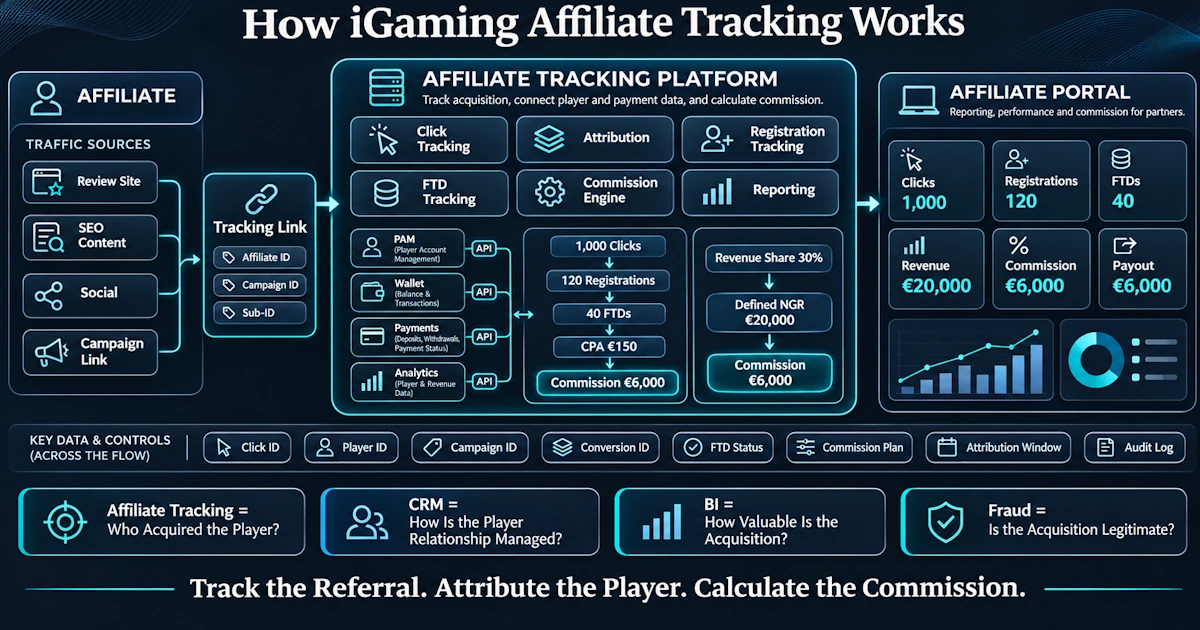
Affiliate tracking software in iGaming is technology used by gambling operators to identify which affiliate referred a player, track what happened after that referral and calculate the commission owed to the affiliate.
A typical affiliate journey might look like:
Affiliate Website ↓ Tracking Link ↓ Casino ↓ Registration ↓ First Deposit ↓ Player Activity ↓ Affiliate Commission
The software connects those events to the correct affiliate using tracking identifiers, attribution rules and data from the casino platform.
It can then calculate commercial models such as:
CPA
Revenue Share
Hybrid
or other customised commission structures.
Modern affiliate platforms can also manage:
Partners
Campaigns
Tracking Links
Creative Assets
Player Attribution
Commission Rules
Reporting
Affiliate Payments
For iGaming operators, the platform therefore acts as the technical and financial layer between affiliate acquisition traffic and the resulting player value.
What Is Affiliate Marketing in iGaming?
Affiliate marketing is a performance-based customer-acquisition model.
An affiliate promotes an online casino or gambling brand through channels such as:
Websites
Comparison Pages
Content
SEO
Social Media
Email, where legally permitted
Paid Media, where contractually and legally permitted
The affiliate then receives compensation according to an agreed commercial model.
For example:Affiliate sends 1,000 visitors ↓ 80 register ↓ 25 make a qualifying first deposit ↓ Operator pays: CPA × 25
Alternatively, the affiliate could receive a percentage of defined player revenue. The tracking system provides the data needed to calculate those results.
What Does Affiliate Tracking Software Actually Do?
At its core, affiliate tracking software answers four questions:
Who referred the player?
Which campaign generated the referral?
What did the player do after arriving?
How much commission does the affiliate earn?
To do this, the platform can track events such as:
Click
Registration
KYC Completion
Qualified First-Time Depositor
Gaming Activity
Revenue
Commission
The exact events depend on the operator and commercial agreement.
Where Does Affiliate Tracking Sit in the iGaming Stack?
A simplified architecture can look like:
AFFILIATE ↓ Tracking Link ↓ Casino Website ↓ PAM / Player Account ↓ Wallet / Games / Payments ↓ Affiliate Tracking Platform ↓ Attribution + Commission ↓ Affiliate Portal / Payout
The affiliate system therefore does not normally operate the casino. It receives selected information from the operational systems and uses it for attribution, performance reporting and commercial settlement.
Affiliate Tracking vs Casino Platform
These systems have different roles.
Casino Platform Manages the gambling operation. It may contain:
PAM
Wallet
Games
Payments
Bonuses
Affiliate Tracking Software Manages:
Referral Attribution
Affiliate Accounts
Campaigns
Commission
Affiliate Reporting
The casino platform knows: Player P-48291 deposited €100. The affiliate platform determines: Player P-48291 belongs to Affiliate A, and therefore Affiliate A may be entitled to commission.
Affiliate Tracking vs CRM
Affiliate tracking and CRM are often confused because both relate to marketing.
Affiliate Tracking focuses mainly on: Where did the player come from?
CRM focuses mainly on: How should the operator communicate with the player after acquisition?
For example:Affiliate A → Player Acquisition then:CRM → Onboarding Journey
The affiliate system attributes the acquisition. The CRM manages the subsequent customer relationship.
Affiliate Tracking vs iGaming Analytics
Analytics provides a broader business view.
Affiliate Software can calculate: Clicks, Registrations, FTDs, Commission.
Analytics / BI may combine Affiliate Data with Payments, Games, CRM, Bonuses and Costs to evaluate wider profitability.
For example, affiliate software may report: Affiliate A generated 500 FTDs. BI may ask: Were those 500 customers profitable after bonuses, payment fees and other costs?
The systems therefore complement each other.
Affiliate Tracking Software vs Affiliate Network
These are not the same thing.
Affiliate Tracking Software is the technology used to run and measure an affiliate programme.
Affiliate Network is an intermediary that can connect advertisers with affiliates and may provide additional commercial services.
An operator can run its own affiliate programme using affiliate software without necessarily using an external affiliate network. Some commercial providers offer both technology and managed-network services.
B2B buyers should therefore distinguish Software from Traffic Source and Managed Service.
Does Affiliate Software Provide Affiliates?
Not necessarily. This is an important commercial distinction.
Buying affiliate-management software does not automatically give the operator publishers, traffic or new customers. The software manages the operator’s relationships and tracking infrastructure.
The operator may still need to:
recruit affiliates
approve partners
negotiate deals
manage relationships
The platform is the operating system for the programme. It is not automatically the programme’s distribution network.
How Does Affiliate Tracking Work?
Consider a simplified player journey.
An affiliate publishes a Casino Review with a personalised link. The player clicks JOIN CASINO. The link contains information identifying the Affiliate and possibly the Campaign.
The player reaches the casino and the tracking platform records a Click. Later, the customer registers and the platform receives a Registration. Then the customer deposits and the casino sends a First Deposit event.
The affiliate platform associates those events with the original referral. The result might be:
Affiliate: A-294
Campaign: C-18
Player: P-48291
Registration: Yes
FTD: Yes
Commission: €120
That is the core affiliate-tracking process.
What Is an Affiliate Tracking Link?
A tracking link contains information that allows the platform to identify the referring affiliate. A simplified example might conceptually contain:
Affiliate ID
Campaign ID
Creative ID
When the user clicks, those parameters help the system create a tracking record (for example, Affiliate ID: 482, Campaign ID: 17). The exact URL structure depends on the software. Operators should avoid exposing unnecessary personal information in tracking URLs.
What Is an Affiliate ID?
An Affiliate ID uniquely identifies the partner (for example, AFF-000482). Every click associated with that identifier can potentially be linked back to the affiliate. One affiliate may have many campaigns, but normally retains one principal affiliate identity or an equivalent account structure.
What Is a Campaign ID?
A Campaign ID identifies a specific marketing initiative. For example, Affiliate: A-482 could run:
Campaign 1 — UK Casino Page
Campaign 2 — Slots Page
Campaign 3 — Email Campaign
Using separate identifiers allows both the affiliate and operator to understand which placement generated the results.
What Is a Sub-ID?
A Sub-ID is an additional tracking parameter that helps affiliates measure individual traffic sources. For example, Affiliate A may use subid=homepage for one placement and subid=slots-guide for another.
The affiliate dashboard can then compare:
Homepage → 50 FTDs
Slots Guide → 110 FTDs
Sub-IDs make attribution more granular without requiring a separate affiliate account for every placement.
What Is Click Tracking?
Click tracking records when a user follows an affiliate tracking link. A click record can contain information such as:
Affiliate ID
Campaign
Timestamp
Landing Page
Tracking Identifier
Potential technical metadata can also be recorded where appropriate. Click tracking provides the beginning of the attribution chain, but Click ≠ Customer and Click ≠ Revenue. Thousands of clicks can produce very few depositing players.
What Is a Unique Click?
A unique-click metric attempts to reduce repeated clicks from the same user or device within a defined period. For example, if one visitor clicks the same affiliate link five times, the platform might report 5 Raw Clicks but 1 Unique Click. The exact deduplication logic varies between platforms, so operators should understand how the metric is calculated before comparing programmes.
What Is a Registration in Affiliate Tracking?
A registration occurs when a referred visitor creates a player account. The affiliate system receives an event such as Player Registered and connects it with the referral record.
A useful metric is Click-to-Registration Conversion. For example, 1,000 clicks and 100 registrations gives a simplified conversion rate of 10%.
What Is an FTD?
FTD stands for First-Time Depositor. It generally refers to a customer completing their first qualifying deposit. For affiliate programmes, FTD is one of the most important acquisition events:
Click → Registration → First Deposit → FTD
However, operators should define exactly what qualifies:
Does a €1 deposit count?
What if the payment is reversed?
What if KYC is incomplete?
The affiliate agreement and tracking logic need a consistent FTD definition.
Registration vs FTD
These are very different acquisition metrics. An affiliate could send 1,000 Registrations but only 50 FTDs, while another affiliate could send 300 Registrations and 100 FTDs. Affiliate B produced fewer registered accounts but more depositing customers. This is why operators typically evaluate traffic quality rather than only traffic volume.
What Is a Qualified FTD?
Some programmes apply additional qualification criteria before paying commission. For example, a player may need to meet a minimum deposit, complete verification or satisfy another defined commercial condition. A platform could therefore distinguish First Deposit from Qualified FTD. The criteria should be transparent in the affiliate agreement and should not be changed retroactively without appropriate contractual handling.
How Does the System Link the FTD Back to the Affiliate?
The original referral is stored using a tracking mechanism. When the customer later creates a player account, the casino platform knows the Player ID, and the affiliate platform associates that Player ID with the Affiliate Attribution ID (e.g., P-48291 → AFF-482). Future events can be matched to that relationship for subsequent revenue-share calculations.
What Is Attribution?
Attribution determines which affiliate receives credit for the customer. This becomes important if a player interacts with multiple affiliates:
Monday → Click Affiliate A
Tuesday → Click Affiliate B
Wednesday → Register
Who gets the player? The answer depends on the operator’s attribution model.
What Is Last-Click Attribution?
With last-click attribution, the most recent qualifying affiliate interaction receives the credit (in the example above, Affiliate B). This is a common digital-marketing concept, though not the only possible model.
What Is First-Click Attribution?
Under a first-click model, the first qualifying referral receives the attribution (Affiliate A). This model rewards the partner who first introduced the customer. Operators need to define the attribution policy clearly.
What Is an Attribution Window?
An attribution window defines how long a referral can remain eligible for credit. For example, if a player clicks an affiliate link and registers 20 days later, the affiliate receives credit under a 30-day window, but not under a 7-day window. There is no universal iGaming attribution window—the commercial agreement and tracking configuration determine it.
Why Does the Attribution Window Matter?
Different rules can significantly change affiliate economics when visitors return directly weeks after an initial click. B2B buyers should ensure the software supports configurable attribution windows where needed.
What Is Cookie-Based Affiliate Tracking?
Cookie-based tracking stores an identifier on the user’s device:
Affiliate Link Click → Tracking Cookie Created → Player Returns Later → Cookie Recognised → Registration Attributed
Cookies have historically been widely used in affiliate attribution, but their use needs to account for browser restrictions, user consent requirements, cookie deletion, privacy rules and changing browser technology.
Are Affiliate Tracking Cookies Always Allowed?
No universal answer applies to every jurisdiction. In the UK, cookies and similar technologies used to store or access information on a user’s device generally require clear information and consent unless a relevant exemption applies. Cookies used only for marketing or attribution purposes should not automatically be assumed to be strictly necessary. Operators need to evaluate affiliate tracking within their wider privacy, cookie and consent-management framework.
First-Party vs Third-Party Cookies
First-Party Cookie: Associated with the website domain the customer is visiting.
Third-Party Cookie: Typically associated with another domain.
Browser restrictions have made third-party-cookie-based attribution increasingly difficult. Many modern tracking architectures therefore rely more heavily on first-party identifiers, server-side tracking and postbacks. However, first-party does not automatically mean no privacy obligations—the purpose and data processing still matter.
What Is Server-to-Server Tracking?
Server-to-server tracking (S2S) passes conversion information directly between backend systems:
Affiliate Click → Tracking ID Created → Customer Registers → Casino Backend sends Registration Event directly to Affiliate Platform
This can reduce reliance on browser-side tracking for later conversion events.
What Is an S2S Postback?
A postback is a server-to-server notification that a particular event occurred (such as Registration Completed or FTD). The casino sends the Player Attribution ID and event directly to the affiliate platform. Modern affiliate platforms commonly support postback tracking because it provides more direct backend event reporting.
Does Server-to-Server Tracking Eliminate Privacy Requirements?
No. Server-to-server tracking changes the technical architecture, but it does not automatically remove privacy, data protection or transparency requirements. It is important not to confuse No Browser Cookie with No Data Protection Obligations.
Alternative & Mobile Tracking Methods
What Is Promo-Code Attribution?
Not all affiliate attribution needs to start with a click. An operator can provide an affiliate with a unique code (e.g., AFFILIATE50). When the customer enters that code during registration or another qualifying process, the system attributes the player to the affiliate. This is useful for influencers, podcasts and offline promotions.
Can Offline Affiliate Campaigns Be Tracked?
Potentially, using Promo Codes, QR Codes, Unique Landing Pages and Campaign IDs. The tracking system connects the offline campaign with digital conversion events.
What Is Mobile Affiliate Tracking?
Mobile attribution introduces additional complexity because customers may move between mobile browser, app store and casino app (Affiliate Link → App Store → App Install → Registration → Deposit). Preserving attribution across that journey can require mobile attribution technology, deep links, app events and server-side integration.
What Is a Deep Link?
A deep link sends the customer to a specific destination rather than only the casino homepage (for example, linking directly to a specific slot page or section of an installed app) while keeping tracking parameters intact.
What Is an Affiliate Portal?
An affiliate portal gives approved partners access to their own programme information, such as:
Clicks, Registrations and FTDs
Revenue, Commission and Payment Status
Tracking Links and Creative Assets
The portal reduces the need for operators to email spreadsheets manually and provides greater transparency around performance calculations.
What Is Affiliate Reporting?
Affiliate reporting provides performance data for both the operator and partner (Clicks, Unique Clicks, Registrations, FTDs, Deposits, Turnover, GGR, NGR, Commission). The exact level of player information visible to affiliates should be carefully controlled—partners should not automatically receive unnecessary personal information about individual customers.
Commission Models in iGaming Affiliate Tracking
What Is a CPA Deal?
CPA stands for Cost Per Acquisition. A simplified CPA model pays a fixed amount for each qualifying player acquisition (e.g., CPA = €150, 20 qualifying FTDs = €3,000 Commission). The definition of a qualifying acquisition needs to be clear.
What Is Revenue Share?
Revenue Share pays the affiliate a percentage of a defined revenue metric generated by referred players (e.g., 30% of €10,000 defined revenue = €3,000 commission). The complicated part is how revenue is defined.
GGR vs NGR in Affiliate Tracking
An affiliate contract may calculate commission using GGR or NGR:
GGR (simplified): Wagers − Player Winnings.
NGR applies additional deductions depending on the agreement, such as Bonuses, Taxes, Payment Costs, Game Fees and Chargebacks.
There is no universal NGR formula used by every affiliate programme. Two programmes both advertising 30% Revenue Share can produce very different payments depending on deductions. The commercial question should always be: 30% of what?
What Is a Hybrid Affiliate Deal?
A Hybrid model combines more than one commission structure (e.g., €75 CPA plus 15% Revenue Share). This allows the operator and affiliate to share both acquisition risk and long-term player value.
What Is CPL?
CPL (Cost Per Lead) pays for a defined lead event (such as a Verified Registration) rather than requiring a first deposit. It is less common in casino affiliate programmes than CPA and revenue share, but some platforms support it.
What Is a Tiered Commission?
A tiered commission changes according to performance (e.g., 1–20 FTDs → €100 CPA; 21–50 → €120; 51+ → €140). Revenue-share tiers operate similarly. Incorrect tier logic can create partner-payment disputes.
What Is Negative Carryover?
Negative carryover arises when an affiliate’s referred players generate a negative revenue result during one month, and the contract carries that negative amount into the next period before new positive commission is calculated.
With negative carryover: Month 1 (−€5,000) + Month 2 (+€8,000) = €3,000 commissionable basis.
Without negative carryover: Month 2 starts fresh at €8,000.
What Is a High-Roller Policy?
Some programmes apply specific rules when a single referred player generates unusually large wins or losses that could distort an affiliate’s monthly revenue-share calculation. If such rules exist, the tracking system needs to apply them transparently.
Commission Calculation, Versioning & Payments
What Is Commission Calculation?
Commission calculation takes tracked player activity and applies the partner’s commercial agreement. A mature platform can support many partner-specific commercial structures simultaneously.
Why Is Commission Versioning Important?
Affiliate deals change over time (e.g., moving from 25% to 30% Revenue Share on 1 April). Players acquired before the change may remain under the old deal depending on the contract. The platform needs to know which commercial rule applied to which player during which period, and deal changes must be traceable.
What Is Commission Recalculation?
Financial data can change after the initial calculation due to chargebacks, payment reversals, bonus adjustments or corrected game transactions. The platform needs transparent rules for recalculation or subsequent-period adjustments.
What Is an Affiliate Payment?
A typical workflow is: Commission Calculated → Review → Approved → Invoice / Payment Process → Paid. Some platforms include integrated affiliate-payment functionality, while others export approved commissions to finance or external payment systems.
Why Should Affiliate Payouts Be Separate From Player Withdrawals?
Player withdrawals pay gambling customers from the player-account environment, whereas affiliate payouts pay commercial marketing partners under a B2B agreement. Systems should never treat affiliate commission as a player-wallet transaction.
Partner Management & Compliance
What Is an Affiliate Manager?
An affiliate manager is the operator employee responsible for commercial partner relationships, using the platform to manage partner accounts, deals, campaigns, communications, performance and payments.
What Is an Affiliate Account?
An affiliate account stores partner details (Affiliate ID, Company/Partner, Status, Manager, Markets, Commission Plan, Payment Details, Campaigns, Notes). Access to sensitive information should be role controlled.
What Is Affiliate Onboarding?
A structured onboarding workflow (Application → Review → Approved → Deal Assigned → Tracking Links Activated) ensures commercial review, contracts, due diligence, marketing review and payment setup are completed before tracking links go live.
Why Does Affiliate Due Diligence Matter?
Poorly controlled affiliates can create misleading advertising, inappropriate targeting, spam, brand risk and regulatory risk. Operators need to understand who the partner is, how they acquire customers, which markets they target and which channels they use.
Does the Operator Remain Responsible for Affiliates?
In regulated markets, responsibility cannot necessarily be transferred simply because marketing was performed by an affiliate. In Great Britain, the UK Gambling Commission expects licensed operators to maintain appropriate oversight of third parties they contract with, and the operator remains responsible for relevant conduct carried out on its behalf.
Affiliate Marketing and Advertising Rules
Affiliate content can qualify as gambling advertising. In Great Britain, CAP gambling rules apply to relevant third-party affiliate marketing acting on an operator’s behalf—covering social responsibility, age targeting, misleading claims, promotional terms and ad identification.
Why Is Affiliate Compliance Monitoring Important?
Partners can publish new pages, change claims or alter traffic sources after initial approval. Operators need ongoing oversight, often combining affiliate-management tools with dedicated compliance-monitoring technology.
What Is Creative Management?
Affiliate platforms often host approved marketing materials (Banners, Logos, Landing Pages, Tracking Links, Campaign Text). Central creative version control allows operators to deactivate or replace outdated material when offers change (for example, if a welcome bonus changes from 100% up to €200 to 50% up to €100).
What Is a Landing Page?
A landing page is the destination reached after clicking an affiliate link. Tracking data can compare which destination produces stronger results, while all landing pages must still comply with applicable gambling and marketing requirements.
Affiliate Fraud & Traffic Quality
What Is Affiliate Fraud?
Affiliate fraud refers to attempts by partners or related actors to generate illegitimate commissions, including:
Fake Registrations & Fake FTDs
Self-Referral
Duplicate Accounts
Incentivised Activity Outside the Agreement
Manipulated Traffic
Common Fraud Types
Self-Referral: An affiliate attempts to earn commission by referring themselves or accounts they control. Account linking, KYC and fraud technology help detect it.
Affiliate Cookie Stuffing: Placing affiliate tracking identifiers on users without a genuine qualifying referral interaction to capture unearned commission.
Click Fraud: Generating artificial or manipulated click volume that does not represent genuine interested users.
Conversion Fraud: Creating artificial qualifying events (such as fake accounts) to generate CPA commission.
Why Do KYC and Fraud Detection Matter to Affiliate Tracking?
If a programme pays €150 CPA per FTD and 40 out of 100 FTDs turn out to be duplicate or fraudulent accounts, the commercial value changes dramatically. Exchanging data with KYC, fraud detection and PAM systems allows operators to apply qualified acquisition rules and identify whether an issue is an isolated fraudulent customer or systematic low-quality traffic from one partner.
What Is Traffic Quality?
Traffic quality looks beyond volume to evaluate Registration Rate, FTD Rate, KYC Pass Rate, Fraud Rate, Chargebacks, Player Activity, Revenue and Retention.
What Is Affiliate ROI?
ROI (Return on Investment) compares the economic value of affiliate-generated customers with the cost of acquiring them (including commission, bonus costs, payment costs and other expenses).
Why Is FTD Count Alone Not Enough?
An affiliate generating 60 high-value FTDs can be far more profitable than one generating 100 low-value FTDs. Ranking partners only by FTD volume can be misleading without broader BI and LTV (Lifetime Value) analysis.
What Is Affiliate Cohort Analysis?
Grouping players by Affiliate and Acquisition Period (e.g., Affiliate A — January FTD Cohort) and tracking performance over 3, 6 and 12 months removes short-term gambling variance and provides a stable view of customer quality.
Scaling Affiliate Operations
Sub-Affiliate Tracking: Manages hierarchies where a Master Affiliate recruits Sub-Affiliates and earns a defined share of their performance.
Master Affiliate Account: Groups several partner accounts or websites under one commercial relationship with combined reporting and separate campaign tracking.
Multi-Brand Affiliate Management: Allows an operator group to manage multiple casino brands in one platform with strict separation of attribution, permissions, commission and reporting.
Multi-Currency Affiliate Tracking: Handles multiple currencies (EUR, GBP, USD, etc.) with clear rules for revenue currency, commission currency, FX rates and conversion timing.
Multi-Jurisdiction & GEO Segmentation: Separates traffic, offers, advertising rules and commission economics by geographic market and licence.
Technical Architecture, Data & Security
Pixel Tracking vs Server-to-Server Tracking
Pixel / Browser-Side: Relies on browser execution and potentially cookies.
Server-to-Server: Sends events directly between backend systems for more robust conversion reporting.
Conversion Deduplication & Idempotency
If both a browser event and a server postback report the same FTD—or if a lost response causes the casino to retry an FTD event—unique event identifiers (Conversion ID: FTD-83922) and idempotent processing ensure the system does not count two FTDs or create duplicate CPA commissions.
Event Taxonomy & Timestamps
Clear event definitions (registration_completed, first_deposit_completed, qualified_ftd) prevent events like Deposit Initiated from being treated as completed FTDs. Consistent timezone, event time and processing time definitions are equally critical for accurate last-click attribution.
Data Reconciliation, Disputes & Drill-Down
Affiliate data should be reconcilable with casino source systems (such as PAM). When disputes arise over FTD counts or commission, controlled player-level drill-down (using anonymised references rather than unnecessary personal data) allows teams to verify Tracking IDs, qualification status and commission logic transparently.
Data Export & APIs
Exporting data (CSV, JSON or via APIs) supports finance, BI, auditing and vendor migration. An Affiliate API also lets authorised systems or partners retrieve performance data with strict access controls so one partner cannot view another’s data.
Role-Based Permissions, Audit Logs & Security
Role-Based Permissions: Separate access for Affiliates, Affiliate Managers, Finance and Administrators.
Audit Logs: Traceable records of commission changes, partner approvals, payment adjustments and manual attribution overrides (which must be restricted, reasoned and logged).
Security: Authentication, MFA, encryption, API security and permissions protect financially important B2B records and payout details.
Regulatory & Privacy Considerations
Is Affiliate Tracking Software Gambling Software?
Not necessarily. In Great Britain, the UK Gambling Commission distinguishes core remote gambling software from general associated business applications—specifically listing affiliate management alongside performance analytics and CRM as associated activities not normally treated as gambling software where they do not accept wagers, determine results or allocate winnings. Regulatory positions still depend on jurisdiction and actual functionality.
Compliance, Self-Exclusion & Placement
Even when not classified as core gambling software, affiliate programmes carry regulatory risk. Operators must maintain oversight over:
Self-Excluded Customers: Preventing direct marketing (email/SMS) by affiliates to suppressed customers.
Underage Marketing: Enforcing CAP gambling rules on audience, content and placement.
Responsible Placement: Taking reasonable steps to ensure digital gambling ads do not appear on websites providing unauthorised access to copyrighted content.
Cookie & Privacy Governance: Managing consent, privacy notices, data minimisation (sharing controlled player references rather than full PII) and configurable data retention.
Attribution & Reliability Challenges
Multi-Touch vs Contractual Attribution: Marketing analytics may credit multiple touchpoints, but commercial settlement requires a single deterministic contractual rule (e.g., Last Click, First Click or Promo Code).
Cross-Device & Cross-Brand Attribution: Linking journeys across devices or multiple operator brands requires explicit policies and careful privacy handling.
Monitoring, Downtime & Event Replay: Operators should monitor for sudden zero-click drops, missing Affiliate IDs or postback failures. Tracking-link redundancy keeps visitor redirects working during reporting outages, and event replay ensures conversions during downtime are not permanently lost.
Vendor Lock-In & Migration: Switching platforms requires exporting affiliate accounts, campaigns, deal rules and—most importantly—preserving existing Player → Affiliate relationships so ongoing revenue-share obligations remain intact.
What Should Operators Look for in Affiliate Tracking Software?
A B2B evaluation should examine the full programme lifecycle:
Tracking & S2S Integration: Reliable click, registration and FTD attribution via postbacks or APIs.
Attribution & Commission Models: Configurable windows, first/last click, CPA, Revenue Share, Hybrid, CPL and transparent GGR/NGR deductions.
Multi-Brand & Multi-Currency: Clean data separation and consistent FX handling.
Affiliate Portal & Reporting: Partner self-service and controlled drill-down without exposing unnecessary PII.
Fraud, Compliance & Creatives: Risk-system integration, market/channel controls and centralised creative management.
Payments, Permissions & Audit Trail: Smooth payout workflows, RBAC, traceable deal changes and full historical data export.
What Should Operators Test Before Buying?
Ask the provider to demonstrate realistic scenarios:
Create an affiliate, two campaigns and separate tracking links.
Track a click, a registration and an FTD via S2S postback.
Send the same FTD twice and prove it is not duplicated.
Switch between First-Click and Last-Click attribution and adjust the attribution window.
Configure a €150 CPA deal, a 30% Revenue-Share deal (with exact NGR calculation) and a Hybrid deal.
Change a commission plan and inspect the audit trail.
Reverse a qualification and export affiliate data.
Take the conversion API offline and replay missing events.
Show how existing revenue-share players would migrate to another platform.
Common Red Flags
Unclear attribution rules or no precise FTD definition.
Revenue share showing a percentage without a transparent NGR formula.
Duplicate postbacks creating duplicate commissions.
No audit trail for deal changes or manual overrides.
Excessive player PII exposed to affiliates.
No fraud integration, tracking health monitoring, event replay or historical migration path.
Treating marketing compliance as the affiliate’s problem alone.
Affiliate Tracking vs Related iGaming Systems
| System | Main Role |
| Affiliate Tracking | Attributes acquired players and calculates partner commission |
| PAM | Manages player accounts and account state |
| CRM | Manages customer journeys and communications |
| Bonus Engine | Applies promotional reward rules |
| Analytics / BI | Measures wider business performance |
| Fraud Detection | Identifies abusive accounts and acquisition patterns |
| Payments | Processes player financial transactions |
| Finance | Manages accounting and approved partner payments |
The systems can exchange information, but they should still have clearly defined responsibilities within the broader iGaming technology stack.
A Simple End-to-End Affiliate Tracking Flow
Affiliate Promotion: Affiliate A publishes a casino review.
Tracking Link: Player clicks Campaign C-104.
Click Recorded: Tracking platform creates
Click ID CL-88291.Player Registers: PAM creates
Player P-48291.Attribution: Platform connects
P-48291 → Affiliate A.First Deposit: Player deposits €100.
Qualification: Rules confirm
Qualified FTD ✓.Commission: Under a €150 CPA deal, Affiliate Commission = €150 (or under Revenue Share, player activity feeds into the agreed GGR/NGR calculation).
Reporting: Affiliate portal displays Click, Registration, FTD and Commission.
Payment: Approved commission enters the Affiliate Payout Process.
Final Thoughts
Affiliate tracking software in iGaming is the technology that connects Affiliate Traffic to Player Acquisition and Affiliate Commission:
Affiliate → Tracking Link → Casino → PAM / Wallet → Affiliate Platform → Commission
Accurate tracking alone is not enough—operators also need clear commercial definitions, privacy controls, partner due diligence, fraud controls, marketing compliance, auditability and reliable data integration.
The central distinction from related systems is clear:
Affiliate Tracking: Who acquired the player and what do we owe the partner?
CRM: How do we manage the player relationship?
BI: How valuable was the acquisition to the business?
Fraud Detection: Was the acquisition or account legitimate?
The strongest affiliate platform creates a traceable, trustworthy chain from referral to registration, qualified player, revenue and commission.
Frequently Asked Questions
What is affiliate tracking software in iGaming? Affiliate tracking software is technology used by gambling operators to identify which affiliate referred a customer, track subsequent conversion events and calculate the affiliate’s commission.
How does an online casino know which affiliate referred a player? The system can use tracking links, campaign identifiers, cookies, server-side tracking, promo codes or other attribution methods to connect a player registration with the referring affiliate.
What is an FTD in affiliate marketing? FTD stands for First-Time Depositor. It generally refers to a referred customer completing their first qualifying deposit. The precise qualification rules should be defined by the affiliate programme.
What is the difference between CPA and revenue share? CPA pays a defined amount for a qualifying acquisition, while revenue share pays a percentage of a contractually defined revenue measure generated by referred players. Hybrid deals combine elements of both.
What is server-to-server affiliate tracking? Server-to-server tracking sends conversion information directly between backend systems. It can be used to report events such as registrations and first deposits without relying entirely on browser-side conversion tracking.
Is affiliate tracking software considered gambling software? Not necessarily. In Great Britain, the Gambling Commission specifically distinguishes affiliate-management applications from core gambling software where they do not perform functions such as accepting wagers, determining results or allocating winnings. The regulatory position can differ by jurisdiction and actual product functionality.