
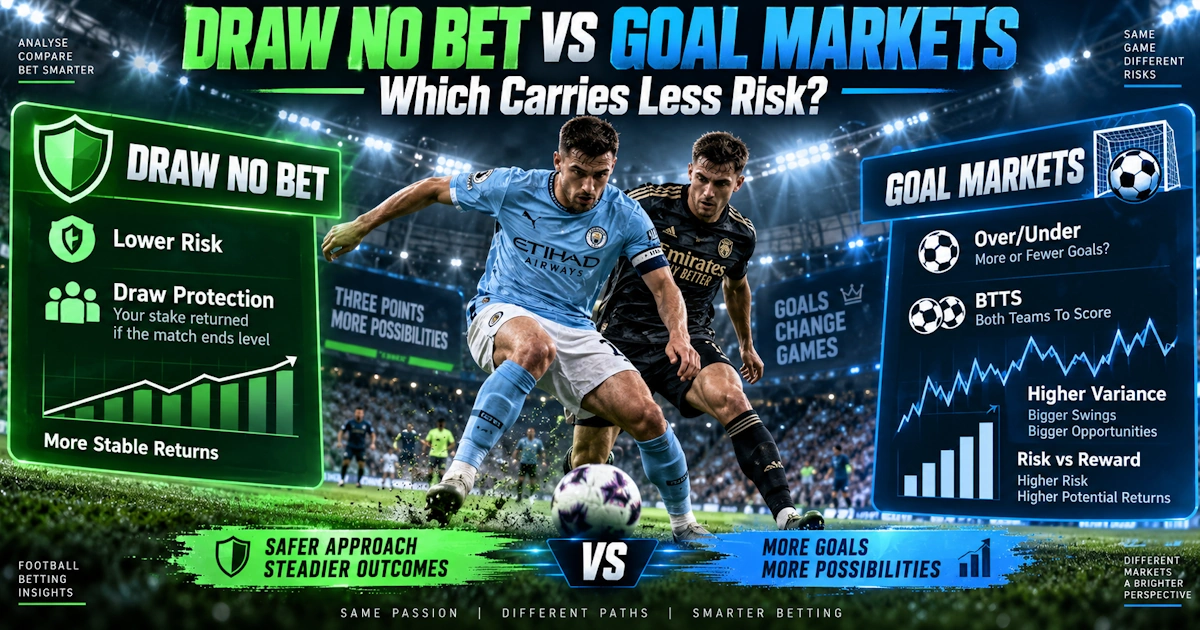
Draw No Bet and goal markets solve two very different betting problems.
Draw No Bet asks whether one team is better than the other while protecting you if the match finishes level. Goal markets ignore the winner completely and focus on how many goals are scored or whether one or both teams find the net.
So which carries less risk?
There is no universal answer.
A strong favourite in a tight match may be better suited to Draw No Bet. An attacking underdog that regularly scores but often loses may be much more suitable for Team Over 0.5 Goals. In another fixture, both teams may be unreliable in the result market but statistically strong for BTTS.
The useful question is not which market is safer in general. It is which market removes the uncertainty you understand least well.
What Is Draw No Bet?
Draw No Bet, often shortened to DNB, removes the draw from the final result.
If you back the home team:
- Home win = bet wins
- Draw = stake returned
- Away win = bet loses
This makes DNB less aggressive than a normal 1X2 win bet.
Suppose the home team is priced:
- Home win: 2.10
- Draw No Bet: 1.50
The DNB price is lower because the bookmaker is giving you protection against the draw.
That protection can be valuable when you believe one team is stronger but expect a close match.
Why DNB Can Feel Safer
Football has a high number of draws compared with many other sports.
If you back a team to win and the match finishes 1-1, the bet loses.
With Draw No Bet, the same result produces a refund.
That reduces one major risk.
Imagine a team has these 20 home results:
- 10 wins
- 6 draws
- 4 defeats
A standard home-win bet would have won 50% of the time.
A DNB selection would have:
- Won 50%
- Refunded 30%
- Lost only 20%
That is a much more forgiving outcome distribution.
However, the odds will reflect that reduced risk.
You are not receiving free insurance.
What Counts as a Goal Market?
Goal markets include many different bets, so comparing them as one group can be misleading.
Common options include:
- Over 0.5 match goals
- Over 1.5 goals
- Over 2.5 goals
- Under 2.5 goals
- BTTS – Yes
- Team Over 0.5 goals
- Team Over 1.5 goals
Their risk levels are very different.
Over 0.5 match goals needs only one goal. Over 2.5 requires at least three. BTTS requires both teams to contribute. Team Over 0.5 needs only one particular side to score.
So saying “goal markets are risky” is too broad. Some are much more forgiving than others.
Team Over 0.5 Can Be Lower Risk Than DNB
Consider an away underdog.
It has:
- Scored in 8 of its last 10 away matches
- Averaged 1.3 away goals
- Produced around 1.2 away xG
- Lost 6 of those 10 matches
Would you rather back it Draw No Bet or simply to score?
DNB still requires the team to avoid defeat.
Team Over 0.5 only requires one goal.
A 3-1 defeat loses DNB but wins the team-goal selection.
This is a good example of why market risk depends on the team profile.
If you trust the attack but not the defence, a goal market may carry less practical risk.
DNB Can Be Better in Low-Scoring Matches
Now consider a different fixture.
The home side is:
- Strong defensively
- Unbeaten in 8 home matches
- Conceding only 0.7 goals per home game
- Winning many matches 1-0
The visitors also play cautiously.
Over 2.5 is difficult to justify because the match profile is controlled.
BTTS is also questionable.
But if you believe the home side is clearly the stronger team, DNB may suit the situation very well.
A 0-0 or 1-1 gives the stake back, while a narrow 1-0 home win is enough.
This is where DNB can be particularly useful.
Think About What Can Go Wrong
A simple way to compare markets is to list the ways each bet can fail.
Home Draw No Bet The bet loses only if the away team wins. A draw is neutral.
Home Team Over 0.5 The bet loses if the home team fails to score, regardless of whether the match ends 0-0 or the visitors win 1-0.
Over 2.5 The bet loses with:
- 0-0
- 1-0
- 0-1
- 1-1
- 2-0
- 0-2
BTTS – Yes The bet loses whenever either side fails to score.
Thinking in scorelines helps reveal which market is actually more forgiving for that specific match.
Practical Example: DNB Carries Less Risk
Suppose Team A is at home.
Its statistics:
- 7 wins, 2 draws and 1 defeat in 10 home matches
- Concedes only 0.8 goals per home game
- Keeps five clean sheets
- Produces moderate attacking xG
Team B:
- Wins only 2 of 10 away
- Draws 4
- Scores very little away
Possible results include:
- 1-0
- 1-1
- 2-0
- 0-0
There are not many strong reasons to expect three goals.
Home Draw No Bet may be a cleaner selection than Over 2.5 or BTTS.
You are backing the stronger side while protecting yourself against a low-scoring draw.
Practical Example: Goal Market Carries Less Risk
Now imagine Team C is an away underdog.
Its record:
- Scored in 9 of 10 away matches
- Lost 6 of 10
- Averaged 1.5 away goals
- Conceded 2.0
The home favourite:
- Scores heavily
- Concedes regularly
- Keeps few clean sheets
A likely score range could include:
- 2-1
- 3-1
- 2-2
- 3-2
Away Draw No Bet would be risky because the underdog loses frequently.
Away Team Over 0.5 may be much more logical.
You are isolating the one part of the underdog you trust: its ability to score.
Practical Example: BTTS vs DNB
Suppose two evenly matched sides have:
Home team
- Scores in 8 of 10
- Concedes in 7 of 10
Away team
- Scores in 8 of 10
- Concedes in 8 of 10
Neither side wins consistently.
A DNB selection forces you to decide which team is more likely to avoid defeat.
BTTS avoids that question completely.
If the most realistic scores are 1-1, 2-1 and 1-2, BTTS may fit the match better than choosing a side.
The market with less risk is the one that aligns with the strongest statistical evidence.
Odds Matter More Than the Market Name
A safer-looking market can still be poor value.
Suppose Home DNB is priced at 1.30.
That is a very short price.
If the away side has enough attacking quality to win 25% of the time, the bet may not offer much value.
Now suppose Team Over 0.5 is available at 1.65 and the team has scored in roughly 75% of similar fixtures.
That may be more attractive despite being a goal market.
Risk should always be judged together with price.
A market can be statistically likely but still not worth betting if the odds are too low.
Use Implied Probability
Odds can be converted into implied probability.
For example:
- 1.50 = 66.7%
- 1.67 = about 59.9%
- 1.80 = 55.6%
- 2.00 = 50%
Suppose DNB is priced at 1.50.
You need to believe the true probability of a losing outcome is low enough for that price to make sense.
Likewise, if BTTS is 1.90, the market implies a probability of roughly 52.6% before bookmaker margin.
The question becomes: Is your estimated probability higher than the market’s?
That is more useful than asking which bet feels safer.
DNB Is Often Better When Team Strength Is Clear
Draw No Bet works particularly well when:
- One team is clearly stronger
- Draw probability is meaningful
- The match may be low-scoring
- The stronger side rarely loses
- You are unsure whether it will win comfortably
Typical scorelines may include:
- 1-0
- 1-1
- 2-0
- 0-0
DNB handles those scenarios better than aggressive goal bets.
It can also be useful in derbies or difficult away matches where a strong team may dominate without necessarily winning.
Goal Markets Are Better When Scoring Is Easier to Predict Than the Result
Goal markets often make more sense when:
- Both teams score and concede regularly
- Match winners are inconsistent
- An underdog has strong attacking numbers
- One favourite can score multiple goals alone
- Tactical styles suggest an open game
- Defensive absences create uncertainty
Football results can be decided by one late goal.
A match can be statistically balanced and still finish 2-1 either way.
If the goal pattern is easier to identify than the winner, betting the goals can remove unnecessary result uncertainty.
Variance Matters
Some markets naturally have more variance.
Over 0.5 team goals is simpler than Over 2.5 team goals.
DNB is generally less volatile than backing an underdog to win.
BTTS in Both Halves is far more demanding than ordinary BTTS.
When comparing risk, look at how many separate conditions need to happen.
For example:
- Home DNB: Home side must not lose.
- BTTS: Both teams must score.
- Over 2.5: At least three goals must occur.
- Team Over 0.5: One specified team must score once.
The fewer conditions, the simpler the bet—but usually the shorter the odds.
Match Profile Should Decide
Consider the broad match type.
Strong home team, weak away attack DNB or Home Team Over 0.5/1.5 may be more suitable than BTTS.
Two open teams with unreliable defences BTTS or Over 2.5 may be easier to justify than selecting a DNB side.
Balanced low-scoring match DNB can offer useful protection against the draw.
Strong favourite vs weak defence Team Over 1.5 may provide a better angle than DNB if the favourite’s win price is extremely short.
The market should follow the match analysis, not the other way around.
A Simple Comparison Checklist
Before choosing between DNB and a goal market, check:
- How often each team wins, draws and loses
- Home and away scoring rates
- Clean-sheet rates
- xG and xGA
- Shots on target
- Failure-to-score percentages
- Tactical matchup
- Which side has the stronger attack
- Whether one team can be trusted defensively
- Likely scorelines
- Available odds
- Which outcome your analysis is most certain about
If your strongest opinion is about which team is better, DNB may fit.
If your strongest opinion is about how the match will score, choose the relevant goal market.
Frequently Asked Questions
Is Draw No Bet safer than Over 2.5?
Often it can be because a draw refunds the stake, while Over 2.5 requires at least three goals. But the answer depends on the teams and odds.
Is Team Over 0.5 lower risk than DNB?
It can be when a team scores regularly but often loses. The team only needs one goal rather than a non-losing result.
What happens if a DNB match finishes level?
The stake is returned.
Is BTTS riskier than DNB?
BTTS requires both teams to score, so it has a different risk structure. In an open match between two inconsistent teams, it may still be the more logical prediction.
Which market is best for strong favourites?
It depends. DNB may be too short, while Team Over 1.5 can offer a better price when the favourite regularly scores multiple goals.
Final Thoughts
Draw No Bet does not automatically carry less risk than every goal market.
It simply removes one important outcome: the draw.
That makes it useful when you trust one team’s overall strength but are worried about a tight match.
Goal markets remove a different uncertainty. They allow you to ignore the winner entirely and focus on scoring.
A weak underdog can lose and still win Team Over 0.5. Two inconsistent sides can share the goals and win BTTS even when the match result is impossible to predict confidently.
The best choice depends on what your analysis tells you most clearly.
If you understand who is more likely to avoid defeat, DNB may offer the cleaner route. If you understand where the goals are likely to come from, the goal market may carry less practical risk.
Do not search for the safest market in football.
Search for the market that asks you to predict the part of the match you understand best.
Responsible betting: Lower-risk markets still lose and short odds can create false confidence. Compare probability with price, use a fixed staking budget and never bet money you cannot afford to lose.