
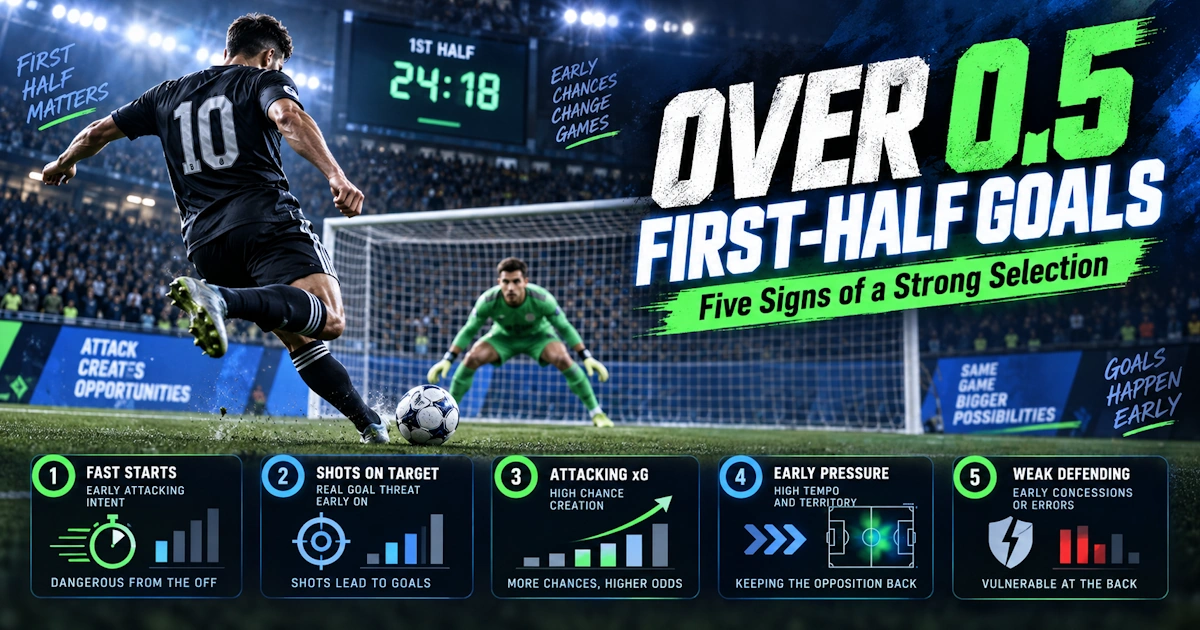
Over 0.5 First-Half Goals is one of the simplest football goal markets.
You need just one goal before half-time.
That makes it look easy, especially compared with Over 2.5, BTTS or more aggressive first-half lines. But the market can still be deceptive. A match may have strong full-time goal statistics while regularly staying 0-0 for the first 45 minutes. Another game may contain two teams that score freely overall but start cautiously.
The key is to analyse the first half as its own match.
Full-time averages still matter, but early scoring patterns, first-half xG, shots on target, tactical approach and defensive vulnerability are much more relevant.
Here are five of the strongest signs that an Over 0.5 First-Half Goals selection may be worth considering.
Sign 1: Both Teams Regularly See First-Half Goals
The best place to start is obvious: how often do these teams actually have a goal before half-time?
Suppose the home team has recorded Over 0.5 First-Half Goals in 8 of its last 10 home matches.
The visitors have recorded the same outcome in 7 of their last 10 away fixtures.
That gives you two trends pointing in the same direction.
As a practical benchmark, a rate around 70% or higher can be a useful starting point. It should not be treated as a betting rule, but it shows that early goals are normal rather than unusual.
Look at:
- Home team’s first-half Over 0.5 rate at home
- Away team’s first-half Over 0.5 rate away
- Last 5–10 relevant matches
- Full-season first-half scoring pattern
Venue matters.
A team may have first-half goals in 75% of home matches but only 45% away. If it is playing at home, the overall percentage hides the stronger statistic.
The more both teams regularly produce first-half goals in the correct venue, the better the foundation.
Sign 2: One Team Starts Matches Aggressively
You do not always need both teams to be strong early scorers.
One aggressive team can be enough.
Imagine the home side has:
- Scored before half-time in 7 of its last 10 home matches
- Opened the scoring in 6 of those
- Averaged around 0.9 first-half goals
- Created strong pressure during the opening 30 minutes
The visitors may not score early very often, but perhaps they concede first-half goals regularly.
That creates a useful matchup.
Some teams are naturally fast starters because they:
- Press high immediately
- Use attacking full-backs
- Start with high tempo
- Play direct early balls into the box
- Try to score before the opponent settles
Other teams build slowly and become more dangerous after half-time.
For this market, the first type is much more useful.
A team that scores 60% of its goals after the 60th minute may be excellent for full-time Over markets but poor for first-half betting.
The timing of the attack matters.
Sign 3: First-Half xG and Shots Support the Trend
A first-half goal percentage can look strong even when the underlying chance creation is weak.
This is where xG and shots become valuable.
Suppose Team A has produced a first-half goal in four consecutive matches.
That looks encouraging.
But its average first-half xG is only 0.35, and it creates one shot on target before the break.
That run may depend on efficient finishing.
Now compare Team B.
It has first-half goals in only three of five matches, but averages:
- 0.85 first-half xG
- 2.2 shots on target
- Several penalty-area attempts
- Frequent early corners
Team B may actually have the stronger early scoring process.
For Over 0.5 First-Half Goals, useful indicators include:
- Combined first-half xG
- First-half shots on target
- Big chances before half-time
- Shots inside the box
- Penalty-area touches
- Early corners
As a rough practical guide, a match where the teams regularly combine for around 1.0 or more first-half xG deserves more attention than one producing only 0.4–0.5.
Again, these are not fixed thresholds. They are useful filters.
Sign 4: The Defensive Numbers Show Early Vulnerability
An early goal can come from good attacking play or poor defending.
Ideally, your selection has both.
Check whether either team tends to concede early.
Useful statistics include:
- First-half goals conceded
- Percentage of matches conceding before half-time
- First goal conceded timing
- First-half xGA
- First-half shots on target allowed
Imagine the visitors have conceded a first-half goal in 7 of their last 10 away matches.
The home team has scored in the first half in 8 of 10 at home.
That is one of the strongest types of overlap.
You are matching: early attacking strength with early defensive weakness
This is far more useful than simply looking at the total goals both teams have scored over 90 minutes.
Defensive injuries can make this even more relevant.
If the away team is missing:
- A starting centre-back
- Defensive midfielder
- First-choice goalkeeper
its historical first-half defensive numbers may actually understate the current risk.
Sign 5: The Tactical Matchup Creates Early Danger
Statistics tell you what has happened.
Tactics help explain why it may happen again.
Some matchups naturally create early-goal potential.
High press vs risky build-up If one team presses aggressively and the opponent insists on playing short from the back, turnovers can create chances within minutes.
High defensive line vs fast forwards One direct ball can create a one-on-one.
Strong home favourite vs nervous away defence The home team may attack from kick-off, especially in front of a strong crowd.
Two teams that both need to win If neither side benefits from sitting back, the opening phase may be more aggressive.
On the other hand, certain tactical setups weaken the selection.
A deep defensive block against a slow possession team can produce long periods of harmless control.
Two cautious sides may spend the first half trying not to make the first mistake.
The market should fit the expected match rhythm.
Why Full-Time Over 2.5 Statistics Can Mislead You
One of the most common mistakes is using full-time Over 2.5 numbers to justify a first-half goal bet.
Suppose both teams have Over 2.5 in 7 of their last 10 matches.
That sounds promising.
But imagine many of those games were:
- 0-0 at half-time / 2-1 at full-time
- 0-0 at half-time / 3-1 at full-time
- 1-0 at half-time / 3-0 at full-time
The full-time trend is strong.
The first-half trend is much weaker.
A team that scores heavily after the break should not automatically be treated as a strong early-goal side.
Always isolate the first-half data.
Practical Example: Strong Over 0.5 First-Half Candidate
Imagine the home side has:
- First-half goal in 8 of 10 home matches
- Scored before half-time in 7 of 10
- 0.9 first-half xG
- 2.4 first-half shots on target
The visitors have:
- Conceded before half-time in 7 of 10 away matches
- 0.8 first-half xGA
- Only three first-half clean sheets
- Several early defensive errors
The home side is also known for pressing aggressively from kick-off.
That gives the selection support from:
- Historical percentage
- xG
- Shots
- Defensive weakness
- Tactical style
This is much stronger than relying on one statistic alone.
Practical Example: Strong Full-Time Goals, Weak First Half
Now consider two teams with Over 2.5 in 8 of their last 10 matches.
However:
- Home side scores most goals after the 60th minute
- Visitors have 0-0 half-time in 5 of 10 away games
- Combined first-half xG is only 0.55
- Both average fewer than two first-half shots on target
The full-time goal profile looks excellent.
The first-half profile does not.
This may still be a good match for Over 2.5, but Over 0.5 First-Half Goals is much less convincing.
Practical Example: One Team Can Carry the Bet
Suppose a strong home favourite has:
- Scored first-half goals in 9 of 10 home matches
- Averaged 1.1 first-half goals
- Produced 1.0 first-half xG
The visitors rarely score early, but they concede before half-time in 65% of away fixtures.
You do not need the visitors to contribute.
A 1-0 half-time score is enough.
This is why one dominant early attack can be more important than balanced scoring from both sides.
First Goal Timing Can Add Extra Context
Average opening-goal timing can be useful.
Suppose the home team’s average first goal comes around the 23rd minute.
The visitors typically concede their first goal around the 28th.
Those patterns fit the market well.
Now imagine both teams usually see the first goal after minute 55.
Their full-time matches may still be high-scoring, but Over 0.5 First-Half becomes less attractive.
Goal-timing statistics are particularly useful when combined with first-half xG and early scoring percentage.
Set Pieces Can Create the First-Half Goal
Do not focus only on open play.
Corners, free kicks and penalties can produce the goal you need.
A team with strong aerial players and excellent delivery may be dangerous even if its open-play attack is average.
Check:
- First-half corners
- Set-piece goals
- Penalties won
- Opponent’s set-piece defence
One early corner can change the entire bet.
This is especially useful when a favourite faces an opponent expected to defend deep and concede territory.
Be Careful With Small Samples
Early in the season, first-half percentages can look extreme.
If a team has first-half goals in 4 of 5 matches, that is an 80% rate.
One 0-0 half immediately reduces it to 67%.
That is why early-season data should be supported by:
- Previous-season first-half trends
- Current xG
- Tactical continuity
- Squad changes
- Quality of opponents
Do not treat five matches as a perfect sample.
Use them as evidence.
Over 0.5 First-Half Goals Checklist
Before selecting the market, check:
- First-half Over 0.5 percentages
- First-half scoring rates
- First-half conceding rates
- First-half xG and xGA
- Shots on target
- Big chances
- Average first-goal timing
- Home and away splits
- Tactical approach
- Defensive injuries
- Set-piece threat
- Whether the odds justify the probability
The strongest selections usually have at least three or four separate indicators pointing towards an early goal.
Frequently Asked Questions
What does Over 0.5 First-Half Goals mean?
At least one goal must be scored before half-time.
Is one strong attacking team enough?
Yes. You only need one goal, so a dominant home attack can carry the selection by itself.
Are full-time Over 2.5 statistics useful?
They provide context, but first-half scoring and conceding statistics are more important for this market.
Is first-half xG useful?
Very. It helps show whether early goals are supported by real chance creation rather than unusually efficient finishing.
What is a good first-half Over 0.5 percentage?
There is no strict threshold, but rates around 70% or higher can be a useful starting point when supported by other statistics.
Final Thoughts
Over 0.5 First-Half Goals is simple, but good selections require more than finding two high-scoring teams.
The best signs are usually: strong first-half scoring rates, aggressive starts, solid first-half xG, early defensive vulnerability and a tactical matchup that naturally creates chances.
One team may be enough to carry the bet, especially when a strong home attack faces an away defence that regularly concedes early.
At the same time, do not let full-time goal trends mislead you. A match can be excellent for Over 2.5 and still be poor for first-half goals if both teams usually start slowly.
Treat the first 45 minutes as a separate match.
When the statistics and tactical picture both point towards early pressure, Over 0.5 First-Half Goals becomes much easier to justify.
Responsible betting: First-half markets can be affected by small samples and match variance. Use several indicators together, keep stakes within a fixed budget and never bet money you cannot afford to lose.