
A busy football weekend can make it feel as if there are opportunities everywhere.
Premier League, La Liga, Bundesliga, Serie A, lower divisions, evening matches, international games—the list can become enormous. Once you start looking through the fixtures, it is surprisingly easy to end up with ten, fifteen or even twenty predictions.
The problem is simple: more matches do not automatically create more good bets.
In fact, the opposite often happens.
The first three or four selections may be based on strong statistics, a clear tactical matchup and reasonable odds. The next few may be acceptable. By the time you reach selection number twelve, you may be betting mainly because the match exists.
That gradual drop in selection quality is one of the biggest reasons betting on too many matches produces poor results.
The goal should not be to predict everything on the schedule.
It should be to identify the small number of matches where your analysis gives you a genuine reason to act.
More Betting Volume Only Helps If You Have an Edge
In theory, placing more bets can be useful if every selection has positive expected value.
But that is a very important condition.
Suppose a market is genuinely a 50-50 event.
A bookmaker offers odds of 1.90 on each side.
At odds of 1.90, a winning 1-unit bet makes 0.90 units, while a losing bet costs 1 unit.
If the true probability is 50%, the expected return is: 0.50 × 0.90 – 0.50 × 1 = -0.05 units
That is an expected loss of 5% per unit staked.
If you place five such bets, the expected loss is around 0.25 units.
If you place 20, it becomes around 1 unit.
The extra betting volume did not improve your chances.
It simply exposed more money to a market where you had no advantage.
More bets are useful only when the quality of the selections remains high.
The Best Match Is Rarely as Good as the Tenth-Best Match
Imagine analysing Saturday’s fixtures and ranking your goal selections.
Your first three might look like this:
Match 1
Strong Over 2.5 history
High xG
Both teams create many shots on target
Weak defensive records
Match 2
BTTS supported by both teams’ home-away numbers
Few clean sheets
Reliable scoring rates
Match 3
Strong favourite facing a defence that allows high xGA
Team Over 1.5 looks logical
These are genuine selections.
Then you continue searching.
Match 8 might have:
Average xG
One team missing a striker
Mixed home-away numbers
Unclear motivation
You include it anyway because you want more action.
At that point, you are no longer applying the same standard.
This is sometimes called selection dilution: the more bets you force yourself to make, the lower the average quality tends to become.
Bookmaker Margin Is Paid Every Time You Bet
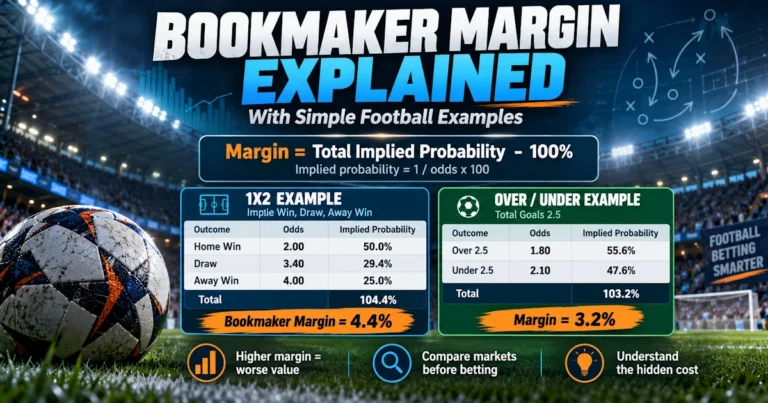
Every market contains a bookmaker margin.
You do not see it as a separate fee, but it is built into the odds.
Consider a perfectly balanced match.
Fair odds might theoretically be:
Outcome A: 2.00
Outcome B: 2.00
A bookmaker might instead offer:
1.91
1.91
That difference is part of the bookmaker’s margin.
Each time you enter a market without a genuine pricing advantage, you expose yourself to that margin again.
This is why betting for entertainment on every match is mathematically very different from waiting for a small number of situations where you believe the price is wrong.
Volume magnifies both skill and mistakes.
If you have an edge, more qualified opportunities can help.
If you do not, more betting generally means more exposure to the house margin.
Too Many Matches Encourage Superficial Analysis
Detailed football analysis takes time.
For a single goal prediction, you might check:
Shots on target
Clean sheets
Failure-to-score rates
Team news
Tactical style
Goal timing
Recent opponents
Odds movement
Doing that properly for three matches is realistic.
Doing it for 25 matches in an afternoon is much harder.
The result is usually shortcuts.
Instead of studying a fixture, you start thinking: “Both teams had Over 2.5 last week.” “This league usually has goals.” “They scored three in the previous head-to-head.” “The odds look okay.”
That is not the same level of analysis.
More matches create pressure to make decisions faster, and faster decisions often rely on weaker information.
Betting Too Many Matches Makes Every Game Look Attractive
Once you spend enough time searching for bets, your brain begins finding reasons to bet.
This is a dangerous change.
Normally, analysis should begin neutrally: Is there a strong prediction here?
But after searching for the tenth selection, the question can quietly become: What can I bet on in this match?
Those are completely different questions.
Almost every football match can be turned into a betting argument if you look hard enough.
You can find a reason for Over.
You can find another for Under.
You can find an H2H trend, a recent scoring run or a defensive weakness.
The discipline lies in saying: The evidence is not strong enough. Skip it.
Skipping is part of prediction quality.
More Bets Create More Variance
Even good bets lose.
Suppose you have ten selections that you estimate each have a 60% chance of winning.
You should not expect exactly six winners every time.
You might win eight.
You might win four.
Short-term results fluctuate.
When you bet many matches in a short period, that variance can become emotionally difficult.
Imagine losing six of the first eight Saturday bets.
The temptation may be to increase stakes on the evening fixtures to recover the losses.
That turns a normal statistical losing run into a bankroll problem.
Fewer, pre-planned bets make this much easier to control.
Practical Example: Five Strong Bets vs Fifteen Mixed Bets
Imagine two bettors.
Bettor A Places five carefully researched bets. Average estimated edge is strong. Stake: 1 unit each. Total exposure: 5 units
Bettor B Starts with the same five bets but then adds ten more weaker selections. Total exposure: 15 units
Suppose the five strong selections return +2 units.
The additional ten produce -3 units.
Bettor A finishes: +2 units
Bettor B finishes: -1 unit
They started with exactly the same good ideas.
The difference was that Bettor B refused to stop.
This happens frequently in football betting. Poor results are not always caused by failing to find good selections.
Sometimes they come from surrounding good selections with too many mediocre ones.
Accumulators Make the Problem Even Worse
Too many matches become particularly dangerous when combined into one accumulator.
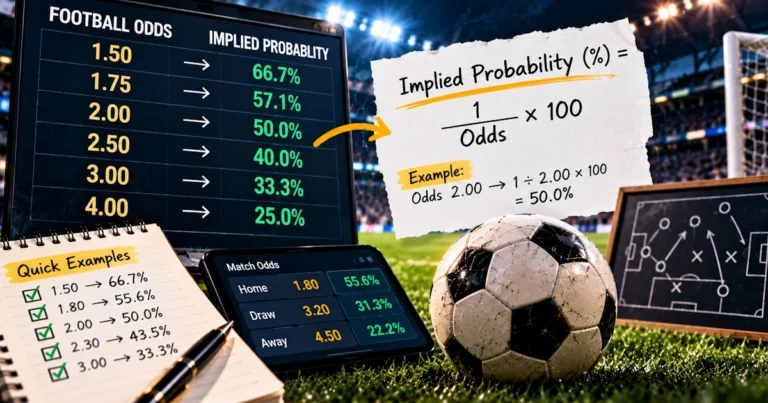
Suppose each selection has a genuine 70% probability of winning.
For five independent selections: 0.70⁵ ≈ 16.8%
For eight: 0.70⁸ ≈ 5.8%
Every leg may look individually strong, yet the probability of all of them winning falls rapidly.
This is why adding “one more safe match” is rarely as harmless as it feels.
That 1.30 favourite still creates another failure point.
A shorter accumulator made from your strongest three selections can often be more sensible than chasing huge odds with eight or ten matches.
Too Many Markets Can Hide Where You Are Actually Good
Suppose you bet:
Over 2.5
BTTS
Draw No Bet
Corners
Cards
First-half goals
Correct scores
Player props
At the end of the month, you have 150 bets.
You know whether you made money, but you may have little idea where your actual strength lies.
Now imagine you focus mainly on:
Over/Under
BTTS
Team goals
After several months, patterns become much easier to identify.
Perhaps your BTTS analysis is excellent but your first-half predictions consistently lose.
That is useful information.
Too much betting can create so much noise that it becomes difficult to learn from your results.
Opportunity Is Not the Same as Obligation
There may be 60 football matches available today.
You are not required to bet on 60.
You are not required to bet on ten.
You are not required to bet at all.
This is one of the healthiest ways to think about football prediction.
Some days genuinely offer many strong setups.
Other days may provide only one.
The number of bets should come from the quality of the schedule, not from a personal target.
If you decide in advance that you need ten selections every Saturday, you will eventually be forced to include weak ones.
Set Minimum Criteria
A simple way to control excessive betting is to create rules a match must satisfy.
For an Over 2.5 selection, for example, you might require several of the following:
Strong combined xG
High shots-on-target numbers
Weak clean-sheet records
Suitable home-away form
No major attacking absences
Tactical styles that support an open match
Acceptable odds
A match that satisfies only one condition does not qualify.
This removes emotion from the selection process.
You are no longer asking whether you like the match.
You are asking whether it passes your filter.
Rank Your Selections
Another useful method is to create a shortlist.
Suppose you find eight potential bets.
Rank them:
Strongest
Second strongest
Third
Fourth
Fifth
Weak
Weak
Weak
Then ask whether you really need numbers six to eight.
Often, simply ranking predictions makes the difference obvious.
Your fourth-best selection should not receive the same confidence as your best one just because both appear on your coupon.
Review Your Results by Bet Number
Here is an interesting exercise for a monthly review.
Record the order in which you selected your bets.
Then compare results from:
First 3 selections
Selections 4–6
Selections 7+
You may discover that the bets identified early in your analysis perform much better than the ones added later.
If so, you have evidence that over-selection is hurting your results.
The solution is not necessarily better prediction.
It may simply be stopping earlier.
A Simple Match Selection Checklist
Before adding another bet, ask:
Does this match meet my normal statistical criteria?
Have I checked xG and shots rather than only recent scores?
Am I using the correct home-away data?
Is important team news available?
Is the price genuinely attractive?
Would I bet this match if it were the only game today?
Is this selection as strong as my earlier ones?
Am I adding it because I found value, or because I want more bets?
That final question can remove a surprising number of unnecessary selections.
Frequently Asked Questions
Is betting on many matches always bad?
No. If you genuinely have positive expected value across many independent opportunities, higher volume can be useful. The problem is that selection quality often declines as bettors force themselves to find more bets.
How many matches should I bet on per day?
There is no correct number. A better approach is to bet only matches that meet your criteria. Some days that may be five; other days it may be zero.
Why do short-priced selections still increase risk?
Because short odds still represent uncertainty. A 1.30 selection is not guaranteed, and adding several such bets creates multiple failure points.
Is it better to specialise in a few markets?
Often, yes. Specialisation makes it easier to develop expertise and evaluate whether your method actually works.
How can I stop adding unnecessary bets?
Set minimum selection criteria, rank your matches and impose a maximum number of bets when you notice that later selections tend to be weaker.
Final Thoughts
Betting on too many matches usually causes problems not because football becomes less predictable, but because your selection standards begin to fall.
The first few bets may have strong xG data, reliable scoring trends and clear tactical support.
The later ones are often added because the schedule is there, the odds look attractive or you want more action.
Each additional bet also exposes more of your bankroll to bookmaker margin and short-term variance.
The solution is not to find a magical maximum number of matches.
It is to make every selection earn its place.
If three matches meet your criteria, bet three.
If only one does, bet one.
And if nothing looks good, betting nothing is also a valid prediction decision.
In football betting, quality of selection matters far more than quantity of action.
Responsible betting: Increasing the number of bets increases total exposure and can encourage chasing losses. Set a fixed budget, use consistent stakes and never bet money you cannot afford to lose.