
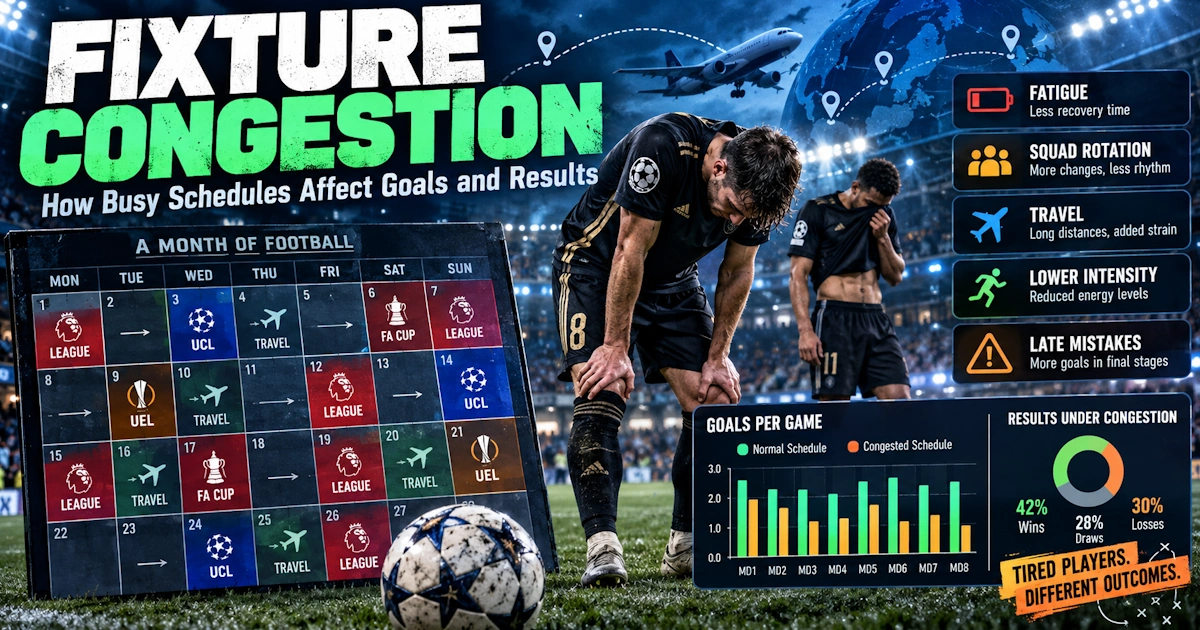
Fixture congestion is often used as a simple explanation for football results. A team plays three matches in eight days, so bettors assume they will be tired.
From there, the prediction usually becomes one of two things. Either the team will perform badly, or the match will produce more goals because tired defenders make mistakes.
The reality is more complicated. Busy schedules can affect recovery, injuries, team selection and tactical decisions.
But research does not show that teams automatically stop performing when they have only a few days between matches. Some clubs rotate well, while others have shallow squads.
Some managers reduce pressing intensity. Others continue playing almost exactly the same way.
For football predictions, fixture congestion is therefore best used as an adjustment factor, not as a betting system by itself.
What Is Fixture Congestion?
Fixture congestion usually describes a period when teams repeatedly play matches with relatively little recovery time. For example, a team might play a league match on Saturday, the Champions League on Tuesday, another league match on Saturday, and a domestic cup game on Wednesday.
A club may play four competitive matches in around 11 or 12 days.
Researchers commonly describe congested periods as situations where players have four days or fewer between matches. A systematic review of professional men’s football found that injury risk generally increased during these congested periods.
However, less recovery does not necessarily mean dramatically worse performance. That distinction is important.
Players Can Still Perform While Carrying Fatigue
One mistake is assuming that tired footballers simply cannot run. Research suggests the picture is more subtle.
A systematic review and meta-analysis found no significant overall reduction in total distance covered during fixture congestion. Some studies did identify changes in lower-intensity running or pacing, but the evidence on physical performance was mixed.
Another study followed a professional team through 35 official matches over 17 consecutive weeks, with games separated by an average of no more than 3.5 days. Researchers found no clear differences in several physical and physiological performance measures when shorter and longer recovery periods were compared.
So, a busy schedule does not automatically mean poor performance. Elite players can maintain match output surprisingly well.
The bigger concerns may appear elsewhere.
Injury Risk Is One of the Strongest Effects
Where fixture congestion becomes more convincing is injury risk. An 11-season UEFA Champions League injury study followed 27 elite teams and found that muscle injury rates in league matches were 32% higher when teams had four days or fewer of recovery compared with six days or more.
The increase was particularly relevant for hamstring and quadriceps injuries. A later systematic review reached a similar general conclusion, finding that congested schedules tend to increase match injury incidence.
This matters for predictions because congestion can affect a team indirectly. The key question may not be if the players are tired.
It may be: Who is actually available to play?
Rotation Can Matter More Than Fatigue
Imagine a strong club plays a league match on Sunday, a Champions League match on Wednesday, and another league match on Saturday. The manager has two choices.
Option 1 is to keep the same starting XI. The strongest players remain on the pitch, but recovery time is limited.
Option 2 is to rotate five or six players. The team is fresher, but perhaps weaker.
For betting analysis, these situations are completely different. A rotated attack can reduce xG, shots on target, creativity, and finishing quality.
A rotated defence can increase chances conceded, defensive errors, poor positioning, and set-piece weakness. So do not simply ask whether a team will rotate.
Ask which positions are changing. That is much more useful.
Busy Schedules Do Not Automatically Mean More Goals
This is one of the biggest misconceptions in goal betting. The logic sounds reasonable: tired players mean tired defenders, which leads to mistakes and goals.
Sometimes that happens. But fatigue can also reduce attacking quality.
Tired attackers may:
- Press less effectively
- Make slower runs
- Produce poorer crosses
- Shoot less accurately
- Take fewer risks
A team playing every three days may also deliberately slow the match. That can produce fewer transitions and fewer chances.
Fixture congestion can therefore support either Over or Under markets depending on how the teams react.
Defensive Fatigue Can Still Create Late Goals
Although congestion does not guarantee high-scoring matches, defensive concentration can become important late in games. Football requires repeated sprinting, accelerating, decelerating, tracking runners, and making tactical decisions.
After repeated matches with limited recovery, mistakes may become more likely even when overall running distance remains similar. A defender does not need to stop running completely to cause a goal.
One delayed reaction can be enough. This is why congested teams can sometimes become interesting for second-half goals, late goals, or opponent team totals.
This is especially true when the opponent has fresh attacking substitutes.
Recovery Can Still Be Incomplete After 72 Hours
Playing again after three days may be common, but full recovery is not guaranteed. One study examining players after three matches within a week found that 72 hours after the final match, players with heavy match exposure showed greater muscle soreness.
They also showed signs of physiological stress compared to less-used teammates. Another study found that non-contact injury risk during congested periods was associated with higher perceived fatigue and muscle soreness two and three days after matches.
This helps explain why clubs invest heavily in recovery sessions, sleep monitoring, nutrition, rotation, and training-load management. Three days between matches may be enough to play again.
It does not necessarily mean every player is fully recovered.
Practical Example: Strong Squad Depth
Imagine Team A plays its third match in seven days. At first, that sounds like a negative.
But Team A has 22 high-level players and rotated four starters in the previous match. Their main striker played only 30 minutes, their first-choice midfielders were rested, and there are no major injuries.
Its opponent played the same number of matches but used almost the same starting XI every time. The fixture list looks equally congested for both clubs.
The physical situation is not. Team A may actually have the fresher starting lineup.
This is why simply counting rest days can be misleading.
Practical Example: Thin Squad and Defensive Problems
Now imagine Team B has played on Sunday, Thursday, Sunday, and Wednesday. Its first-choice centre-back has played every minute, and the defensive midfielder has also started every match.
Another centre-back is injured, and the goalkeeper is a backup. The next opponent has fast forwards, strong counterattacks, and a high shot volume.
Fixture congestion now becomes much more relevant. Not because a mathematical rule says busy schedules produce goals.
But because the schedule is interacting with limited squad depth, defensive injuries, heavy individual workloads, and a dangerous opponent. That combination can strengthen an Over 2.5 or opponent-team-total prediction.
Individual Minutes Matter More Than Team Schedule
A club may have played four matches in 12 days. But one player may have played 360 minutes while another played 95 minutes.
Those players do not have the same fatigue profile. For prediction purposes, look at individual workloads.
Important questions include:
- Did the striker start every match?
- Did both centre-backs play 90 minutes repeatedly?
- Was the goalkeeper rested?
- Did the full-backs play every game?
- Were key players substituted early?
A team-level schedule provides context. Player-level minutes provide better detail.
Travel Can Make Congestion Worse
Not all three-day recovery periods are equal. Imagine Team A plays a Saturday home match, a Tuesday home European match, and a Saturday home match.
Team B plays a Saturday domestic match, a Wednesday European away match involving long travel, and a Saturday away league match. Both technically have similar rest.
Team B also has flights, airport time, hotel changes, reduced sleep opportunities, and less normal training and recovery. Travel can therefore make a congested period more demanding.
This is particularly relevant for European competitions and international breaks.
Tactical Style Matters
Some football styles may be harder to maintain through repeated matches. A team based on aggressive pressing, a high defensive line, repeated sprints, and fast transitions may need significant physical freshness.
Another team playing slow possession, a deep defensive block, and a lower tempo may manage congestion differently. So when analysing a busy schedule, ask whether the team’s normal tactical style demands repeated high-intensity actions.
A high-energy pressing side with limited rotation may deserve more concern than a team comfortable controlling possession at a slower pace.
Congestion Can Reduce Pressing Intensity
Imagine a team normally presses high for 90 minutes. After several matches in quick succession, the manager may instruct players to conserve energy.
Instead of pressing every build-up, they may drop into midfield, defend narrower, press selectively, and slow possession after regaining the ball. This can dramatically change the expected match pattern.
A fixture that normally looks perfect for transitions may become slower. That is why historical averages need to be checked against the current schedule.
European Matches Can Affect Domestic Results
The fixture after a European match is particularly interesting. Suppose a club plays a difficult Champions League match on Wednesday and then an away league game on Saturday.
The next opponent has had a full week to prepare. The difference is not only physical.
The domestic opponent may have had more tactical preparation, more training time, better recovery, and no travel. The European team may also rotate.
An older 11-season UEFA study found little overall relationship between short recovery and team performance, although Europa League matches in that dataset showed more losses after very short recovery periods. The researchers therefore warned against assuming a universal performance decline.
That is a useful lesson. Fixture congestion can matter, but the effect is not identical in every competition or every team.
Look at Squad Depth Before Making a Prediction
Elite clubs often build squads specifically to handle congested calendars. A team might replace an elite winger with another international winger, or a starting midfielder with a high-quality substitute.
The statistical impact may be small. A smaller club may replace the same positions with players far below the starting level.
Therefore, squad depth should be one of your main congestion filters. Ask how much weaker the replacement XI is, not simply how many players changed.
Injuries Can Accumulate Over Time
Fixture congestion becomes more important when it lasts for weeks rather than one busy week. One isolated Wednesday-Saturday turnaround may be manageable.
But consider a sequence of a league game, a European competition, a domestic cup, an international break, and another league game repeated over several weeks. Players may repeatedly receive only limited recovery.
In one study covering six matches in 18 days, physical and technical performance remained relatively stable, but match injury incidence was significantly higher during the congested period. This shows why the effect of congestion may appear first through player availability rather than obvious drops in running statistics.
Practical Example: Over 2.5 Candidate
Imagine the home team has had seven days of rest. It averages 1.9 home xG, 5.8 shots on target, and strong second-half scoring numbers.
The visitors played a European away match three days earlier. Their defensive situation includes a starting centre-back and full-backs who played 90 minutes, another injured defender, and limited rotation options.
The visitors also normally concede around 1.6 away xGA. Congestion is not the reason for the Over 2.5 prediction.
The normal statistics already support goals. The busy schedule adds another concern to an already vulnerable defence.
That is the correct way to use fixture congestion.
Practical Example: Under Candidate Despite Congestion
Now imagine both teams played midweek. You might expect fatigue and goals.
But both managers rotate their attackers. Both teams also prefer slow possession, low-risk football, and a strong defensive structure.
The replacements lack attacking quality. Possible results include 0-0, 1-0, or 1-1.
In this case, congestion may actually reduce attacking output rather than increase goals. Context decides the direction.
Watch the Substitutes
Modern squad depth means substitutes can completely change how congestion affects a match. Imagine a tired defence after 70 minutes.
The opponent brings on two quick wingers, a fresh striker, and an attacking midfielder. The physical advantage can become significant.
This is one reason late goal markets can sometimes become interesting in congested periods. When analysing a match, compare the benches as well as the starting XIs.
A club with five high-quality attacking options can exploit tired opponents much better than a team with little depth.
Do Not Double-Count Congestion
Be careful not to use the same problem twice. Suppose a team has poor recent results because it has already been rotating heavily during a busy schedule.
You might count poor form, rotation, and fixture congestion as three separate negatives. But all three may come from the same underlying cause.
Try to understand what the schedule is actually changing rather than piling several related statistics together.
Fixture Congestion Prediction Checklist
Before adjusting a prediction because of a busy schedule, check:
- Days since the previous match and number of recent matches
- Individual minutes played and travel distance
- Home or away schedule and squad depth
- Rotation options and injuries
- Age of key players and tactical style
- Pressing intensity and expected starting XI
- Quality of substitutes and upcoming fixtures
- Current xG, xGA, and shots on target
- Whether congestion strengthens or weakens the original prediction
Fixture congestion should normally modify your analysis rather than create the prediction from nothing.
Frequently Asked Questions
Does fixture congestion always make teams perform worse? No. Research has found mixed effects on physical performance, and total distance covered is often maintained. Injury risk appears to be a more consistent concern.
Does playing every three days increase injury risk? Research suggests short recovery periods can increase injury risk. One major study found muscle injury rates were 32% higher in league matches with four or fewer recovery days compared with six or more.
Does fixture congestion mean more goals? Not automatically. Defensive fatigue can create mistakes, but attacking quality can also fall. Rotation and tactical changes may even make a match slower.
How many recovery days do footballers need? There is no universal number, but sports science studies show that signs of soreness and physiological stress can remain around 72 hours after heavy match exposure.
What should bettors check first during a congested schedule? Start with individual minutes, expected rotation, injuries and squad depth. These factors usually tell you more than simply knowing a team played three days earlier.
Final Thoughts
Fixture congestion matters in football, but not in the simple way it is often presented. A busy schedule does not automatically make a team weak.
And it does not automatically create an Over 2.5 match. Elite footballers can maintain surprisingly high levels of physical performance through congested periods.
The stronger evidence concerns incomplete recovery, increased physiological stress and a higher risk of muscle injuries. For prediction purposes, the schedule becomes most useful when you connect it to the actual team.
Ask who played the most minutes, who is likely to be rotated, and how strong the replacements are. Is the defence already weakened?
Does the opponent have the style and squad depth to exploit tired players? That is much more useful than seeing “three matches in seven days” and immediately predicting fatigue.
Fixture congestion should rarely be the main reason for a bet. But when it combines with weak squad depth, injuries, travel, poor defensive numbers or heavy individual workloads, it can become an important part of the prediction.
Responsible betting: Fixture congestion can influence probability but does not guarantee a particular result or goal total. Combine schedule analysis with current performance data, keep stakes controlled and never bet money you cannot afford to lose.